

Why it remains the foundation of modern Tarot reading
The Rider-Waite-Smith (RWS) Tarot System is the most recognized tarot deck in the English-speaking world. This deck, created by Arthur Edward Waite and illustrated by Pamela Colman Smith, revolutionized modern tarot practice through its vivid symbolism, illustrated Minor Arcana, and strong roots in esoteric traditions and its enduring influence as a core Rider-Waite-Smith (RWS) Tarot tradition.
Learn more about the RWS Tarot deck with Interpreting the Rider-Waite-Smith (RWS) Tarot System: A Framework
Table of Contents

The Origins of the Rider-Waite-Smith (RWS) Tarot System
If you’ve ever picked up a Tarot deck, chances are it followed the Rider-Waite-Smith (RWS) Tarot deck.
As the most widely used structure in modern Tarot, the Rider-Waite-Smith (RWS) Tarot deck has shaped contemporary practice with countless variations, companion books, and online resources built around it. The Rider-Waite-Smith (RWS) Tarot framework remains a touchstone for both beginners and experienced readers alike.
But what makes this particular system so enduring? Why do beginners and seasoned readers often turn to it as their foundation?
As a system steeped in universal symbolism and visual storytelling, the Rider-Waite-Smith (RWS) Tarot philosophy continues to resonate across cultures and reading styles. Its influence extends far beyond a single deck; it has become the archetypal lens through which modern Tarot is taught, read, and explored. Whether you’re new to Tarot or a long-time practitioner, exploring the Rider-Waite-Smith (RWS) Tarot symbolism offers endless layers of meaning and insight, an evolving conversation between tradition and personal intuition.
When I first started reading Tarot, I felt confident using the RWS Tarot. Over time, as my curiosity grew, I decided to explore beyond it. I assumed switching decks would be easy, but how different could the cards be? I quickly discovered that not all decks follow the same rules. Some used unfamiliar names. Others lacked illustrated minor arcana altogether. I hadn’t realized there were entirely different systems, each with its own structure and philosophy. That initial frustration opened my eyes to just how influential RWS Tarot is to the modern tarot practice and why so many readers choose to begin (and often stay) with it.
Pamela Colman Smith and Arthur Edward Waite: The Creators Behind the Rider-Waite-Smith (RWS) Tarot System
Published in 1909, the Rider-Waite-Smith (RWS) deck marked a groundbreaking collaboration that reshaped tarot history:
Arthur Edward Waite was a scholar who wrote extensively on mysticism, occult, and esoteric subjects. Waite is often remembered as the architect of the RWS Tarot and for the systematic study of the history of Western occultism. This study was done from a spiritual tradition instead of through the lens of religion.

By J. Russell and Sons – Waite, Arthur Edward. “The Secret Tradition in Freemasonry”, Rebman Publishing, London. 1911., Public Domain,
Pamela Colman Smith was an innovative artist and intuitive storyteller whose rare gift was translating invisible emotions, archetypes, and spirits into unforgettable visual form.
Pamela Colman Smith’s Iconic Tarot Illustrations
By The Craftsman – The Craftsman, Vol. XXIII, Number 1, October 1912, CC BY-SA 4.0,

Waite and Smith were not your typical author-illustrator duo. This partnership was forged through a passion for spiritual awareness, intuition, and the desire to connect esoteric subjects into a system that many could use. The deck was shaped by their time in the Hermetic Order of the Golden Dawn. Think ceremonial robes, candlelit rites, and arcane symbols, tools for probing the invisible architecture of the universe. This unique collaboration is a key factor in the enduring influence of the RWS system.
Waite approached the tarot as a scholar of the esoteric, driven to decode the universe through mysticism, symbolism, and ancient texts. He precisely structured the RWS deck, imbuing each card with layered meanings drawn from old and obscure spiritual systems. But it was Smith who gave those meanings vision and breath. Her art did more than follow his descriptions; she transformed them, channeling archetype and emotion into scenes that felt alive, intuitive, and enduring.
It’s a little-known fact that Smith may have drawn inspiration from the Sola-Busca Tarot, a 15th-century Italian deck housed in the British Museum. This deck, the only known fully illustrated tarot deck from that period, may have sparked the visual current Smith channeled, translating centuries-old imagery into something emotionally immediate and entirely her own. Understanding this influence adds depth to the RWS Tarot system’s history.
Learn more about the Sola-Busca Tarot
And yes, both Smith and Waite were part of the Hermetic Order of the Golden Dawn, an elite occult society. The Golden Dawn had secret rituals, spiritual hierarchies, and esoteric teachings. Here is where things get even more interesting and very conspiratorial. Golden Dawn took a decided turn by not fully embracing the traditional Tarot de Marseille practiced and revered in other nations. Many within its ranks felt it lacked the symbolic complexity to understand spirituality accurately. So, not only do we have a secret society, but we also have a divided secret society, mystery, conspiracy theory, and competing Tarot decks and systems.
The deck they created wasn’t just illustrated—it was encoded.
Why the Rider-Waite-Smith (RWS) Tarot System Remains the Foundation of Modern Tarot Practice
1. A Visual Language That Speaks
Before RWS Tarot, most tarot decks, like the historical Tarot de Marseille, relied on unillustrated pip cards for the Minor Arcana. Think of the Three of Wands with the man standing looking out to what could be, holding one wand and two others posted beside him. But, in the three wands in the Tarot de Marseille, there is no background, figure, scene, or story. Just three wands criss-crossed with a decorative background, with no up or down.
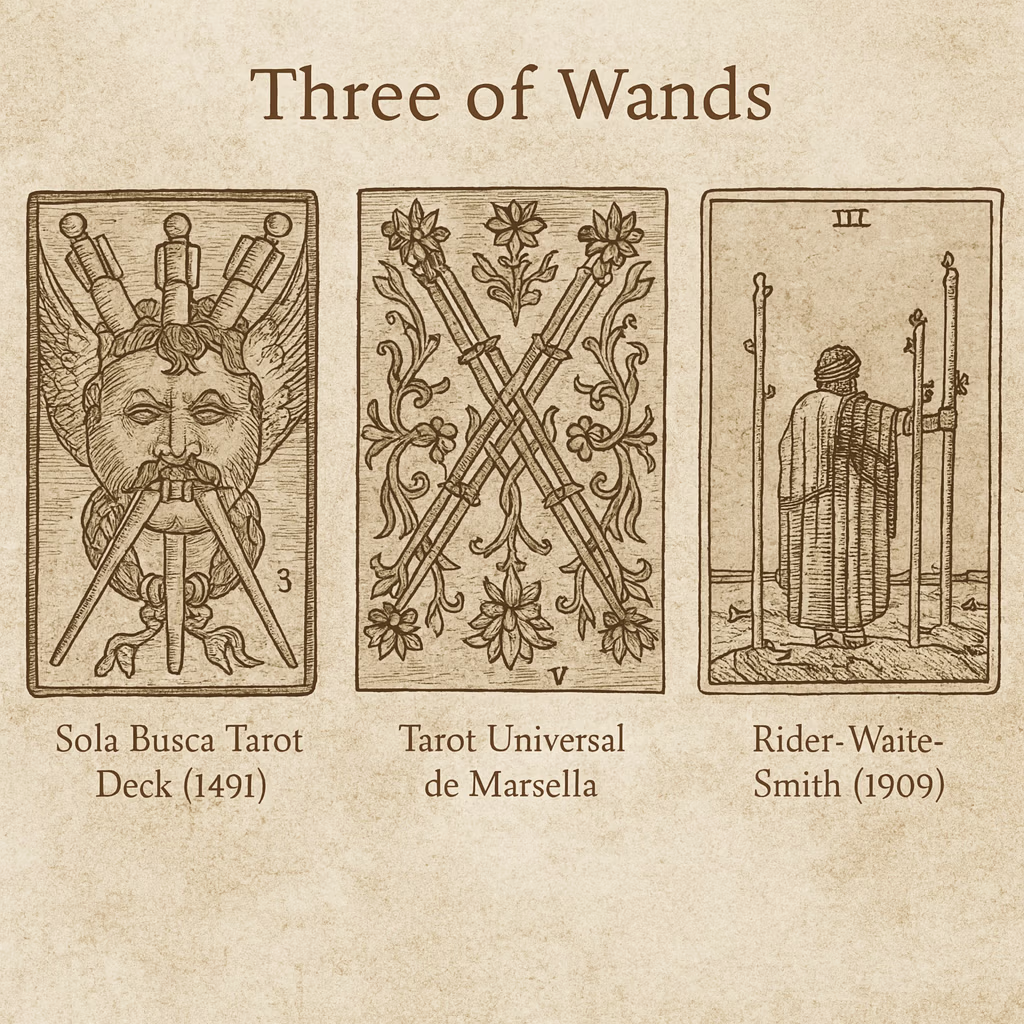
Pamela Colman Smith illustrated all 78 cards with vivid, narrative imagery, forever changing how people read tarot. Her art enabled readings to transition from memorization to storytelling, fostering emotional awareness, meaningful symbolism, and intuitive interpretation. Some argue that the RWS Tarot loses some of the intuition that was replaced with a storytelling approach. These changes in the Tarot deck encouraged many to explore their spirituality more personally and fostered engagement and empowerment. Each image invited exploration and reflection, turning the act of reading into a rich, immersive experience.
While the Rider-Waite-Smith (RWS) Tarot System popularized the storytelling approach, it quietly nodded to an even older visual tradition.
This visual storytelling helped define modern tarot, but it likely owes a quiet debt to the Sola-Busca Tarot, a 15th-century Italian deck Smith had studied at the British Museum. As the only fully illustrated Minor Arcana of its time, the Sola-Busca may have planted the seed for the RWS’s Tarot groundbreaking visual language, which continues to speak across generations.
What made Smith’s artwork groundbreaking wasn’t just its innovation and accessibility. Her illustrations didn’t merely echo esoteric teachings; they told human stories. Each card became a story you could relate to, understand, and intuitively gain perspective on. This approach began the RWS tarot system, which spoke to everyone attuned to emotion, imagination, and lived experience. It transformed tarot from a tool of mystery to a visual language that can be used for self-awareness with a bit of practice and understanding.
2. The Common Ground of Modern Tarot
Most tarot books, beginner decks, and online courses today are rooted in the Rider-Waite-Smith (RWS) Tarot System. Learning is like learning a shared symbolic language that connects readers across continents and cultures. Once you understand its core structure, you can interpret almost any RWS-inspired deck, from the classic to the wildly creative.
However, the RWS Tarot didn’t become the dominant framework or system because of its esoteric depth or occult pedigree. Its staying power comes down to something simpler and more powerful: accessibility.
Thanks to Pamela Colman Smith’s visual storytelling, the cards offer more than symbolic cues; they provide emotional entry points. A figure turning their back on the Eight of Cups. A hand offering a coin in the Ace of Pentacles. These images don’t require years of study to provoke meaning; they invite instinct, intuition, and empathy. That universality is why the RWS deck endures. It became tarot’s common ground not by gatekeeping knowledge but by opening the door.
Published by the Rider Company in 1909, it was one of the first decks to be mass-produced, widely distributed, and printed in English.
Unlike earlier decks, which were rare, regional, or confined to specific mystical orders, the RWS deck was created with a broader audience in mind. It made tarot feel accessible rather than arcane, and that helped the RWS Tarot spread like wildfire through the English-speaking world.
What made it stick was its availability, simplicity, and clarity. It was easy to find, easy to learn, and supported by books that explained the system in plain language. It became the go-to tool for students of tarot, and in many ways, it still is.
Tarot Rider-Waite-Smith (RWS) Tarot System and Archetypes:
So when you pick up a modern deck or crack open a beginner’s guide, chances are you’re working with the bones of the RWS system even if it’s been reimagined with new colors, cultures, or entirely new visions. Its base remains. And that shared understanding that started with the original deck in 1908 has kept the RWS system thriving and changing.
3. Rich Symbolism Rooted in Esotericism
One of the reasons the Rider-Waite-Smith deck continues to resonate today is how intentionally it was constructed. Arthur Edward Waite was a renowned scholar of mysticism, Christian esotericism, and early psychological thought. Put together a layered, multifaceted map within the cards, which included many belief systems within a single symbolic framework. These belief systems’ symbolism can be found in numerous places throughout the 78 cards of RWS Tarot:
- Kabbalah, with its Tree of Life and pathways of spiritual ascent
- Astrology, embedding planetary and zodiacal influences into the archetypes
- Alchemy, using elemental forces and transformation as metaphors for spiritual evolution
- Numerology, assigning meaning through number, repetition, and energetic progression
- Christian mysticism infuses the deck with themes of resurrection, judgment, moral struggle, and divine union


Waite wove these beliefs together. He believed that mapping the symbolism of these belief systems built into the illustrations of the tarot cards could serve as a mirror for one’s spiritual development and the evolution of one’s psyche. The result is a deck that functions on multiple levels: symbolic, emotional, spiritual, and archetypal.
That’s why the RWS Tarot remains relevant today. It’s not necessarily a tool for divination but more of a symbolic map of human experience that continues to speak across traditions, cultures, and time.
These layers weren’t randomly stacked—they were intentionally interwoven, creating a symbolic matrix you can decode from multiple angles.
For modern readers, RWS Tarot isn’t tied to any single path; it’s a fluid, adaptable system that can evolve with your practice. Expanding your learning and exploration to astrology, Kabbalah, alchemy, ritual magic, or spiritual psychology, you’ll find familiar symbols and ideas running through the cards. Its layered design invites the exploration of other belief systems: a tarot spread can mirror a birth chart, echo a path on the Tree of Life, or serve as a tool for inner alchemy.
Flexibility is part of what makes the RWS deck so enduring and relevant. It’s not a ‘learn-it-and-move-on-to-something-else ‘; it’s ‘a series of developmental steps in understanding yourself, a symbolic foundation that transcends traditions, allowing readers to deepen their understanding, cross disciplines, and build a spiritual practice that’s both personal and profound.
4. Adapatable & Flexible Across Traditions
While the Rider-Waite-Smith deck incorporates many Western esoteric symbols and traditions, including those of the Golden Dawn, Kabbalah, astrology, and Christian mysticism, it was never intended to be an isolated system. In fact, one of its greatest strengths is its adaptability.
Thanks to its symbolic depth and rich visual storytelling, the RWS tarot invites interpretation. Over the past century, readers and creators from various cultural, psychological, and spiritual backgrounds have reimagined the cards through their own lenses. The result is a living system, flexible enough to evolve yet grounded enough to retain its integrity.
The Rider-Waite-Smith deck may have been born from early 20th-century Western esotericism, but its symbolic language has proven remarkably flexible and powerfully inclusive. Today, readers continue to reinterpret the cards through various lenses, breathing new life into their archetypes and reshaping what tarot can be.
- Shadowwork and Jungian psychology use the cards as mirrors for unconscious patterns and inner transformation.
- Inner child healing and trauma-informed practices turn tarot into a tool for self-compassion and reflection.
- Feminist reinterpretations reimagine archetypes like the Empress, the Hierophant, and the High Priestess as sources of power, not prescription.
- Culturally diverse decks weave in mythology, worldviews, and spiritual systems outside the West, enriching the collective symbolism.
- Queer and gender-expansive readings transform rigid binaries into fluid, affirming narratives.
This openness is precisely why the Rider-Waite-Smith system continues to be used in practices ranging from energy healing and feminist tarot to queer identity work, ancestral connection, and more. Its symbols are not fixed; they are vessels. And in the hands of each new reader, they can carry whatever truth is needed.
5. Universal Archetypes
The Major Arcana of the Rider-Waite-Smith deck utilizes archetypes to symbolize universal patterns of experience that many can relate to, and that transcend time, culture, and belief. These archetypes allow reflection through a personal lens, which can illustrate growth, demonstrate challenges, and depict transformative cycles.
We can all understand The Fool’s leap of faith and the quick, destructive change The Tower’s collapse symbolizes. Death shows us the necessary endings, while The Star’s quiet promise of renewal, each card becomes a mirror for moments we all encounter. These archetypes aren’t abstract; they’re alive in our stories, struggles, and spirituality.

The RWS Tarot supports many ways of connecting and linking it to our self-awareness and growth. This can be done through tarot meditation or journaling. When we sit with these images, we’re not just interpreting them but allowing a more profound understanding as we relate the cards to our lives. In this way, it becomes a guide.
If you’re inspired to explore the Rider-Waite-Smith system firsthand, consider starting with the Original Rider-Waite Tarot Deck. Its rich symbolism and imagery provide an excellent foundation for both beginners and seasoned readers.
These aren’t just cards. They’re mirrors.
Why Archetypes Still Matter
Archetypes: These stories of understanding help you navigate uncertainty or spiritual growth. There can speak to your experience. These archetypes become companions on the path through meditation, journaling, or quiet reflection. The card does not tell you what to do, but helps you hear your inner voice more clearly.
Because they’re rooted in emotional and psychological truth, not dogma, they resonate across personal, cultural, and spiritual traditions. The symbols are flexible, fluid, and deeply human.
Why it matters: This archetypal structure makes the Rider-Waite-Smith Tarot deck a tool for self-empowerment, emotional wellness, and personal growth—not just fortune-telling.
This is why the RWS system continues to speak to people worldwide. It gives us a framework to explore meaning, but doesn’t confine us. It invites us into a conversation with ourselves and, in doing so, becomes a powerful companion for healing, insight, and transformation.
What to Expect in This Series: Rider-Waite-Smith (RWS) Tarot System
This blog series breaks the RWS system into seven focused posts. We’ll cover:
- The creators and their influences
- How the deck is structured
- The symbolism baked into each card
- A practical approach to interpreting RWS cards
- How this system shaped the decks we use today