
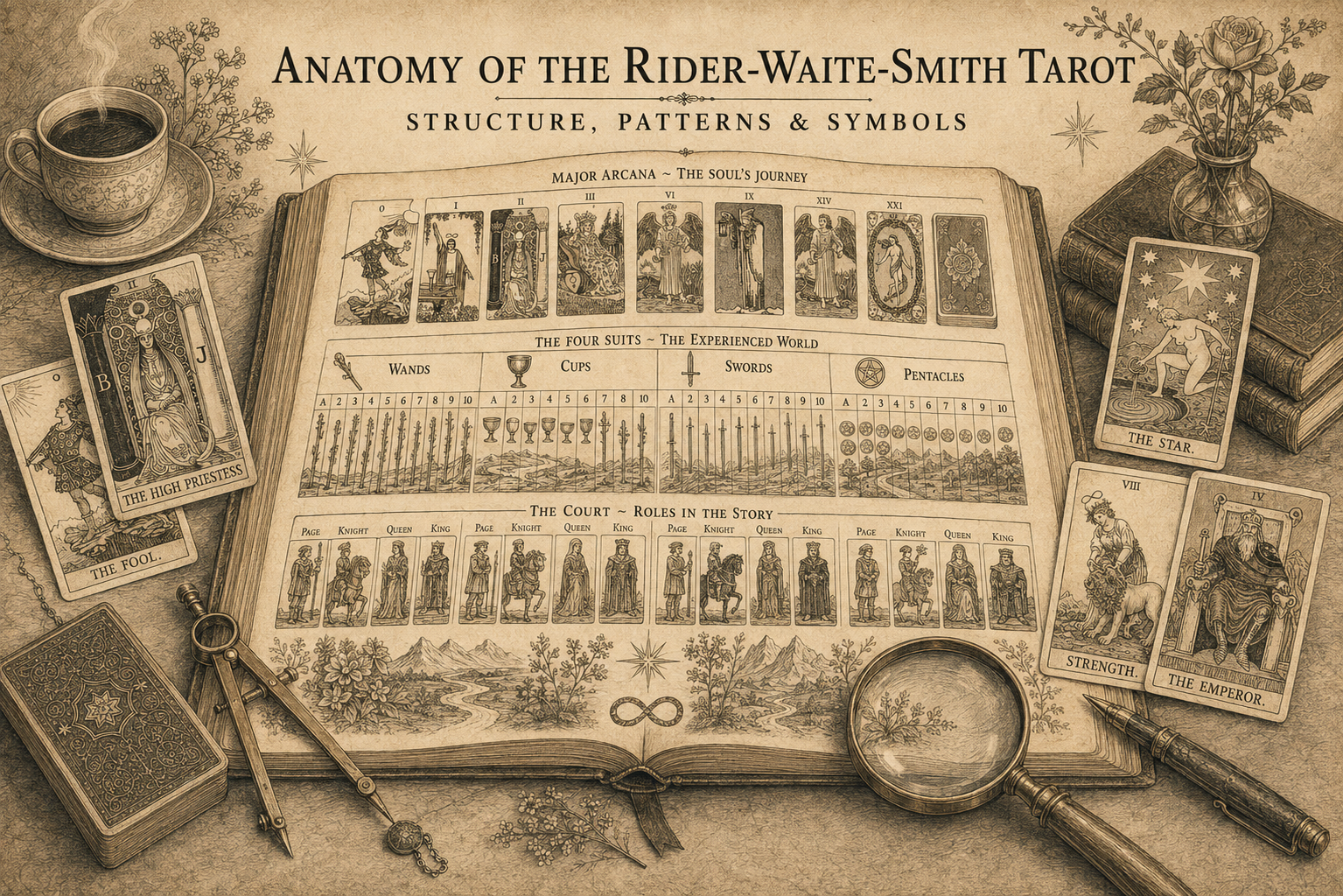
Post 3 of the Rider-Waite-Smith Foundations Series
Before you can read Tarot fluently, it helps to understand the language that shaped modern Tarot. Throughout this series, we’ll explore the history, structure, symbolism, and visual storytelling of the Rider-Waite-Smith system, building a foundation that will support every deck you study afterward.
Spread all 78 Rider-Waite-Smith cards across a table, and the deck can feel like an entire world opening in front of you. There are familiar figures, mysterious landscapes, overflowing cups, raised swords, distant mountains, winding roads, and more symbols than we could possibly notice in one sitting.
It is beautiful.
It can also feel like a lot.
When we are learning Tarot, it is easy to assume that every card must be studied separately. We may reach for guidebooks, make lists of keywords, or try to remember exactly how the Four of Cups differs from the Five of Cups—and then repeat that process 76 more times.
But what if we paused, poured another cup of coffee, and looked at the deck a little differently?
The Rider-Waite-Smith Tarot is not simply a collection of 78 individual cards. Beneath its characters and scenes is an organized structure that connects the cards through divisions, suits, elements, numbers, Court ranks, symbols, and repeating visual patterns. Once we begin noticing those relationships, the deck becomes less like a stack of definitions we must memorize and more like a language we can gradually learn to recognize.
Consider the Four of Cups.
At first, we may see a person sitting beneath a tree with folded arms and a lowered gaze. Three cups rest on the ground while another is offered by a hand emerging from a cloud. Even before we search for a traditional meaning, the illustration gives us something to explore. Is this person uninterested in the offer? Too preoccupied to notice it? Quietly considering whether it is something they truly want?
Then we can step back and see where the card belongs within the larger deck.
The Four of Cups is part of the Minor Arcana, where the larger themes of Tarot meet ordinary human experiences. It belongs to the suit of Cups and carries the emotional, intuitive, and receptive qualities associated with Water. Its number connects it with the other Fours, which explore different expressions of stability, structure, protection, and containment.
Suddenly, we are not studying one isolated card.
The Four of Cups shares its elemental language with every other Cup card. It has a numerical relationship with the Four of Wands, Four of Swords, and Four of Pentacles. Its still, seated figure can be compared with other figures who pause, withdraw, wait, or turn their attention inward. Even the mysterious hand extending from a cloud connects it to the four Aces, where the gift or potential of each suit is first presented.
One card has opened several pathways into the deck—and we have not needed to memorize another list to find them.
That is what we will explore in this article: the hidden architecture beneath the Rider-Waite-Smith Tarot.
Looking Beneath the Surface of the Deck
The word anatomy usually describes the parts of a body and the relationships that allow those parts to work together. We can approach the Rider-Waite-Smith deck in much the same way.
The Major Arcana forms an archetypal sequence of beginnings, choices, challenges, transformation, awakening, and completion. The Minor Arcana brings those larger themes into our relationships, work, communication, creativity, emotions, conflicts, and daily decisions. The four suits organize experience through the elements of Fire, Water, Air, and Earth. The numbers create repeating stages across those suits, while the Court Cards allow elemental energy to take on personality, movement, maturity, and social presence.
Pamela Colman Smith’s illustrations bring all of this structure to life.
Mountains appear behind moments of effort, distance, and transformation. Water winds through cards concerned with emotion, intuition, separation, and passage. Roads and bridges suggest movement between one place—or one state of being—and another. Clothing, gestures, posture, weather, animals, plants, and architecture provide clues about what is happening within each scene.
These details are not scattered decorations. Together, they create a visual vocabulary that repeats and changes throughout the deck.
A numbered Minor Arcana card is simultaneously part of a suit, an expression of an element, a stage within a numerical sequence, and an individual scene with its own characters and symbols. A Court Card carries the nature of its suit while expressing the qualities of its particular rank. A Major Arcana card has its own identity, but it also occupies a place within a larger archetypal journey.
Each card can stand on its own, but none of them exists entirely alone.
As we work through the deck’s anatomy, we will begin asking questions that take us beyond “What does this card mean?”
We will ask:
- Where does this card belong within the deck?
- What does it share with other cards of its suit, number, or rank?
- What changes when we place related cards beside one another?
- Which symbols, landscapes, or gestures appear elsewhere?
- How does this card contribute to the larger structure of the system?
For now, we are not trying to decide exactly what a card means within a particular reading. That will be the work of the next article, when we bring context, spread positions, card relationships, and intuition into the conversation.
Here, we are simply getting to know how the deck is built.
Think of it as turning the cards over in our hands, placing related images beside one another, and noticing the family resemblances that may have been hiding in plain sight. We are not taking the magic out of Tarot by studying its structure. We are learning how its many moving parts work together to create that magic.
So, let’s begin with the deck’s largest divisions—and discover why the Rider-Waite-Smith Tarot is much more than 78 separate cards.

More Than 78 Separate Cards
Now that we have stepped back far enough to see the Rider-Waite-Smith Tarot as a connected system, we can begin sorting the cards into their largest families.
A standard Tarot deck contains 78 cards, but those cards are not divided into 78 separate categories. They belong to three primary groups:
- 22 Major Arcana cards
- 40 numbered Minor Arcana cards
- 16 Court Cards
You may also see the deck described as having two main divisions—the Major Arcana and the Minor Arcana. That is equally correct. The 40 numbered cards and 16 Court Cards together form the 56-card Minor Arcana.
For our study, however, it helps to place the Court Cards in a group of their own. Pages, Knights, Queens, and Kings share the elements and symbols of their suits, but they follow a different structure from the cards numbered Ace through Ten. Giving them their own seat at the table allows us to see more clearly what each part of the deck contributes.
The Major Arcana: The Deck’s Larger Archetypal Story
The 22 Major Arcana cards form the most recognizable sequence in the Tarot deck. Beginning with The Fool at zero and continuing through The World at twenty-one, they introduce us to figures and experiences that feel larger than a single ordinary moment.
Here we meet creators and teachers, rulers and seekers, forces of change, moments of reckoning, and experiences of hope, uncertainty, surrender, and completion. The Magician raises a wand toward the sky. The Hermit carries his lantern into solitude. The Wheel of Fortune turns. The Tower falls. The Star appears after the storm.
Each card has its own identity, but the cards also gain meaning from where they stand within the sequence.
The Magician’s focused intention looks different when we remember that he follows The Fool’s open potential. The Star’s quiet renewal becomes more powerful because it appears after The Tower. The World represents completion, yet its place beside The Fool reminds us that one completed journey may open into another beginning.
This is why the Major Arcana is often explored through the idea of the Fool’s Journey. The sequence can be viewed as a broad story of growth: meeting the world, forming an identity, encountering challenges, looking inward, releasing what no longer holds, and arriving at a new level of awareness.
It is a useful framework, but we do not need to treat it as a strict path that everyone follows in perfect numerical order. Life rarely moves that neatly. We may meet The Hermit more than once, return to the lessons of Strength, or experience another Tower just when we thought the rebuilding was finished.
The Major Arcana gives us a pattern, not a schedule.
The Numbered Minor Arcana: Life in Motion
If the Major Arcana presents the deck’s sweeping archetypal story, the numbered Minor Arcana brings us closer to everyday life.
These 40 cards are divided among four suits:
- Wands
- Cups
- Swords
- Pentacles
Each suit contains ten numbered cards, beginning with the Ace and continuing through Ten. The sequence repeats, but the element of the suit changes how each number takes form.
A Five, for example, often interrupts the stability associated with Four. In Wands, that disruption appears through competing energy and friction. In Cups, it takes an emotional form through grief and disappointment. In Swords, it unfolds through conflict, strategy, and consequence. In Pentacles, it appears in the material world through hardship, scarcity, or exclusion.
The cards share a number, but they do not tell the same story.
This repeating structure is one of the quiet marvels of the Minor Arcana. We can follow Fire, Water, Air, and Earth through the same numerical journey and watch each element respond differently to beginnings, partnerships, growth, stability, difficulty, adjustment, assessment, development, culmination, and completion.
Pamela Colman Smith’s scenic illustrations make these patterns visible through human experience. Instead of seeing only five Wands, we see figures struggling to coordinate their energy. Instead of simply counting eight Pentacles, we meet a craftsperson absorbed in repeated practice. The structure is still present, but now it has posture, movement, atmosphere, and a story.
The word minor can sometimes make these cards sound less important than the Major Arcana. That is not a particularly helpful way to understand the distinction. A conversation, financial decision, strained relationship, work responsibility, or period of exhaustion may belong to the realm of the Minor Arcana, but it can still shape our lives in lasting ways.
These cards show us where the larger themes of Tarot become personal, practical, and lived.
The Court Cards: Elemental Energy with a Personality
At the end of each Minor Arcana suit, we meet four Court Cards: the Page, Knight, Queen, and King.
This gives us a total of sixteen:
- Four Pages
- Four Knights
- Four Queens
- Four Kings
The Court Cards still belong to Wands, Cups, Swords, or Pentacles, but they do something different from the numbered cards. Rather than showing elemental energy moving through a numerical stage, they allow that energy to take on character, behavior, maturity, and a way of engaging with the world.
The Pages approach their elements through curiosity, discovery, and early experience. The Knights carry them into action and pursuit. The Queens cultivate and embody their elemental qualities, while the Kings direct, apply, and take responsibility for them.
Place the four Pages beside one another, and their shared rank becomes easy to see—but so do their differences.
The Page of Wands looks eagerly toward new possibility. The Page of Cups receives something surprising from the emotional and imaginative world. The Page of Swords appears alert, questioning, and ready to respond. The Page of Pentacles gives careful attention to something that can be studied, practiced, or developed.
They are all Pages, but each one is learning a different elemental language.
The same pattern continues through the Knights, Queens, and Kings. Rank gives the Court Card a broad mode of engagement; suit determines the realm in which that engagement unfolds.
The Courts have accumulated a reputation for being among the trickiest cards to learn, partly because they are sometimes taught as a collection of fixed personality descriptions. A Queen becomes a particular type of woman. A Knight becomes a young man with a specific temperament. A King becomes an older authority figure.
Those associations may occasionally be useful, but they are much too narrow to contain the Court Cards. These figures can help us study qualities, roles, stages of development, and different relationships with elemental energy without restricting them to age, gender, appearance, or social position.
For now, we only need to notice that the Courts form a related system within the larger system. We will return to them later and give their ranks and elemental relationships the closer attention they deserve.
Three Families, One Connected Deck
The Major Arcana, numbered Minor Arcana, and Court Cards each offer a different way of organizing human experience.
The Major Arcana presents the larger archetypal landscape. The numbered Minor Arcana shows elemental energy moving through the circumstances of everyday life. The Court Cards allow that energy to become more personal through character, behavior, development, and agency.
These divisions help us study the deck, but they are not walls separating one group from another. The cards continue to share symbols, gestures, landscapes, themes, and visual relationships across their categories.
The Queen of Cups belongs to the Court Cards, but her throne at the edge of the sea connects her to the wider visual language of Water. The Eight of Pentacles is a numbered Minor Arcana card, yet its attentive craftsperson echoes the focused skill and intention we first encounter in The Magician. The Six of Swords shows an ordinary passage across the water, while Death presents transformation on an archetypal scale. Both use movement through a landscape to show that one state is being left behind and another approached.
Once we begin placing related cards beside one another, the edges between these families become more interesting. We can see where their structures differ, where their themes overlap, and how Pamela Colman Smith used recurring visual details to create continuity across the full deck.
With this basic map in front of us, we are ready to look more closely at the first of these families: the Major Arcana and the archetypal sequence running from The Fool to The World.
The Major Arcana: An Archetypal Sequence
If we pull the Major Arcana from the deck and arrange the cards in numerical order, something interesting begins to happen. The individual figures start to look less like strangers and more like characters who belong to the same unfolding story.
The Fool steps forward with very little baggage and no clear idea of where the road will lead. The Magician discovers the ability to act with purpose. The High Priestess invites us into the quieter world of intuition and hidden knowledge. The Empress and Emperor introduce different forms of creation, protection, structure, and authority.
As the sequence continues, we meet teachers, choices, challenges, turning points, losses, revelations, and moments of renewal. By the time we reach The World, we have traveled through an entire landscape of human development.
This is why the Major Arcana is often described as the archetypal heart of Tarot.
An archetype is a recognizable pattern, role, or experience that appears across cultures, stories, and generations. We may never stand on the edge of a cliff dressed like The Fool or hold a lantern on a snowy mountaintop like The Hermit, but we understand what it is to begin without knowing exactly where we are going. We understand the need to step away, search for wisdom, or find our own light in the dark.
The cards make these experiences visible.
From The Fool to The World
The Major Arcana contains 22 cards, beginning with The Fool at zero and continuing through The World at twenty-one.
The Fool’s position is unusual. Zero can represent openness, possibility, and potential that has not yet taken a fixed form. The Fool stands at the beginning of the numbered sequence, but the card is not confined to that position. A Fool-like beginning may appear whenever we step beyond what is familiar, take a chance, or enter a new chapter without knowing how everything will unfold.
From there, the numbered cards create a broad progression.
The early Major Arcana introduces us to identity, ability, influence, relationships, values, and personal direction. The middle cards bring encounters with consequence, change, uncertainty, sacrifice, and transformation. The later cards move through attachment, disruption, hope, reckoning, and completion.
This progression is often called the Fool’s Journey.
The Fool’s Journey gives us a way to study how the cards relate to one another, but it was not presented by Arthur Edward Waite as an official, fixed storyline that every reader must follow. It is a later teaching framework that helps us recognize a developmental arc within the sequence.
That distinction is worth keeping in mind.
The Fool’s Journey is a useful map, but it is not a schedule for how life is supposed to unfold. We do not meet The Hermit once, learn everything solitude has to teach us, and move neatly on to the next lesson. We may encounter The Tower more than once—and usually at a rather inconvenient time. We may reach The World in one area of life while feeling very much like The Fool in another.
The sequence gives us a pattern of development without insisting that growth is orderly.
Three Broad Movements Through the Major Arcana
There are many ways to divide and study the Major Arcana. For this article, it helps to view the sequence in three broad movements. These groupings are not rigid categories. They simply give us smaller stretches of the path to place on the table and examine together.
Developing the Self: The Fool Through The Chariot
The first movement begins with potential and gradually develops a sense of identity, relationship, values, and direction.
The Fool enters the journey open to possibility. The Magician and High Priestess introduce different ways of knowing and engaging: one active and expressive, the other receptive and inward. The Empress and Emperor bring us into the realms of creation, nurture, boundaries, and structure. The Hierophant introduces shared teachings and established traditions, while The Lovers asks us to consider connection, alignment, and choice.
By the time we reach The Chariot, the energy that began as The Fool’s open possibility has developed intention and direction.
Placed together, these cards suggest the gradual formation of the self. We discover that we have tools. We meet inner and outer sources of wisdom. We encounter the people and systems that shape us. We begin deciding what we value and where we want to go.
The Chariot does not promise that the road ahead will be simple. It shows that a direction has been chosen and that different forces must now be guided forward.
Meeting Change and the Inner World: Strength Through Temperance
The second movement turns our attention toward experiences that cannot be managed through determination alone.
Strength follows The Chariot with a quieter kind of power. Instead of driving opposing forces forward, the figure meets the lion through patience, presence, and relationship. The Hermit withdraws from outside noise to search for a more personal light. The Wheel of Fortune reminds us that life contains cycles and changes that do not wait for our permission.
Justice brings consequence and accountability into view. The Hanged Man interrupts forward movement and asks us to consider what becomes visible when our usual perspective is suspended. Death clears the ground through ending and transformation. Temperance begins the patient work of combining, adjusting, and integrating what remains.
These cards occupy the middle of the sequence, where certainty becomes harder to maintain. The journey is no longer only about developing the will or establishing an identity. It becomes a conversation with change, limitation, responsibility, surrender, and the inner resources that help us move through them.
There is a different rhythm here. The movement is less direct. We pause. We reconsider. Something turns. Something ends. Something new must be blended from what has been learned.
Breaking, Awakening, and Completing: The Devil Through The World
The final movement takes us into some of the Major Arcana’s most dramatic landscapes.
The Devil brings us face-to-face with attachment, appetite, fear, power, and the chains we may not realize can be loosened. The Tower breaks open a structure that can no longer hold. Then, after all that noise and falling stone, The Star offers stillness, honesty, and renewal beneath an open sky.
The Moon leads us through uncertainty, instinct, and what cannot yet be seen clearly. The Sun brings illumination, vitality, and openness. Judgement sounds a call toward recognition and awakening. Finally, The World gathers the journey into an image of completion, integration, and participation in something larger.
This portion of the Major Arcana does not offer a simple climb from darkness into light. Its movement is more layered than that. The Star may bring hope, but The Moon reminds us that hope does not eliminate uncertainty. The Sun may illuminate the path, but Judgement still asks us to answer what we now recognize. The World may complete a cycle, but The Fool remains nearby, ready to step into another.
Completion and beginning sit closer together than they first appear.
The Cards Speak Across the Sequence
The numerical order gives the Major Arcana a backbone, but the cards also form relationships across that sequence. Some appear to answer one another. Others repeat visual arrangements, gestures, characters, or themes in ways that invite comparison.
Place The High Priestess beside The Hierophant, for example, and we find two seated figures positioned between pillars. Both are connected with knowledge, but the visual structures suggest different relationships with it. The High Priestess guards a threshold leading toward mystery and inner knowing. The Hierophant sits within a formal setting where teachings, traditions, and shared practices can be passed from one person to another.
The Empress and Emperor offer another natural pairing. Both sit on thrones and hold authority, yet the worlds surrounding them feel entirely different. The Empress is immersed in a fertile landscape of grain, trees, and flowing water. The Emperor sits against hard stone and distant mountains. One environment grows and nourishes; the other establishes order and protection.
These comparisons do not require us to declare one card nurturing and the other rigid, or one intuitive and the other traditional. The value is in noticing how Pamela Colman Smith constructed their worlds differently—and how those differences help each archetype take shape.
Other relationships unfold over greater distances.
The Lovers and The Devil use strikingly similar arrangements: a larger winged figure above two smaller human figures. Yet the posture, atmosphere, gestures, and bonds within the scenes change. The visual echo encourages us to look more closely at choice, desire, freedom, attachment, and the nature of the connection being shown.
The Tower and The Star form a different kind of relationship. One image is filled with lightning, flame, falling figures, and violent motion. The next offers open space, flowing water, and a figure kneeling beneath the stars. The transition does not erase what has happened. Instead, the sequence allows renewal to emerge after disruption.
Even The Fool and The World, positioned at opposite ends of the numbered journey, appear connected. The Fool moves through an open landscape with the possibility of the journey still ahead. The central figure in The World is surrounded by a wreath, holding the experience of completion. One card steps into the unknown; the other gathers what has been lived. Together, they remind us that an ending can also become a threshold.
A Sequence We Can Return To
Studying the Major Arcana as a sequence does not mean we must force every card into one tidy story. The sequence is valuable because it gives us relationships to notice, questions to ask, and patterns to revisit.
We can look at what changes between one card and the next. We can compare figures who share similar postures or settings. We can notice when water appears, when mountains move closer, when walls rise, or when the sky opens. We can ask why a particular archetype appears at this point in the sequence and what becomes possible after it.
Most importantly, we begin to see that a Major Arcana card carries more than its individual title and familiar keywords. It belongs to a numbered progression. It has neighbors. It echoes other images. It participates in a larger conversation about how human beings begin, develop, struggle, change, awaken, and begin again.
The Major Arcana gives the Rider-Waite-Smith Tarot its larger archetypal landscape. The Minor Arcana brings us closer to the small decisions, relationships, responsibilities, conflicts, and ordinary moments through which that larger journey is actually lived.
That is where we will turn next: from the sweeping path between The Fool and The World to the four elemental worlds of everyday life.
The Minor Arcana: Life in Motion
After traveling from The Fool to The World, stepping into the Minor Arcana can feel a little like coming home.
The Major Arcana gives us sweeping archetypes, dramatic turning points, and those larger experiences that seem to divide life into a before and an after. The Minor Arcana brings us back to the places where most of our days are actually lived: around kitchen tables, inside busy workplaces, during difficult conversations, while juggling responsibilities, and in the quiet moments when we wonder what to do next.
Its stories may appear smaller, but they are not less meaningful.
The Minor Arcana explores the choices, emotions, thoughts, conflicts, relationships, resources, and creative sparks that shape everyday life. These are the experiences through which the larger themes of the Major Arcana become personal. Transformation may belong to Death, for example, but we often experience that transformation through an Eight of Cups departure, a Three of Swords realization, or a difficult Five of Pentacles season.
The Major Arcana may describe the chapter. The Minor Arcana often shows us what is happening on the page.
Four Suits, Four Ways of Experiencing Life
The 40 numbered Minor Arcana cards are divided into four suits:
- Wands
- Cups
- Swords
- Pentacles
Each suit contains an Ace through Ten and is traditionally connected with one of the four classical elements:
- Wands correspond with Fire.
- Cups correspond with Water.
- Swords correspond with Air.
- Pentacles correspond with Earth.
These associations give each suit its own realm of experience and its own way of moving through the world.
Wands carry the heat of inspiration, desire, creativity, ambition, and action. Cups hold emotion, intuition, relationships, imagination, and connection. Swords move through thought, communication, truth, tension, and decision-making. Pentacles bring us into the physical world of work, health, resources, security, skill, and material life.
That sounds wonderfully tidy when written as a list.
The cards themselves are much messier—and far more interesting.
Fire can warm, illuminate, inspire, or burn out of control. Water can nourish, connect, reflect, overwhelm, or grow stagnant. Air can clarify and communicate, but it can also become sharp, restless, or cutting. Earth can support and sustain us, yet it may also become heavy, restrictive, or overly concerned with what can be measured and controlled.
No suit is entirely positive or negative. Each one shows an element behaving under different conditions.
That is an important distinction because it keeps us from flattening the suits into simple categories. Wands are not always exciting. Cups are not always loving. Swords are not automatically bad news, and Pentacles are about much more than money.
Each suit contains possibility, tension, growth, imbalance, and consequence.
Following an Element from Ace Through Ten
If we place one complete suit in numerical order, we can watch its element change as it moves from the Ace to the Ten.
The Ace introduces the suit in its most concentrated or emerging form. It is the seed, invitation, resource, or opening from which the rest of the sequence develops. From there, the element encounters partnership, growth, stability, disruption, adjustment, reflection, expansion, and culmination.
The Ace of Wands presents Fire as a fresh spark. By the Two, someone is considering what could be done with that potential. The Three looks outward toward expansion. The Four gives the energy a place to gather and be celebrated. Then the Five disrupts that stability with competing movement.
The sequence continues through success, defense, momentum, persistence, and finally the weight carried by the figure in the Ten of Wands. The same element that began as an exciting possibility has become a demanding responsibility.
Fire has not suddenly turned into a different element. It has developed.
We can see a similar progression in Cups. The Ace begins with emotional and intuitive abundance. The Two brings that energy into relationship. The Three expands connection into community and celebration. The Four pauses, containing the emotional flow until it begins to feel withdrawn or disconnected. The Five confronts disappointment and loss.
By the time we reach the Ten of Cups, Water has moved through attraction, imagination, departure, memory, satisfaction, and emotional fulfillment. It has shown us that connection is not a single feeling but a changing experience.
The Ace-through-Ten structure allows us to watch each element encounter a full range of conditions.
The Numbers Repeat, but the Stories Change
Now suppose we gather all four Fives and place them beside one another.
We might expect them to look like variations of the same card. After all, they share the same number. Instead, Pamela Colman Smith gives us four very different scenes.
In the Five of Wands, several figures raise their staffs in a jumble of movement. Fire meets disruption through competition, friction, effort, and energies that are not yet working together.
In the Five of Cups, a cloaked figure faces three spilled cups while two remain standing behind them. Water experiences disruption emotionally, through grief, disappointment, and attention fixed on what has been lost.
In the Five of Swords, one figure gathers swords while others walk away. Air meets disruption through conflict, strategy, communication, victory, defeat, and the consequences left after an argument.
In the Five of Pentacles, two figures move through snow beneath an illuminated window. Earth encounters disruption through material hardship, physical vulnerability, exclusion, or a loss of security.
The number provides a shared structural pattern, but the element determines where and how that pattern appears.
Five disturbs what Four tried to stabilize. Fire turns that disturbance into competing action. Water feels it as emotional loss. Air expresses it through conflict and consequence. Earth experiences it in the body and material world.
This is one of the most useful relationships within the Minor Arcana. We do not need to choose between studying the numbers and studying the individual scenes. The shared number helps us recognize the family resemblance; the suit and artwork show us why the cards are not interchangeable.
The same principle applies throughout the sequence.
All four Aces introduce elemental potential, but a new idea is not the same as a new emotional connection or a new material opportunity. All four Tens bring their suits toward a point of culmination, but culmination may look like emotional harmony, material legacy, mental exhaustion, or the burden of carrying too much responsibility.
The structure repeats without producing identical stories.
Pamela Colman Smith Makes the Structure Human
Earlier Tarot decks often presented the numbered suit cards as arrangements of repeated suit symbols. A card might show six swords, eight cups, or ten coins arranged decoratively, leaving much of the interpretive bridge between number and element to the reader.
Pamela Colman Smith took a different approach in the Rider-Waite-Smith deck. She turned the numbered cards into scenes filled with people, places, gestures, weather, movement, and tension.
The Three of Pentacles does not simply display three coins. It brings us into a building where a craftsperson appears to discuss the work with two other figures. Through that scene, Earth’s concern with skill and tangible results becomes a story about learning, planning, cooperation, and creating something that must stand in the real world.
The Six of Swords does not give us six blades arranged in a pattern. It places those swords inside a boat carrying figures across the water. Air—the element associated with thought and communication—is no longer abstract. It travels with them. The swords are part of the passage, suggesting that our thoughts, memories, concerns, or hard-earned understanding may accompany us even as we move away from a difficult place.
The Eight of Pentacles shows a person practicing a craft repeatedly. The Four of Cups gives emotional withdrawal a posture and a setting. The Nine of Wands places persistence in the body of a tired, guarded figure who is still standing.
Smith’s illustrations allow us to see elemental and numerical structure as lived experience.
This is part of what makes the Rider-Waite-Smith deck so approachable for visual study. We can learn from the system underneath the cards while also responding to the humanity within them. A number may tell us that something has reached a particular stage, but the bent shoulders, distant mountains, crossed arms, spilled cups, or watchful expressions show us what that stage feels like.
Why “Minor” Does Not Mean Unimportant
The word minor can give the impression that these cards deal only with small or temporary matters. Yet the Minor Arcana contains experiences that can affect us deeply.
A difficult conversation may change a relationship. A period of financial strain can reshape a family’s sense of security. A creative idea may grow into a new vocation. Repeated practice can become mastery. Exhaustion can force us to reconsider what we are carrying and why.
These may be everyday experiences, but everyday life is where patterns take root.
A single disagreement may not feel as dramatic as The Tower, but unresolved conflict can slowly weaken the structure of a relationship. A small opportunity may not seem as important as The Wheel of Fortune, but an Ace of Pentacles beginning can grow through steady care into something lasting. An Eight of Pentacles season of practice may eventually change what we are capable of doing.
The Minor Arcana reminds us that change is not always announced by lightning.
Sometimes it begins with a conversation, a choice, a repeated habit, a cup offered, a sword lowered, or one small seed placed carefully into the ground.
One Structure, Four Elemental Journeys
When we look at the Minor Arcana as a whole, we begin to see a beautifully organized pattern: four elements traveling through the same ten numerical stages.
Each suit begins with potential. Each develops, meets tension, adjusts, and moves toward culmination. Yet none of them travels in quite the same way because Fire, Water, Air, and Earth respond differently to every stage.
This gives us two directions for studying the cards.
We can follow one suit from Ace through Ten and watch its element develop over time. Or we can gather the four cards sharing a number and compare how the same structural stage changes from one element to another.
Both approaches help us move beyond memorizing isolated meanings.
Instead of trying to keep 40 unrelated definitions in order, we can begin recognizing the repeating framework beneath them. Then we return to Pamela Colman Smith’s scenes, where that framework takes on emotion, movement, conflict, atmosphere, and personality.
The Minor Arcana is orderly underneath, but wonderfully human on the surface.
Now that we can see its basic structure, we are ready to place the four suits around the table one at a time. We will begin with Wands and the restless, creative movement of Fire before turning to the emotional currents of Cups, the searching mind of Swords, and the grounded, tangible world of Pentacles.
The Four Suits: Four Lenses on Everyday Life
We have already met the four suits and watched them travel through the same Ace-to-Ten structure. Now, let’s give each one a little more room at the table.
Wands, Cups, Swords, and Pentacles are sometimes taught as four tidy lists of keywords. Wands mean action. Cups mean emotion. Swords mean thought. Pentacles mean money.
Those associations give us a useful starting point, but they cannot show us the full range of each suit. A suit is not simply a subject label attached to ten cards. It is a way of experiencing, responding to, and moving through life.
Think about one ordinary decision—perhaps accepting a new job.
Wands might ask whether the opportunity excites you. Cups may draw your attention to how the change will affect your relationships and emotional well-being. Swords may examine the facts, uncertainties, and conversations surrounding the decision. Pentacles might consider the salary, schedule, commute, long-term security, and effect on your daily life.
The situation has not changed. We are simply looking at it through four different elemental lenses.
That is the role the suits play within the Rider-Waite-Smith system. Each one helps organize a particular dimension of human experience, while Pamela Colman Smith’s scenes show us what happens when that elemental energy grows, struggles, succeeds, stalls, or becomes unbalanced.
Wands: The Movement of Fire
Lay the Wands cards across the table, and it is difficult to miss their energy.
Figures travel, compete, defend their positions, look toward distant horizons, and carry more than seems comfortable. Even when no person appears, as in the Eight of Wands, the staffs themselves rush through the air as if they have somewhere important to be.
Wands correspond with Fire and are connected with inspiration, creativity, desire, courage, ambition, enterprise, and action. This is the suit of the spark—the moment an idea catches our attention and makes us want to do something with it.
Fire rarely wants to remain only an idea.
The Ace of Wands presents that first concentrated possibility. A hand emerges from a cloud holding a budding staff, while a distant landscape waits below. Nothing has been built yet. The card gives us potential, not a finished result.
As the suit develops, that potential begins seeking direction. The figure in the Two of Wands holds a small globe and looks beyond the walls surrounding him. In the Three, another figure watches ships from a high place. Both cards look outward, but the scene has shifted from considering possibility to waiting for movement and expansion.
By the time we reach the Four of Wands, the suit’s energy has created a place where people can gather. The Five scatters that shared energy into competition or friction. The Six organizes it around recognition and visible success. Then the Seven asks the central figure to defend the position that has been gained.
Fire creates momentum, but momentum brings its own complications.
The later Wands show movement becoming faster, more demanding, and more difficult to sustain. The Eight flies forward. The Nine remains standing but guarded. The Ten bends beneath the accumulated weight of all those staffs.
This progression reveals something important about the suit: inspiration and responsibility often grow together. The project that once made us reach eagerly for the Ace may eventually require persistence, boundaries, and decisions about how much we can realistically carry.
Wands can represent confidence, passion, leadership, and creative courage. They can also show impatience, scattered effort, exhaustion, or action without enough reflection. Fire may warm the room and light the way, but unattended, it can consume the very thing we hoped to create.
Throughout the suit, Smith uses posture and movement to make Fire visible. Figures lean forward, lift their staffs, brace themselves, and look into the distance. The landscapes often feel open, dry, or exposed. The Wands themselves are not polished ceremonial rods; many are living branches with small leaves sprouting from them.
Fire’s story is therefore not only about burning. It is also about life pushing outward—growing, reaching, attempting, and becoming.
Cups: The Movement of Water
If Wands asks, “What moves me to act?” Cups often asks, “What am I feeling, receiving, or sharing?”
Cups correspond with Water and carry the emotional, relational, intuitive, and imaginative dimensions of life. This suit moves through affection, friendship, grief, memory, longing, fantasy, disappointment, satisfaction, and belonging.
Water connects.
It fills a shared vessel, moves between people, reflects what surrounds it, and finds its way into hidden places. Yet Water can also spill, overflow, stagnate, or carry us farther than we intended to go.
Pamela Colman Smith fills the Cups cards with these changing conditions.
The Ace begins with abundance. Water pours from an overflowing cup into the pool below, creating a sense that emotion or intuition is entering the world in more than a cautious trickle. The Two brings two figures face-to-face, each holding a cup. What began as possibility now exists between people.
The Three widens that connection into a circle of celebration. Then the Four interrupts the flow. The seated figure folds their arms beneath a tree while a cup is offered nearby. The emotional world has not disappeared, but the figure’s relationship with it has changed.
By the Five, Water has spilled. In the Six, it carries us into memory and familiar affection. The Seven fills the air with visions, possibilities, temptations, and projections. The Eight shows a figure walking away from carefully stacked cups, while the Nine and Ten explore different forms of satisfaction and emotional abundance.
The suit does not tell us that connection always grows smoothly toward happiness. It shows the emotional world turning, pausing, grieving, imagining, leaving, remembering, and opening again.
That is part of Water’s nature: it moves in cycles rather than straight lines.
Recurring visual details reinforce this quality. Rivers wind through the background. The sea stretches behind Court figures. Cups overflow or remain upright, spill onto the ground, float in clouds, or stand carefully arranged. Characters face one another, turn away, celebrate together, or sit alone with their attention elsewhere.
These scenes give emotion a physical shape.
Cups can show compassion, love, imagination, intuition, and meaningful connection. They can also reveal avoidance, emotional overwhelm, wishful thinking, fixation on the past, or disappointment that makes it difficult to see what remains.
Water helps us feel and relate, but feeling is not the same as clarity. A reflection on the water’s surface can reveal something true, or it can shift with every ripple.
This makes Cups a suit of both connection and perception. It asks not only what we feel, but how our feelings shape the world we believe we are seeing.
Swords: The Movement of Air
Swords has acquired a rather intimidating reputation.
If we spread the suit across the table, that reputation is not difficult to understand. We encounter blindfolds, sleepless nights, arguments, difficult choices, and scenes of separation or defeat. Swords rarely arrives carrying a tray of cookies and asking whether everyone is comfortable.
But the suit is not simply a collection of bad news.
Swords corresponds with Air and governs thought, communication, discernment, truth, conflict, belief, and decision-making. Air allows us to name an experience, examine an idea, speak clearly, recognize a pattern, and separate one possibility from another.
The sword is an appropriate symbol because it has an edge.
A clear thought can cut through confusion. An honest conversation can separate truth from assumption. A necessary boundary can divide what we will accept from what we will not. Yet the same sharpness can become criticism, cruelty, overthinking, or conflict when it is used without care.
The Ace of Swords begins with concentrated mental force. A crowned sword rises from a hand emerging from a cloud, presenting the possibility of clarity, truth, or decisive understanding. The Two immediately complicates that clarity with a blindfolded figure holding two crossed swords. Information may be present, but a decision has not been made.
The Three gives pain a stark and unforgettable image: three swords piercing a heart beneath a stormy sky. The Four moves from mental pain into stillness and recovery. The Five returns us to conflict and consequence, while the Six carries the suit across the water in a quieter scene of passage.
The Seven introduces strategy, secrecy, or indirect action. The Eight surrounds a bound and blindfolded figure with swords, creating a visual experience of restriction. The Nine brings thought into the night, where worry becomes difficult to silence. The Ten takes the suit to an unmistakable ending.
This is not an especially gentle progression, but it is deeply human.
Our minds help us solve problems, make choices, and communicate with one another. They can also trap us in repeating thoughts, replay old conversations at two in the morning, and invent twelve terrible outcomes before breakfast.
Swords shows both capacities.
Smith makes the element of Air visible through windblown clothing, restless skies, raised weapons, distance between figures, and landscapes that often feel cool or exposed. Birds appear in several cards, reinforcing the suit’s connection with perspective, messages, and the movement of thought.
The figures themselves frequently show the physical consequences of the mental world. They cover their faces, lower their heads, turn away, stand alert, or lie awake. Thought may be invisible, but its effect on the body is not.
Swords reminds us that clarity can be freeing, yet truth may still be uncomfortable. It can help us understand a problem without promising that we will enjoy what we discover.
Pentacles: The Movement of Earth
Pentacles brings the deck back into the world we can touch.
This suit corresponds with Earth and is associated with the body, health, work, money, resources, home, security, craft, nature, and the material conditions of everyday life. It asks what can be planted, practiced, built, repaired, maintained, or passed along.
Pentacles is often reduced to finances, but money is only one form of material exchange. Time, energy, labor, skill, food, shelter, physical well-being, and access to support all belong here too.
Earth concerns itself with what sustains life.
The Ace of Pentacles offers a single coin above a garden path. Like the other Aces, it presents potential, but this potential will need tangible care. A seed may contain an entire future garden, yet it still needs soil, water, light, and someone willing to tend it.
The Two introduces movement and adjustment as a figure manages two Pentacles connected by an infinity-shaped loop. The Three brings skill into collaboration. The Four holds resources close. The Five shows the physical and emotional strain of insecurity or exclusion.
Then the suit begins rebuilding. The Six examines giving and receiving. The Seven pauses to assess what has grown. The Eight returns to focused practice. The Nine shows cultivated independence, and the Ten expands material stability across generations, family, and community.
Earth moves more slowly than Fire, but slow does not mean inactive.
Roots grow where we cannot see them. Skills develop through repetition. Savings accumulate one contribution at a time. A stable home is maintained through hundreds of small tasks that rarely look dramatic enough to belong on a Tarot card.
Pentacles makes those efforts visible.
Smith fills the suit with gardens, fields, buildings, tools, clothing, cultivated land, and evidence of labor. People work with their hands, exchange resources, wait for growth, and inhabit environments shaped by what has been built before them.
Even the challenges of the suit are physical. Scarcity is felt in the cold. Overwork appears in repeated motion. Possessiveness wraps its arms around what it is afraid to lose.
Pentacles can represent patience, reliability, health, craftsmanship, and lasting security. It can also reveal stagnation, materialism, fear of change, unequal resources, or attachment to safety at the expense of growth.
Earth supports us, but it can become too compacted for anything new to take root.
This suit asks practical questions: What resources are available? What requires consistent care? What are we building? Is the structure sustainable? What must be practiced rather than merely understood?
If Wands gives us the desire to begin, Pentacles helps us return tomorrow and continue the work.
No Part of Life Belongs to Only One Suit
Separating the suits helps us study them, but real experiences rarely stay inside one elemental category.
A creative project may begin with the spark of Wands, require the clear planning of Swords, carry the emotional investment of Cups, and depend on the steady practice of Pentacles. A relationship contains feeling, communication, desire, and practical responsibility. Even a financial decision may involve fear, ambition, family connection, personal values, and careful analysis.
The suits overlap because we do.
This is why a Tarot spread can contain several elemental perspectives on the same situation. One card may show what we want. Another may reveal what we think. A third may point toward what we can realistically sustain.
Within the deck’s structure, however, each suit gives one elemental current a chance to become easier to recognize. We can follow Fire as it seeks expression, Water as it creates connection, Air as it searches for clarity, and Earth as it builds form.
Once we understand those four currents, the numbered cards begin to make even more sense. The suits tell us where an experience is unfolding. The numbers help us notice what stage that experience may have reached.
Next, we will return to the Ace-through-Ten sequence and look more closely at the numerical pattern shared by all four suits.
The Numerical Pattern: From Ace Through Ten
Now that we have followed each suit through its elemental world, we can turn the cards slightly and look across the deck in another direction.
Instead of placing all the Wands together, gather the four Aces. Then the four Twos. Continue until the four Tens sit side by side.
A different layer of the Minor Arcana begins to appear.
The suits tell us where an experience is unfolding: through action, emotion, thought, or the material world. The numbers help us recognize how that experience is developing.
An Ace introduces something. A Two creates relationship or tension between possibilities. A Three expands. A Four establishes form. A Five disturbs it.
This does not mean every card sharing a number carries an identical meaning. The Five of Cups cannot be reduced to the Five of Wands wearing a wetter outfit. Each card has its own scene, emotional atmosphere, symbols, and story.
The numbers provide structure—not a script.
A Note About Numerology in Tarot
Numerology gives Tarot readers a way to study the qualities and patterns associated with numbers. Different traditions interpret those patterns in slightly different ways, so we should be cautious about presenting one numerical system as the only correct approach.
Within the Rider-Waite-Smith deck, the most helpful place to begin is with observation.
What seems to change between one numbered card and the next? What do the four cards sharing a number have in common? Where do they behave differently? Does the artwork support the numerical association, complicate it, or invite us to look more closely?
The number is one layer of the card. Its suit, imagery, title, historical associations, and position within the full sequence remain equally important.
With that in mind, let’s follow the numerical path from Ace through Ten.
Aces: Elemental Potential
The Aces contain each suit in its most concentrated and emerging form.
A hand reaches from a cloud holding a Wand, Cup, Sword, or Pentacle. Each card feels like an offering, but none shows us what will happen after that offering is accepted.
The Ace of Wands gives us a spark that could become a project, passion, ambition, or creative pursuit. The Ace of Cups introduces emotional, relational, intuitive, or imaginative possibility. The Ace of Swords brings the potential for clarity, truth, communication, or decisive thought. The Ace of Pentacles offers something that may be planted, practiced, built, or made tangible.
Aces are often described as beginnings, but they are more accurately understood as opportunities for beginnings.
A seed is not yet a garden. A spark is not yet a fire that can sustain us. The Ace opens a door, but someone still has to walk through it.
Twos: Relationship, Choice, and Polarity
With Two, the singular potential of the Ace encounters another force.
This may create partnership, balance, contrast, attraction, tension, or choice. Two asks how separate energies will relate to one another.
The Two of Cups shows two people meeting and exchanging cups. The Two of Pentacles presents a figure managing two moving resources. In the Two of Swords, two possible directions remain suspended as the blindfolded figure holds both blades. The Two of Wands places one wand in the figure’s hand while another remains secured to the wall, suggesting a relationship between present position and future possibility.
The Twos do not all produce harmony. Relationship can create cooperation, but it can also require negotiation. Choice can provide freedom, yet it may leave us hovering between possibilities.
Two makes us aware that nothing develops entirely by itself.
Threes: Growth and Expansion
Three takes the relationship introduced by Two and allows something new to emerge from it.
This is the number of development, expression, collaboration, and expansion. The energy has begun moving beyond its earliest form.
The Three of Wands looks outward as plans begin extending into the wider world. The Three of Cups expands connection into friendship, celebration, and community. The Three of Pentacles brings different roles together around a shared piece of work.
Then we reach the Three of Swords, which can seem like the difficult guest at an otherwise cheerful gathering.
Yet it also shows expansion—only here, Air expands through a painful realization. A thought, truth, or understanding has become impossible to contain. The heart knows something it may not have wanted to know.
Growth is not always comfortable. Sometimes expansion gives us more opportunity; sometimes it gives us more truth than we were prepared to hold.
Fours: Structure and Stability
Four establishes boundaries around what has been developing.
It is associated with stability, foundation, containment, order, and rest. After the movement of Three, Four attempts to create something that can hold.
The Four of Wands builds a place of celebration and belonging. The Four of Swords creates a protected pause for rest and recovery. The Four of Pentacles holds tightly to material security. The Four of Cups contains emotion so completely that the seated figure appears disconnected from what is being offered.
Structure can support us, but it can also become restrictive.
A strong container protects what is inside. A closed container may prevent anything new from entering. The Fours invite us to notice whether stability is providing a foundation or becoming a form of stagnation.
Fives: Disruption and Challenge
Five disturbs the order created by Four.
Across the suits, we encounter competition, grief, conflict, and material hardship. Something no longer fits comfortably inside the structure that had been established.
The Five of Wands scatters Fire into competing efforts. The Five of Cups turns Water toward disappointment and loss. The Five of Swords brings Air into conflict and consequence. The Five of Pentacles exposes insecurity within the material world.
Fives are rarely the cards we hope will leap cheerfully from the deck, but their disruption serves a structural purpose.
Without Five, the sequence might settle permanently into the stability of Four. Five creates movement by revealing what the existing arrangement cannot resolve.
It asks what happens when the plan meets reality.
Sixes: Adjustment, Exchange, and Reorientation
After the disturbance of Five, Six begins responding to what has happened.
The Sixes often contain movement toward harmony, recognition, support, transition, or restored balance. However, they do not erase the experiences that came before them.
The Six of Wands receives recognition after struggle. The Six of Cups returns to memory, familiarity, and emotional exchange. The Six of Swords crosses troubled water, carrying the swords along rather than pretending they never existed. The Six of Pentacles shows resources being distributed between those who hold them and those who need them.
Six adjusts the relationship between different parts of the card.
This may bring relief, but it also raises questions. Who receives recognition? What are we carrying into the next place? Is an exchange generous, fair, unequal, or conditional?
Balance is not always a finished state. Sometimes it is an active process of recalibration.
Sevens: Assessment and Complexity
Seven slows the sequence long enough for us to examine what has developed.
The Sevens are associated with evaluation, strategy, testing, discernment, and complexity. By this point, the suit has accumulated enough experience that instinct alone may no longer be sufficient.
The Seven of Wands defends a position. The Seven of Cups confronts a confusing abundance of possibilities. The Seven of Swords approaches a situation indirectly or strategically. The Seven of Pentacles pauses to assess the results of sustained effort.
Each figure must determine how to respond to circumstances that are no longer simple.
Seven asks us to look again. Is this position worth defending? Which possibility has substance? Is the current strategy wise? Has the work produced enough to justify continuing in the same way?
These cards remind us that progress sometimes requires evaluation rather than immediate movement.
Eights: Movement, Skill, and Development
Eight places energy back into motion.
This number is often connected with progress, organization, repetition, power, and development. Something is being strengthened through action or sustained engagement.
The Eight of Wands moves quickly through open air. The Eight of Pentacles develops skill through careful repetition. The Eight of Cups walks away from an emotional arrangement that can no longer provide what is needed.
The Eight of Swords complicates the pattern. Its bound figure appears unable to move, surrounded by the very symbol of Air. Yet the loose bindings, open spaces between the swords, and distant path invite us to question whether the restriction is as complete as it initially appears.
Movement does not always mean traveling rapidly forward. It can involve practicing, leaving, recognizing a limiting belief, or discovering how to work within—or move beyond—the structure surrounding us.
Eight asks what becomes possible when energy is directed consistently.
Nines: Culmination and Individual Experience
Nine brings the sequence close to completion, but it has not yet reached the collective fullness of Ten.
The Nines often feel personal. They show what has been accumulated, embodied, endured, or experienced by the individual.
The Nine of Wands remains guarded after repeated challenges. The Nine of Cups sits before a display of emotional satisfaction. The Nine of Swords lies awake beneath the weight of distressing thoughts. The Nine of Pentacles stands within a cultivated garden, surrounded by the results of patience and material care.
Each card presents someone living with what the suit has become.
Nine may bring satisfaction, independence, resilience, or wisdom. It can also reveal exhaustion, isolation, worry, or the consequences of carrying an experience largely alone.
The finish line is near, but Nine pauses to ask: What has this journey created within the person who traveled it?
Tens: Completion, Fullness, and Transition
Ten carries the suit to its point of completion or fullest expression.
The Ten of Cups expands emotional fulfillment into family and shared belonging. The Ten of Pentacles places material security within a larger network of home, ancestry, community, and legacy.
The Ten of Wands and Ten of Swords offer more difficult forms of completion.
In the Ten of Wands, Fire has accumulated into a burden that must be carried to its destination. In the Ten of Swords, Air reaches an ending so complete that nothing more can be added to it. Yet even there, light appears on the horizon.
Completion is not always comfortable, and it does not always resemble success.
Sometimes a cycle ends because it has fulfilled its purpose. Sometimes it ends because it has become unsustainable. Ten shows us the full consequence of the path taken through the suit—and prepares the energy to return, eventually, to the openness of another Ace.
The Sequence Is a Pattern, Not a Ladder
It can be tempting to imagine Ace through Ten as a simple climb from beginning to successful completion. The cards quickly remind us that development is rarely so tidy.
The Nine of Cups may look more comfortable than the Five of Cups, but the sequence is not grading one emotional experience as better than another. The Five reveals disruption. The Nine shows what Cups looks like near culmination. Each occupies a different structural place and contributes something necessary to the suit’s story.
Nor do we always move through these stages in order.
A project may begin with Ace-like excitement, become tangled in a Five-like challenge, return to the planning of Two, and require the patient assessment of Seven before it can continue. Human experience moves forward, backward, sideways, and occasionally in a circle while insisting it has discovered a shortcut.
The numerical sequence helps us recognize stages, but it should not be used to force life into a perfectly straight line.
Studying the Cards Across the Numbers
One of the best ways to become familiar with this structure is to choose a number and place its four cards together.
Start with the Fours and compare the different forms of stability. Move to the Sevens and look for assessment, defense, uncertainty, or strategy. Place the Tens together and notice what completion looks like in Fire, Water, Air, and Earth.
Then return to the artwork.
Which figures are moving? Which are still? Where are the suit symbols placed? What has been gathered, exchanged, lost, defended, or carried? Which card fits the shared numerical pattern most easily, and which one makes you think harder?
That last card may be the most useful one to study.
When a card resists the pattern, it prevents numerology from becoming another list of keywords to memorize. It asks us to bring number, element, scene, and symbolism into conversation with one another.
The numbers give the Minor Arcana a repeating rhythm. The suits change the sound of that rhythm, and Pamela Colman Smith’s illustrations turn it into forty distinct human experiences.
The numbered cards show elemental energy moving through stages. The Court Cards take the next step: they give that energy roles, personalities, approaches, and different forms of maturity.
Next, we will invite the Pages, Knights, Queens, and Kings to join us—and discover why the Courts are much more flexible than the narrow personality labels often assigned to them.
The Court Cards: Elemental Energy in Human Form
The Court Cards have a reputation for being some of the most difficult cards in the Rider-Waite-Smith deck.
The numbered Minor Arcana gives us scenes to enter. We can see the spilled cups, the swiftly moving Wands, the carefully practiced craft, or the swords surrounding a worried figure. The Courts seem less cooperative. A Page, Knight, Queen, or King appears, looks back at us, and politely refuses to explain whether they represent a person, a personality, a role, an attitude, or something we are being asked to develop.
The slightly frustrating answer is that they may represent any of these things.
That flexibility is not a flaw in the Court Cards. It is part of their purpose.
The Courts give elemental energy a recognizable way of moving through the world. They show how Fire, Water, Air, and Earth might be explored, pursued, embodied, protected, expressed, or directed through different roles and stages of development.
Rather than treating them as sixteen people we must memorize, we can study them as a system:
- The suit tells us which elemental energy is being expressed.
- The rank tells us how that energy is being approached or embodied.
- The artwork shows us the personality, posture, environment, and condition of that particular expression.
A Page of Cups and a Page of Swords share the same rank, but they do not approach life in the same way. A Queen of Wands and a King of Wands share the same suit, but they hold and direct Fire differently.
The Court Cards become easier to understand when we compare both across the ranks and down the suits.
The Four Ranks: Different Relationships with an Element
Pages, Knights, Queens, and Kings are often associated with levels of maturity or development. That can be a useful framework, but it should not become a rigid ladder in which Pages are childish and Kings are automatically wiser or more valuable.
Each rank performs a different role.
Pages explore and encounter. Knights pursue and enact. Queens embody and cultivate. Kings direct and organize.
These roles may suggest development, but they also describe approaches that remain useful throughout life. There are times when we need the curiosity of a Page, the momentum of a Knight, the inner steadiness of a Queen, or the responsibility of a King.
A beginner can sometimes approach a situation with remarkable maturity. An experienced person may need to return to the Page’s willingness to ask questions. Growth does not require us to leave curiosity behind.
Pages: Curiosity, Messages, and Emerging Potential
The Pages stand at the beginning of the Court sequence. They are students, messengers, observers, and explorers of their elements.
Each Page is encountering something that has not yet become fully familiar.
The Page of Wands studies the budding staff with open interest. Fire appears here as enthusiasm, discovery, creative possibility, and the desire to see where an idea might lead.
The Page of Cups receives a surprising visitor when a fish rises from the cup. Water becomes imagination, emotional openness, intuition, and the willingness to respond to something unexpected.
The Page of Swords stands alert beneath a restless sky, holding the sword upright while looking behind them. Air appears as questioning, watchfulness, mental energy, communication, and ideas that may be developing faster than experience.
The Page of Pentacles holds the coin carefully and gives it full attention. Earth becomes study, practice, patience, and the desire to understand how something can be made useful or real.
Pages do not need to have mastered their elements. Their strength lies in their willingness to engage with them.
When a Page appears, the card may represent a younger person or someone new to a particular experience. It may also describe news, a learning opportunity, an emerging part of ourselves, or a situation asking for curiosity rather than certainty.
The Page’s question is often: What can I discover here?
Knights: Movement, Pursuit, and Commitment
If the Pages encounter their elements, the Knights put them into motion.
Every Knight is traveling, but each moves differently.
The Knight of Wands charges across the landscape with a raised staff and a horse that seems nearly as excited as the rider. Fire becomes adventure, confidence, risk, charisma, and rapid action. The energy is compelling, although it may move before it has considered where it will land.
The Knight of Cups advances more gently, holding the cup as though presenting an invitation. Water becomes romantic pursuit, imagination, emotional expression, and movement guided by an ideal or feeling.
The Knight of Swords rushes forward beneath wind-tossed clouds and trees. Air becomes urgency, conviction, argument, ambition, and decisive action. The Knight knows where the sword is pointed, although the card may leave us wondering whether enough time was spent examining what lies ahead.
The Knight of Pentacles barely appears to move at all. Horse and rider pause together while the Knight studies the Pentacle. Yet this is still a card of commitment. Earth moves through reliability, routine, patience, and the willingness to continue after excitement has faded.
Placed together, the Knights show that movement is not always measured by speed.
The Knight of Wands leaps. The Knight of Cups follows a vision. The Knight of Swords charges toward a conclusion. The Knight of Pentacles advances through consistency.
Knights may represent people actively pursuing the qualities of a suit, but they can also describe momentum, methods, missions, or the way we are approaching a goal. Their energy is useful because it creates movement. It can become difficult when pursuit narrows our vision so completely that we stop noticing anything beyond the objective.
The Knight’s question is often: How will I pursue this?
Queens: Embodiment, Relationship, and Inner Authority
The Queens hold their elements rather than chase them.
This does not make their energy passive. Their power is expressed through embodiment, understanding, cultivation, and the ability to create an environment in which the element can be sustained.
The Queen of Wands sits confidently with a sunflower in one hand and a wand in the other. A black cat rests at her feet. Fire appears as warmth, independence, creative confidence, magnetism, and the ability to encourage life in others without making herself smaller.
The Queen of Cups sits at the edge of the sea, studying an elaborate covered cup. Water becomes emotional depth, compassion, intuition, receptivity, and the capacity to remain present with experiences that cannot always be explained.
The Queen of Swords raises one hand while holding her sword upright in the other. Air becomes discernment, honest communication, clear boundaries, independence, and wisdom shaped by experience.
The Queen of Pentacles holds the Pentacle in a fertile landscape filled with plant life and small living details. Earth becomes care, resourcefulness, physical well-being, practical support, and the creation of lasting comfort.
Each Queen has developed an intimate relationship with her element. She does not simply possess it; she understands how to live with it.
Queens may represent people who express these qualities, but they can also show an internal resource, a way of caring for a situation, or an invitation to develop a more grounded relationship with the element involved.
Their authority often begins within. The Queen does not need to prove she has a cup, sword, wand, or Pentacle. Her environment shows what she has learned to cultivate around it.
The Queen’s question is often: How can I embody and sustain this?
Kings: Direction, Responsibility, and Outer Authority
The Kings bring elemental energy into leadership, decision-making, structure, and visible responsibility.
They are often interpreted as mastery, but mastery should not be confused with perfection. Each King still carries the strengths and potential imbalances of the suit.
The King of Wands holds Fire as vision, enterprise, confidence, leadership, and the ability to inspire action. At his best, he knows how to direct creative energy toward a larger purpose. At his most difficult, confidence can harden into impatience, domination, or a belief that everyone should share his enthusiasm immediately.
The King of Cups sits on a throne surrounded by moving water. A ship and sea creature appear nearby, yet he remains composed. Water becomes emotional steadiness, diplomacy, compassion, and the ability to respond without being swept away. That composure may be healthy regulation, but in some contexts it could also become emotional distance or excessive control.
The King of Swords holds the sword upright while facing forward. Air becomes reason, strategy, ethical judgment, communication, and intellectual authority. His clarity can provide excellent direction, although it may become cold or inflexible when human complexity is treated like a problem that should fit neatly into a chart.
The King of Pentacles sits within a richly cultivated environment. Earth becomes stewardship, security, material responsibility, practical leadership, and the ability to maintain what has been built. His stability can support others, but it may also become possessiveness, status-seeking, or resistance to necessary change.
Kings ask what we will do with the experience and resources we have gained.
Their authority is outward-facing. It affects decisions, systems, expectations, and other people. For that reason, the Kings often draw our attention to accountability. Having influence is not the same as using it wisely.
The King’s question is often: How will I direct this responsibly?
Following One Suit Through the Courts
Looking across a single rank helps us compare four ways of being a Page, Knight, Queen, or King. Looking down one suit reveals another pattern: how the same element changes as it moves through the four Court roles.
Consider the Court of Wands.
The Page discovers Fire and becomes curious about its possibilities. The Knight pursues it with speed and enthusiasm. The Queen embodies it as confidence, creativity, and warmth. The King directs it toward vision and leadership.
The element remains Fire, but the relationship with it changes.
We can follow Water in the same way. The Page of Cups receives an imaginative or emotional surprise. The Knight carries feeling forward as an invitation or ideal. The Queen holds emotional depth with receptivity and care. The King brings that depth into composure, diplomacy, and responsible response.
Within Swords, the Page questions and observes. The Knight acts on an idea or conviction. The Queen applies discernment shaped by experience. The King directs thought through judgment, strategy, and authority.
Within Pentacles, the Page studies what can be developed. The Knight commits to the necessary work. The Queen creates an environment in which life and resources can flourish. The King manages, protects, and expands what has been established.
This gives us a progression without requiring us to label one rank as better than another.
The King of Pentacles may know how to manage an established enterprise, but the Page of Pentacles may be better prepared to learn an entirely new skill. The Queen of Swords may understand how to communicate a difficult truth with precision, while the Page of Swords may notice a question everyone else has stopped asking.
Different moments call for different Courts.
People, Roles, or Parts of Ourselves?
One of the most persistent questions about Court Cards is whether they represent actual people.
Sometimes they do.
A Court Card may bring a recognizable person into a reading: the energetic colleague who launches three ideas before lunch, the thoughtful friend who notices an emotional shift before anyone says a word, or the dependable family member who arrives with a toolbox and a practical plan.
However, reducing each Court to a physical description or personality type can make the cards unnecessarily narrow.
Older correspondence systems sometimes assign the Courts particular ages, genders, appearances, or social positions. These associations are part of Tarot’s history, but they do not need to define how we work with the cards today. A Queen does not have to represent a woman. A Page does not have to represent a child. A King is not automatically a man with formal authority.
The Courts describe energies and roles that any person may express.
A Court Card may represent:
- A person influencing the situation
- A role someone is currently performing
- A quality being expressed or needed
- A stage of learning or development
- A method for approaching the situation
- A part of the reader that is becoming more visible
- The atmosphere surrounding an interaction
Context helps us decide which possibility is most useful.
If the Knight of Pentacles appears in a question about completing a long project, the card may describe the steady method the work requires rather than a particular individual. If the Queen of Swords appears in a relationship reading, she may represent someone involved, a need for honest boundaries, or the reader’s own capacity to speak clearly.
Instead of asking only, “Who is this?” we can also ask:
- What is this figure doing?
- How does this Court relate to the suit?
- Is this energy helping, developing, or becoming unbalanced?
- Does the situation need curiosity, movement, embodiment, or direction?
- Do I recognize this role in myself or someone around me?
These questions keep the Courts open without making them vague.
Gender, Rank, and Modern Reading
The royal titles in the Court Cards come from the social structures reflected in the deck’s historical environment. Page, Knight, Queen, and King carry cultural ideas about age, gender, hierarchy, and authority.
Modern readers do not have to discard those titles, but we can examine them thoughtfully.
The Queen and King can be understood as different expressions of authority rather than fixed feminine and masculine personalities. The Queen tends to emphasize embodiment, relationship, cultivation, and internal command of the element. The King tends to emphasize direction, organization, responsibility, and external application.
These are tendencies within the structure—not rules about gender.
The same person may express the Queen of Cups while caring for someone in distress, the King of Swords while making a policy decision, the Page of Wands while experimenting with a creative idea, and the Knight of Pentacles while completing the unglamorous work required to bring that idea to life.
We contain more than one Court.
This approach preserves the useful distinctions between the ranks while allowing the cards to speak to readers and situations beyond traditional gender roles.
The Court Cards Have Their Own Landscapes
The figures may draw our attention first, but their surroundings help define how each Court expresses its element.
The Wands Courts occupy warm, dry landscapes. Salamanders and lions appear in their clothing and thrones, reinforcing Fire’s associations with vitality, courage, and appetite. Their living staffs continue the suit’s recurring image of growth seeking expression.
The Cups Courts remain close to water. Waves, rivers, fish, ships, and sea creatures connect their emotional and imaginative lives with a landscape that is always moving. Even when a figure appears composed, Water continues flowing nearby.
The Swords Courts stand beneath active skies. Clouds gather and disperse, trees bend in the wind, and birds cross the distance. These visual details make Air visible and give the suit’s mental energy a sense of alertness and motion.
The Pentacles Courts are surrounded by cultivated land, flowers, animals, fields, and evidence of material abundance. Their environments show Earth not as an inert object but as something cared for, practiced, grown, and maintained.
Posture matters too.
Which Courts face forward, and which turn to the side? Which hold their suit symbol close, and which raise it toward the world? Which horses charge, step carefully, or remain still? Which figures appear absorbed in their symbol, and which seem ready to use it?
The Court Cards do not explain themselves through action-filled scenes in the same way as many numbered cards. Their clues are quieter. We learn about them through the way they hold their symbols, inhabit their landscapes, and relate to the energy surrounding them.
The Courts as a Living System
The Court Cards become much less intimidating when we stop asking each one to provide a single permanent identity.
They are not sixteen job descriptions or a stack of personality labels. They are sixteen relationships with elemental energy.
Pages show us what it is to meet that energy with openness. Knights show what happens when we follow it. Queens reveal how it can be embodied and sustained. Kings demonstrate how it may be directed through responsibility and influence.
The suits then change what each role is working with.
Fire explores purpose and action. Water moves through feeling and connection. Air engages thought and communication. Earth develops resources and tangible life.
When rank and suit meet, a distinct character emerges—but that character remains capable of playing several roles within a reading.
The Page of Cups can be a person, a message, an intuitive surprise, or an invitation to respond with imagination. The King of Pentacles can represent a leader, a practical strategy, a relationship with security, or the responsibility that comes with managing resources.
The artwork and the question help us decide which door to open.
Studied this way, the Court Cards complete the architecture of the Minor Arcana. The numbered cards show elemental experiences unfolding from Ace through Ten. The Courts show those same elements being encountered, pursued, embodied, and directed.
Together with the Major Arcana, they give the Rider-Waite-Smith deck its basic structure: archetypal experiences, everyday developments, and human roles moving through one interconnected visual world.
Next, we can look beneath these divisions and study the recurring symbols that bind the entire deck together—mountains, water, pathways, gardens, animals, colors, gestures, and the many small details Pamela Colman Smith placed in conversation across the cards.
The Symbolic Language of the Rider-Waite-Smith Deck
Once we understand the deck’s broad structure, we can begin noticing the smaller details that connect its cards.
A mountain rises behind one figure and reappears in the distance of another card. Water flows quietly through a landscape, crashes beneath a throne, or collects in a still pool. A character faces left while another looks toward the right. Paths wind between towers, animals appear beside human figures, and familiar colors return in different combinations.
These details are part of the Rider-Waite-Smith deck’s symbolic language.
They do not function like a secret code in which every mountain, bird, or yellow cloak has one permanent translation. Instead, symbols gather meaning through repetition, placement, contrast, historical association, and the particular story taking place within each card.
A mountain may suggest difficulty in one scene and spiritual elevation in another. Water may represent emotion, intuition, transition, purification, or the unconscious, but its condition matters. A calm pool does not feel the same as a turbulent sea.
Symbolism helps us move beyond simply naming what appears on a card. It asks us to consider why that detail may be there, how it behaves within the scene, and what changes when it appears somewhere else.
Symbolism Begins with Observation
When readers first begin studying Tarot symbolism, it is tempting to reach immediately for a reference book.
We see a flower and ask what it means. We notice a bird and want its official definition. We wonder whether the figure’s red clothing, crossed arms, or turned head contains a message we are supposed to recognize.
Reference materials can help, especially when a symbol comes from a religious, mythological, astrological, or esoteric tradition that may not be familiar to us. However, looking up a symbol too quickly can cause us to miss what the card is already showing.
Before asking what a detail means, begin with what you can observe.
Consider:
- What is present in the scene?
- Where is it placed?
- Is it close to the central figure or far in the background?
- Is it repeated?
- Is it growing, flowing, falling, opening, or remaining still?
- How does the figure respond to it?
- What feeling does it create within the image?
- Where else have you noticed something similar in the deck?
This approach keeps symbolism connected to the artwork.
For example, simply noticing “water” is not enough. In the Two of Swords, water stretches behind the seated figure while rocks interrupt its surface. In the Six of Swords, a boat moves across water that appears disturbed on one side and calmer on the other. In the King of Cups, waves rise around the throne while the King remains composed.
Water appears in all three cards, but it participates differently in each scene.
The first invites us to consider emotion or uncertainty held at a distance. The second turns water into a passage through changing conditions. The third places emotional movement around a figure who has learned how to remain steady within it.
The shared symbol creates a relationship. The individual scene gives that relationship meaning.
Mountains: Distance, Difficulty, and Perspective
Mountains appear throughout the Rider-Waite-Smith deck, sometimes dominating the landscape and sometimes resting quietly along the horizon.
They naturally suggest elevation, distance, challenge, endurance, and the long view. Reaching a mountain requires effort. Standing on one changes what we can see. A mountain may represent an obstacle, but it can also serve as a landmark—something that helps us understand where we are going.
In The Fool, distant mountains remind us that the bright beginning unfolding in the foreground will not remain effortless forever. The journey contains heights still to be climbed, even if The Fool is not yet concerned with them.
In The Hermit, the figure has already reached a high, isolated place. The mountain becomes a setting for wisdom gained through effort, solitude, and perspective. The Hermit is not merely looking toward the climb. He stands where the climb has carried him.
The Eight of Cups presents another relationship with mountainous terrain. A figure leaves the arranged cups and walks toward a rough, distant landscape. The path ahead does not look particularly comfortable, yet the departure appears necessary. Here, the mountains reinforce the difficulty and seriousness of seeking something beyond the emotional situation being left behind.
Mountains can therefore tell us where a challenge is located.
Is it far away or immediately ahead? Has the figure already climbed it? Is the mountain blocking the path, marking a destination, or giving the character a wider view?
The landscape may quietly reveal whether the card is anticipating a challenge, entering it, or looking back from the other side.
Water: Emotion, Intuition, and the Unseen Current
Water is one of the deck’s most expressive recurring symbols.
It appears as rivers, pools, rain, waterfalls, distant seas, and restless waves. It fills cups, carries boats, nourishes gardens, and separates one area of a card from another.
Because Water is the element associated with Cups, its appearance often draws our attention toward emotion, intuition, memory, relationship, imagination, and the unconscious. Yet Water does not belong exclusively to that suit.
Its presence in Swords cards is especially revealing. Thought may be the suit’s primary concern, but thoughts do not occur in an emotional vacuum.
In the Three of Swords, rain falls behind the pierced heart. The pain is mental and emotional at once. In the Six of Swords, the boat’s passage suggests that moving away from difficulty still requires us to travel through an emotional landscape. In the Two of Swords, water waits behind a figure attempting to hold a decision in careful suspension.
The condition of the water can be more important than its mere presence.
Still water may suggest reflection, emotional quiet, containment, or something lying beneath an undisturbed surface. Flowing water can indicate movement, renewal, connection, or the inability to keep an experience frozen in place. Rough water may reveal emotional intensity, instability, or forces that must be navigated rather than controlled.
We can ask:
- Is the figure near the water, inside it, or separated from it?
- Is the water moving?
- Can we see where it begins or ends?
- Does it support the scene or threaten it?
- Is someone pouring, crossing, receiving, or ignoring it?
Water gives the deck an emotional current, but every card meets that current differently.
Paths, Roads, and Bridges: The Possibility of Movement
Paths appear in many Rider-Waite-Smith landscapes, often beginning near the foreground and disappearing into the distance.
A path suggests movement, direction, transition, and choice. It implies that the present scene is not the only place available. Something exists beyond the card’s immediate moment.
In the Ace of Pentacles, a garden path passes beneath an arch and continues toward distant mountains. The Pentacle may be offered in the foreground, but the path reminds us that material potential must be followed and developed. The opportunity is an entrance rather than a finished destination.
The Moon presents a much more uncertain path. It winds between a dog and a wolf, passes two towers, and continues toward distant heights. The road exists, but it cannot be seen clearly from beginning to end. We must move through instinct, uncertainty, and shadow without receiving the comfort of a brightly marked route.
Other cards use bridges and crossings to connect separate places. These structures suggest that movement is possible, although crossing may require effort, courage, or a willingness to leave familiar ground.
When a path appears, notice its condition.
Is it straight or winding? Open or obstructed? Does someone stand on it? Is the figure moving toward us, away from us, or refusing to move at all? Can we see the destination?
A path does not promise that movement will be easy. It simply reminds us that the scene contains somewhere else to go.
Gardens, Fields, and Cultivated Land
Natural landscapes in the deck are rarely meaningless decoration.
Gardens, fields, grapevines, flowers, and cultivated ground often show the relationship between potential and care. A wild landscape grows according to its own rhythms. A garden reflects attention, labor, selection, protection, and time.
This makes cultivated land especially important within the suit of Pentacles.
The Seven of Pentacles shows a figure pausing beside a plant heavy with Pentacles. The growth is visible, but so is the waiting. The card brings together effort, assessment, patience, and the uncomfortable fact that living things cannot always be rushed simply because we are ready for results.
The Nine of Pentacles places its figure within a rich garden. The scene suggests that abundance has been cultivated rather than discovered by accident. The vines, falcon, clothing, and surrounding Pentacles create an atmosphere of refinement, independence, discipline, and material enjoyment.
In The Empress, wheat, trees, and flowing water surround the seated figure. Fertility is not presented as one isolated symbol. It fills the entire environment. The card feels abundant because the landscape itself appears alive, nourished, and capable of producing more life.
Gardens ask practical questions about growth:
- What has been planted?
- What is being tended?
- Has enough time passed?
- Who benefits from what is growing?
- Is the environment fertile, neglected, controlled, or naturally abundant?
- Does the card show potential, labor, harvest, or enjoyment?
These details reinforce one of the deck’s recurring lessons: growth is both mysterious and practical. We may not control every stage, but what we tend still matters.
Buildings, Walls, and Towers: What Has Been Constructed
Where natural landscapes suggest organic development, buildings show what people and societies have constructed.
Homes, castles, churches, walls, towns, and towers can represent security, achievement, community, institutions, beliefs, boundaries, or systems that organize human life. Their meaning depends on whether they shelter, separate, confine, or collapse.
The Four of Wands uses architecture to create a threshold for celebration. The garlanded staffs frame a welcoming space, while figures and buildings in the background suggest community and belonging.
The Ten of Pentacles places its scene within an established structure filled with family, animals, patterned clothing, and symbols of accumulated wealth. Architecture helps create the feeling that something has endured long enough to become part of a larger legacy.
Walls can also limit perspective.
In the Two of Wands, the central figure stands within the safety of a constructed space while looking toward the wider world. The wall offers security and elevation, but it also separates contemplation from direct experience.
Then, of course, we reach The Tower.
Here, the structure is not sheltering anyone. Lightning breaks through its crown, flames burst from its openings, and figures fall as the building collapses. The Tower makes visible what can happen when a structure—physical, social, psychological, or spiritual—can no longer contain the truth pressing against it.
Architecture invites us to ask:
- What has been built here?
- Who is protected by it?
- Who may be excluded?
- Does the structure support life or restrict it?
- Is it stable, unfinished, distant, or falling apart?
- Does the figure remain inside, stand outside, or look beyond its walls?
Not every building represents safety, and not every collapse represents failure. Sometimes the structure is the achievement. Sometimes it is the problem.
Animals: Instinct, Companionship, and Untamed Nature
Animals bring instinctive life into the deck.
They may accompany a figure, pull a vehicle, appear on clothing or furniture, or emerge unexpectedly from the landscape. Some behave as recognizable animals, while others carry mythological, religious, or heraldic associations.
The small dog in The Fool is one of the deck’s most memorable companions. Depending on how we read its posture, it may be encouraging, warning, protecting, or sharing The Fool’s excitement. The animal introduces instinct into a moment dominated by openness and possibility.
The black cat at the Queen of Wands’s feet adds another layer to her self-possessed Fire. Cats can suggest independence, sensitivity, mystery, watchfulness, and a comfort with their own nature. The cat does not explain the Queen, but it contributes to the atmosphere surrounding her.
In Strength, the relationship between the woman and the lion becomes the card’s central action. The lion represents an immense natural force—desire, courage, appetite, anger, vitality, or instinct. The woman does not defeat the animal through violence. Their interaction suggests influence through presence, compassion, trust, and inner steadiness.
The Moon gives us both a dog and a wolf. One is associated with domesticated nature; the other remains wild. Together, they create a tension between what has been socialized and what cannot be entirely tamed.
Animals often show us an energy that exists beneath speech and reason.
When one appears, consider:
- Is the animal calm, alert, restrained, or active?
- Does it assist the figure or challenge them?
- Is it wild, domesticated, or mythical?
- Does the person notice it?
- Is the animal physically present, or does it appear as decoration on a throne, garment, or shield?
An animal may represent instinct, but the relationship between human and animal shows us how that instinct is being encountered.
Sky, Weather, and Light
The sky creates the emotional ceiling of a Tarot card.
A bright yellow background can make a scene feel exposed, energized, or full of conscious awareness. Gray clouds may introduce uncertainty, thoughtfulness, tension, or transition. Darkness can suggest mystery, fear, rest, the unknown, or an experience taking place beyond ordinary visibility.
Weather makes that atmosphere active.
Rain falls in the Five of Pentacles and the Three of Swords. Wind moves through the Swords Courts. Clouds release hands, symbols, and divine offerings in the Aces. Lightning splits The Tower’s darkness in a sudden flash of revelation.
Light also helps tell us what can be seen.
The Sun illuminates openly. The Moon offers reflected and uncertain light. The Hermit carries a lantern that reveals only part of the path at a time. The Star places the figure beneath a sky filled with distant points of guidance.
These are different kinds of clarity.
Sunlight may reveal what is already present. Lightning exposes something suddenly. A lantern gives enough light for the next step. Starlight may not show every stone in the road, but it helps us remember our direction.
When studying a card, notice whether the sky reflects the figure’s experience or contrasts with it. A difficult scene may contain a bright horizon. A calm figure may sit beneath restless weather. Those contrasts often prevent a card from collapsing into one emotional note.
Color as Emphasis and Atmosphere
Color is one of the first things we notice and one of the easiest symbolic layers to oversimplify.
Red is often associated with vitality, action, desire, courage, or passion. Blue may suggest reflection, receptivity, spirit, calm, or emotional depth. Yellow can evoke awareness, energy, intellect, warmth, or illumination. White may indicate openness, innocence, purity, or spiritual possibility. Black can suggest mystery, protection, grief, power, or the unknown.
These associations can be useful, but color should not be read separately from the card.
A red cloak on a figure standing still creates a different effect from red clothing on a charging Knight. Blue water beneath a clear sky does not carry the same atmosphere as a dark sea surrounding a throne. White can suggest innocence in one card and lifelessness or surrender in another.
Repetition matters too.
If a color appears across a figure’s clothing, the landscape, and surrounding symbols, it may establish the dominant mood of the card. If one small red detail appears within an otherwise pale image, that contrast may draw our attention toward the one place where energy remains active.
We should also remember that printed editions of the Rider-Waite-Smith deck vary. Colors have shifted across reproductions, restorations, and modern recolorings. A color-based interpretation should therefore remain connected to the particular deck in front of us rather than treated as an unchangeable historical fact.
Color gives us a visual emphasis. It helps us feel the card before we have explained it.
Clothing, Posture, and Gesture
The people in the Rider-Waite-Smith deck communicate long before we decide who they are.
A figure lowers their head. Another raises a hand. Someone sits with crossed arms, braces beneath a heavy load, looks over one shoulder, or stands with feet planted firmly apart.
These choices make internal experience visible.
The Four of Cups shows withdrawal through the entire body. The figure’s folded arms, crossed legs, lowered gaze, and position beneath the tree create a closed shape. A cup is being offered, but the posture tells us that availability does not guarantee receptivity.
The Nine of Wands shows persistence differently. The figure is injured and watchful, leaning on one staff while eight more stand behind. The body appears tired, but it has not left the scene.
In the Two of Pentacles, posture becomes adaptation. The figure moves while balancing two Pentacles within a looping cord. The card’s meaning does not come only from the coins. It comes from the active relationship between the body, the objects, and the uneven environment behind them.
Hands are especially expressive.
They offer, receive, bless, point, grip, conceal, and release. A hand emerging from a cloud suggests something entering the human world from beyond the visible scene. A hand raised by a seated figure may signal authority, communication, blessing, refusal, or direction depending on its position.
We can also look at where figures direct their attention.
Are they looking at the suit symbol, another person, the horizon, the ground, or something outside the card? What might they be noticing—or deliberately avoiding?
Posture gives emotion weight. Gesture gives intention form. Together, they turn symbolic figures into people we can almost imagine meeting.
Objects and Tools: How Energy Is Held
Wands, Cups, Swords, and Pentacles are more than labels for the four suits. They are objects handled differently from card to card.
A Wand may be raised, carried, planted, defended, or bundled with nine others. Cups may be exchanged, spilled, stacked, offered, or carefully examined. Swords can be held upright, crossed, carried away, placed at rest, or embedded in the landscape. Pentacles may be balanced, given, cultivated, guarded, or incorporated into a larger pattern of family and community.
The object remains recognizable. Its use changes.
This is another way the deck shows us that elemental energy is not inherently helpful or harmful. What matters is how it is held, directed, shared, protected, or allowed to move.
The Magician makes this especially visible. A Wand, Cup, Sword, and Pentacle appear together on the table. The four elemental tools are available, while the figure stands between the heavens and the earth in a gesture of connection and direction.
The card does not simply tell us that resources exist. It draws attention to the ability—and responsibility—to work with them consciously.
Whenever an object appears, we can ask:
- Who possesses it?
- How tightly is it held?
- Is it being used, displayed, offered, hidden, or abandoned?
- Is there one or are there many?
- Does the object support the figure, burden them, or create distance?
- What would change if the figure released it?
A symbol’s meaning often lives in the verb beside it. A sword held is not the same as a sword lowered. A cup offered is not the same as a cup spilled.
Symbols Change Through Context
One of the most important lessons in studying the Rider-Waite-Smith deck is that symbols do not remain perfectly still.
A crown may indicate authority, achievement, spiritual connection, ego, or a position vulnerable to being overturned. A wall may protect one figure and confine another. A blindfold can suggest blocked perception, deliberate withdrawal, uncertainty, impartiality, or a temporary refusal to look.
Even familiar esoteric symbols shift according to their surroundings.
The infinity symbol appears above The Magician and above the woman in Strength. In both cards, it suggests an ongoing current of power or possibility, but the cards express that current differently. The Magician directs energy through conscious action and available tools. Strength works through relationship, patience, and compassionate influence over instinct.
The symbol connects the cards without making them identical.
This is why a symbolic dictionary can only take us so far. It may tell us that a rose has associations with love, beauty, desire, secrecy, or spiritual unfolding. The card still asks us to notice the rose’s color, condition, placement, and relationship with everything around it.
Symbols behave more like words in a sentence than labels on storage boxes.
The surrounding image changes how we understand them.
Historical and Esoteric Layers
The Rider-Waite-Smith deck draws from many sources.
Its imagery reflects Christian art, Western esotericism, astrology, ceremonial magic, alchemy, mythology, folklore, numerology, social customs, and the visual traditions of earlier Tarot decks. Arthur Edward Waite’s involvement with the Hermetic Order of the Golden Dawn contributed to the deck’s esoteric framework, while Pamela Colman Smith transformed that framework into an imaginative visual world.
Not every influence is equally visible, and not every detail has one confirmed explanation.
Some symbols were deliberately connected with established occult correspondences. Others may reflect Smith’s artistic instincts, theatrical experience, religious interests, or the visual culture surrounding her. In some cases, later readers have developed interpretations that are meaningful even when we cannot prove that Waite or Smith consciously intended them.
That uncertainty does not make symbolic study useless. It simply asks us to distinguish among different kinds of interpretation:
- What we can directly observe in the artwork
- What historical sources tell us
- What established Tarot traditions associate with the symbol
- What the symbol suggests within the card’s particular scene
- What we personally notice or intuit during a reading
These layers can work together without being treated as the same thing.
Historical study gives us context. Visual analysis shows us relationships within the deck. Intuition helps us recognize what becomes meaningful in the present moment.
A strong interpretation does not need to pretend that a personal response is an ancient secret—or that historical scholarship leaves no room for personal connection.
Reading Symbols in Relationship
A single symbol can deepen a card, but the Rider-Waite-Smith deck becomes especially interesting when several details begin interacting.
Consider the Eight of Cups.
We see eight cups arranged in the foreground, a gap within their formation, a figure turning away, water dividing the landscape, rough mountains ahead, and an unusual moon watching over the departure.
No single detail carries the entire meaning.
The cups show what has been gathered. The gap suggests something absent or incomplete. The turned body gives us departure. The water creates an emotional crossing. The mountains show that the next stage will require effort. The moon adds uncertainty, inner guidance, or a journey that cannot be navigated by ordinary clarity alone.
Together, the symbols create a story about leaving something substantial because it is no longer enough.
We can approach other cards in the same way.
Rather than asking, “What does the bird mean?” ask how the bird relates to the sky, figure, landscape, and action. Instead of deciding that a wall always means restriction, notice whether it shelters the character or prevents them from seeing beyond their current position.
The richest symbolism often appears between details.
It is found in the distance between the offered cup and the folded arms, the contrast between a bright horizon and a painful foreground, or the relationship between a cultivated garden and the disciplined figure standing within it.
Building a Personal Symbol Journal
Symbolic knowledge grows through repeated encounters.
One useful study practice is to create a symbol journal organized by recurring image rather than by individual card. Give mountains, water, animals, flowers, buildings, celestial bodies, colors, and gestures their own pages.
Each time a symbol appears, record:
- The card in which you found it
- What the symbol looks like
- Where it appears in the composition
- What is happening around it
- Its traditional or historical associations
- How it changes the mood of the card
- Other cards containing a similar detail
- Your personal response or memory
- Questions that remain unresolved
Over time, the journal becomes more than a collection of definitions. It becomes a map of relationships across the deck.
You may discover that water repeatedly appears near moments of transition, that walls often raise questions about security and limitation, or that a particular color catches your attention whenever a figure is being asked to act.
Your observations may not always match a guidebook—and that is worth examining rather than immediately correcting.
Ask whether the difference comes from the particular deck edition, the context of the card, your own associations, or a symbolic pattern you have not yet fully understood. Curiosity is more useful here than trying to force every detail into the first definition you find.
From Symbol Recognition to Visual Conversation
The purpose of studying symbols is not to make a reading sound more complicated.
We do not need to mention every mountain, flower, fold of clothing, and distant bird each time a card appears. Too many disconnected symbolic definitions can bury the card’s central story beneath a pile of interesting facts.
Instead, symbolic study helps us recognize which details matter in the moment.
A symbol becomes especially important when:
- It repeats across several cards in a spread
- It directly relates to the question
- It contrasts sharply with the rest of the image
- A figure appears focused on it
- It creates movement between cards
- It changes the emotional atmosphere
- It is the first detail that catches our attention
Imagine that several cards in a reading contain water. One shows a still pool, another depicts a river, and a third places a figure before a rough sea. That repetition may suggest an emotional development occurring across the spread—from containment, to movement, to conditions that require active navigation.
The cards are no longer speaking one at a time. Their symbols have begun answering one another.
That is the deeper value of the Rider-Waite-Smith deck’s visual language.
Pamela Colman Smith did not simply illustrate 78 separate meanings. She created a world in which landscapes, objects, colors, gestures, and elemental forces recur in changing forms. The deck teaches through comparison. Every familiar detail carries traces of the other places we have seen it.
A mountain remembers other journeys. A cup remembers what has been offered and spilled. A path recalls the figures who followed it—and those who turned away.
Learning the Language Without Losing the Story
Symbolism can make the Rider-Waite-Smith deck feel wonderfully layered, but it should bring us closer to the scene rather than pull us away from it.
The first question does not need to be, “What hidden correspondence am I supposed to know?”
It can simply be, “What is happening here?”
Then we look more closely.
What kind of world surrounds the figure? What is moving? What remains still? Where does the path lead? What has been built, lost, offered, carried, or left behind? Which details repeat elsewhere in the deck?
From there, historical knowledge, traditional associations, and intuition can deepen what we see.
The Rider-Waite-Smith deck rewards this kind of patient attention. Its symbols do not demand that we solve them like a puzzle before we are allowed to read the cards. They invite us into an ongoing visual conversation.
Structure tells us where a card belongs. Symbolism shows us how that card lives within its world.
Together, they help us understand why the deck feels both organized and endlessly open to discovery. The Major Arcana gives us archetypal experiences. The Minor Arcana follows elemental energy through everyday life. The Court Cards show that energy taking human form. Recurring symbols weave all three groups into one interconnected system.
Now that we have examined the architecture of the deck and the visual language running through it, we can bring these layers back together. The final step is not memorizing one more collection of meanings. It is learning how structure, element, number, role, and symbolism cooperate when we sit down with an individual card.
How the Parts Work Together
The Rider-Waite-Smith deck becomes easier to understand when we stop treating each card as an isolated collection of meanings.
Every card belongs to a larger structure. Its position within that structure gives us a place to begin, while its artwork gives that structure a particular life.
A card may belong to the Major Arcana or Minor Arcana. It may carry the elemental character of a suit, the developmental pattern of a number, or the role of a Court rank. Its landscape, posture, color, objects, and recurring symbols then show us how those larger patterns are being expressed within one specific scene.
None of these layers needs to work alone.
When we bring them together, the card begins to feel less like a vocabulary word we must memorize and more like a living part of the deck’s visual system.
Begin with the Card’s Structural Home
Before reaching for a detailed interpretation, identify where the card belongs.
Ask:
- Is this a Major Arcana, numbered Minor Arcana, or Court Card?
- Which suit or element is present?
- What number or Court rank does it carry?
- What kind of experience does that structural position usually describe?
This first step gives us a frame.
A Major Arcana card often points toward an archetypal lesson, meaningful transition, or larger pattern of development. A numbered Minor Arcana card tends to show elemental energy moving through an everyday experience. A Court Card gives that energy a role, approach, personality, or level of responsibility.
The card’s category does not determine its entire meaning, but it tells us what kind of language it is speaking.
If we draw the Seven of Pentacles, for example, we know we are working within the Minor Arcana and the element of Earth. Seven introduces assessment, challenge, reconsideration, or a need to look again. Before examining the picture, we already have a useful structural question:
What is being evaluated within the practical, material, or physical world?
The artwork can now answer more clearly.
Let the Artwork Make the Pattern Specific
In the Seven of Pentacles, a figure leans on a tool and studies a plant bearing Pentacles. The work has produced visible results, but the figure is not harvesting, celebrating, or walking away. They are pausing.
The posture tells us that the assessment is not abstract. This person has invested effort and is now living inside the uncomfortable space between labor and outcome.
The cultivated plant reinforces Earth’s connection with growth, resources, patience, and tangible development. The Pentacles are present, so the work has not been fruitless. Yet the figure’s expression and stillness suggest that visible growth does not automatically settle the question of whether the present approach should continue.
Structure gives us Earth and Seven.
The artwork gives us labor, waiting, visible results, and thoughtful dissatisfaction.
Together, these layers suggest an evaluation of what sustained effort has produced—and whether more time, a different method, or a revised expectation is needed.
We have reached this understanding without beginning with a memorized list of meanings. The traditional interpretation becomes recognizable because we can see how it grows from the card’s construction.
Use Symbolism to Deepen the Central Story
Once the main scene is clear, symbolism can add depth.
The Seven of Pentacles includes cultivated growth rather than a wild plant. That difference matters. The figure has participated in creating what appears before them. This is not simply something that happened; it is something that has been tended.
The tool suggests continued work remains possible. The figure has paused, but has not necessarily finished. The Pentacles growing from the plant connect material results with natural timing. Some processes can be encouraged and supported, but they cannot be forced to mature simply because we are tired of waiting.
Each symbol contributes to the same central story.
That is an important distinction. We do not need to collect every possible association connected with plants, tools, clothing, or color. We look for the details that help explain what is already happening.
Symbolism should clarify the card’s conversation, not interrupt it with a lecture from the glossary.
Compare the Card with Its Neighbors
A card’s place within a sequence becomes clearer when we compare it with the cards around it.
The Six of Pentacles focuses on the distribution of material resources. One figure gives while others receive, raising questions about generosity, need, balance, and the power involved in deciding who receives what.
The Seven of Pentacles turns from exchange toward evaluation. What has our investment—of effort, money, care, or time—actually produced?
The Eight of Pentacles then returns to focused work. The figure repeats the same craft carefully, suggesting skill developed through practice, attention, and sustained engagement.
Read together, these cards create movement:
- Six distributes resources.
- Seven evaluates results.
- Eight refines the work.
This does not mean every reading containing the Seven of Pentacles must involve the Six and Eight. The sequence simply helps us understand the Seven’s structural role. It occupies the pause between what has already been invested and the deeper commitment or improved skill that may come next.
The card is not merely “waiting.” It is assessing what waiting and working have created.
Compare Across the Suits
We can also place the four Sevens together.
The Seven of Wands defends a position. The Seven of Cups examines an abundance of possibilities. The Seven of Swords acts through strategy or an indirect approach. The Seven of Pentacles assesses the results of sustained effort.
All four cards contain some form of complication, evaluation, or reconsideration. The suit changes what is being examined.
Fire asks whether the position is worth defending.
Water asks which possibility has emotional or imaginative substance.
Air asks whether the strategy is intelligent, ethical, or effective.
Earth asks whether the work and investment are producing something sustainable.
This comparison helps us recognize the numerical pattern without flattening the cards into four versions of the same meaning.
Seven creates a structural relationship. Pamela Colman Smith’s scenes preserve the individuality of each experience.
Try the Same Process with a Major Arcana Card
Major Arcana cards do not carry suit and number in quite the same way as the numbered Minor Arcana, but their structure still matters.
Consider Strength.
As a Major Arcana card, Strength points beyond a passing mood or ordinary task. It explores a broader human relationship with courage, instinct, influence, self-command, and power.
The central image shows a woman interacting with a lion. She does not appear to be fighting, overpowering, or fleeing from it. Her body remains composed as her hands rest near the lion’s mouth. The lion possesses obvious physical strength, yet the card’s action centers on relationship rather than conquest.
Flowers soften the scene, while the infinity symbol above the woman’s head connects Strength with an ongoing current of spiritual or creative power. That same symbol appears above The Magician, but the two cards express power differently.
The Magician directs energy through tools, attention, and deliberate action. Strength works through patience, presence, trust, and compassionate influence over instinct.
The lion may represent appetite, anger, desire, fear, courage, vitality, or another force that cannot simply be argued out of existence. The woman shows a way of engaging with that force without allowing it to rule the entire scene.
Structure tells us that we are facing an archetypal lesson.
The artwork shows a relationship between human awareness and animal instinct.
The repeated symbol connects this card with another expression of power.
Together, these layers reveal why Strength is not merely a card about “being strong.” It asks what kind of strength can remain present without becoming violent, controlling, or afraid of its own intensity.
Try the Process with a Court Card
Court Cards require one additional question: what relationship with the element does the rank describe?
Consider the Page of Swords.
Swords brings the element of Air—thought, communication, perception, conflict, truth, and judgment. The Page approaches that element through curiosity, alertness, learning, and emerging potential.
In the artwork, the Page stands beneath an active sky, holding the sword upright while looking to the side. The stance feels ready, but not entirely settled. Clouds gather, birds move in the distance, and the landscape appears touched by wind.
Everything in the card seems mentally awake.
That alertness may become curiosity, preparation, observation, or the courage to ask an important question. It may also become nervous vigilance, premature conclusions, gossip, or the habit of preparing for an argument before anyone has actually started one.
The card’s potential does not come from assigning the Page a fixed personality. It comes from observing how Page-like openness and inexperience meet the quick, cutting energy of Air.
In a reading, the Page of Swords might represent a person. It could just as easily describe news, a question, a developing idea, a need to investigate, or an invitation to watch carefully before speaking.
Rank, suit, and scene give us several possibilities while still keeping the card recognizable.
A Practical Five-Layer Study Method
When studying an individual Rider-Waite-Smith card, we can bring the deck’s architecture together through five layers.
1. Structure
Identify the card’s larger family.
Is it part of the Major Arcana, a numbered Minor Arcana card, or a Court Card?
This tells us whether we are primarily looking at an archetypal experience, an elemental development, or an elemental role.
2. Element
If the card belongs to the Minor Arcana, identify its suit.
Is the card working through Fire, Water, Air, or Earth? Does the scene show action, emotion, thought, or material experience—and how might those categories overlap?
Elements provide a field of experience, not a single keyword.
3. Number or Rank
For numbered cards, consider what stage the number suggests. Is something beginning, dividing, developing, stabilizing, changing, or nearing completion?
For Court Cards, ask how the rank relates to the element. Is the energy being explored, pursued, embodied, or directed?
This gives the card a functional role within its group.
4. Scene and Action
Describe what is actually happening.
Who is present? What are they doing? What are they holding, watching, avoiding, offering, building, or leaving behind? Is the scene moving or still? What appears to have happened just before this moment, and what might happen next?
This is where the card stops being a category and becomes a story.
5. Symbolic Relationships
Notice the details that reinforce, complicate, or challenge the central scene.
Look at water, mountains, weather, paths, buildings, animals, clothing, posture, gestures, colors, and repeated objects. Which details seem most important? Where else do they appear in the deck? How do they behave differently here?
Not every symbol must be interpreted. Choose the ones that help the card speak more clearly.
The Layers Should Cooperate, Not Compete
Sometimes one layer will seem to contradict another.
A number may suggest movement, while the figure appears trapped. A suit associated with emotion may show careful control. A card connected with completion may depict an ending that feels painful rather than successful.
These tensions are often where the card becomes most interesting.
The Eight of Swords belongs to a number associated with movement, development, and directed energy, yet the central figure appears bound and surrounded by swords.
Rather than deciding that the number or image must be wrong, we can ask how they interact.
Perhaps Eight’s movement is present as a possibility that has not yet been recognized. The bindings appear loose. The swords do not create a completely closed wall. A path seems available, although the blindfold prevents the figure from seeing it easily.
Air, the element of thought and perception, may be contributing to the restriction—but it may also provide the awareness needed to reconsider it.
The apparent contradiction creates the card’s central question:
What becomes possible when a limiting perception is examined more carefully?
A strong deck does not always make its patterns obvious. Sometimes it teaches us by resisting them.
From Card Study to Card Reading
Studying a card and interpreting it within a reading are related, but they are not identical activities.
During study, we can explore a card slowly. We can compare it with its numerical companions, research historical symbols, examine the landscape, and record several possible expressions.
During a reading, the question and surrounding cards help us decide which of those possibilities matters now.
The Seven of Pentacles may speak about a business investment in one reading, a relationship receiving uneven effort in another, or the frustration of developing a skill that has not yet reached the hoped-for level.
Its structure remains consistent. Its application changes.
This is why card study should expand our flexibility rather than replace one rigid keyword with a longer, more impressive list.
We are learning what the card is capable of saying.
The reading tells us which part of that language belongs in the present conversation.
The Deck as an Interconnected World
The Rider-Waite-Smith deck contains 78 cards, but it does not contain 78 unrelated ideas.
The Major Arcana provides a sequence of archetypal encounters. The four suits carry elemental experience through daily life. The numbers create repeating stages and rhythms. The Court Cards give those elements roles, approaches, and forms of expression. Recurring symbols connect distant cards through shared landscapes, objects, colors, and gestures.
These systems overlap.
Water flows through Cups but also enters Swords. Mountains appear in hopeful beginnings, difficult departures, and solitary achievements. Gardens connect patience, abundance, independence, and fertility. The infinity symbol links different expressions of power. Paths remind us that the scene shown on a card is often one moment within a longer journey.
Every card belongs to several conversations at once.
That is what gives the Rider-Waite-Smith system its depth. We can study one card closely and still discover relationships leading outward through the rest of the deck.
Building Understanding Instead of Collecting Keywords
Learning the Rider-Waite-Smith system does not require abandoning traditional meanings. Those meanings provide valuable anchors, connect us with Tarot’s history, and give readers a shared language.
But an anchor is not the entire ship.
If we know that the Five of Cups is traditionally associated with grief, disappointment, or loss, we have a useful beginning. When we notice the spilled cups, the two cups still standing, the turned body, the river, the bridge, and the distant structure, the card becomes more complete.
Grief is present, but so are remaining resources and a possible crossing.
The card does not demand that we ignore the loss and “look on the bright side.” Nor does it suggest that what has fallen is the only thing left in the world. Its imagery allows sorrow and possibility to occupy the same landscape.
That complexity is difficult to capture in a short keyword. It becomes visible when structure and symbolism work together.
A Foundation for Deeper Interpretation
Understanding the anatomy of the Rider-Waite-Smith deck gives us a reliable place to begin with any card.
We can identify its structural home, recognize its elemental field, consider its number or rank, enter its scene, and follow the symbols that matter most. We can compare it with related cards without forcing it to lose its individuality.
The goal is not to perform all these steps mechanically every time we draw a card.
With practice, the layers begin to work together naturally.
We see the Eight of Cups and recognize Water, development, departure, a broken arrangement, uncertain light, and difficult terrain almost at once. We notice the Queen of Wands and feel Fire expressed through confidence, warmth, cultivated presence, and an independent gaze. We meet The Hermit and understand that the mountain, lantern, solitude, and archetypal role all belong to the same visual sentence.
What once looked like 78 separate lessons begins to reveal a shared grammar.
That grammar does not remove mystery from Tarot. It gives us a way to approach the mystery without becoming lost inside it.
The Rider-Waite-Smith deck rewards readers who look closely. Its structure gives us stability, while its artwork leaves enough room for observation, intuition, and discovery. Traditional knowledge offers roots. Personal experience allows the cards to keep growing.
Learning the system is therefore not about reaching a point where every card produces an immediate, perfect answer.
It is about becoming familiar enough with the deck’s world that we know how to enter the conversation.
And once we understand how the cards are built, we are ready to take the next step: learning how to interpret what we see.