
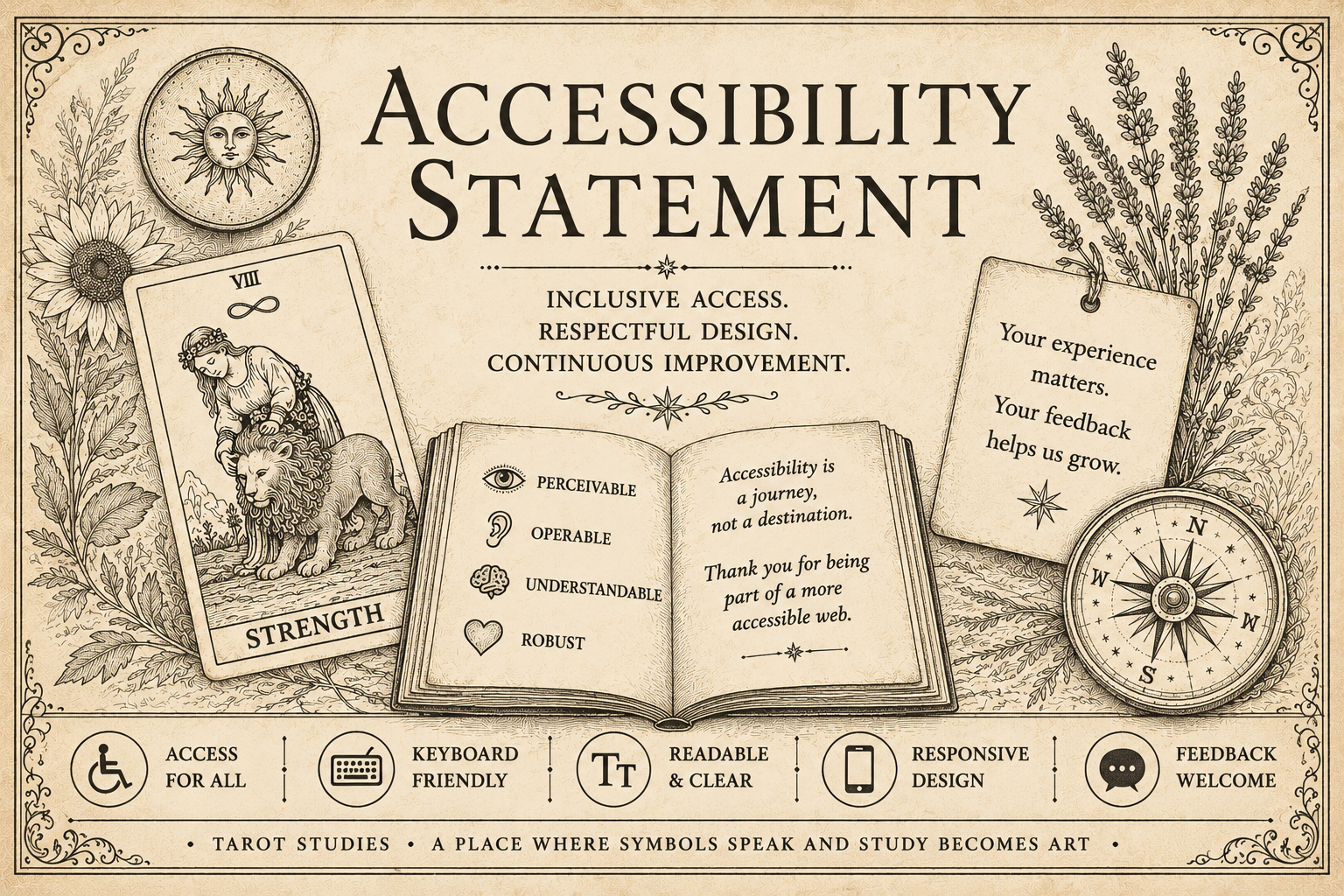
Accessibility Statement for TarotStudies.blog
Last Updated: August 14, 2026
Tarot Studies is committed to making TarotStudies.blog and its educational resources as accessible and usable as reasonably possible for people with different abilities, devices, technologies, and ways of navigating the web.
Accessibility is not something I consider finished once a page is published. Tarot Studies continues to grow, older material is regularly revisited, and new articles, illustrations, downloads, services, and website features can introduce new accessibility challenges.
My goal is to keep learning, identify barriers when I find them, and improve the site over time.
1. Our Accessibility Goal
Tarot Studies works toward recognized web-accessibility practices, including the principles reflected in the Web Content Accessibility Guidelines (WCAG).
Where reasonably possible, I aim to support:
- clear and logical headings;
- meaningful page structure;
- readable typography and spacing;
- sufficient color contrast;
- descriptive alternative text for meaningful images;
- keyboard-friendly navigation;
- understandable links and buttons;
- accessible forms and labels;
- responsive layouts across different screen sizes;
- limited reliance on animation, flashing, or motion;
- understandable content organization; and
- alternatives or improvements when a format creates an accessibility barrier.
This is an ongoing goal rather than a claim that every page, resource, or feature currently meets every accessibility requirement.
2. Content Structure & Readability
Tarot Studies articles and educational pages are designed with headings, paragraphs, lists, and other structural elements intended to make longer material easier to navigate.
Because Tarot Studies often contains detailed educational material, symbolism studies, card comparisons, illustrations, and long-form articles, I also work to improve:
- logical reading order;
- manageable paragraph length;
- descriptive headings;
- visual spacing;
- navigation between related sections;
- clearly identified links;
- readable font sizes; and
- organization that supports both visual scanning and assistive technology.
Older articles may not yet follow the same standards as newer or recently revised material.
3. Images, Tarot Illustrations & Alt Text
Images are an important part of Tarot Studies because Tarot itself is highly visual.
Tarot cards, symbolic diagrams, illustrations, infographics, screenshots, and educational graphics may communicate information that is not fully represented by decorative alt text alone.
Where appropriate, I work to provide alternative text or surrounding written context that communicates the meaningful purpose of an image.
This is especially important for Tarot Studies illustrations that teach:
- card symbolism;
- relationships between figures or objects;
- card structure;
- numerical details;
- orientation;
- visual comparisons; or
- other information necessary to understand the lesson.
Older images may have incomplete, inconsistent, or less useful alternative text. Improving alt text across older Tarot Studies material remains an ongoing project.
Decorative images may intentionally use minimal or empty alternative text when they do not add meaningful information.
4. Color, Contrast & Visual Design
Tarot Studies uses a distinctive visual style that includes parchment tones, sepia illustrations, fine linework, decorative borders, and detailed educational graphics.
As this visual identity has developed, I have also become more attentive to how design choices affect readability and accessibility.
I continue to review:
- text/background contrast;
- small decorative text;
- dense illustrations;
- information communicated through color alone;
- text placed inside images;
- typography at smaller screen sizes; and
- visual complexity that may make information harder to interpret.
Where an illustration contains important educational information, the surrounding page should provide enough written context that understanding does not depend entirely on seeing the image.
5. Keyboard & Navigation Accessibility
Tarot Studies uses WordPress and related website tools that provide accessibility features intended to support keyboard and assistive-technology navigation.
I work to maintain navigation, links, buttons, and page structure in ways that support users who do not navigate primarily with a mouse or touchscreen.
However, because website themes, plugins, embedded services, and individual page designs can change, I do not assume that every interactive element is automatically accessible simply because the underlying platform supports accessibility features.
If you encounter a menu, button, form, link, or other feature that cannot be used with your preferred navigation method, please let me know.
6. Forms, Scheduling & Payment Services
Tarot Studies may use forms and third-party services for subscriptions, contact, scheduling, and payment.
These may include services such as:
- WordPress.com or Jetpack subscription features;
- TidyCal for appointment scheduling; and
- PayPal for payment processing.
These services are operated by third parties and maintain their own accessibility practices and technologies.
I try to select and use services responsibly, but Tarot Studies cannot directly control every accessibility feature of an external platform.
If a third-party service prevents you from scheduling, purchasing, subscribing, or accessing a Tarot Studies service, please contact me so we can explore a reasonable alternative where possible.
7. PDFs, Worksheets & Downloadable Resources
Tarot Studies includes and continues to develop printable PDFs, worksheets, guides, reference materials, spreads, and other downloadable resources.
PDF accessibility is an area I am continuing to improve.
Some older resources may not yet include all features that support assistive technologies, such as:
- properly tagged reading order;
- searchable text;
- accessible headings;
- descriptive alternative text;
- appropriately identified form fields; or
- sufficient contrast.
As older resources are revised and new ones are created, I will continue working toward more accessible digital formats.
If you purchase or download a Tarot Studies resource that you cannot reasonably access because of its format, please contact me. When possible, I will work with you to provide the information in a more accessible form.
8. Embedded & Third-Party Content
Tarot Studies may include or link to content provided by third parties, including videos, social-media content, external websites, scheduling tools, payment systems, or other embedded services.
These providers control the accessibility of their own platforms and content.
Where possible, Tarot Studies aims to provide enough surrounding context that a reader can understand why an external resource has been included even when the embedded material itself presents an accessibility limitation.
9. AI-Assisted Content & Accessibility
Artificial intelligence is used as one of several tools in the Tarot Studies creative and editorial process.
AI may sometimes assist with tasks such as drafting alternative text, reviewing page organization, identifying readability issues, or developing accessible descriptions.
AI-generated accessibility information is not assumed to be correct simply because it was generated.
Alternative text, descriptions, and accessibility-related suggestions may require human review and correction, particularly with Tarot imagery where small visual details can carry significant meaning.
For more information about the role of AI in Tarot Studies, please see How Tarot Studies Uses AI.
10. Known Areas for Continued Improvement
Accessibility work currently includes continued attention to:
- alternative text on older posts and illustrations;
- accessibility of PDFs and downloadable resources;
- color contrast in some older graphics;
- text embedded inside educational illustrations;
- keyboard navigation across changing templates and plugins;
- cognitive accessibility and information density;
- captions or transcripts for multimedia when applicable;
- accessibility of third-party tools and embedded content; and
- testing new site features as Tarot Studies expands.
This list may change as additional barriers are identified.
11. Accessibility Is an Ongoing Process
Tarot Studies is a living educational project.
Articles are revised. Illustrations change. Resources are updated. Website tools come and go.
Accessibility therefore needs to be part of that continuing revision process rather than treated as a single task that can be checked off once and forgotten.
When I find an accessibility problem, my goal is to understand it, correct it where reasonably possible, and incorporate what I learn into future Tarot Studies work.
12. Feedback & Accessibility Assistance
If you experience an accessibility barrier while using TarotStudies.blog or a Tarot Studies resource, I want to know about it.
Please contact:
Misti Hight / Tarot Studies
mlhight@tarotstudies.blog
TarotStudies.blog
When reporting an accessibility issue, it is helpful if you can tell me:
- which page, resource, or service you were trying to use;
- what barrier you encountered;
- the device, browser, or assistive technology involved, if relevant; and
- what format or alternative might help.
You do not need to provide disability or medical information in order to report an accessibility problem.
I will make reasonable efforts to understand the issue and provide an accessible alternative or correction where possible.
13. Related Policies
This Accessibility Statement should be read alongside:
- Privacy Policy
- Terms of Use
- Disclaimer
- How Tarot Studies Uses AI
Together, these pages explain how Tarot Studies approaches access, privacy, responsible use, transparency, and the continued development of the site.
Tarot Studies
A Place Where Symbols Speak and Study Becomes Art
Accessibility is part of making Tarot education genuinely useful.
If the doorway is difficult to use, improving the doorway is part of the work.