
When Recognizing the Card Is Not Enough
Post 4 of the Rider-Waite-Smith Foundations Series
Before you can read Tarot fluently, it helps to understand the language that shaped modern Tarot. Throughout this series, we’ll explore the history, structure, symbolism, and visual storytelling of the Rider-Waite-Smith system, building a foundation that will support every deck you study afterward.
Learning to recognize a Tarot card and learning to interpret it are not quite the same thing.
I discovered this while sitting in the carefully arranged Tarot corner I thought every reader was supposed to have. The candles were flickering, crystals were nearby, and soft music played in the background. Everything looked suitably magical. Yet, when I spread out all 78 cards, each one seemed to shout, “Translate me!”
The artwork fascinated me, but understanding what it had to say felt much harder. I could turn to the guidebook and find a tidy collection of keywords. The Hermit meant solitude. The Tower meant upheaval. The Five of Cups meant grief. I could recognize the cards and repeat their familiar meanings, but I often struggled to connect those definitions with the question in front of me.
Knowing that a card could mean something was not the same as understanding why it mattered in this particular reading.
That gap between recognition and interpretation is where many developing Tarot readers become stuck. We may know the card’s name, remember its most common keywords, and even recognize several of its symbols. Still, when someone asks, “But what does this mean for my situation?” the answer suddenly feels less certain.
The temptation is to search for more information. We reach for another guidebook, open another browser tab, or collect an even longer list of meanings. More knowledge can certainly deepen our understanding, but it does not automatically teach us how to interpret what we know.
Interpretation asks us to do something more active. We must look at the card, consider its traditional foundation, notice what is happening within its scene, and decide which possibilities are relevant to the question. We also need room for the personal impressions and intuitive responses that arise when we spend time with the image.
This does not mean abandoning the guidebook or replacing Tarot’s established meanings with whatever happens to pop into our minds. The Rider-Waite-Smith deck has a deliberate structure and a rich symbolic language. Its suits, numbers, archetypes, figures, landscapes, and recurring symbols give us a dependable foundation.
The guidebook still has a place at the table.
It simply does not need to do all the talking.
Moving from Anatomy to Interpretation
In the previous article, we opened the Rider-Waite-Smith deck and examined how its parts belong together. We explored the archetypal territory of the Major Arcana, followed the four elemental suits through everyday experience, compared the patterns created by numbers and Court ranks, and looked at the visual symbols that echo across the deck.
That anatomy gives us a way to understand how a card is constructed.
Now we need to bring those parts to life.
A Tarot card does not arrive in a reading as an isolated definition. It appears in response to a question. It may occupy a particular spread position, sit beside other cards, or draw our attention toward one small detail that changes the way we understand the entire scene.
The Eight of Cups, for example, is commonly associated with leaving something behind. But that keyword alone does not tell us whether the card is describing emotional growth, disappointment, avoidance, a necessary departure, or the difficult recognition that something meaningful is still no longer enough.
To interpret the card, we have to look closer.
The figure has turned away from eight carefully arranged cups. Mountains rise ahead, and the path does not appear easy. The moon offers some light, but it does not reveal the entire journey. The card contains departure, but it also contains uncertainty, effort, investment, and the courage—or perhaps the reluctance—to continue walking.
The traditional meaning gives us the territory. Observation helps us discover what is happening inside it.
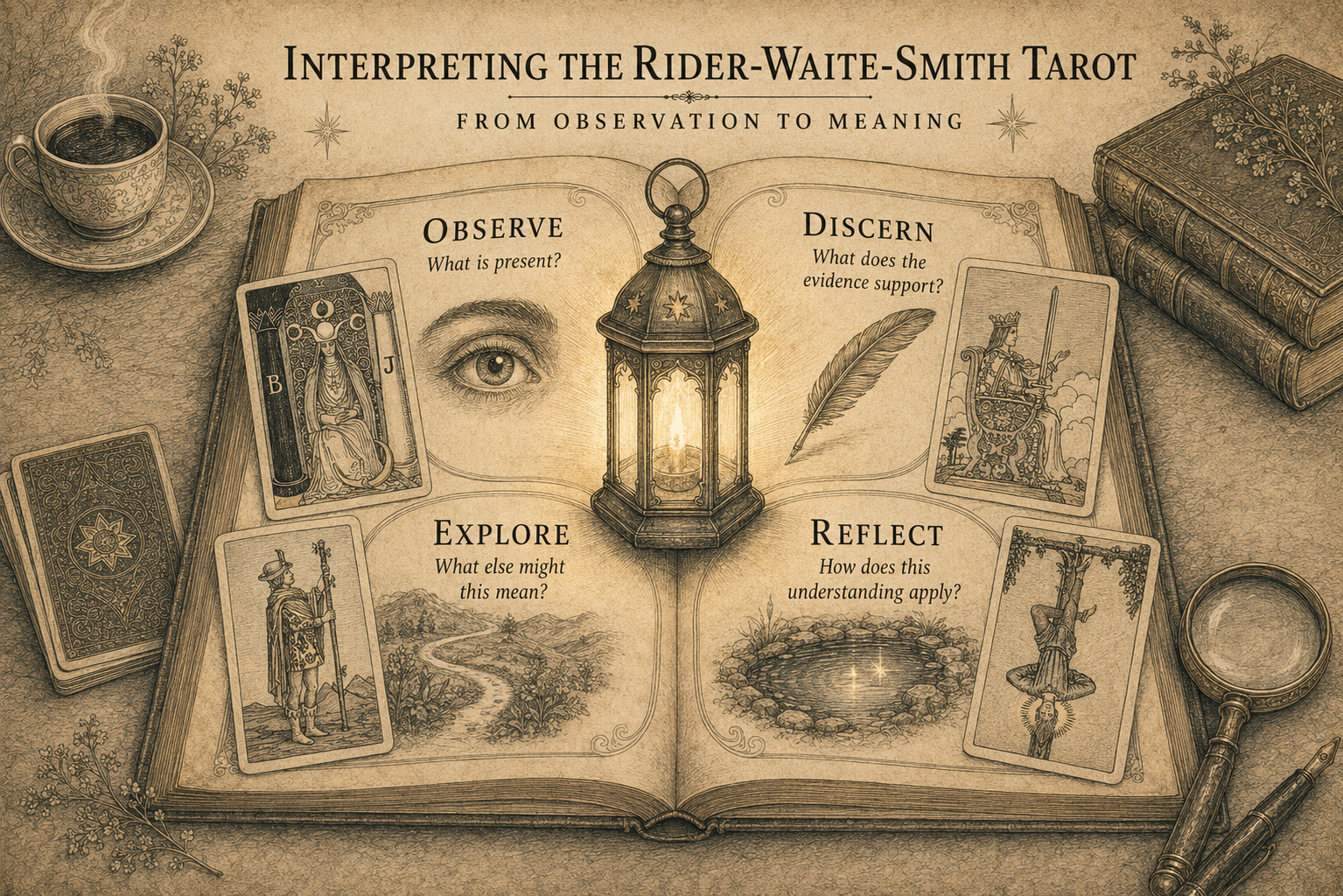
The Lantern Method
To guide this movement from observation to meaning, we will use the Lantern Method.
The method takes its central image from The Hermit, who carries a lantern into a landscape that cannot be seen all at once. His light does not stretch to the horizon or reveal every turn in the road. It illuminates what is close enough to examine and gives him enough guidance to take the next deliberate step.
Tarot often works in much the same way.
A reading may not reveal the entire future or provide one perfectly certain answer. It can, however, help us recognize where we are, notice what we have overlooked, examine the patterns influencing a situation, and consider our next step with greater awareness.
The Lantern Method moves through four stages:
- Observe: What is present?
- Discern: What does the evidence support?
- Explore: What else might this mean?
- Reflect: How does this understanding apply?

These stages create a pause between seeing a card and deciding what it means. Instead of reaching immediately for the first familiar keyword, we allow the card to show us its scene. We then connect what we observe with traditional knowledge, test our impressions against the question, explore more than one supported possibility, and reflect on what the emerging interpretation helps us understand.
The process gives intuition room to speak without asking it to work alone. It also gives traditional knowledge an important role without allowing memorized definitions to overpower the image.
With practice, these four stages will not always feel separate. Observation, knowledge, intuition, and reflection will begin flowing together more naturally. For now, however, slowing the process down allows us to see how an interpretation is formed.
We do not have to illuminate the entire road.
We only need enough light to begin.
From Memorization to Illumination
Why Keywords Are a Beginning, Not an Interpretation
When we begin learning Tarot, keywords feel like small islands of certainty.
The Rider-Waite-Smith deck contains 78 cards, each with its own history, symbols, traditional meanings, and possible expressions. Faced with that much information, reducing each card to a short list can make the deck feel manageable.
The Magician becomes manifestation.
The Hermit becomes solitude.
The Tower becomes upheaval.
The Five of Cups becomes grief.
These associations are not wrong. In fact, they give us an essential foundation. They help us recognize the card’s general territory and offer something familiar to hold onto while we are still learning the deck’s language.
The difficulty begins when the keyword becomes the entire interpretation.
I remember filling journal pages with meanings gathered from guidebooks, books, and online sources. Each new description seemed important, so I kept adding more. Yet, even with all those notes, something still felt incomplete. I was learning how other people defined the cards, but I had not yet learned how to recognize which part of a card mattered within the reading in front of me.
More information did not always create more clarity. Sometimes it simply gave me a longer list to sort through.
A keyword such as solitude may help us recognize The Hermit, but it does not explain the nature of that solitude. Is the figure withdrawing intentionally to think? Has he reached a stage of life where experience has made him a guide for others? Is he protecting a period of private study, or has reflection slowly become isolation?
The card contains more than one of these possibilities. The question, spread position, artwork, and surrounding cards help us determine which one is being illuminated.
The same is true of The Tower. If we stop at upheaval, we may see only destruction. When we look more closely, however, we notice that the lightning strikes a structure crowned by false authority. The crown is thrown loose. Flames emerge from the windows. Figures fall from a place that can no longer protect them.
The scene is undeniably disruptive, but it may also speak about revelation, liberation, the collapse of an illusion, or the painful freedom that arrives when an unstable structure can no longer be maintained.
The keyword opens the door. Interpretation asks us to walk through it.
A keyword tells us what territory we have entered. It does not tell us everything happening within the landscape.
This is why Tarot can never be reduced to a vocabulary test. We are not trying to remember the secret word that unlocks the card. We are learning to recognize how its established meaning changes shape within a particular scene, question, and moment.
Learning to Look Before Deciding
Once we recognize a card, the mind naturally wants to explain it. We see three spilled cups and think grief. We see a blindfold and think confusion. We see a figure walking away and think abandonment.
Those conclusions may eventually become part of the interpretation, but they arrive after we have already taken an important step: noticing what is present.
The Lantern Method asks us to slow that moment down.
Before deciding that the figure in the Five of Cups is grieving, we can observe that the figure’s head is lowered toward three overturned cups. Two cups remain standing behind them. A river crosses the landscape, a bridge reaches across it, and a building waits in the distance.
Observation does not remove feeling or intuition from the reading. It gives both something to respond to.
This distinction can feel overly careful at first. After all, the figure certainly appears sorrowful. Why not simply say so?
Because the details help us understand the particular shape of that sorrow. The figure is not surrounded by complete emptiness. Something has been spilled, something remains, and a possible path continues through the landscape. The card contains loss, but it also contains resources that are not yet within the figure’s field of attention.
That is a richer interpretation than Five of Cups equals grief. It is also an interpretation we can explain because it grew from what we noticed.
Learning to observe begins with simple questions:
- Who or what is present?
- What is happening in the scene?
- Where is the central figure looking?
- What are they holding, guarding, offering, or leaving?
- What appears open or blocked?
- What has already happened?
- What remains available?
- What detail catches my attention first?
- What seems likely to happen next?
We can also pay attention to the card’s atmosphere. Does the scene feel active or still? Open or enclosed? Heavy or light? Ordered or chaotic? Does its energy appear to expand outward, draw inward, move forward, or remain fixed in place?
At this point, we are not trying to produce a polished reading. We are gathering what the lantern reveals.
A useful practice is to describe the card as though we were speaking to someone who could not see it. This keeps us close to the image. Instead of saying, “This is a card about feeling trapped,” we might say:
A blindfolded figure stands within a loose enclosure of swords. Their arms are bound, but the path ahead does not appear completely closed.
The first statement gives us a conclusion. The second gives us something to investigate.
From there, we can begin asking whether the restriction is physical, emotional, mental, assumed, temporary, or partly self-maintained. Observation does not hand us one automatic answer. It reveals the details from which supported possibilities can grow.
Three Voices Within an Interpretation
A meaningful Tarot interpretation rarely comes from one source alone. It develops through a conversation among three different voices: traditional knowledge, visual evidence, and informed intuition.
Traditional Knowledge
Traditional knowledge includes what we have learned about the card through the Rider-Waite-Smith system:
- Whether it belongs to the Major or Minor Arcana
- Its suit and elemental association
- Its number or Court rank
- Its commonly accepted meanings
- Its recurring symbols
- Its upright or reversed orientation
- Its relationship with other cards in the deck
This knowledge gives the interpretation roots. It keeps us connected to the card’s established identity and prevents every image from becoming whatever we want it to mean in the moment.
Traditional knowledge is not the enemy of intuition. It provides the symbolic language through which intuition can become clearer.
Visual Evidence
Visual evidence is what the card actually shows us.
It includes the figures, gestures, objects, landscape, weather, direction, posture, distance, movement, and relationships within the scene. It also includes what appears missing, hidden, interrupted, or overlooked.
The Eight of Cups does not merely represent leaving. It shows a figure turning away from eight carefully arranged cups and walking toward a difficult landscape beneath uncertain light. Those details give the departure its character. Something substantial has been built or gathered, yet a visible gap remains. The decision to leave does not appear impulsive or easy.
Visual evidence gives the traditional meaning a particular shape.
Informed Intuition
Informed intuition is the response that arises as we engage with the card.
A detail may catch our attention before we understand why. A scene may remind us of a personal experience, a familiar relationship pattern, a dream, or a moment from a story. We may feel tension, relief, hesitation, loneliness, or possibility before we can put the feeling into words.
These responses matter, but the Lantern Method does not ask us to accept every first impression as unquestionable truth. Instead, we become curious about it.
Why did the bridge attract my attention before the spilled cups?
Why does this figure feel relieved rather than defeated?
Why does the lantern seem more important than the darkness surrounding it?
Intuition often notices a thread before the conscious mind understands where it leads. Observation helps us find that thread within the image, while discernment helps us decide how much weight it should carry.
A helpful sentence is:
I am reading the card this way because I noticed…
This does not require every intuitive impression to have one universally accepted symbolic explanation. It simply asks us to remain aware of how the impression connects with the card and the reading.
Clarity Is Not the Same as Certainty
One reason readers cling to keywords is that keywords appear definite. They seem to promise that every card has a correct answer and that, with enough memorization, we can avoid uncertainty altogether.
Tarot is rarely that tidy.
A card may support several related meanings without giving us permission to choose absolutely anything. The goal is not rigid certainty, but contextual fit.
We can ask:
- Is this possibility supported by the artwork?
- Does it belong within the card’s traditional territory?
- Does it respond to the question?
- Does it fit the card’s spread position?
- Is it consistent with the surrounding cards?
- Am I noticing what the card shows, or projecting what I hope or fear it will say?
These questions do not weaken intuition. They help us understand it more clearly.
The Lantern Method allows us to hold structure and possibility at the same time. The lantern does not flood the entire landscape with light, but neither does it leave us wandering in complete darkness. It shows us enough to recognize the ground beneath our feet, the details closest to us, and the possible directions ahead.
This is the shift from memorization to illumination.
We stop asking, “Which definition am I supposed to repeat?”
We begin asking, “What is this card helping me notice?”
That question leads us into the first stage of the Lantern Method: Observe.
The Lantern Method
The Lantern Method begins with a simple idea: we cannot interpret what we have not taken the time to see.
When a familiar card appears, its meaning often reaches our minds before its artwork reaches our attention. We recognize The Tower and think upheaval. We see the Three of Swords and expect heartbreak. We turn over The Sun and immediately reach for joy.
That quick recognition is useful, but it can also cause us to look past the card itself. Once we believe we know what a card means, we may stop noticing what is actually happening within its scene.
The Lantern Method slows this process down through four stages:
- Observe: What is present?
- Discern: What does the evidence support?
- Explore: What else might this mean?
- Reflect: How does this understanding apply?
Each stage brings a different kind of light to the reading. Observation gathers details. Discernment connects those details with Tarot’s traditional structure. Exploration opens the interpretation to supported possibilities. Reflection considers why those possibilities matter.
We begin by lifting the lantern and looking.
Stage One: Observe
What Is Present?
The first stage of the Lantern Method is inspired by The High Priestess.
She sits between two pillars, surrounded by symbols that invite interpretation, yet her presence is quiet and still. She does not rush forward to explain what she knows. She watches. She listens. She allows understanding to emerge before she gives it a name.
This is the kind of attention we bring to the Observe stage.
Observation asks us to pause before deciding what the card means. We allow our eyes to travel through the scene, notice what attracts us, and gather details without forcing those details into an immediate conclusion.
This may sound simple, but it can be surprisingly difficult. The moment we recognize a symbol, we naturally begin interpreting it.
A blindfold becomes confusion.
A spilled cup becomes grief.
A mountain becomes an obstacle.
A crown becomes authority.
Those associations may eventually help us understand the card, but they are not observations. They are meanings we have assigned to what we see.
During the Observe stage, we step back one small pace.
Instead of saying:
The figure is trapped.
We might begin with:
A blindfolded figure stands loosely bound within a partial enclosure of swords.
Instead of saying:
The figure is grieving.
We might observe:
A cloaked figure lowers their head toward three cups that have spilled onto the ground.
The difference matters. The first version gives us a conclusion. The second preserves the details that will help us decide whether that conclusion fits.
Observation creates a little breathing room between the image and our assumptions.
Observe Without Judgment
In my earlier one-card intuitive practice, I used an exercise called Observe Without Judgment. The reader spent several minutes looking at a card and recording its colors, shapes, symbols, expressions, postures, and background details before reaching for the guidebook.
That practice remains an important part of the Lantern Method.
Observing without judgment does not mean becoming emotionally detached from the card. It means noticing our reaction without immediately treating that reaction as the card’s complete message.
Perhaps The Tower makes you anxious before you have examined the image. That feeling is real and worth recording. However, anxiety alone does not tell you what The Tower is illuminating in this reading.
Perhaps The Sun creates an immediate sense of relief. That response may become meaningful, but it does not automatically mean that every difficulty has disappeared.
At this stage, we can hold two observations at once:
I notice that two figures are falling from the tower.
And:
I notice that my body tenses when I look at them.
One observation describes the card. The other describes our response to it. Both provide information, but they are not the same kind of information.
Keeping that distinction allows intuition to remain present without letting fear, hope, or familiarity take control of the reading.
Enter the Scene
One of the most useful ways to observe a Rider-Waite-Smith card is to treat it as a still frame taken from a larger story.
Every scene suggests that something happened before the moment we can see. Something may also happen after it.
The Eight of Cups shows a figure already in motion. The cups have been arranged, the decision to turn away has apparently been made, and the journey has begun. We are not seeing the moment of arrival or the instant of decision. We are meeting the figure somewhere in between.
The Four of Pentacles captures a very different moment. Its central figure remains seated and tightly arranged around the pentacles. Nothing in the card appears eager to move. The posture, placement of the coins, and distance from the city create a scene of holding rather than traveling.
Before assigning meaning, we can ask:
- What appears to have happened just before this scene?
- What is happening now?
- What seems unfinished?
- What might happen if nothing changes?
- Is the central figure beginning, continuing, resisting, or completing an action?
- Does the scene suggest arrival, departure, waiting, confrontation, or recovery?
These questions help us see the card as a living moment instead of a collection of symbolic objects.
We are not yet deciding exactly what the story means. We are noticing what kind of story may be unfolding.
Follow the Central Action
When a card contains many details, it is easy to become overwhelmed by its symbolism. We may try to decode every flower, cloud, color, garment, and distant structure before we understand what the card is doing.
A useful place to begin is with the card’s central action.
Ask:
- Who is doing something?
- What are they doing?
- What are they holding, offering, guarding, carrying, or leaving?
- Where are they looking?
- What are they moving toward or away from?
- Is another figure responding?
- What appears available but unused?
- What appears blocked, hidden, or out of reach?
Finding the verb can bring a complicated card into focus.
The Ten of Wands is carrying.
The Four of Swords is resting.
The Six of Pentacles is giving and receiving.
The Seven of Wands is defending.
The Two of Pentacles is balancing.
The Page of Cups is encountering something unexpected.
The verb does not provide the entire interpretation, but it reveals the movement around which the rest of the scene is organized.
This is especially useful when a card contains a familiar symbol that threatens to take over our attention. In the Six of Pentacles, for example, the scales matter—but so does the act of distributing coins. Observing the relationship between the symbol and the action gives us more information than studying either one alone.
Notice Direction and Relationship
The figures in the Rider-Waite-Smith deck rarely exist as isolated decorations. Their posture, gaze, distance, and direction help establish relationships within the scene.
A figure may:
- Face an approaching challenge
- Turn away from something already built
- Look toward one object while ignoring another
- Stand above, below, beside, or apart from other figures
- Offer something freely
- Hold something protectively
- Move with or against the flow of the landscape
- Look beyond the card’s visible border
These relationships become especially important when several cards appear together, but they begin within the individual card.
In the Five of Cups, the figure faces the spilled cups while the two upright cups remain behind them. The card does not merely contain loss and remaining resources. It shows a relationship of attention: the loss occupies the figure’s view, while what remains sits outside it.
We do not have to rush into telling the figure to turn around. That would move beyond observation and into advice. For now, we notice where the figure’s attention rests and what their position prevents them from seeing.
Read the Landscape
The background of a Tarot card is not empty space. It helps establish the conditions surrounding the central action.
Mountains may make a destination feel distant or difficult. Water may separate one part of the scene from another. A wall may protect, divide, or contain. A road can suggest movement even when no one appears to be walking. A city in the distance may introduce community, structure, safety, responsibility, or a life occurring beyond the central figure.
During the Observe stage, we do not need to choose among those meanings yet. We simply notice how the landscape shapes the scene.
Ask:
- Is the setting open or enclosed?
- Is the land easy to cross?
- Does water connect parts of the scene or divide them?
- Is shelter nearby or far away?
- Does the background feel inhabited or empty?
- Is the central figure part of the surrounding world or separated from it?
- Is there a visible path forward?
- What lies between the figure and their possible destination?
The bridge in the Five of Cups becomes significant because a river separates the figure from the distant building. The bridge does not erase the loss or promise that the figure will cross. It shows that a route exists within the landscape.
That is an observation with possibilities still attached.
Observe the Atmosphere
A card communicates through more than its objects and figures. It also creates an atmosphere.
Before naming that atmosphere as hopeful, sorrowful, dangerous, or peaceful, notice how the scene produces the feeling.
Consider whether the card appears:
- Active or still
- Open or enclosed
- Heavy or light
- Ordered or chaotic
- Expanding or contracting
- Warm or distant
- Immediate or gradual
- Balanced or unstable
- Quiet or noisy
- Moving forward or circling in place
You can even imagine the card through your other senses.
If the scene had a sound, would it contain conversation, rushing water, footsteps, music, wind, thunder, or complete silence? If you could enter the landscape, would the air feel warm, cold, damp, sharp, or still? Would the ground beneath you feel steady?
These sensory impressions should not replace what the card shows. They help us spend enough time with the scene to notice its emotional texture.
The Eight of Wands may feel swift not only because we know its traditional association with movement, but because eight staffs travel in the same direction across an open sky. The Four of Swords may feel quiet because the figure is horizontal, the setting is enclosed, and the action has paused.
Atmosphere grows from the arrangement of the scene.
Notice What Draws Your Attention
Observation is not always orderly. Sometimes one detail catches the eye before we have considered anything else.
It may be the bridge rather than the spilled cups.
The small dog rather than The Fool.
The distant mountains rather than the figures in the foreground.
The infinity symbol rather than the lion in Strength.
That first point of attention is worth recording.
Ask yourself:
- What did I notice first?
- What detail keeps pulling me back?
- Is it central to the action or easy to overlook?
- What changes when I focus on it?
- Did I notice it because of the artwork, the question, or a personal association?
- Does another detail complicate my first impression?
We do not need to explain the attraction immediately. At this stage, “My attention keeps returning to the lantern” is enough.
Later, during Discern, we can examine how that detail relates to the card’s traditional symbolism. During Explore, we can consider why it may matter in this reading. Observation simply protects the detail from being overlooked.
A Five of Cups Observation
Let us return to the Five of Cups and practice looking before deciding.
We can observe:
- A cloaked figure stands with their back partly turned toward us.
- The figure’s head and shoulders are lowered.
- Three cups have spilled in front of the figure.
- Two cups remain standing behind them.
- A river moves through the middle of the landscape.
- A bridge crosses the river.
- A building stands on the opposite side.
- The sky is gray.
- The figure is not currently moving toward the bridge or the upright cups.
- The card contains both spilled and unspilled vessels.
- The route across the water is visible, but it requires a change in direction.
Notice what we have not yet declared.
We have not decided that the figure should stop grieving. We have not called the upright cups a hidden blessing. We have not assumed the building represents safety or that crossing the bridge will solve the problem.
Those may become possibilities, but observation allows us to reach them carefully.
This protects the Five of Cups from being flattened into either despair or forced optimism. The scene contains loss, continuation, distance, and possibility. Before deciding how those elements fit together, we allow all of them to remain visible.
A Simple Observation Practice
Choose one Rider-Waite-Smith card and spend three to five minutes with it.
For the first pass, write only what you can see:
- Name five visible details.
- Identify the central action.
- Notice where each figure is looking.
- Describe the landscape.
- Record what appears open, blocked, hidden, or available.
- Name the detail that attracted your attention first.
For the second pass, describe the atmosphere:
- Is the scene still or active?
- Does its energy move inward or outward?
- What might the scene sound or feel like?
- What appears to have happened just before this moment?
- What seems likely to happen next?
Finally, read through what you wrote and circle any words that are interpretations rather than observations.
You do not need to remove them. Simply notice where your mind began creating meaning.
That movement is natural. It is also the bridge into the next stage.
Observation gathers what the lantern reveals. Discernment asks what that evidence can reasonably support.
Stage Two: Discern
What Does the Evidence Support?
Once we have observed the card, the next step is to decide what those observations can reasonably support.
The guide for this stage is the Queen of Swords.
She holds her sword upright, bringing the clarity and precision of the Air element to the reading. Her expression is watchful rather than cold, and her raised hand appears open to whatever approaches. She is willing to listen, but she does not accept every idea without examining it.
This is the posture of discernment.
During the Observe stage, we allowed details, reactions, and impressions to gather without demanding an immediate explanation. Now we begin sorting through what we noticed. We connect the card’s visible evidence with its traditional structure, the question being asked, and the role it occupies within the spread.
Discernment does not silence intuition. It gives intuition something solid to stand on.
Its central question is:
What does the evidence support?
This question protects us from two common extremes. On one side, we have interpretations controlled entirely by memorized definitions. On the other, we have impressions that drift so far from the card that almost any meaning could be assigned to it.
The Lantern Method asks us to work between those extremes.
Traditional knowledge establishes the card’s territory. Visual evidence shows what is happening within that territory. Context helps us determine which part of the landscape matters now.
Bring Traditional Knowledge Back to the Table
During observation, we temporarily stepped away from familiar definitions so we could see the card with greater attention. Discernment invites that knowledge back into the reading.
This is where we consider:
- Whether the card belongs to the Major Arcana, Minor Arcana, or Court Cards
- Its suit and elemental association
- Its number or Court rank
- Its established themes
- Its central symbols
- Its upright or reversed orientation
- The question being asked
- Its position within the spread
- Its relationship with surrounding cards
These parts do not operate as separate meanings that must all be mentioned. They work together to help us understand the card’s identity.
The Five of Cups, for example, belongs to the suit of Cups, connecting it with emotion, relationships, receptivity, and the ways we form attachments. Its number, five, introduces disruption into that emotional territory. The illustration shows three spilled cups, two upright cups, a lowered figure, a river, a bridge, and a distant building.
When these pieces are brought together, grief, disappointment, regret, and emotional disruption become well-supported themes.
However, the card does not support only one emotional conclusion. The standing cups and visible bridge complicate the scene. They suggest that the disruption has not erased everything and that movement remains possible, even if the figure is not currently ready to turn toward it.
Traditional knowledge gives us a framework. The illustration tells us how that framework is being expressed.
Begin with the Card’s Structural Identity
When a card feels confusing, start with its broadest structural identity.
Major Arcana
A Major Arcana card often points toward an archetypal experience, meaningful transition, developmental lesson, or larger pattern shaping the situation.
The Hermit may therefore represent more than having a quiet evening alone. Depending on the question, it could indicate a period of searching, withdrawal, self-examination, accumulated wisdom, or learning to follow an internal source of guidance.
This does not mean that every Major Arcana card predicts an enormous, life-altering event. It means the card’s influence may reach beneath the immediate circumstance into a more significant theme.
Minor Arcana
A Minor Arcana card commonly brings the reading into the landscape of daily life. Its suit identifies the area of experience, while its number helps describe the pattern developing within that area.
For example, the Fives often introduce disruption, instability, or adjustment. When that pattern enters the suit of Cups, the disturbance becomes emotional or relational. In Pentacles, it may appear through material insecurity, health, work, belonging, or access to support.
The number creates a recognizable pattern, but the suit determines where and how that pattern is experienced.
Court Cards
A Court Card may describe a person, role, approach, developmental stage, or way of expressing the suit’s element.
The Page of Wands might represent a curious beginner, an emerging idea, an invitation to experiment, or the part of us willing to follow a spark before knowing exactly where it will lead.
The correct interpretation depends on what the card is doing in the reading. Discernment prevents us from automatically assigning every Court Card to a literal person—or assuming that it must represent someone of a particular age, appearance, or gender.
Structure narrows the possibilities without closing them too quickly.
Connect the Symbol to the Scene
Symbols carry established associations, but their placement and relationship within the card matter.
Consider the infinity symbol above the woman in Strength. On its own, the lemniscate can suggest continuity, limitless potential, eternal movement, or the union of opposing forces. Within the Strength card, however, it appears above a calm figure interacting gently with a lion.
The symbol does not float in an empty space. It belongs to a scene.
The woman’s posture, the lion’s presence, their physical relationship, and the absence of visible force help shape how we understand it. The infinity symbol may deepen the card’s themes of continuing inner development, balanced power, or the patient integration of instinct and awareness.
That reading is stronger than saying:
The infinity symbol means endless possibilities.
The phrase may be relevant, but it remains too broad until it is connected with the rest of the card.
A useful sequence is:
- Identify the symbol.
- Notice where it appears.
- Examine what surrounds it.
- Connect it with the card’s larger structure.
- Decide which associations fit the question.
The same symbol may behave differently in another card. Mountains behind The Hermit do not necessarily function exactly as they do behind the figures in the Eight of Cups. Water in the Two of Swords creates a different relationship with the scene than the river in the Five of Cups.
Symbolic dictionaries can give us possible associations. Discernment asks us to determine how the symbol is functioning here.
Let the Central Action Test the Meaning
The central action we identified during observation becomes one of our strongest forms of evidence.
Suppose the Ten of Wands appears in a reading. Traditional meanings may include burden, responsibility, effort, pressure, persistence, or nearing completion. The figure’s action—carrying ten wands toward a nearby town—helps us decide which meanings deserve attention.
The card supports the idea of carrying a considerable load. It also shows continued movement and a destination that appears close. Depending on the question, this could describe:
- Taking on too much responsibility
- Persisting through the final stage of demanding work
- Carrying obligations without asking for help
- Becoming so focused on the burden that the destination is difficult to see
- Accepting a heavy workload because completion is near
The visible action does not tell us which possibility is automatically correct. It does, however, give us boundaries.
An interpretation about avoiding all responsibility would require additional evidence because the figure is visibly carrying the wands. An interpretation about immediate rest would also need support from the question, position, or surrounding cards because the central action is continued effort.
Discernment does not ask, “Can I make this meaning fit somehow?”
It asks, “Is this the clearest meaning supported by what the card is showing me?”
Consider the Question
A card does not appear in isolation. It responds to something.
The question directs the lantern toward a particular part of the card’s landscape.
If the Eight of Cups appears in response to “What should I understand about my career?” its departure imagery may draw attention toward work that no longer feels meaningful, the search for something more fulfilling, or the recognition that a professional path has reached its emotional limit.
If the same card appears in response to “What is interfering with this relationship?” leaving may still be relevant, but the emphasis could shift toward emotional withdrawal, avoidance, or the difficulty of remaining present when something feels incomplete.
The card has not changed. The question changes which supported expression deserves the strongest consideration.
Ask:
- What is the question actually asking?
- Does my interpretation respond to it?
- Am I answering a different question because it feels easier?
- Which part of the card speaks most directly to this situation?
- Am I treating the card as a prediction when the question asks for reflection?
- Am I giving advice when the position asks me to identify an influence?
A beautiful interpretation can still miss the reading if it does not answer the question.
Respect the Spread Position
The spread position gives the card a job.
A card placed in a “challenge” position should not be interpreted exactly as it would be in a “resource” position. Its traditional identity remains intact, but its function changes.
Strength in a resource position might point toward patience, emotional steadiness, compassionate influence, or the ability to work with a difficult instinct without trying to overpower it.
Strength in a challenge position could reveal:
- Doubting one’s own resilience
- Trying to control through force
- Suppressing anger instead of understanding it
- Confusing endless endurance with healthy strength
- Offering patience to everyone except oneself
Neither interpretation requires us to change the card’s core identity. The position directs our attention toward a different expression of it.
A useful sentence stem is:
In this position, the card may be showing…
That small phrase reminds us that we are interpreting the card within a specific role rather than reciting everything it could ever mean.
Test the Intuitive Impression
Intuitive impressions often arrive before explanations.
A figure may look relieved rather than lonely. A landscape may remind us of a place from childhood. A symbol may suddenly seem more important than the central figure. We may sense tension in a card that is traditionally considered positive or possibility within a card associated with difficulty.
Discernment does not require us to dismiss these impressions simply because they are personal. It asks us to investigate them.
Try completing this sentence:
I am reading the card this way because I noticed…
For example:
I am reading the Eight of Cups as a reluctant departure because I noticed that the cups are carefully arranged rather than scattered or destroyed.
Or:
I am reading the Four of Pentacles as self-protection rather than simple greed because I noticed how completely the figure has arranged the pentacles around the body.
Or:
I am reading The Hermit as guidance rather than isolation because my attention keeps returning to the lantern he carries outward into the darkness.
The observation does not prove that the interpretation is the only correct one. It shows that the interpretation has a relationship with the card.
If we cannot connect an impression with the artwork, traditional structure, question, spread position, or surrounding cards, we do not have to throw it away. We can simply hold it more lightly.
We might say:
One possibility I am considering is…
This allows intuition to remain part of the reading without presenting every impression as certainty.
Separate Interpretation from Reaction
Sometimes the strongest voice in a reading does not come from the card. It comes from our reaction to it.
The Tower appears, and we immediately expect disaster.
The Devil appears, and we fear that something terrible or morally wrong has entered the situation.
The Three of Swords appears, and we decide that heartbreak is inevitable.
The Sun appears, and we assume everything will work out exactly as we hope.
These reactions are understandable. Tarot cards carry emotional reputations, and our personal experiences add another layer. A card that appeared during a painful period may continue to make us uneasy long after that situation has passed.
Discernment asks us to notice when fear, hope, preference, or memory begins speaking louder than the card.
We can ask:
- What am I assuming because of the card’s reputation?
- What does the image actually show?
- Am I treating possibility as prediction?
- Am I choosing the meaning I fear most?
- Am I choosing the meaning I want most?
- Does the question support this conclusion?
- Are the surrounding cards reinforcing it?
- What other explanation fits the evidence?
This does not mean an emotional reaction is irrelevant. Our reaction may reveal a personal association, shadow, expectation, or area requiring reflection. It simply should not be mistaken automatically for the card’s message.
Feeling frightened by The Tower is information about our experience of the card.
Predicting catastrophe is an interpretation that requires evidence.
Work with Reversals Thoughtfully
When a reversed card appears, its orientation becomes part of discernment. It does not erase the card’s upright identity or automatically replace it with the opposite meaning.
A reversed expression may be:
- Internalized
- Blocked
- Delayed
- Avoided
- Diminished
- Excessive
- Distorted
- Misused
- Beginning to shift
- In the process of being released
The question is not simply, “What is the opposite of this card?”
Instead, ask:
- What part of the upright energy is having difficulty moving?
- Is the energy being resisted or avoided?
- Is it operating internally rather than visibly?
- Is there too much or too little of the card’s quality?
- Is the situation changing into or out of this pattern?
- How does the reversed image alter the direction, balance, or relationship within the scene?
Reversed Strength, for example, does not have to mean weakness. It might point toward self-doubt, depleted patience, suppressed instinct, misdirected control, or difficulty trusting a quieter form of power.
Reversed Hermit may suggest isolation, avoidance of needed reflection, reluctance to return from solitude, or depending so heavily on outside guidance that the inner lantern is ignored.
Discernment identifies which expressions are supported. The next stage, Explore, will allow us to consider those expressions more fully.
Know When the Evidence Is Incomplete
Not every card produces an immediate, polished interpretation.
Sometimes we can identify the card’s general territory without knowing exactly how it applies. The question may be too broad. The spread position may be unclear. Our personal reaction may be overpowering the image. We may simply need more experience with the card.
Discernment includes the willingness to say:
I can see that this card concerns emotional disappointment, but I am not yet certain whether it describes a loss, a regret, or a narrowed field of attention.
That is not a failed reading.
It is a more honest reading than selecting one dramatic interpretation and presenting it as fact.
The Queen of Swords reminds us that clarity does not come from pretending uncertainty has disappeared. It comes from recognizing what we know, what the evidence suggests, and what remains unresolved.
A Five of Cups Discernment
In the Observe stage, we gathered the visible details of the Five of Cups. Now we can begin connecting them.
Structural evidence
- As a Minor Arcana card, the Five of Cups may describe an experience unfolding within daily life.
- The suit of Cups connects the card with emotion, relationships, attachment, receptivity, and connection.
- The number five introduces disruption, instability, or adjustment.
Visual evidence
- Three cups have spilled, supporting loss, disappointment, or an emotional investment that did not unfold as hoped.
- Two cups remain standing, showing that the loss is significant but not complete.
- The figure faces the spilled cups, suggesting that attention is currently concentrated on what has gone wrong.
- The lowered posture supports sorrow, heaviness, or contemplation.
- The river creates separation between the figure and the distant building.
- The bridge shows that a route across the separation exists.
- The figure is not yet moving toward the bridge or turning toward the remaining cups.
Supported themes
From this evidence, we might reasonably consider:
- Grieving a genuine loss
- Regret about what has happened
- Emotional attention narrowed by disappointment
- Difficulty recognizing what remains available
- A necessary period of mourning before movement becomes possible
- The existence of a way forward that the person may not yet be ready to use
Notice the restraint within these possibilities.
The card does not prove that the figure will cross the bridge. It does not tell us that the remaining cups compensate for what was lost. It does not demand immediate gratitude or promise that everything will soon be repaired.
It supports both grief and continuation.
That balance protects the card from becoming either hopeless or carelessly optimistic.
A Simple Discernment Practice
Return to the card you used during the Observe exercise.
Begin with its structure:
- Is it Major Arcana, Minor Arcana, or a Court Card?
- If it is Minor Arcana, what suit and element are present?
- What pattern does its number or rank introduce?
- Is the card upright or reversed?
- Which two traditional themes seem most relevant?
Then return to your observations:
- Which visible details support those themes?
- Does the central action reinforce or complicate the familiar meaning?
- Which symbol seems most important within this particular scene?
- What interpretation did you assume too quickly?
- What possibility is not supported strongly enough?
- How does the question narrow the card’s meaning?
- What role does the spread position give the card?
Finally, complete these sentences:
The strongest theme I can support is…
I am reading the card this way because I noticed…
Another possibility exists, but I would need more context about…
My personal reaction to this card is…
The card itself appears to show…
The goal is not to eliminate ambiguity. It is to distinguish a supported interpretation from a familiar definition, personal reaction, or untested assumption.
Observation showed us what the lantern revealed.
Discernment has helped us identify the firmest ground within that light.
Now we can become curious about the paths branching beyond it. That leads us into the third stage of the Lantern Method: Explore—What else might this mean?
Stage Three: Explore
What Else Might This Mean?
After observation and discernment, we have a supported interpretation taking shape.
We know what the card visibly contains. We have connected those details with its traditional structure, the question, and the spread position. We have identified the firmest ground beneath our reading.
Now we can become curious.
The guide for this stage is the Page of Wands.
The Page stands in an open landscape, holding a wand that has begun to sprout. His attention is fixed on it as though he has just discovered something worth investigating. He does not yet know what the wand will become or where the idea might lead. He simply recognizes the spark and is willing to follow it.
This is the spirit of Explore.
During this stage, we ask:
What else might this mean?
That question does not invite us to abandon everything we established during Discern. It encourages us to examine the card from more than one supported angle before settling too quickly on a single interpretation.
The Five of Cups may concern grief, but what kind of grief? Is the card describing an active loss, regret about a past decision, difficulty noticing what remains, or the moment before someone becomes ready to turn around?
The Hermit may indicate solitude, but is that solitude restorative, necessary, protective, avoidant, or beginning to feel isolating?
The Four of Pentacles may involve control, but is the figure hoarding, conserving, protecting, stabilizing, or holding so tightly that nothing can move?
Exploration gives the card room to breathe.
It allows us to recognize that Tarot’s meanings are not rigid definitions. They are patterns capable of taking different forms within different lives, questions, and moments.
Curiosity After Clarity
Exploration works best after discernment.
If we begin generating possibilities before observing the card or considering its traditional identity, the reading can drift in almost any direction. A personal memory, clever metaphor, or strong emotional response may become more influential than the card itself.
Discernment gives exploration boundaries.
Those boundaries are not walls. They are more like the edges of the landscape illuminated by the lantern. Within that light, we may discover several paths. We can examine them without pretending they all lead to the same destination—or that every imaginable path belongs to the card.
A helpful exploration follows three principles:
- The possibility remains connected to the card’s traditional territory.
- Something in the image, question, position, or surrounding cards supports it.
- The possibility adds useful understanding rather than unnecessary complication.
This is the difference between expanding an interpretation and inventing one.
Suppose the Page of Cups appears in a reading about creative work. The traditional themes of emotional openness, imagination, curiosity, and unexpected messages are supported by the young figure examining a fish that has appeared in the cup.
We might explore the card as:
- A surprising creative idea
- An invitation to approach the project playfully
- A message that initially appears strange or impractical
- The willingness to respond to imagination without demanding immediate proof
- A beginner’s emotional openness toward the work
- A reminder that inspiration may arrive in an unexpected form
These possibilities differ, but each belongs within the card’s territory.
An interpretation about rigidly following an established business plan would require much stronger contextual evidence. It does not naturally grow from the Page’s character, the suit of Cups, or the unexpected encounter occurring in the image.
Exploration is generous, but it is not limitless.
Open the Card Through Questions
The simplest way to explore a card is to ask it better questions.
A keyword tends to close the card quickly:
Five of Cups means grief.
A question opens it again:
What has this figure lost, and what remains outside their attention?
Questions help us examine the relationships within the card instead of reaching immediately for one conclusion.
Try asking:
- What could this figure be thinking or feeling?
- What might they want but not yet know how to ask for?
- What are they protecting?
- What are they avoiding?
- What have they misunderstood?
- What remains available to them?
- What would change if they turned, moved, released, accepted, or spoke?
- What part of the scene contains the greatest tension?
- What part contains possibility?
- Who or what has the most influence within this card?
- What truth might be difficult to acknowledge?
- What would this card look like one moment later?
These questions do not all need answers. Their purpose is to loosen our grip on the first interpretation long enough to notice alternatives.
The Page of Wands does not interrogate the sprouting wand until every mystery has disappeared. He studies it because curiosity itself may reveal the next direction.
Let the Card Speak
One of the practices from my earlier intuitive work was to ask:
If this card could speak, what would it say?
This question can help us move from describing a scene to experiencing its perspective.
The voice that emerges may belong to the central figure:
I am still looking at what was lost because I am not ready to decide what comes next.
It may belong to an overlooked symbol:
I have been standing behind you this entire time.
It may come from the landscape:
The bridge is available, but it will not cross itself.
It may even belong to the card as a whole:
Do not confuse a difficult moment with the end of the story.
These statements are not secret messages hidden inside the cardstock. They are imaginative ways of exploring relationships already present in the image.
The Five of Cups visibly contains a grieving figure, spilled vessels, standing vessels, water, distance, and a bridge. Giving those elements a voice allows us to consider how they may relate to one another.
This technique works especially well when we remain aware of who is speaking.
If the figure says, “Nothing remains,” that statement reflects the figure’s possible perspective. It is not an objective description of the entire card because two cups remain standing.
That distinction can reveal something important: the figure’s experience may be real without representing the whole situation.
Treat the Card as a Story in Motion
In the Observe stage, we treated the card as a still frame and noticed what may have happened before or after it.
During Explore, we can begin developing those possible stories.
Ask:
- What brought the figure to this moment?
- What choice may have already been made?
- What decision is still waiting?
- What happens if the central action continues?
- What interrupts the scene?
- What changes if the figure notices something currently outside their view?
- Is this the beginning, middle, climax, or aftermath of the story?
- What would resolution look like?
- What might prevent that resolution?
Consider the Eight of Swords.
The central figure is blindfolded and bound within a loose arrangement of swords. The familiar interpretation of feeling trapped is well supported. Exploration asks us to look at the possible story surrounding that condition.
Perhaps the figure has been restricted by circumstances beyond their control. Perhaps fear has made the enclosure appear more complete than it is. Perhaps they cannot yet see an available path. Perhaps movement is possible, but not while they continue using the same information or assumptions.
These are not interchangeable conclusions. They create different readings and may lead to different reflections.
If the card appears in a position called “What I cannot control,” external restriction may deserve more attention.
If it appears as “What I am not seeing,” the blindfold and incomplete enclosure may point toward limited perspective.
If it appears as “My next step,” the card may not be advising reckless action. It could suggest first identifying which restriction is real, which is assumed, and what information is missing.
The image stays the same. The story changes as context directs our attention.
Explore Through the Senses
A Tarot card is visual, but our response to it does not have to remain visual.
In my earlier Senses Spread, I practiced imagining the sound, texture, temperature, rhythm, and atmosphere of a card. These impressions helped the scene feel less like a flat illustration and more like a place I could enter.
During Explore, sensory questions can reveal emotional qualities that are difficult to reach through keywords alone.
Ask:
- If this card had a sound, what would I hear?
- Is the sound steady, chaotic, distant, sudden, or nearly silent?
- If the scene had a temperature, would it feel warm, cold, sharp, humid, or changing?
- What texture belongs to the card?
- Does the energy feel heavy or light?
- Does it move quickly, slowly, evenly, or in bursts?
- Where do I feel the card’s tension in my body?
- Does the scene invite me closer or make me want to step back?
The Four of Swords may sound almost silent. Its atmosphere may feel cool, enclosed, and still. Those impressions support rest, retreat, recovery, or the suspension of outward activity.
The Eight of Wands may carry the sound of air rushing past. Its rhythm may feel swift and coordinated because all eight wands move through the open sky in the same direction.
The Tower may sound like thunder, breaking stone, alarms, or stunned silence immediately after impact. Each sensory possibility emphasizes a different moment within upheaval.
Sensory exploration becomes most useful when we bring it back to the reading.
If the Two of Pentacles feels like music with a quick, repeating rhythm, perhaps the card is emphasizing adaptability and ongoing coordination. If the rhythm feels increasingly frantic, the reading may be highlighting the strain of keeping too many things in motion.
The impression opens the possibility. Context helps us decide whether it fits.
Follow Personal Associations Carefully
Tarot images often awaken memories, stories, dreams, and associations that are not part of a traditional symbolic dictionary.
A boat may remind you of a childhood trip. A garden may recall someone who cared for you. A distant city may feel like ambition, homesickness, or the safety of returning home. A dog may bring up loyalty, distraction, protection, or a particular memory of companionship.
These associations can make a reading deeply personal. They can also reveal why one detail demanded your attention.
Ask:
- What memory or story does this card bring to mind?
- Which part of the image triggered the association?
- What emotion accompanies it?
- Does the association clarify the question?
- Is it helping me understand the card, or replacing what the card shows?
- Would this association still make sense if I were reading for someone else?
- Does the person receiving the reading share this symbolic connection?
A personal association does not need to be universal to be meaningful.
However, it should be named honestly.
We might say:
The garden makes me think of something that requires patient tending. That association seems relevant because the question concerns the slow development of this project.
That is different from declaring:
Gardens always symbolize business growth.
Exploration allows personal meaning to enter without disguising it as fixed tradition.
Change the Point of View
Most readers naturally identify with the central figure in a card. Sometimes the interpretation becomes clearer when we explore another point of view.
In the Six of Pentacles, are we the person giving, the person receiving, or the person waiting? Are we examining generosity, dependence, power, fairness, or the conditions attached to assistance?
In the Five of Wands, are we participating in the conflict, observing it, trying to organize it, or mistaking lively competition for hostility?
In the Ten of Cups, are we part of the celebrating family, looking toward the scene from outside it, or trying to understand what emotional fulfillment means beyond the idealized image?
Changing perspective does not mean assigning ourselves randomly to every object in the card. It helps us recognize that a scene containing multiple figures may also contain multiple experiences.
Try asking:
- With whom do I identify first?
- Whose perspective have I ignored?
- Who has power in this scene?
- Who appears to have less choice?
- What does one figure know that another may not?
- How would the meaning change if I viewed the scene from the background?
- Am I assuming the central figure represents me simply because they are most visible?
This technique is particularly helpful in relationship readings, where it is tempting to assign one person to each figure before considering the larger pattern between them.
Sometimes the card describes neither individual alone. It describes the exchange.
Explore the Tension Between Two Truths
Some of the richest Tarot interpretations emerge when a card contains two truths at once.
Strength contains instinct and restraint.
The Hermit contains solitude and guidance.
The Tower contains destruction and liberation.
The Four of Pentacles contains security and restriction.
The Five of Cups contains loss and continuation.
The Eight of Cups contains investment and departure.
Exploration asks us not to flatten that tension too quickly.
The Five of Cups does not require us to choose between “the figure is grieving” and “something remains.” Both are visibly true.
The more useful question may be:
How are grief and remaining possibility existing together?
Perhaps the card describes a person who intellectually knows that support remains but cannot emotionally access it yet. Perhaps it suggests that healing will require honoring the loss before turning toward what is left. Perhaps it reveals that attention has become so concentrated on disappointment that continuation feels invisible.
The tension creates the interpretation.
Look for pairs such as:
- Holding on and feeling confined
- Wanting change and fearing its consequences
- Being protected and being isolated
- Remaining patient and becoming stagnant
- Acting confidently and acting impulsively
- Resting and avoiding
- Giving generously and controlling access
- Leaving something behind and still caring about it
A card does not always ask us to resolve these opposites immediately. Sometimes its value lies in helping us recognize that both are influencing the situation.
Invite the Surrounding Cards into the Conversation
When reading a spread, exploration includes examining how the cards alter one another.
A card’s identity remains intact, but its emphasis may change through contrast, repetition, reinforcement, or progression.
If the Five of Cups appears beside The Hermit, the reading may emphasize private grieving, withdrawal, or the wisdom that develops through sitting honestly with disappointment.
Beside the Three of Cups, attention may shift toward support that remains available, reconnection with community, or the difference between private sorrow and shared care.
Beside the Eight of Cups, the reading may explore whether grief is leading toward a necessary departure—or whether someone is leaving before fully processing what happened.
Beside The Sun, the remaining cups and visible bridge may become more prominent, suggesting that sorrow exists within a larger movement toward clarity or renewed engagement.
We should not force cards into one seamless story if they genuinely conflict. Contrast may be the message.
Ask:
- Do these cards reinforce the same theme?
- Does one card reveal what another overlooks?
- Is there a movement from one condition to another?
- Do the figures face toward or away from each other?
- Are elements repeating or missing?
- Does one card intensify, soften, challenge, or redirect another?
- What becomes visible only when the cards are read together?
Exploration turns a spread from a row of separate definitions into a conversation.
Generate Possibilities Before Choosing
A useful way to avoid becoming attached to the first meaning is to deliberately create more than one supported interpretation.
For a single card, try developing three possibilities:
- The most direct interpretation
- An alternative supported by a different detail
- A tension that allows both to coexist
For the Four of Pentacles, that might look like:
- Direct: The figure is holding tightly to material resources.
- Alternative: The figure may be trying to create security after experiencing instability.
- Tension: The effort to remain safe may also be preventing movement, exchange, or connection.
This exercise helps us move beyond simplistic positive-or-negative labels.
It also reveals which interpretation responds most clearly to the question.
We are not required to include all three possibilities in the final reading. Explore is the room where we examine them. Discernment remains present, helping us decide which possibilities deserve the most weight.
Avoid the Possibility Pile-Up
Exploration can become overwhelming when every symbol produces five meanings and every meaning creates three more questions.
Soon the reader has collected so many possibilities that the card feels less clear than when the process began.
More possibilities do not always create a better interpretation.
Watch for signs that exploration has gone too far:
- The interpretation no longer responds to the question.
- Every symbol is being decoded separately.
- Personal associations have replaced the card’s central action.
- Contradictory meanings are being listed without examining their relationship.
- The reading relies on several “maybe” statements but identifies no central theme.
- A dramatic possibility receives attention simply because it is dramatic.
- The card could be exchanged for almost any other card without changing the interpretation.
When this happens, return to the Queen of Swords and ask:
Which possibility has the strongest support?
The Page of Wands opens doors. The Queen of Swords reminds us that we do not have to walk through all of them.
A useful final filter is:
- What possibility answers the question most directly?
- What detail provides the strongest support?
- What alternative genuinely adds depth?
- What can be set aside because it is interesting but not relevant?
Exploration should enrich the reading, not bury it.
A Five of Cups Exploration
We have observed the Five of Cups and discerned several supported themes. Now let us explore how those themes might take shape.
Possibility One: Active Grief
The spilled cups, lowered posture, and fixed attention may describe someone who is still living inside the immediate experience of loss.
In this interpretation, the remaining cups are not yet an invitation to “look on the bright side.” They show that the loss is not the whole landscape, but the figure may need time before that distinction becomes emotionally available.
Possibility Two: Regret and Reconsideration
The figure may be looking at the consequences of a choice, conversation, or missed opportunity.
The card could be asking whether reflection is helping the person learn from what happened—or keeping them emotionally anchored to a moment that cannot be changed.
Possibility Three: Narrowed Attention
The card may describe a field of attention dominated by disappointment.
Something remains. A route exists. A destination is visible. Yet none of those elements currently occupy the figure’s view.
This does not necessarily mean the person is choosing negativity. Grief naturally narrows attention. The card may simply be revealing the limits of what can be seen from the current position.
Possibility Four: The Pause Before Turning
Perhaps the card captures the moment before movement becomes possible.
The figure has not turned toward the upright cups or the bridge, but the image preserves both within the scene. The card may describe a transition that has not begun outwardly, even though the conditions for it are present.
Possibility Five: Two Truths at Once
The strongest interpretation may not require choosing between grief and hope.
The card may be saying:
Something meaningful has been lost, and something meaningful remains.
One truth does not cancel the other.
Which possibility fits best depends on the question and spread position.
In a position called “What needs acknowledgment?” active grief may deserve emphasis.
In “What am I overlooking?” narrowed attention and the standing cups may become central.
In “What supports healing?” the bridge may suggest a route toward connection, while the card still cautions against rushing the grieving process.
In “What is keeping me stuck?” regret may be holding the figure’s attention on what cannot be restored.
Exploration does not give us five competing answers. It helps us recognize which expression of the card is most alive in this reading.
A Simple Exploration Practice
Return to the card you used for Observe and Discern.
Begin with the strongest interpretation you identified:
The clearest meaning I can support is…
Then open the card through curiosity:
- What else might this scene describe?
- What would the central figure say?
- What might an overlooked symbol say?
- What happened immediately before this moment?
- What could happen next?
- What does the card sound or feel like?
- What personal memory or story does it awaken?
- What tension exists between two supported meanings?
- How would the interpretation change from another figure’s point of view?
- What possibility becomes more important because of the question or spread position?
Write three supported possibilities.
For each one, complete:
This possibility fits because…
Then narrow them:
The possibility that answers the question most directly is…
The alternative that adds the most useful depth is…
The interesting idea I can set aside is…
This final step matters. Exploration is not finished when we have generated every meaning we can imagine. It is finished when curiosity has helped us see the card more fully without losing sight of the question.
Observation showed us what was present.
Discernment established what the evidence could support.
Exploration has revealed the different forms that supported meaning might take.
Now we must bring that understanding back to the life, choice, relationship, or question in front of us.
That leads to the final stage of the Lantern Method: Reflect—How Does This Understanding Apply?
Stage Four: Reflect
How Does This Understanding Apply?
By the time we reach Reflect, we have spent considerable time inside the card.
We have observed its visible details. We have connected those details with the card’s traditional structure. We have explored several supported interpretations and considered which one speaks most clearly to the question.
Now we turn the lantern around.
The guide for this final stage is The Hermit.
The Hermit stands alone on a mountain, holding a lantern before him. He is not using its light to reveal an entire road or predict every turn ahead. The lantern illuminates only the ground close enough for the next careful step.
That is the work of reflection.
During this stage, we ask:
How does this understanding apply?
This question brings the reading out of the card and into the life, relationship, decision, or inner experience we are trying to understand.
A reading becomes useful not when we have listed every possible meaning, but when something in the card helps us recognize what is happening more clearly.
Sometimes that recognition leads to action. Sometimes it changes the question. Sometimes it asks us to wait, listen, set a boundary, begin a conversation, acknowledge a feeling, or reconsider an assumption.
And sometimes the most honest result is simply:
I need more time to sit with this.
Reflection does not force every card into a lesson or turn every reading into a tidy answer. It helps us understand what the reading has illuminated and decide what, if anything, we are ready to do with that light.
Return to the Original Question
Before applying the reading, return to the question that began it.
After spending time exploring symbols, stories, emotions, and possible interpretations, it is surprisingly easy to drift away from what we originally wanted to understand.
We may have asked:
What is contributing to my exhaustion?
Yet find ourselves interpreting the Ten of Wands as a prediction that a demanding project will soon end.
The image does show a destination ahead, and completion may be part of the card’s territory. However, the original question asks about the source of exhaustion. The more useful reflection may concern what we are carrying, why we have accepted so much responsibility, and whether we believe we must manage it alone.
Return to the question and ask:
- What was I genuinely trying to understand?
- Does my interpretation respond to that question?
- Has the reading revealed a deeper or more accurate question?
- Am I looking for confirmation rather than understanding?
- Am I asking the card to make a decision that belongs to me?
- What part of the answer feels clear?
- What remains unresolved?
The reading may show that the original question was too broad, too predictive, or focused on another person’s thoughts instead of our own experience.
That is not a failure. Sometimes the first light the lantern offers is a better question.
“What will happen with this relationship?” may become:
What pattern is shaping this relationship, and what choices remain available to me?
“Will I get the job?” may become:
What can I understand about my readiness, expectations, and next steps in this opportunity?
Returning to the question keeps reflection anchored in the purpose of the reading.
Locate the Card in Real Life
Tarot speaks through archetypes, symbols, and illustrated scenes. Reflection asks where those patterns are appearing in lived experience.
If the Four of Pentacles suggests holding tightly, where is that happening?
It could involve:
- Money being saved out of genuine necessity
- Time being protected after a period of overcommitment
- Feelings being withheld because vulnerability feels unsafe
- A role or identity being defended against change
- Resources being controlled to preserve power
- A routine providing stability but leaving little room for growth
The card does not tell us which of these situations is present simply because it contains the theme of holding. We locate the pattern by returning to the question and looking honestly at our circumstances.
Ask:
- Where do I recognize this pattern?
- What recent moment carries the same energy as the card?
- Who or what does the central figure remind me of?
- What am I doing that resembles the card’s central action?
- Where do I feel the same tension shown in the image?
- What part of my life contains the card’s strongest theme?
- Is this pattern happening around me, within me, or between people?
- What concrete example supports the connection?
Suppose the Eight of Cups appears in a reading about work. Rather than stopping at “walking away,” we might notice that we have been completing our responsibilities while feeling increasingly disconnected from their purpose. We may not be ready to leave the job, but we recognize the emotional departure already taking place.
That recognition is the beginning of application.
The card’s scene becomes useful because it gives visible form to something that may have been difficult to name.
Ask What the Card Helps You Recognize
Not every reading needs to introduce new information.
Sometimes a card confirms something we already know but have not fully acknowledged.
The Two of Swords may not reveal a mysterious hidden choice. It may show how much energy we are spending trying not to make one.
The Ten of Wands may not announce that we are busy. We probably know that. It may help us recognize the difference between meaningful responsibility and carrying every available task because we do not trust anyone else to help.
The Hermit may not tell us to withdraw from the world. It may reveal that constant advice, noise, or urgency has made it difficult to hear our own judgment.
Reflection asks:
- What does this reading put into words?
- What have I known but avoided acknowledging?
- What appears different now that I can see the pattern?
- What assumption has the card challenged?
- What feeling has been given a recognizable shape?
- What part of the situation have I minimized?
- What possibility have I overlooked?
- What truth feels clearer, even if it is uncomfortable?
The value of the reading may lie in recognition rather than revelation.
Tarot often works like a mirror. The mirror does not create the expression on our face. It gives us a way to see what was already there.
Distinguish Insight from Instruction
Understanding a card does not automatically tell us what to do.
The Five of Cups may help us recognize grief. That does not mean the card is instructing us to “move on.”
The Hermit may reveal a need for reflection. That does not necessarily mean we should end a relationship, cancel every plan, or disappear into solitude.
The Tower may show that a structure has become unstable. That does not give us permission to act recklessly or destroy something simply because change seems inevitable.
There is an important difference between:
This card helps me recognize…
and:
This card tells me to…
The first leaves room for reflection, choice, context, and responsibility. The second can turn an interpretation into an order before we have considered its consequences.
Before turning insight into action, ask:
- Is the card describing a condition, offering a perspective, identifying a challenge, or suggesting an approach?
- Does the spread position actually ask for advice?
- What practical information exists outside the reading?
- What responsibilities or consequences must be considered?
- Is the action proportional to what the card supports?
- Am I using the card to authorize something I already wanted to do?
- Would a smaller step allow me to learn more?
- Do I need guidance from an appropriate professional or trusted person?
Tarot may help us identify that a work situation feels unsustainable. It cannot review our finances, employment contract, benefits, or available opportunities unless we bring that information into the decision.
It may help us recognize that a relationship lacks honest communication. It cannot decide another person’s intentions or guarantee how they will respond.
It may reveal fear surrounding a health concern. It cannot diagnose the cause or replace medical care.
Reflection respects the insight of the reading without asking the cards to carry responsibilities they cannot safely hold.
Find the Smallest Honest Step
When action is appropriate, it does not have to be dramatic.
The Hermit’s lantern offers enough light for the next step, not the entire journey.
A reading about the Eight of Cups does not always require immediately leaving. The next step might be admitting that something no longer feels fulfilling, identifying what is missing, or beginning a practical conversation about change.
The Four of Pentacles may not require us to release everything we have protected. It may invite us to notice one place where safety has become rigidity.
The Queen of Swords may not demand a confrontation. She may suggest writing down what needs to be said, separating facts from assumptions, or deciding which boundary has become necessary.
Ask:
- What is one response within my control?
- What can I acknowledge today?
- What conversation needs preparation?
- What boundary needs clarification?
- What information should I gather?
- What habit could I observe before trying to change it?
- What support might I ask for?
- What can I stop carrying?
- What is the smallest step that respects both the insight and my circumstances?
A useful next step should be specific enough to recognize.
“Be stronger” is difficult to apply.
“Pause before agreeing to another responsibility and check whether I actually have time for it” gives Strength or the Ten of Wands a place to enter daily life.
“Let go” is vague.
“Write down what I am still hoping to recover and what remains possible now” gives the Five of Cups a more compassionate form.
“Trust my intuition” may sound encouraging, but “record my first impression before opening the guidebook” creates a practice through which that trust can develop.
Reflection translates symbolic understanding into something we can notice, consider, or try.
Recognize When the Next Step Is Not Action
Tarot culture sometimes treats every insight as a call to immediate transformation.
We pull a card, identify the lesson, write an affirmation, choose an action, and expect ourselves to emerge tidier by the end of the journal page.
Real life is rarely that cooperative.
Some cards describe experiences that need to be witnessed before they can be changed. Grief, uncertainty, anger, exhaustion, or disappointment may require time rather than correction.
When The Tower repeatedly appeared during a painful period in my own life, I could recognize the upheaval surrounding me, but the experience was too raw to transform immediately into a lesson. Only later, when I returned to my journal, could I see how my relationship with the card had changed and what the readings had been revealing.
That pause mattered.
Reflection may lead us to:
- Wait for more information
- Allow a feeling to exist without trying to solve it
- Record the reading and return later
- Step away from Tarot for a while
- Seek support before taking action
- Accept that we are not ready to answer the question
- Let the meaning develop through experience
- Choose rest instead of another assignment for self-improvement
A card can be meaningful even when we do not know what to do with it yet.
The Hermit reminds us that stillness can be part of the process. His solitude is not empty. It creates the conditions in which understanding can mature.
Hold Difficult Cards Without Forcing Positivity
When a difficult card appears, reflection should not rush to rescue us from discomfort.
The Five of Cups contains two standing cups, but those cups do not erase the three that have spilled.
The Tower may eventually create room for rebuilding, but collapse can still be frightening, painful, and disruptive.
The Three of Swords may reveal clarity through pain, but that does not make heartbreak secretly pleasant.
Finding a constructive application does not require turning every difficult experience into a gift.
Ask:
- What needs acknowledgment before I look for possibility?
- What part of this situation genuinely hurts?
- Am I using a positive interpretation to avoid the card’s discomfort?
- What remains available without pretending nothing was lost?
- What support would make this experience more manageable?
- What can be learned later rather than demanded now?
- What would a compassionate response look like?
The goal is not to leave every reading feeling cheerful. It is to leave with a more honest relationship to what the card has shown.
Hope becomes more trustworthy when it does not require denial.
Let Encouraging Cards Remain Honest Too
Positive cards also require reflection.
The Sun, Ten of Cups, Nine of Pentacles, or Six of Wands can create an immediate sense of relief. We may treat them as promises that everything will unfold exactly as we hope.
But an encouraging card still asks to be applied thoughtfully.
The Sun might help us recognize clarity, openness, renewed energy, or the freedom to be fully seen. It does not necessarily guarantee a particular outcome.
The Nine of Pentacles may reflect accomplishment and independence, but it can also invite us to consider what has been cultivated over time and whether we are allowing ourselves to enjoy it.
The Six of Wands may signal recognition, progress, or restored confidence. Reflection might ask whether we can receive acknowledgment without becoming dependent on it.
Ask:
- What is genuinely working?
- What deserves acknowledgment or celebration?
- What conditions helped create this progress?
- How can I participate in the opportunity shown?
- Am I treating encouragement as a guarantee?
- What part of this card asks for continued care?
- What strength or resource am I being invited to trust?
Reflection allows positive cards to offer encouragement without turning them into promises the reading cannot make.
Keep Choice and Agency in the Reading
A reflective Tarot reading should expand our awareness of choice rather than make us feel trapped by prediction.
Cards may reveal patterns, pressures, emotional climates, likely consequences, or directions in which a situation appears to be moving. They do not remove human agency, changing circumstances, or the choices of other people.
Instead of saying:
The Eight of Cups means you will leave.
We might reflect:
The card suggests that emotional disengagement or the desire for something more meaningful is becoming difficult to ignore. What choices do you have if that feeling continues?
Instead of:
The Tower means everything is going to fall apart.
We might say:
The card highlights instability, disruption, or a truth that may be difficult to contain. What part of the structure already feels unreliable, and what support would you need if it changed?
Instead of:
The Two of Swords says you will make the wrong decision.
We might consider:
The card appears to show a decision being delayed while important information, emotion, or conflict remains difficult to face.
Language matters because it shapes the reader’s relationship with the card.
Words such as may, could, appears, suggests, and invites us to consider do not weaken a reading. They accurately reflect the nature of interpretation and preserve space for the person living the situation.
The Lantern Method is not meant to replace one rigid guidebook definition with one rigid intuitive conclusion.
It is meant to help us see more clearly while remaining responsible for how we respond.
Reflecting When Reading for Someone Else
When reading for another person, application requires additional care.
We may recognize a strong theme in the cards, but we do not know every detail of the person’s life. An interpretation that feels obvious to us may not fit their experience—or they may not be ready to discuss it.
Reflection becomes a conversation rather than a declaration.
Try asking:
- Where, if anywhere, do you recognize this pattern?
- Does this interpretation connect with the question you brought?
- Which part of the card feels most relevant to you?
- Is the card describing something happening now, or something you are concerned may happen?
- What choices feel available from where you stand?
- What would a manageable next step look like?
- Is there another part of the image that better reflects your experience?
This approach does not require the reader to abandon knowledge or confidence. It recognizes that the person receiving the reading remains the primary authority on their own life.
We should also avoid turning symbolic imagery into unsupported claims about health, pregnancy, death, legal outcomes, financial certainty, infidelity, another person’s private thoughts, or other high-stakes matters.
A card may open reflection around fear, trust, communication, instability, or preparation. When a situation requires medical, legal, mental-health, safety, or financial expertise, responsible application includes directing the person toward appropriate real-world support.
The reading can illuminate the question. It should not pretend to replace the resources the situation requires.
Allow the Meaning to Change Over Time
Some readings become clearer only after we have lived with them.
A card may seem confusing because we do not yet have enough context. A detail that felt insignificant may become important later. An interpretation we felt certain about may need to be revised.
That is one reason journaling can be so valuable.
After a reading, record:
- The question
- The card or spread
- The visible details that stood out
- Your strongest supported interpretation
- Alternative possibilities you considered
- Your emotional reaction
- The connection you saw with your life
- Any action or next step you chose
- What remained unclear
Then return to the entry later.
You may discover that the card expressed itself differently than expected. You may recognize a pattern across several readings. You may see that fear caused you to choose the most dramatic interpretation, or that hope caused you to overlook an uncomfortable detail.
This does not prove that you were a poor reader.
It shows that Tarot understanding develops through a relationship between the card, the reader, and lived experience.
My own journal became more useful when it stopped being a place where I tried to record perfect definitions and became a living record of how my understanding changed. The repeated appearance of The Tower, for example, gained meaning when I could look back across several entries and see the pattern from a little distance.
Reflection continues after the cards are gathered.
Sometimes the final part of the reading happens days, weeks, or months later, when life provides the context that was missing at the table.
A Five of Cups Reflection
We have followed the Five of Cups through every stage of the Lantern Method.
During Observe, we noticed the cloaked figure, the spilled and standing cups, the river, bridge, distant building, lowered posture, and the figure’s direction of attention.
During Discern, we connected those details with the suit of Cups, the disruptive pattern of five, and the card’s established themes of grief, disappointment, regret, and emotional disruption.
During Explore, we considered several supported possibilities: active grief, regret, narrowed attention, the pause before turning, and the coexistence of loss with what remains.
Now we ask:
How does this understanding apply?
Suppose the card appeared in response to:
What do I need to understand about recovering from this disappointment?
The card may help us recognize that something meaningful has been lost and that we are still facing it. The lowered figure and spilled cups support the need to acknowledge that grief rather than rush past it.
The standing cups may remind us that the loss is not the whole landscape. However, reflection should not demand that we feel grateful for what remains before we are ready.
The bridge may suggest that a path forward exists, but the figure has not yet turned toward it. The application may not be “cross the bridge immediately.” It may be:
- Name what was lost without minimizing it.
- Notice what remains without using it to cancel the loss.
- Identify the support, relationship, or possibility represented by the standing cups.
- Consider what would help movement become possible.
- Recognize that not being ready to move is different from having no path.
- Return to the question after the first intensity of grief has softened.
A reflective statement might be:
This card helps me recognize that my attention is still centered on what went wrong. I do not need to force myself to move on, but I can begin noticing what remains available when I am ready to turn toward it.
A possible next step might be:
I will write separately about what I lost, what remains, and what support could help me move between the two.
If the card appeared in a different position, the application would change.
In “What needs acknowledgment?”
The reflection may remain with the spilled cups. Something hurts, and trying to move immediately toward optimism could become another form of avoidance.
In “What am I overlooking?”
The standing cups, bridge, or distant building may become more important. The card could ask us to notice resources or routes that grief has temporarily placed outside our field of attention.
In “What is keeping me stuck?”
The figure’s fixed direction may suggest that attention remains tied to something that cannot be restored. Reflection might focus on the difference between honoring the loss and repeatedly reliving it.
In “What supports healing?”
The bridge may represent connection, transition, or a practical route through emotional separation. Yet the card still reminds us that healing does not require pretending the cups never spilled.
The image has not changed.
The application changes because the question gives the card a different role in our lives.
A Simple Reflection Practice
Return to the card you used during Observe, Discern, and Explore.
Begin by writing your strongest interpretation in one or two sentences:
This card appears to show…
Then return to your original question:
- Does this interpretation answer what I asked?
- Has the reading revealed a more useful question?
- What remains uncertain?
Next, locate the pattern:
- Where do I recognize this in my life?
- What specific experience resembles the card’s central action?
- Is this happening within me, around me, or between people?
- What assumption, emotion, or truth has the card helped me see?
Now decide what kind of response the reading supports.
Recognition
This card helps me acknowledge…
Perspective
This card changes how I understand…
Question
This card invites me to ask…
Action
One small step within my control is…
Boundary
What I may need to protect, limit, or communicate is…
Support
The information, help, or perspective I need is…
Pause
I am not ready to act, but I can continue noticing…
Finally, complete:
The most honest message I can take from this reading is…
I know this applies because…
The smallest useful next step is…
What I do not yet know is…
I will return to this reading when…
The goal is not to manufacture a dramatic transformation.
It is to leave the reading with a clearer understanding of what the card has illuminated and a responsible way to carry that insight forward.
The Lantern Method as a Complete Practice
The four stages of the Lantern Method create a rhythm between careful attention, knowledge, curiosity, and personal application.
Observe: What Is Present?
We begin with the card itself.
We notice the figures, symbols, landscape, atmosphere, direction, relationships, and central action before rushing to interpret them.
Discern: What Does the Evidence Support?
We bring in the card’s traditional structure, suit, number, rank, orientation, question, spread position, and surrounding cards.
We test our impressions and distinguish supported meaning from assumption or reaction.
Explore: What Else Might This Mean?
We open the card through curiosity.
We consider other perspectives, sensory impressions, personal associations, story possibilities, tensions, and alternative interpretations without wandering beyond the card’s territory.
Reflect: How Does This Understanding Apply?
We return to the original question and connect the reading with lived experience.
We decide whether the insight calls for recognition, a new perspective, an action, a boundary, support, patience, or more time.
These stages do not always remain perfectly separate.
We may return to observation after noticing that an interpretation feels unsupported. We may move from exploration back to discernment when possibilities begin piling up. Reflection may reveal that we misunderstood the question and need to look at the card again.
The method is a cycle rather than a test.
Its purpose is not to create a perfect reading every time. It is to give us somewhere to return when the card feels confusing, when intuition feels silent, or when too many possible meanings begin competing for attention.
The lantern does not illuminate everything at once.
It reveals enough for us to look carefully, think clearly, remain curious, and take the next honest step.
The Lantern Method in Practice
A Complete Five of Cups Reading
The four stages of the Lantern Method are easier to understand when we can watch them unfold within one continuous reading.
For this walkthrough, we will use the Five of Cups and the question:
What do I need to understand about recovering from this disappointment?
This question gives the card a clear purpose without demanding a prediction. We are not asking when the disappointment will disappear or whether everything will return to the way it was. We are asking what the experience may require us to recognize.
Imagine placing the Five of Cups on the table.
Before opening the guidebook, searching for keywords, or deciding that the card means we need to “move on,” we begin by turning on the lantern.
Stage One: Observe
What Is Present?
At first glance, the Five of Cups feels heavy.
A cloaked figure stands beneath a gray sky with their head lowered. Three cups lie spilled on the ground. Two cups remain standing behind the figure. A river cuts across the landscape, separating the foreground from a distant building. A bridge crosses the water, but the figure is not facing it.
Those are our first observations.
We can continue by looking more carefully:
- The figure is standing rather than sitting or lying down.
- Their dark cloak covers most of their body.
- Their face is hidden from view.
- Their posture appears lowered and inward.
- The spilled liquid is visibly pooling on the ground.
- The three fallen cups occupy the figure’s field of attention.
- The two standing cups remain behind the figure.
- The river creates distance between the figure and the building.
- The bridge provides a visible route across that distance.
- The landscape feels quiet, still, and subdued.
- No other person is present in the scene.
- The figure is not visibly moving toward or away from anything.
At this stage, we resist the urge to translate every detail immediately.
We can say that the figure’s head is lowered. We cannot yet know with certainty whether they are grieving, ashamed, exhausted, praying, or simply deep in thought.
We can say that the cups have spilled. We cannot assume what they contained, how they fell, who was responsible, or whether they can be refilled.
We can say that two cups remain standing. We cannot claim that the figure is deliberately ignoring them. They may not be ready to turn. They may not know the cups are there. They may know perfectly well and still feel the loss of the other three.
Observation gives us the scene before interpretation begins rearranging it.
The First Impression
After gathering the visible details, we can acknowledge our immediate response:
My first impression is that this card feels lonely, disappointed, and emotionally heavy.
That impression matters, but it remains an impression.
We might also notice a physical or sensory response. Perhaps the card feels cold and still. Perhaps the lowered figure makes our own shoulders sink. Perhaps the silence of the landscape reminds us of the strange quiet that follows bad news, when the world continues around us but we have not yet caught up with it.
These responses bring us closer to the card without requiring us to decide exactly what it means.
Our Observe-stage notes might read:
A cloaked figure stands facing three spilled cups. Two cups remain upright behind them. A river separates the figure from a distant building, but a bridge crosses the water. The atmosphere feels quiet, cold, and heavy. My attention moves first to the spilled cups and then to the bridge.
Now that we have looked carefully, we can begin asking what the evidence supports.
Stage Two: Discern
What Does the Evidence Support?
The Five of Cups is a Minor Arcana card, so it is likely to describe an experience, reaction, or pattern unfolding within everyday life rather than an overwhelming archetypal force.
The suit of Cups connects the card with emotion, relationships, attachment, receptivity, memory, and the ways we connect with what matters to us.
The number five often introduces disruption, instability, conflict, or adjustment. Something has disturbed the emotional condition represented by the suit.
Traditional meanings commonly associated with the Five of Cups include:
- Grief
- Disappointment
- Regret
- Emotional loss
- Attention fixed on what went wrong
- Difficulty recognizing what remains
- The possibility of continuation after loss
These familiar meanings fit the card because they are supported by both its structure and imagery.
The spilled cups provide evidence of something lost, damaged, or no longer available in its previous form. The figure’s lowered posture and direction of attention support sorrow, contemplation, or emotional heaviness. The standing cups show that the loss is significant but not total. The bridge indicates that a route forward exists, even though the figure is not currently moving toward it.
The question narrows these possibilities further:
What do I need to understand about recovering from this disappointment?
Because the question concerns recovery, the card is not simply describing disappointment. It may be showing us something about the relationship between loss, attention, readiness, and movement.
Separate the Card from the Assumption
This is also where we test our first interpretation.
A familiar reading might say:
Stop focusing on what went wrong and appreciate what you still have.
That interpretation notices the two standing cups, but it may move too quickly.
The figure is facing a genuine loss. Three cups have spilled. The card does not suggest that those cups were unimportant or easily replaced. It does not show the figure cheerfully turning around, crossing the bridge, or arriving safely at the distant building.
“Look at what remains” may eventually become part of the reading, but “get over it” is not supported.
Another tempting interpretation might be:
Everything will be fine because there is still a way forward.
The bridge does show a route. However, the existence of a route does not guarantee that the figure is ready to use it—or that crossing will be simple.
The strongest supported interpretation is more restrained:
Recovery may require acknowledging what was genuinely lost while gradually becoming aware that the loss is not the whole landscape.
That statement respects both the spilled cups and the standing ones.
What We Know—and What We Do Not
At the end of Discern, we can identify the firmest ground:
The Five of Cups supports grief, disappointment, and attention concentrated on what has been lost. It also shows that something remains and that a path forward exists, although movement has not yet begun.
We can also name what remains uncertain:
The card does not tell me whether I am ready to move forward, what the standing cups represent, or what crossing the bridge would require.
Discernment has not produced one final answer. It has established the boundaries within which meaningful exploration can begin.
Stage Three: Explore
What Else Might This Mean?
Now we allow curiosity to enter.
Rather than treating “grief” as the conclusion, we ask what form that grief may be taking and what the less obvious elements of the scene might contribute.
Several possibilities emerge.
Possibility One: The Disappointment Needs to Be Acknowledged
Perhaps recovery has been difficult because part of us is trying to minimize what happened.
The spilled cups may represent more than an unfortunate result. They may contain expectations, trust, effort, time, hope, or a future we had already begun imagining.
In this reading, the figure’s attention is not necessarily unhealthy. Looking at the spilled cups may be a necessary part of understanding what was lost.
The card could be saying:
You cannot recover honestly from a disappointment you have not allowed yourself to name.
Possibility Two: Attention Has Narrowed Around the Loss
Grief often changes what we can see.
The Five of Cups contains standing cups, a bridge, and a distant building, but none of those elements currently occupy the figure’s attention. This does not mean they are choosing to be negative. It may show how disappointment has narrowed their emotional field.
In this interpretation, the card helps us recognize that something remains outside our present view.
That “something” could be:
- Support from another person
- A skill or resource that was not lost
- A different opportunity
- A lesson that will become visible later
- The ability to begin again
- A part of ourselves that remains intact
The card does not require us to know immediately which possibility the standing cups represent. It simply asks us not to confuse what we can see right now with everything that exists.
Possibility Three: Recovery Has a Route, but It Also Has a Distance
The bridge is especially important within a question about recovery.
A bridge joins two separated places. It does not erase the river or pretend that the distance was never there. It provides a way to cross.
Perhaps recovery will require a conversation, a practical decision, support from someone else, or a gradual change in perspective. Perhaps the bridge represents time—the slow movement between the immediate experience of disappointment and the ability to see beyond it.
The figure is not standing on the bridge yet.
That detail suggests that recognizing a path and being ready to take it are not the same thing.
Possibility Four: The Figure Is Paused, Not Permanently Trapped
The Five of Cups is a still image.
We do not know whether the figure has been standing there for five minutes or five months. We also do not know what happens in the next moment.
If we imagine the card as one frame within a longer story, this may be the pause before the figure turns.
That possibility changes the emotional tone without forcing optimism.
The card may not show permanent despair. It may show a necessary interval in which the figure faces what happened before deciding what can happen next.
Possibility Five: Loss and Continuation Are Both True
The richest interpretation may be found within the tension at the center of the card:
Something meaningful has been lost, and something meaningful remains.
The standing cups do not replace the fallen ones.
The fallen cups do not make the standing ones meaningless.
Recovery may depend on allowing these truths to exist together rather than demanding that one cancel the other.
Let the Card Speak
If the figure could speak, perhaps they would say:
I know there are things behind me, but I am not ready to turn away from what happened.
If the standing cups could speak, they might say:
We are not asking you to pretend nothing was lost. We are asking you to remember that loss did not take everything.
The bridge might add:
You do not have to cross today, but the path will still be here when you are ready.
These imagined voices grow from what is already present in the image. They do not reveal a secret prediction. They help us experience the relationships within the card more personally.
Narrow the Possibilities
The strongest possibility for this question is that recovery requires both acknowledgment and gradual reorientation.
The most useful alternative is that the figure may be in a necessary pause rather than refusing to move.
An interesting idea we can set aside is the exact identity of the distant building. We might imagine it as safety, home, community, or a future destination, but the question does not require us to define it precisely.
Exploration has expanded the card. Now reflection will bring that expanded understanding back into real life.
Stage Four: Reflect
How Does This Understanding Apply?
We return to the question:
What do I need to understand about recovering from this disappointment?
The Five of Cups suggests that recovery may not begin with immediate action. It may begin with a more honest acknowledgment of what the disappointment represented.
Perhaps we did not lose only an opportunity. We lost the version of the future we had attached to it.
Perhaps we did not lose only a relationship. We also lost trust, belonging, routine, or the person we believed we could be within that connection.
Perhaps we did not lose only a successful outcome. We lost confidence in our judgment or temporarily questioned whether the effort had been worthwhile.
The card invites us to name the contents of the spilled cups.
Locate the Pattern
We might ask:
- What exactly am I disappointed about?
- What did I expect to happen?
- What did I invest emotionally?
- What part of the loss hurts most?
- Am I grieving the event itself, the consequences, or the future I imagined?
- What remains available to me?
- What support have I been unable to notice or accept?
- What might the bridge represent in practical terms?
- What would help me become ready to turn?
These questions allow the symbolic scene to connect with lived experience.
Suppose the disappointment concerns a project that did not succeed as hoped.
The spilled cups might represent the time, enthusiasm, and expectations invested in the work. The standing cups might represent the skills developed and the parts of the project that still hold value. The bridge could represent reviewing what happened, asking for feedback, revising the plan, or resting before deciding whether to try again.
The card would not be saying:
Immediately begin a new project.
It might instead be saying:
Let yourself understand what this project meant to you. When you are ready, look at what the experience did not take away.
The Smallest Honest Step
A useful next step should respect the figure’s grief and the route that remains.
One possible reflection practice would be to divide a journal page into three parts:
- The Spilled Cups: What was lost, changed, or did not happen as hoped?
- The Standing Cups: What remains available, intact, learned, or supportive?
- The Bridge: What could help me move between where I am and what comes next?
This does not turn the card into an assignment to feel better.
It creates space for the complete scene.
A reflective statement might be:
This card helps me recognize that I am still looking at what went wrong because the disappointment mattered. I do not need to force myself to move on, but I can begin noticing what remains without using it to minimize what was lost.
The smallest honest step might be:
I will name what I lost and identify one source of support or possibility that still exists. I do not have to decide what to do with it yet.
That is enough light for now.
The Complete Reading
When the four stages are brought together, the reading might sound like this:
The Five of Cups shows a figure focused on three spilled cups while two remain standing behind them. A bridge crosses the river toward a distant building, but the figure has not yet turned toward it. The card supports grief, disappointment, regret, and attention narrowed around what has been lost.
In response to your question, the card suggests that recovery may begin by acknowledging what this disappointment genuinely cost you. The standing cups show that something remains, but they do not erase the loss or require immediate optimism. The bridge suggests that a route forward exists, although recognizing that route is different from being ready to take it.
You may be in the pause before turning rather than permanently stuck. For now, the most useful reflection may be to name what was lost, notice what remains, and consider what kind of support would make movement possible when you are ready.
This interpretation is not dramatic.
It does not promise that everything will soon improve. It does not tell the reader to forget the spilled cups, and it does not leave them stranded beside them forever.
It follows the evidence from the card toward a compassionate and practical understanding.
How the Reading Changed Through Each Stage
At the beginning, the card may have seemed to say:
You are disappointed.
After Observe, we could see the complete landscape rather than only the grieving figure.
After Discern, we understood why grief, loss, narrowed attention, and continuation belonged to the card.
After Explore, we recognized several ways those themes might express themselves.
After Reflect, the reading became personal and useful:
Recovery may require honoring what was lost while slowly becoming aware of what remains and what could help you move forward.
The card itself did not change.
Our relationship with it did.
That is the purpose of the Lantern Method. It slows the moment between seeing a card and declaring its meaning. Within that pause, observation, knowledge, curiosity, and reflection begin working together.
Try the Walkthrough with Your Own Card
Choose one card and one open, reflective question.
You might ask:
- What do I need to understand about this situation?
- What pattern is shaping my response?
- What am I not seeing clearly?
- What deserves more attention?
- What would support my next step?
- What can this experience help me recognize?
Then move through the complete method.
Observe
What is visibly present?
Record the figures, objects, landscape, colors, direction, posture, atmosphere, and central action without immediately assigning meaning.
Discern
What does the evidence support?
Consider the card’s traditional identity, structure, suit, number, rank, orientation, question, and position. Identify the themes with the strongest support.
Explore
What else might this mean?
Develop three possible interpretations. Look for different perspectives, tensions, stories, sensory impressions, or overlooked details. Keep each possibility connected to the evidence.
Reflect
How does this understanding apply?
Locate the pattern within real life. Decide whether the reading supports recognition, a new question, a conversation, an action, a boundary, support, patience, or a pause.
Finish with:
The strongest interpretation I can support is…
The card helps me recognize…
The smallest honest next step is…
What remains uncertain is…
You do not need to produce a polished reading on your first attempt.
The purpose is to practice moving deliberately from the image to interpretation rather than leaping across the space between them.
With repetition, the stages begin to feel less like separate instructions and more like a natural rhythm:
Look.
Consider.
Wonder.
Reflect.
The lantern remains in your hands throughout the process. The guidebook may add knowledge. Intuition may reveal a new angle. Context may change which detail matters most. Experience may deepen the meaning later.
But the reading begins with your willingness to look carefully—and to follow the light one honest step at a time.
The Lantern Method in Practice
A Complete Five of Cups Reading
The four stages of the Lantern Method are easier to understand when we can watch them unfold within one continuous reading.
For this walkthrough, we will use the Five of Cups and the question:
What do I need to understand about recovering from this disappointment?
This question gives the card a clear purpose without demanding a prediction. We are not asking when the disappointment will disappear or whether everything will return to the way it was. We are asking what the experience may require us to recognize.
Imagine placing the Five of Cups on the table.
Before opening the guidebook, searching for keywords, or deciding that the card means we need to “move on,” we begin by turning on the lantern.
Stage One: Observe
What Is Present?
At first glance, the Five of Cups feels heavy.
A cloaked figure stands beneath a gray sky with their head lowered. Three cups lie spilled on the ground. Two cups remain standing behind the figure. A river cuts across the landscape, separating the foreground from a distant building. A bridge crosses the water, but the figure is not facing it.
Those are our first observations.
We can continue by looking more carefully:
- The figure is standing rather than sitting or lying down.
- Their dark cloak covers most of their body.
- Their face is hidden from view.
- Their posture appears lowered and inward.
- The spilled liquid is visibly pooling on the ground.
- The three fallen cups occupy the figure’s field of attention.
- The two standing cups remain behind the figure.
- The river creates distance between the figure and the building.
- The bridge provides a visible route across that distance.
- The landscape feels quiet, still, and subdued.
- No other person is present in the scene.
- The figure is not visibly moving toward or away from anything.
At this stage, we resist the urge to translate every detail immediately.
We can say that the figure’s head is lowered. We cannot yet know with certainty whether they are grieving, ashamed, exhausted, praying, or simply deep in thought.
We can say that the cups have spilled. We cannot assume what they contained, how they fell, who was responsible, or whether they can be refilled.
We can say that two cups remain standing. We cannot claim that the figure is deliberately ignoring them. They may not be ready to turn. They may not know the cups are there. They may know perfectly well and still feel the loss of the other three.
Observation gives us the scene before interpretation begins rearranging it.
The First Impression
After gathering the visible details, we can acknowledge our immediate response:
My first impression is that this card feels lonely, disappointed, and emotionally heavy.
That impression matters, but it remains an impression.
We might also notice a physical or sensory response. Perhaps the card feels cold and still. Perhaps the lowered figure makes our own shoulders sink. Perhaps the silence of the landscape reminds us of the strange quiet that follows bad news, when the world continues around us but we have not yet caught up with it.
These responses bring us closer to the card without requiring us to decide exactly what it means.
Our Observe-stage notes might read:
A cloaked figure stands facing three spilled cups. Two cups remain upright behind them. A river separates the figure from a distant building, but a bridge crosses the water. The atmosphere feels quiet, cold, and heavy. My attention moves first to the spilled cups and then to the bridge.
Now that we have looked carefully, we can begin asking what the evidence supports.
Stage Two: Discern
What Does the Evidence Support?
The Five of Cups is a Minor Arcana card, so it is likely to describe an experience, reaction, or pattern unfolding within everyday life rather than an overwhelming archetypal force.
The suit of Cups connects the card with emotion, relationships, attachment, receptivity, memory, and the ways we connect with what matters to us.
The number five often introduces disruption, instability, conflict, or adjustment. Something has disturbed the emotional condition represented by the suit.
Traditional meanings commonly associated with the Five of Cups include:
- Grief
- Disappointment
- Regret
- Emotional loss
- Attention fixed on what went wrong
- Difficulty recognizing what remains
- The possibility of continuation after loss
These familiar meanings fit the card because they are supported by both its structure and imagery.
The spilled cups provide evidence of something lost, damaged, or no longer available in its previous form. The figure’s lowered posture and direction of attention support sorrow, contemplation, or emotional heaviness. The standing cups show that the loss is significant but not total. The bridge indicates that a route forward exists, even though the figure is not currently moving toward it.
The question narrows these possibilities further:
What do I need to understand about recovering from this disappointment?
Because the question concerns recovery, the card is not simply describing disappointment. It may be showing us something about the relationship between loss, attention, readiness, and movement.
Separate the Card from the Assumption
This is also where we test our first interpretation.
A familiar reading might say:
Stop focusing on what went wrong and appreciate what you still have.
That interpretation notices the two standing cups, but it may move too quickly.
The figure is facing a genuine loss. Three cups have spilled. The card does not suggest that those cups were unimportant or easily replaced. It does not show the figure cheerfully turning around, crossing the bridge, or arriving safely at the distant building.
“Look at what remains” may eventually become part of the reading, but “get over it” is not supported.
Another tempting interpretation might be:
Everything will be fine because there is still a way forward.
The bridge does show a route. However, the existence of a route does not guarantee that the figure is ready to use it—or that crossing will be simple.
The strongest supported interpretation is more restrained:
Recovery may require acknowledging what was genuinely lost while gradually becoming aware that the loss is not the whole landscape.
That statement respects both the spilled cups and the standing ones.
What We Know—and What We Do Not
At the end of Discern, we can identify the firmest ground:
The Five of Cups supports grief, disappointment, and attention concentrated on what has been lost. It also shows that something remains and that a path forward exists, although movement has not yet begun.
We can also name what remains uncertain:
The card does not tell me whether I am ready to move forward, what the standing cups represent, or what crossing the bridge would require.
Discernment has not produced one final answer. It has established the boundaries within which meaningful exploration can begin.
Stage Three: Explore
What Else Might This Mean?
Now we allow curiosity to enter.
Rather than treating “grief” as the conclusion, we ask what form that grief may be taking and what the less obvious elements of the scene might contribute.
Several possibilities emerge.
Possibility One: The Disappointment Needs to Be Acknowledged
Perhaps recovery has been difficult because part of us is trying to minimize what happened.
The spilled cups may represent more than an unfortunate result. They may contain expectations, trust, effort, time, hope, or a future we had already begun imagining.
In this reading, the figure’s attention is not necessarily unhealthy. Looking at the spilled cups may be a necessary part of understanding what was lost.
The card could be saying:
You cannot recover honestly from a disappointment you have not allowed yourself to name.
Possibility Two: Attention Has Narrowed Around the Loss
Grief often changes what we can see.
The Five of Cups contains standing cups, a bridge, and a distant building, but none of those elements currently occupy the figure’s attention. This does not mean they are choosing to be negative. It may show how disappointment has narrowed their emotional field.
In this interpretation, the card helps us recognize that something remains outside our present view.
That “something” could be:
- Support from another person
- A skill or resource that was not lost
- A different opportunity
- A lesson that will become visible later
- The ability to begin again
- A part of ourselves that remains intact
The card does not require us to know immediately which possibility the standing cups represent. It simply asks us not to confuse what we can see right now with everything that exists.
Possibility Three: Recovery Has a Route, but It Also Has a Distance
The bridge is especially important within a question about recovery.
A bridge joins two separated places. It does not erase the river or pretend that the distance was never there. It provides a way to cross.
Perhaps recovery will require a conversation, a practical decision, support from someone else, or a gradual change in perspective. Perhaps the bridge represents time—the slow movement between the immediate experience of disappointment and the ability to see beyond it.
The figure is not standing on the bridge yet.
That detail suggests that recognizing a path and being ready to take it are not the same thing.
Possibility Four: The Figure Is Paused, Not Permanently Trapped
The Five of Cups is a still image.
We do not know whether the figure has been standing there for five minutes or five months. We also do not know what happens in the next moment.
If we imagine the card as one frame within a longer story, this may be the pause before the figure turns.
That possibility changes the emotional tone without forcing optimism.
The card may not show permanent despair. It may show a necessary interval in which the figure faces what happened before deciding what can happen next.
Possibility Five: Loss and Continuation Are Both True
The richest interpretation may be found within the tension at the center of the card:
Something meaningful has been lost, and something meaningful remains.
The standing cups do not replace the fallen ones.
The fallen cups do not make the standing ones meaningless.
Recovery may depend on allowing these truths to exist together rather than demanding that one cancel the other.
Let the Card Speak
If the figure could speak, perhaps they would say:
I know there are things behind me, but I am not ready to turn away from what happened.
If the standing cups could speak, they might say:
We are not asking you to pretend nothing was lost. We are asking you to remember that loss did not take everything.
The bridge might add:
You do not have to cross today, but the path will still be here when you are ready.
These imagined voices grow from what is already present in the image. They do not reveal a secret prediction. They help us experience the relationships within the card more personally.
Narrow the Possibilities
The strongest possibility for this question is that recovery requires both acknowledgment and gradual reorientation.
The most useful alternative is that the figure may be in a necessary pause rather than refusing to move.
An interesting idea we can set aside is the exact identity of the distant building. We might imagine it as safety, home, community, or a future destination, but the question does not require us to define it precisely.
Exploration has expanded the card. Now reflection will bring that expanded understanding back into real life.
Stage Four: Reflect
How Does This Understanding Apply?
We return to the question:
What do I need to understand about recovering from this disappointment?
The Five of Cups suggests that recovery may not begin with immediate action. It may begin with a more honest acknowledgment of what the disappointment represented.
Perhaps we did not lose only an opportunity. We lost the version of the future we had attached to it.
Perhaps we did not lose only a relationship. We also lost trust, belonging, routine, or the person we believed we could be within that connection.
Perhaps we did not lose only a successful outcome. We lost confidence in our judgment or temporarily questioned whether the effort had been worthwhile.
The card invites us to name the contents of the spilled cups.
Locate the Pattern
We might ask:
- What exactly am I disappointed about?
- What did I expect to happen?
- What did I invest emotionally?
- What part of the loss hurts most?
- Am I grieving the event itself, the consequences, or the future I imagined?
- What remains available to me?
- What support have I been unable to notice or accept?
- What might the bridge represent in practical terms?
- What would help me become ready to turn?
These questions allow the symbolic scene to connect with lived experience.
Suppose the disappointment concerns a project that did not succeed as hoped.
The spilled cups might represent the time, enthusiasm, and expectations invested in the work. The standing cups might represent the skills developed and the parts of the project that still hold value. The bridge could represent reviewing what happened, asking for feedback, revising the plan, or resting before deciding whether to try again.
The card would not be saying:
Immediately begin a new project.
It might instead be saying:
Let yourself understand what this project meant to you. When you are ready, look at what the experience did not take away.
The Smallest Honest Step
A useful next step should respect the figure’s grief and the route that remains.
One possible reflection practice would be to divide a journal page into three parts:
- The Spilled Cups: What was lost, changed, or did not happen as hoped?
- The Standing Cups: What remains available, intact, learned, or supportive?
- The Bridge: What could help me move between where I am and what comes next?
This does not turn the card into an assignment to feel better.
It creates space for the complete scene.
A reflective statement might be:
This card helps me recognize that I am still looking at what went wrong because the disappointment mattered. I do not need to force myself to move on, but I can begin noticing what remains without using it to minimize what was lost.
The smallest honest step might be:
I will name what I lost and identify one source of support or possibility that still exists. I do not have to decide what to do with it yet.
That is enough light for now.
The Complete Reading
When the four stages are brought together, the reading might sound like this:
The Five of Cups shows a figure focused on three spilled cups while two remain standing behind them. A bridge crosses the river toward a distant building, but the figure has not yet turned toward it. The card supports grief, disappointment, regret, and attention narrowed around what has been lost.
In response to your question, the card suggests that recovery may begin by acknowledging what this disappointment genuinely cost you. The standing cups show that something remains, but they do not erase the loss or require immediate optimism. The bridge suggests that a route forward exists, although recognizing that route is different from being ready to take it.
You may be in the pause before turning rather than permanently stuck. For now, the most useful reflection may be to name what was lost, notice what remains, and consider what kind of support would make movement possible when you are ready.
This interpretation is not dramatic.
It does not promise that everything will soon improve. It does not tell the reader to forget the spilled cups, and it does not leave them stranded beside them forever.
It follows the evidence from the card toward a compassionate and practical understanding.
How the Reading Changed Through Each Stage
At the beginning, the card may have seemed to say:
You are disappointed.
After Observe, we could see the complete landscape rather than only the grieving figure.
After Discern, we understood why grief, loss, narrowed attention, and continuation belonged to the card.
After Explore, we recognized several ways those themes might express themselves.
After Reflect, the reading became personal and useful:
Recovery may require honoring what was lost while slowly becoming aware of what remains and what could help you move forward.
The card itself did not change.
Our relationship with it did.
That is the purpose of the Lantern Method. It slows the moment between seeing a card and declaring its meaning. Within that pause, observation, knowledge, curiosity, and reflection begin working together.
Try the Walkthrough with Your Own Card
Choose one card and one open, reflective question.
You might ask:
- What do I need to understand about this situation?
- What pattern is shaping my response?
- What am I not seeing clearly?
- What deserves more attention?
- What would support my next step?
- What can this experience help me recognize?
Then move through the complete method.
Observe
What is visibly present?
Record the figures, objects, landscape, colors, direction, posture, atmosphere, and central action without immediately assigning meaning.
Discern
What does the evidence support?
Consider the card’s traditional identity, structure, suit, number, rank, orientation, question, and position. Identify the themes with the strongest support.
Explore
What else might this mean?
Develop three possible interpretations. Look for different perspectives, tensions, stories, sensory impressions, or overlooked details. Keep each possibility connected to the evidence.
Reflect
How does this understanding apply?
Locate the pattern within real life. Decide whether the reading supports recognition, a new question, a conversation, an action, a boundary, support, patience, or a pause.
Finish with:
The strongest interpretation I can support is…
The card helps me recognize…
The smallest honest next step is…
What remains uncertain is…
← Part III: Anatomy of the Rider-Waite-Smith Tarot System | Return to Rider-Waite-Smith Tarot Study →