
When making a choice feels like more responsibility than you signed up for
When the Universe Has Opinions Before Breakfast
When I see The Lovers, I don’t necessarily jump straight to romance. I tend to think about choices. Important choices. The kind that supposedly affect everything else in your world, sending your life down one path instead of another.
And quite frankly, I’m not feeling particularly enthusiastic about making one of those decisions today.
Can I just choose what I want for breakfast instead?
Oatmeal with blueberries or a peanut butter and banana sandwich? Those are the kinds of decisions I’m prepared to make this morning. Both are perfectly reasonable options, and I’m fairly confident that whichever one I choose isn’t going to dramatically alter the course of my existence.
At least, I certainly hope not. The universe can be exhausting some days. There are days when I’m perfectly willing to contemplate the meaning of life, examine my relationships, and consider whether my choices reflect my deepest values. And then there are days when I’d appreciate the universe minding its own business long enough for me to finish my coffee.
But perhaps that’s part of what makes The Lovers interesting. We tend to associate this card with significant decisions, relationships, commitments, and those moments when we find ourselves standing at some imaginary crossroads, wondering which direction we’re supposed to take.
And while those interpretations certainly have their place, I wonder whether we sometimes make the idea of choice more complicated than it needs to be.
Not every decision is a defining moment. Not every alternative represents a missed opportunity. And choosing one thing doesn’t automatically mean we’ve made some terrible mistake by leaving another behind.
Sometimes we simply need to decide what matters to us right now, make a choice, and get on with our day. Perhaps The Lovers isn’t always asking us to make a life-changing decision.
Perhaps it’s inviting us to examine our relationship with choice itself, including why we sometimes feel that every decision carries the weight of our entire future.
Traditional Foundation
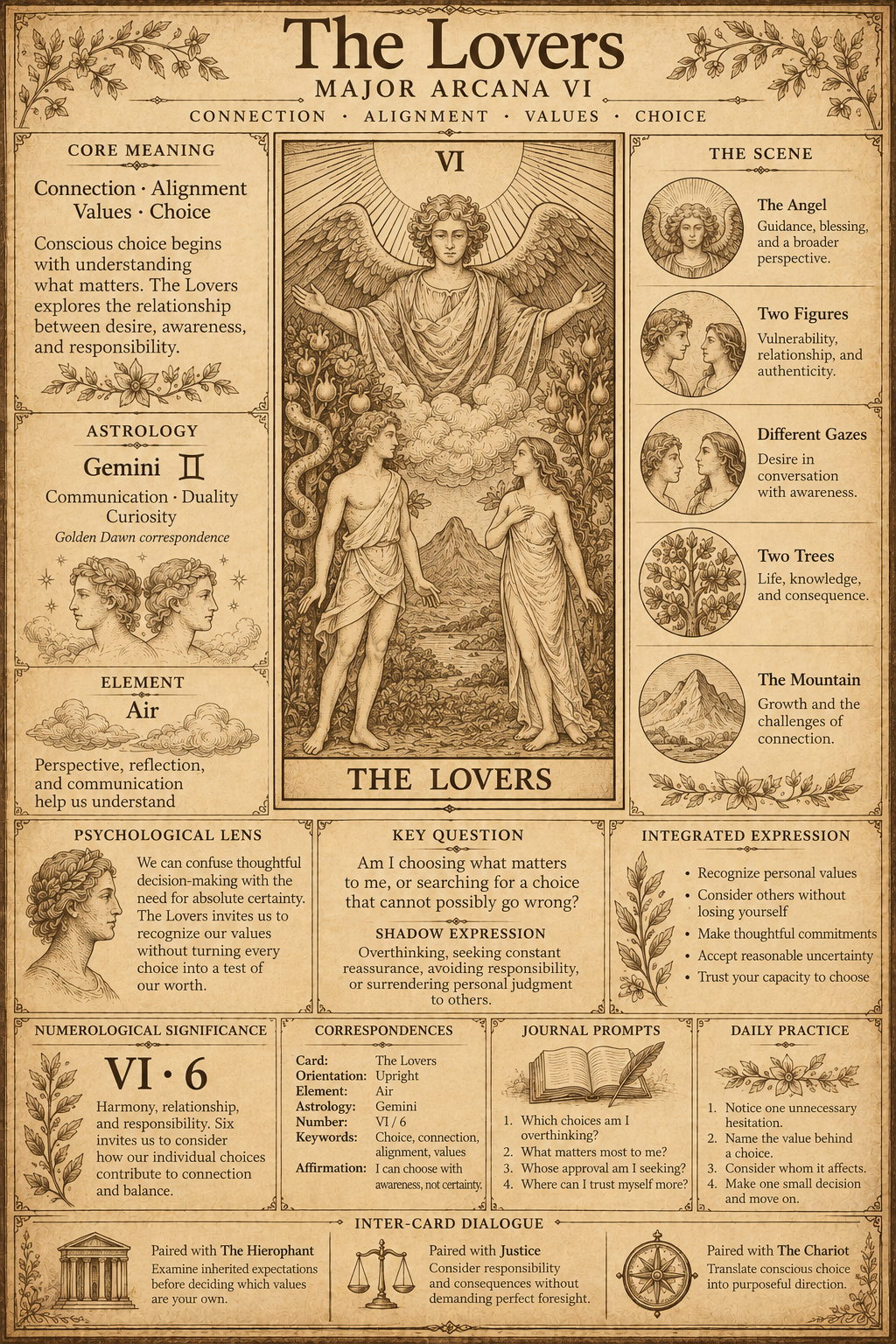
Traditionally, The Lovers represents love, relationships, harmony, attraction, and meaningful choices. It is Major Arcana VI, associated with the number six, which in modern numerological interpretations often brings themes of harmony, connection, responsibility, and the desire to bring different parts of our lives into balance.
But before we start making decisions that could alter the course of our existence, let’s take a closer look at what is actually happening in the Rider-Waite-Smith illustration.
At the center of the card stand two naked figures, traditionally understood as Adam and Eve, beneath an angel traditionally identified as Raphael. Their nakedness suggests innocence, vulnerability, and authenticity. There is nothing to hide behind, no carefully constructed identity to maintain, and no elaborate explanation for why they are standing where they are. They simply exist as they are.
Above them, a great winged angel, traditionally identified as Raphael, extends his arms in a gesture that suggests blessing and protection.

The angel is associated with healing, guidance, and the possibility of bringing different parts of ourselves into harmony. Interestingly, the angel isn’t pointing toward one person or the other, and he certainly isn’t holding up a sign announcing which choice is correct.
Behind the woman stands the Tree of Knowledge of Good and Evil, with a serpent winding around its trunk. This introduces the familiar biblical themes of temptation, awareness, and the consequences of gaining knowledge. Behind the man stands the Tree of Life, bearing twelve flame-like fruits. Later symbolic interpretations associate these forms with the twelve signs of the zodiac, adding another layer to the relationship between human experience and the larger patterns of life.
And then there is the mountain rising between them.
Mountains frequently represent challenges, aspirations, or the effort involved in reaching a greater understanding. Here, the mountain sits in the distance, visually occupying the space between the two figures while also drawing our attention toward something beyond their immediate circumstances. We might interpret it as a reminder that relationships and choices involve growth, and that growth is not always particularly convenient.
What I find interesting about this scene is that nobody appears to be making an actual decision. The figures are standing beneath the angel, surrounded by symbols of awareness, possibility, and consequence. The woman looks toward the angel, while the man looks toward the woman, creating a visual relationship between the three figures.
That arrangement is worth examining. We might interpret the man’s gaze as representing human attraction or desire, while the woman’s upward gaze suggests awareness of something beyond the immediate relationship. The angel introduces another perspective, one associated with guidance and a broader understanding. For another examination of guidance and inherited values, see The Hierophant. This is a symbolic reading of the composition rather than a fixed instruction about how the figures should behave.
There is a relationship between desire, awareness, and understanding, but the card doesn’t tell us exactly what anyone is supposed to do next.
The Lovers is also traditionally associated with Gemini in the Golden Dawn system of tarot correspondences. Gemini is an air sign represented by the twins and associated with communication, curiosity, duality, and the consideration of different perspectives. This correspondence adds another dimension to the card. We may recognize two possibilities, understand the appeal of both, and still need to decide how to move forward.
And perhaps that is where the traditional symbolism becomes useful. The Rider-Waite-Smith introduction offers more background on the system.
The Lovers doesn’t simply represent choosing between two options. It invites us to consider the relationship between what we want, what we understand, and what we value. Sometimes those things align beautifully. Other times, they seem to be having three entirely different conversations.
Waite’s original explanation places considerable emphasis on human love, innocence, and the relationship between the figures. The familiar interpretation of The Lovers as a card of meaningful choices draws on broader tarot traditions and later approaches to reading the card. From a Tarot Studies perspective, these interpretations don’t have to compete. Relationships involve choices, and choices often reveal something about our relationships with ourselves and others. The interesting question is how we bring those meanings into our own experience without assuming the card is demanding an immediate, life-changing decision.
The challenge isn’t necessarily that one choice is right and the other is wrong. It may be that making a meaningful choice requires us to understand ourselves well enough to recognize what matters.
Of course, understanding ourselves doesn’t mean we need to turn every ordinary decision into an elaborate examination of our personal values.
Sometimes oatmeal is just oatmeal.
Sometimes the Struggle Is…
Sometimes the struggle is:
- Feeling that every decision carries consequences far beyond the choice itself.
- Overthinking perfectly reasonable options because we want to make the right decision.
- Confusing what we genuinely want with what we believe we should want.
- Worrying that choosing one possibility means permanently losing another.
- Looking for reassurance from everyone else because we don’t quite trust our own judgment.
- Recognizing what matters to us but struggling to make choices that reflect those values.
- Feeling responsible for how our decisions might affect everyone around us.
- Believing that a meaningful life requires every choice to have some deeper purpose.
And sometimes the struggle is simply being tired of making decisions.
There is a difference between avoiding responsibility and recognizing that we have a limited amount of mental and emotional energy. We cannot approach every choice with the same intensity, nor should we have to. Some decisions deserve careful consideration, while others deserve about thirty seconds and a reasonable amount of confidence in our own preferences.
The Lovers reminds us that conscious choice involves awareness, but awareness doesn’t require endless deliberation. We can recognize our values, consider our options, and make a decision without demanding absolute certainty about everything that might follow.
Perhaps part of learning to trust ourselves is accepting that we won’t always know whether we’ve made the best possible choice. Sometimes we simply make the best choice we can with what we know, and allow ourselves to move forward.
The Key Question
This card asks an important question:
Am I making choices based on what genuinely matters to me, or am I making them harder because I believe every decision has to be the right one?
There is something worth considering in how much importance we assign to our decisions. We want to make thoughtful choices, particularly when relationships, commitments, and personal values are involved. But somewhere along the way, thoughtful consideration can turn into an exhausting search for certainty.
We start looking for the choice that guarantees the best outcome, avoids disappointing anyone, and leaves us with absolutely no regrets. Preferably with written confirmation from the universe that we’ve selected correctly.
Unfortunately, that confirmation rarely arrives.
Perhaps The Lovers invites us to recognize that making a choice isn’t the same as knowing exactly how everything will turn out. We can understand what matters to us without knowing every consequence, and we can make decisions that reflect our values without requiring them to be perfect.
The question may be less about whether we’re choosing the right path and more about whether we’re allowing ourselves to choose at all.

That Distinction Matters
There is a difference between taking responsibility for our choices and believing we must somehow take responsibility for every possible outcome. One asks us to be thoughtful and aware. The other asks us to predict the future, account for every possibility, and somehow guarantee that nothing will go wrong.
That’s quite a job description for someone who was just trying to decide what to have for breakfast.
The Lovers is traditionally associated with harmony and alignment, but I don’t think alignment necessarily means finding the one perfect choice. It means developing an understanding of what we value and allowing that understanding to influence how we live. Sometimes that involves significant commitments, difficult conversations, or decisions that genuinely change the direction of our lives. Other times, it involves smaller choices that gradually establish the patterns of our everyday existence.
And there is another consideration here. We can make a choice that genuinely reflects our values and still experience an outcome we did’t expect. We can make a thoughtful decision and later
discover that we would do something differently. Neither experience automatically means we failed to choose wisely.
Of course, some decisions do carry lasting consequences. Relationships, financial commitments, family responsibilities, and other significant choices may affect people beyond ourselves. Those decisions deserve consideration, honest communication, and an understanding of what we’re agreeing to. Justice offers a related perspective on discernment and responsibility. Trusting ourselves doesn’t mean ignoring those responsibilities. It means recognizing when careful thought is necessary and when continued deliberation is no longer helping.
Perhaps one of the more difficult parts of personal responsibility is accepting that we have influence over our decisions and occasionally reminding the universe of that fact. We can appreciate a little guidance without needing every choice to become a lesson in personal growth. Sometimes we know what we want, understand why we want it, and are perfectly capable of making the decision ourselves.
The universe is welcome to offer suggestions. It doesn’t necessarily get a vote.
The two figures in The Lovers stand beneath an angel associated with guidance and healing, but the artwork offers no guarantee about what happens next. They are surrounded by symbols of knowledge, desire, innocence, and consequence. Their relationship to those things is part of what gives the card its meaning.
We might think of this as the difference between choosing with awareness and choosing with certainty. Awareness allows us to consider what we know, acknowledge what we want, and recognize what matters. Certainty demands answers that may not yet exist.
Maybe we don’t need to know exactly where every choice will lead. Maybe we need to trust ourselves enough to make a reasonable decision, remain open to what we learn, and recognize when something needs to change.
The Hidden Gift
There is also something deeply liberating hidden inside The Lovers. Permission.
Permission to make our own choices, to recognize what matters to us, and to trust that we are capable of making decisions without requiring approval from every person, circumstance, or celestial authority that might have an opinion.
There is a certain freedom in realizing that we don’t have to justify every preference or turn every decision into a declaration about who we are. We can value relationships without allowing them to determine our identity. We can listen to advice without being obligated to follow it. And we can recognize that something once mattered deeply to us while accepting that our priorities may have changed.
That last part can be particularly difficult. Sometimes we hold on to choices simply because we made them. We invested time, energy, emotion, or perhaps a considerable amount of stubbornness, and changing direction feels like admitting we were wrong. But the person who made that original decision may not have known everything we know today.
Growth occasionally means making a different choice.
The Lovers reminds us that meaningful connection doesn’t require abandoning ourselves. Whether we’re considering romantic relationships, friendships, family expectations, or our relationship with our own values, there is room for both connection and individuality.
But relationships also introduce something important into the discussion. Our choices may belong to us, yet they don’t always affect only us. Choosing with integrity sometimes means considering another person’s needs, listening to a perspective that challenges our own, or recognizing that a shared commitment requires cooperation rather than unilateral decisions.
There is a difference between compromising because we genuinely value a relationship and surrendering our preferences because we’re afraid of disappointing someone. The first can strengthen connection. The second may gradually leave us wondering where we disappeared in the process.
Perhaps the hidden gift isn’t simply having the freedom to choose. It’s learning to become comfortable with that freedom while remaining connected to the people and responsibilities that matter to us.
Because freedom comes with responsibility, uncertainty, and the occasional uncomfortable realization that nobody else can make every decision for us. There may not be a perfect answer waiting to be discovered. Sometimes we have to decide what feels reasonable, act with the understanding we have, and allow experience to teach us the rest.
We don’t need to make every choice independently, and asking for guidance isn’t a weakness. But there is a difference between seeking another perspective and handing someone else the responsibility for deciding what matters to us.
The Lovers offers us the opportunity to recognize that personal authority and meaningful connection can exist together. A related exploration of self-leadership appears in The Chariot. We can be responsible for ourselves without becoming disconnected from others, and we can care deeply about someone without making their approval the measure of every decision.
Bringing The Lovers Into Your Day
Today may not be about making some enormous, life-altering decision that sends us down an entirely different path. We may not need to reevaluate every relationship, reconsider our priorities, or spend the afternoon examining whether our choices are perfectly aligned with our authentic selves.
It may simply be about recognizing that we have choices and allowing ourselves to make them without turning every decision into an elaborate exercise in personal development.
That sounds simple enough, but it can be surprisingly difficult when we’ve become accustomed to questioning ourselves. We might know what we want and still hesitate because we’re worried about disappointing someone, missing an opportunity, or discovering later that another option would have been better. Before long, we’ve spent more time considering the possibilities than the decision actually deserves.
Perhaps today we can practice giving our choices an appropriate amount of attention. Important decisions deserve thoughtful consideration,

particularly when they affect our relationships, responsibilities, or long-term well-being. But not everything requires a committee meeting with our higher selves.
We might begin by noticing where we’re making things unnecessarily complicated. Perhaps there’s a decision we’ve postponed because we’re waiting for absolute certainty. Maybe we’ve been asking everyone else for advice when what we really want is reassurance that we won’t be blamed if things don’t work out. Or perhaps we’ve become so accustomed to considering what other people expect that we’ve stopped noticing our own preferences.
These patterns are worth recognizing, not because we need to correct every one of them immediately, but because awareness gives us an opportunity to respond differently.
There is something valuable about allowing ourselves to have preferences without needing to defend them. We can choose how to spend an afternoon, decline an invitation, change our minds about a plan, or simply acknowledge that we don’t have the energy to make another significant decision today.
Of course, personal freedom doesn’t mean our choices exist without consequences or responsibilities to others. The Lovers reminds us that relationships involve consideration, honesty, and mutual respect. But consideration doesn’t require abandoning our own needs, and compromise doesn’t mean someone else’s preferences must always outweigh our own.
Maybe today’s practice is to make one small choice consciously, without second-guessing it afterward. Notice what you want, consider what matters, make the decision, and allow yourself to move on.
Not every choice needs to teach us something profound. Sometimes the practice is simply becoming comfortable with the fact that we made a decision and life continued.
Until Next Time
The Lovers reminds us that our choices are part of how we build our lives, express our values, and develop relationships with ourselves and others. Some decisions will carry considerable weight, while others will barely register beyond the moment in which we make them. Learning to recognize the difference may be just as important as learning how to choose.
There will always be circumstances we cannot control, possibilities we cannot anticipate, and outcomes we cannot guarantee. But uncertainty doesn’t take away our ability to make thoughtful choices or our freedom to reconsider them when we learn something new.
Perhaps the deeper lesson of The Lovers is that we don’t need to spend our lives searching for the one perfect decision. We need to understand what matters, recognize our responsibilities, and develop enough trust in ourselves to participate in our own lives without constantly questioning whether we’re doing it correctly.
The Lovers does not ask us to make every choice a defining moment in our lives.
It asks us to recognize what matters, take responsibility for the choices that belong to us, and trust ourselves enough to make them.
And honestly?
The universe may have plenty of lessons left to teach us, but we don’t have to turn every moment into a classroom.
Sometimes we can simply live our lives, make our choices, and enjoy our breakfast while it’s still warm.
Until next time…
Misti
References & Further Study
The following works provide historical background and additional perspectives on the symbolism and interpretation of The Lovers. The reflections on decision fatigue, self-trust, and personal responsibility in this Daily Pull are contemporary Tarot Studies interpretations, not claims made by these authors.
- Arthur Edward Waite, The Pictorial Key to the Tarot (1910). Primary historical source for Waite’s description of the Rider-Waite-Smith Lovers image, including the figures, angel, two trees, and mountain. See Part II, “The Doctrine Behind the Veil,” card VI.
- Israel Regardie, The Golden Dawn. A source for the Golden Dawn system of tarot correspondences, including the traditional attribution of Gemini and the element Air to The Lovers. Correspondences belong to a particular esoteric framework rather than being universal to every tarot tradition.
- Rachel Pollack, Seventy-Eight Degrees of Wisdom. Further reading on tarot imagery, Major Arcana themes, and the psychological dimensions of relationships and choice.
Further Exploration
For a deeper examination of commitment and consequences, read The Lovers Tarot Card: Why It’s More Brutal Than the Nine of Swords. The Lovers Story Page explores its role in the Major Arcana.