
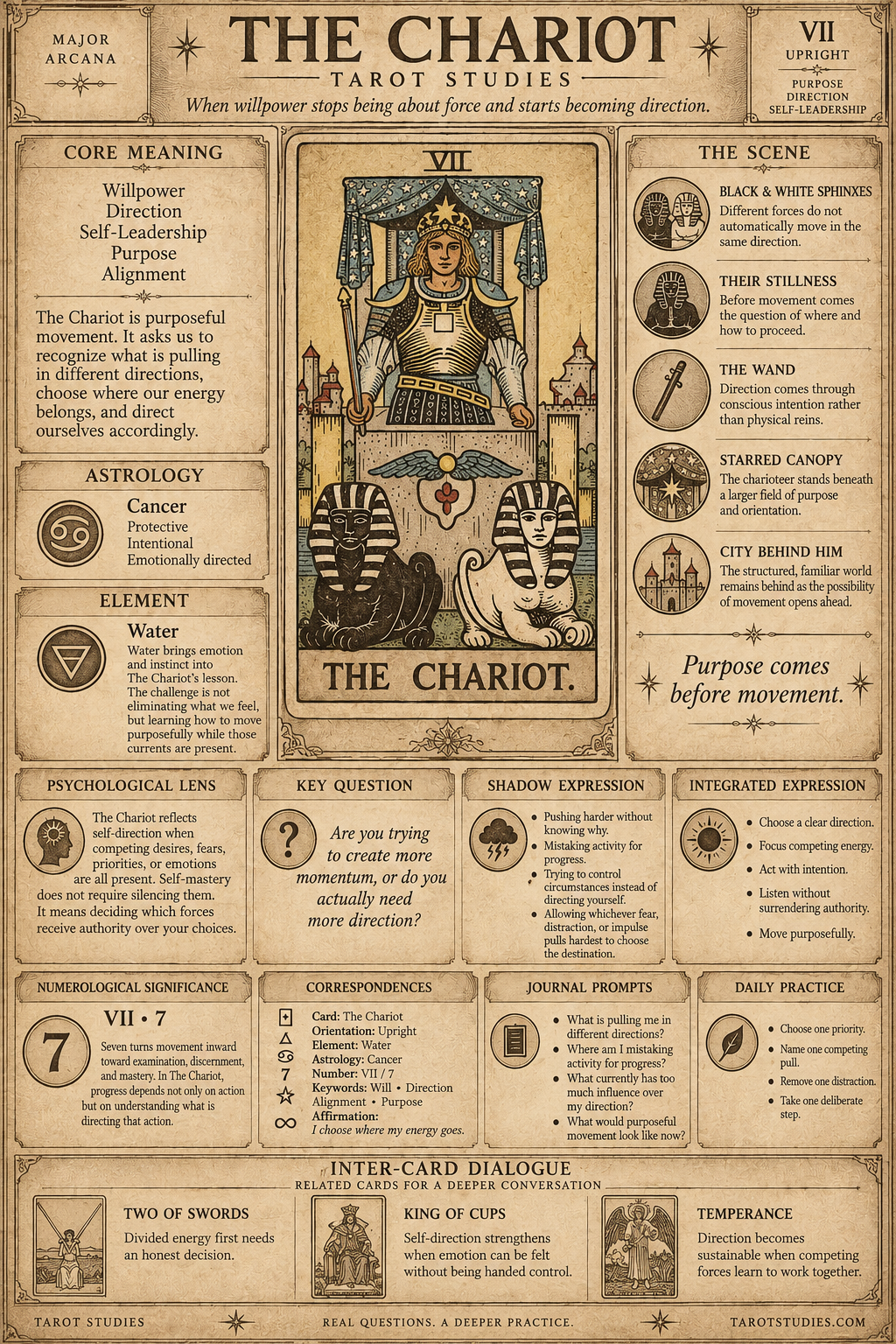
Daily Tarot Pull: The Chariot
When willpower stops being about force and starts becoming direction
I often think of The Chariot as this raging beast barreling forward. Things are being thrown to the right, things are being thrown to the left, and somehow, no matter what gets in the way, you’re going to make it through. There is something almost unstoppable about the way we tend to imagine this card. Once The Chariot gets moving, everybody else might want to clear the road.
Except then I look at the Rider-Waite-Smith card and pause, because those sphinxes aren’t moving.
Suddenly, all that momentum I imagined isn’t actually there. The charioteer isn’t racing down the road. He isn’t wrestling with reins or trying to control two creatures charging in opposite directions. In fact, he doesn’t appear to be holding conventional reins at all. He is standing still, with one black sphinx and one white sphinx sitting quietly in front of him.
And that changes the way I read the entire card. The Chariot becomes less about having enough force to barrel through whatever stands in your way and more about figuring out where you’re going, why you’re going there, and how you’re going to get all of these competing forces moving in the same direction.
Because those sphinxes could pull apart. One could want to go right while the other wants to go left. Or, apparently, they could just sit there and wait for you to figure yourself out. The Chariot is incredibly purposeful that way.
When we talk about this card as willpower, determination, or even mind over matter, I don’t think the lesson is simply that a strong enough mind can overpower every obstacle. The charioteer isn’t defeating the sphinxes. He has to direct them.
Maybe that is the more interesting kind of control The Chariot represents. It isn’t really about force at all.
It’s about alignment.
The Traditional Foundation
Traditionally, The Chariot is associated with willpower, determination, discipline, control, and forward movement. It is the seventh card of the Major Arcana, and its imagery certainly looks prepared for a journey. The charioteer stands armored and confident, the city behind him, while the road and landscape extend beyond the scene.
But the Rider-Waite-Smith artwork makes that idea of movement more complicated than it first appears. The charioteer stands beneath a canopy decorated with stars. His armor suggests preparation and protection, while the square on his chest reinforces themes of stability and grounded intention. He holds a wand rather than conventional reins, suggesting that whatever directs this chariot will require something other than simply pulling harder on the controls.
Then there are the two sphinxes. One is black and one is white, creating an immediate visufal contrast.

They can be read as opposing or complementary forces: different desires, instincts, priorities, possibilities, or parts of ourselves that do not automatically move together simply because we have decided we would like them to.
And importantly, neither sphinx is moving. That detail makes the traditional idea of control much more interesting. The charioteer is not controlling a vehicle already racing wildly down the road. He is faced with something more difficult: bringing different forces under a common purpose.
This gives mind over matter a slightly different meaning. It is not necessarily the mind overpowering everything that resists it. It is the conscious mind recognizing competing impulses and deciding how its energy will be directed. The Chariot therefore represents more than determination. It represents directed determination.
You can have tremendous drive and still go nowhere if your energy is divided. You can also move very quickly and discover that speed was never the same thing as progress.
The charioteer’s strength begins before the journey does because before he can move forward, he has to know where he intends to go.
Sometimes the Struggle Is…
The Chariot becomes especially recognizable when we know we want to move forward but discover that wanting something and being internally aligned with it are two different things. We can be completely sincere about the destination and still have different parts of ourselves pulling toward different outcomes.
Sometimes the struggle is:
- knowing where you want to go but hesitating when it is time to move
- trying to pursue two priorities that keep pulling your energy in different directions
- mistaking constant activity for meaningful progress
- believing that pushing harder will solve a problem that actually requires clearer direction
- trying to control circumstances when the real work is learning to direct yourself
- having the motivation but not yet having the plan
- letting distractions determine where your energy goes
- waiting to feel completely certain before committing to a direction
This is where the stillness of those two sphinxes becomes surprisingly relatable. We can have the armor. We can have the chariot. We can have the destination somewhere in our minds. We can even be completely convinced that we are ready to go and still find ourselves sitting there, wondering why all that determination has not translated into movement.
That does not necessarily mean we lack motivation. Sometimes our energy is simply divided. One part of us wants the destination while another worries about what getting there will require. One part wants change while another prefers what is familiar. One part says go, while another quietly plants its feet. That tension does not automatically mean something is wrong with us or with the direction we have chosen. It may simply mean there is something inside the decision that still needs our attention.
The Chariot does not pretend those competing forces disappear once we become determined enough. It asks us to notice them, understand what they are pulling toward, and become purposeful enough to lead them. That is very different from demanding that every part of ourselves enthusiastically agree before we are willing to move.
The Key Question
This card asks an important question: Are you trying to create more momentum, or do you actually need more direction?
It is an uncomfortable question when our instinct is to solve stalled progress by doing more. Push harder. Work longer. Add another task to the list. Try another strategy. Surely if enough energy gets thrown at the problem, something eventually has to move. But effort is only useful when it has somewhere purposeful to go. Otherwise, we can exhaust ourselves creating a tremendous amount of motion without getting any closer to where we actually want to be.
Those two sphinxes offer a useful picture of what happens inside us when our intentions are divided. We may consciously want one thing while our habits support another. We may be committed to a goal while simultaneously protecting ourselves from the discomfort required to reach it. We may even have several worthwhile priorities competing for the same limited supply of time, attention, and energy. None of those things necessarily means we need more motivation. Sometimes they mean we need to decide what deserves our direction.
So perhaps the question isn’t simply, How badly do I want this? Wanting something can provide the energy, but it cannot make every competing priority disappear or automatically decide what happens next.
The more useful question may be:
Am I actually directing myself toward it?
Because The Chariot reminds us that determination becomes powerful when it stops scattering itself across every possible direction and begins moving with purpose.

That Distinction Matters
There is a difference between controlling everything around you and learning to direct yourself. That distinction matters because The Chariot can easily look like a card about control. The charioteer appears composed, armored, and completely in command, but he cannot eliminate the difference between the black and white sphinxes. He cannot make them become the same creature, want the same things, or represent the same forces. His task is to work with what is already there.
That feels much closer to real life than the idea that enough willpower gives us complete control. We cannot control every interruption, other people’s choices, unexpected setbacks, changing circumstances, or whether the road behaves itself once we finally start moving. Life has never been especially cooperative about following the itinerary. Trying to control all of those things can become its own exhausting distraction from the part we actually have some authority over: how we respond and where we choose to direct our energy next.
What we can influence is the authority we give those outside forces. Fear can affect us without choosing for us. Doubt can affect us without deciding for us. Other people’s expectations can influence us without becoming our destination. Even our own emotions can be acknowledged without automatically being handed the steering wheel.
That is the deeper self-leadership inside The Chariot: not everything that affects me gets to direct me. The goal is not to become so disciplined that nothing gets through the armor. The charioteer’s discipline is not Nothing will affect me. It is the ability to recognize what is pulling at him, understand that those forces are real, and still decide where he is going.
That kind of control is quieter than the version we usually associate with The Chariot. It does not require dominating the road, the sphinxes, or every circumstance along the way. It requires knowing the difference between what deserves our attention and what deserves the authority to determine our direction.
The Hidden Gift
There is also something deeply reassuring hidden inside The Chariot. You do not have to eliminate every conflicting thought, feeling, fear, or desire before you can move forward. The card does not suggest that self-mastery means becoming perfectly certain, perfectly confident, or somehow immune to internal conflict.
The black sphinx does not need to become white. The white sphinx does not need to become black. Their differences remain visible, and that may be part of the lesson. The goal is not to erase the tension between them or force one side to defeat the other. Alignment does not require agreement.
That matters because we sometimes treat internal conflict as evidence that we are not ready. We think confidence should mean having no doubts, commitment should mean never wanting to turn back, and determination should somehow silence every part of us that is afraid, tired, distracted, or uncertain. Then, when those feelings inevitably show up, we assume something must be wrong with the decision or with our ability to follow through.
Human beings are considerably less tidy than that. You can want something and still be afraid of it. You can know a decision is right for you and still grieve what you are leaving behind. You can feel confident about your direction while having absolutely no idea how every mile of the journey is going to unfold. Those conflicting experiences can exist at the same time without canceling each other out.
The Chariot does not require perfect internal agreement before movement becomes possible. It asks for enough self-awareness to recognize what is pulling at you, enough curiosity to understand why, and enough purpose to decide what will guide you. That is a much more realistic version of self-mastery than waiting until every part of ourselves enthusiastically votes yes.
Alignment does not mean every part of you agrees. It means every part of you doesn’t get an equal vote on where you’re going. You can listen to all of those voices without allowing each one to choose the destination.
Bringing The Chariot Into Your Day
Today may not be about charging forward, pushing harder, or proving that nothing can stop you. It may simply be about getting your sphinxes pointed in the same direction. Before asking yourself for more effort, more discipline, or more determination, it may be worth noticing where your energy is already going and whether all of it is actually moving toward the same purpose.
If five things are competing for your attention, perhaps the answer is not finding enough determination to accomplish all five at once. The answer may be deciding which one actually deserves to move first. That could mean choosing one priority and giving it your full attention, making the decision you have been circling instead of continuing to debate every possible outcome, or taking one purposeful step toward something that matters rather than taking ten frantic steps simply because standing still feels uncomfortable.

The Chariot can also invite us to notice the difference between resistance and information. If part of you keeps pulling in another direction, you do not necessarily have to overpower it. You can ask what it is responding to. Fear may need reassurance. Uncertainty may need information. Exhaustion may need rest. Distraction may need a boundary. Sometimes understanding what is creating the resistance gives us far more useful information than simply demanding that we push through it.
Listening to those things does not mean handing them control of the chariot. It means understanding what you are actually trying to lead. There is a difference between allowing fear to tell you something and allowing fear to choose for you. There is a difference between recognizing exhaustion and abandoning the destination. Self-leadership leaves room for those signals without automatically turning every one of them into instructions.
So perhaps today’s practice is surprisingly simple: Where am I trying to go, what is pulling me away from it, and what is one deliberate action that deserves my energy today? The answer does not have to be dramatic. It might be sending the email, finishing the task you keep avoiding, saying no to something that is scattering your attention, asking for the information you need, or finally choosing between two options you have been trying to keep open.
Then take that action, not because you have conquered every doubt or guaranteed yourself an obstacle-free road, but because you have chosen where your energy belongs. The Chariot reminds us that purposeful movement does not have to begin with a grand charge forward. Sometimes it begins with getting clear enough to take the next step in the direction you actually intend to go.
Until Next Time
The Chariot does not ask us to become an unstoppable force that barrels through everything standing between us and where we want to go. It asks us to become purposeful enough to direct our own movement. That may require determination, but it also requires knowing what we are directing that determination toward.
There will always be things pulling to the right and things pulling to the left. There will be distractions, doubts, competing priorities, unexpected obstacles, and occasionally our own stubborn resistance sitting squarely in the middle of the road. The goal is not to make all of that disappear before we begin. If we wait for a perfectly clear road and complete internal agreement, those sphinxes may be sitting there for quite a while.
Instead, The Chariot asks us to know ourselves well enough to recognize those competing forces without allowing every one of them to determine where we go next. We can listen to fear without letting fear choose the destination. We can acknowledge uncertainty without requiring certainty before we act. We can change course when new information matters without confusing every moment of hesitation with a reason to abandon the journey.
That may be the deeper form of willpower inside this card. It is not the ability to overpower everything in our path. It is the ability to remain connected to our purpose while deciding what deserves our energy, what needs our attention, and what simply does not get to choose the direction.
And honestly? Maybe The Chariot was never the raging beast I imagined it to be. Maybe its real power is contained in that strange moment before anything moves: one person, two very different sphinxes, and the quiet understanding that purpose comes before movement.
Until next time…
Misti