
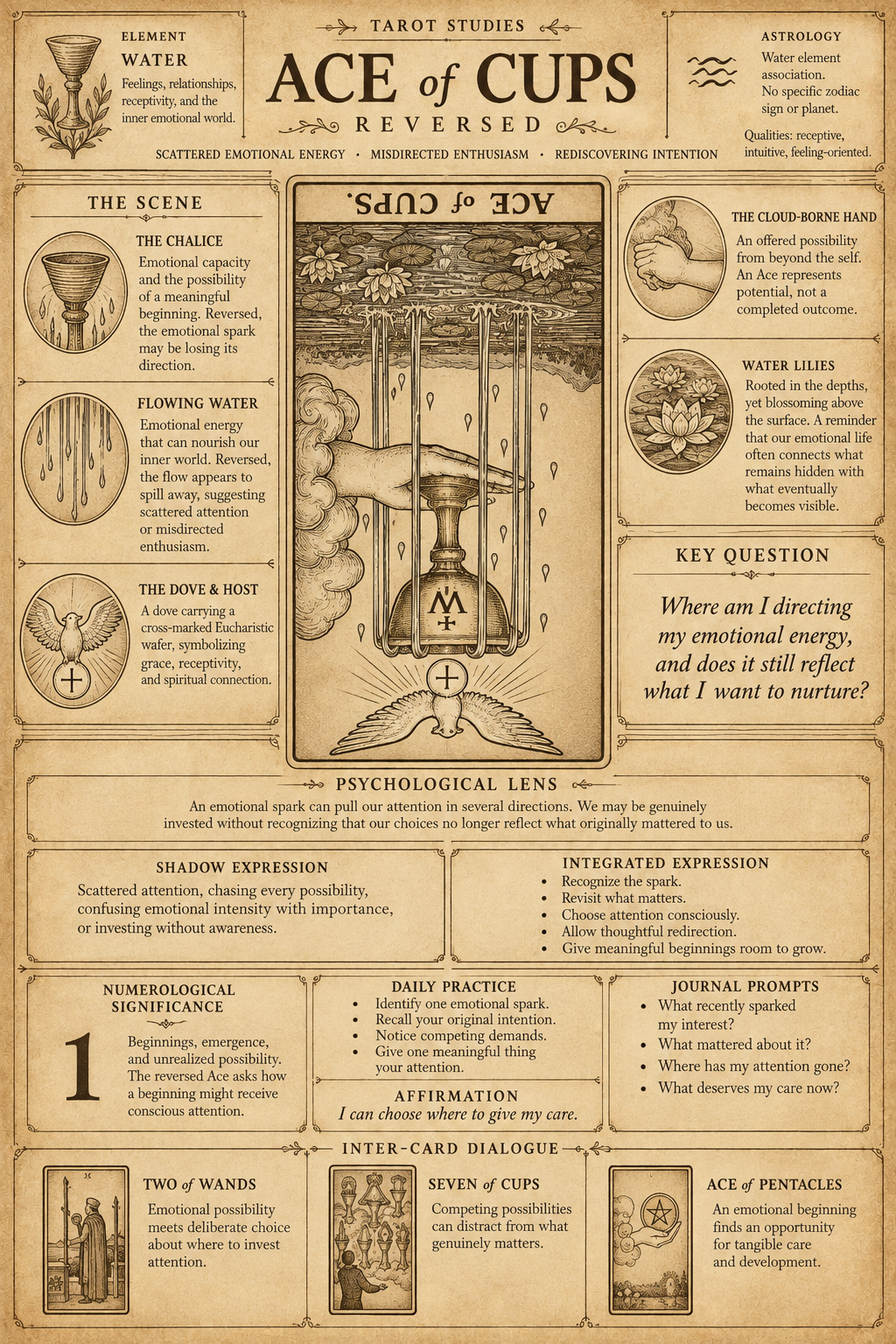
Ace of Cups Reversed|Today’s Insight and Intention
When emotional potential loses its direction
There is something exciting about a new beginning, especially when it involves something we genuinely care about. We get an idea, discover an interest, begin a relationship, or find ourselves enthusiastic about a possibility that wasn’t even on our radar yesterday.
And suddenly, we’re ready to pour ourselves into it.
The Ace of Cups captures that initial emotional spark. There is potential, excitement, and the sense that something meaningful might develop if we give it our attention.
But what happens when the Ace appears reversed?
I don’t necessarily see an empty cup. I see a cup whose contents may be going somewhere other than where we originally intended. We might still have plenty of enthusiasm, but we’re spreading it across several directions. Or perhaps we’re so determined to make something happen that we’ve stopped considering whether we’re still working toward the thing that mattered in the first place.
Very much a case of being busy watering everything in sight while forgetting which plant we actually wanted to grow.
The Ace of Cups Reversed invites us to look at the relationship between our emotional energy and our intentions. The potential may still be there.
The more interesting question is what we’re doing with it.
Traditional Foundation
Traditionally, the Ace of Cups represents emotional beginnings, love, compassion, receptivity, and the possibility of meaningful connection. As an Ace, it introduces the potential for something to develop rather than promising a particular outcome. It is the beginning of an emotional experience, not necessarily the completed story.
In the Rider-Waite-Smith illustration, created by Pamela Colman Smith, a hand emerges from a cloud holding a large chalice. Water flows from the cup into a pool below, where water lilies grow. Above the chalice, a dove descends carrying a cross-marked Eucharistic Host, connecting the imagery to Christian symbolism of grace and communion.
The hand emerging from the cloud suggests an offering, something available to receive but not yet fully understood. The chalice provides a vessel for that offering, while the flowing water introduces movement, abundance, and emotional expression. There is a relationship between receiving something meaningful and allowing it to become part of our experience.
The water lilies add another layer to this symbolism. Their flowers emerge from the water,

suggesting that growth can develop from experiences and emotions that exist beneath our immediate awareness. The imagery encourages us to consider not only what we feel but also what those feelings might help us recognize or develop.
When the Ace appears reversed, the familiar image changes orientation. The cup that once appeared ready to receive now seems to be pouring downward. This creates an interesting symbolic shift. The emotional potential represented by the Ace has not necessarily disappeared, but its expression, direction, or availability may deserve closer attention.
Traditional reversed interpretations include instability, change, and questions of emotional sincerity. Contemporary interpretations often explore emotional blocks, difficulty receiving affection, or exhaustion. Each offers a different way of understanding what happens when the natural flow of emotional experience becomes complicated.
But there is another possibility worth considering.
The reversed Ace may represent emotional energy that is still present but no longer moving toward its original intention. We might be enthusiastic, invested, and actively pursuing something while gradually losing sight of what made it meaningful in the first place.
The cup hasn’t necessarily lost its significance. We may simply need to reconsider where its contents are going.
We may simply need to reconsider where its contents are going.
Sometimes the Struggle Is…
Sometimes the struggle is:
- Feeling excited about several possibilities and having difficulty choosing where to begin.
- Starting something meaningful, then becoming distracted by everything surrounding it.
- Confusing emotional intensity with genuine importance.
- Continuing to invest in something because we’ve already invested so much.
- Feeling responsible for every person or possibility that asks for our attention.
- Becoming so focused on making something happen that we forget why we wanted it.
- Mistaking a change in direction for a failure to follow through.
None of these experiences automatically means our original enthusiasm was misplaced. Sometimes our interests change because we’ve learned something. Sometimes an unexpected opportunity genuinely deserves our attention.
But sometimes we’re simply responding to whatever feels most urgent, interesting, or emotionally compelling in the moment.
And those aren’t always the same things as what matters most to us.
The Key Question
This card asks an important question:
Where am I directing my emotional energy, and does it still reflect what I want to nurture?
It’s worth noticing that this question doesn’t ask whether we’re doing enough, caring enough, or working hard enough.
We can be incredibly invested in something and still be moving away from our intention. We can spend time, effort, and emotional energy without giving meaningful attention to the thing we originally hoped to develop.
The Ace of Cups Reversed encourages us to examine that difference without immediately judging ourselves for it.
What sparked our interest in the first place? What did we hope would grow from that beginning? And how closely do our current choices reflect those original intentions?
The answers may reveal that we’re exactly where we need to be. They may also show us that something deserves a thoughtful adjustment.
Either way, awareness gives us a choice.

That Distinction Matters
There is a difference between losing enthusiasm and losing direction.
When enthusiasm disappears, we may need to reconsider whether something still matters to us. But when direction becomes scattered, the original interest may be very much alive. We’re simply giving pieces of our attention to so many competing demands that nothing receives the care we intended.
The reversed Ace doesn’t have to represent a shortage of emotional energy. Sometimes it reflects an abundance that hasn’t found a meaningful place to settle.
And there is another distinction worth considering: changing direction isn’t always the same as abandoning an intention.
Sometimes we discover a better approach. Sometimes new information changes our understanding of what we want. Growth occasionally requires us to reconsider plans that once made perfect sense. The question is whether we’re making those changes consciously or simply following whichever possibility happens to capture our attention next.
One is thoughtful redirection. The other can leave us wondering how we ended up so far from where we meant to go.
The Ace of Cups Reversed asks us to recognize the difference.
The Hidden Gift
There is also something deeply liberating hidden inside this card. We don’t have to give our emotional energy to everything that asks for it, and recognizing that can change how we approach the things we care about.
That might sound obvious until we consider how often enthusiasm becomes obligation. We get excited about an idea and suddenly feel responsible for every possible version of it. We care about someone and begin believing that caring requires us to respond to every need. We discover something meaningful and turn it into a collection of expectations that barely resemble what attracted us in the first place. Apparently, even our enthusiasm can develop an administrative department.
[Insert Ace of Autumn Cups from Seasons of the Witch: Autumn Tarot here]
The reversed Ace offers an opportunity to reconsider those expectations. We can care deeply without committing ourselves to every possibility, and we can recognize that something is worthwhile without deciding it deserves our attention right now. We can even acknowledge that an original intention has changed without treating that discovery as a personal failure.
The gift is not simply learning to hold on to emotional energy. It is recognizing that we have some choice about where that energy goes, how much of ourselves we invest, and whether our efforts still reflect what matters to us. Sometimes that conscious choice is exactly what allows a meaningful beginning to develop into something more substantial.
Bringing the Ace of Cups Reversed Into Your Day
Today may not be about finding another source of inspiration, making a dramatic change, or convincing ourselves to become more enthusiastic. It may simply be about noticing where our attention has gone and deciding whether that’s where we want it to remain. Sometimes we become so occupied with everything we’re doing that we forget to consider whether those efforts are still supporting what we originally wanted to accomplish.
We might revisit a project that originally excited us and ask what made it meaningful before it became complicated. We might recognize that we’re saying yes to too many things because each one seems worthwhile on its own. Or we might discover that we’re continuing down a particular path because we’ve already started, even though our priorities have changed. None of these realizations automatically requires a dramatic decision, but each offers an opportunity to become more intentional about where we’re investing our energy.
There is no requirement to resolve all of that today.

Instead, consider choosing one thing that deserves your care and giving yourself a moment to remember why it mattered, what you hoped would grow from it, and what kind of attention would genuinely support that growth. Then take one manageable step in that direction, not because everything else is unimportant, but because meaningful attention requires some degree of choice.
The Ace of Cups Reversed reminds us that emotional investment and meaningful progress are not necessarily the same thing. We can be busy, enthusiastic, and genuinely committed while still needing to reconsider where our efforts are going. Sometimes the most useful thing we can do is make sure we’re nurturing what we actually want to grow.
Until Next Time
The Ace of Cups Reversed does not ask us to stop caring or to treat our enthusiasm as something that needs to be controlled. It asks us to become more conscious of the relationship between what moves us emotionally and what we choose to nurture. There is nothing wrong with discovering new interests, changing direction, or recognizing that something we once wanted no longer holds the same importance. The challenge is noticing when those changes are intentional and when we’ve simply become distracted by everything competing for our attention.
And honestly? Sometimes we don’t need a bigger cup or more water. We just need to remember what we intended to water in the first place.
Until next time…
Misti
Sources & Further Study
A. E. Waite, The Pictorial Key to the Tarot (1911). A primary historical reference for the Rider-Waite-Smith imagery and Waite’s published card interpretations.
Read The Pictorial Key to the Tarot on Wikisource
Biddy Tarot, Ace of Cups Tarot Card Meanings. A contemporary overview of upright and reversed interpretations, including emotional beginnings, receptivity, and emotional blocks.
Read Biddy Tarot’s Ace of Cups meanings
Tina Gong, Labyrinthos, Ace of Cups Meaning. Additional contemporary interpretations of the Ace of Cups and its reversed expression.
Read Labyrinthos’s Ace of Cups interpretation
A note on interpretation: The emphasis on scattered or misdirected emotional potential is a Tarot Studies interpretation of the reversed imagery. It is not presented as Waite’s original definition or as the only valid meaning of the card.
Previous:
Next: