
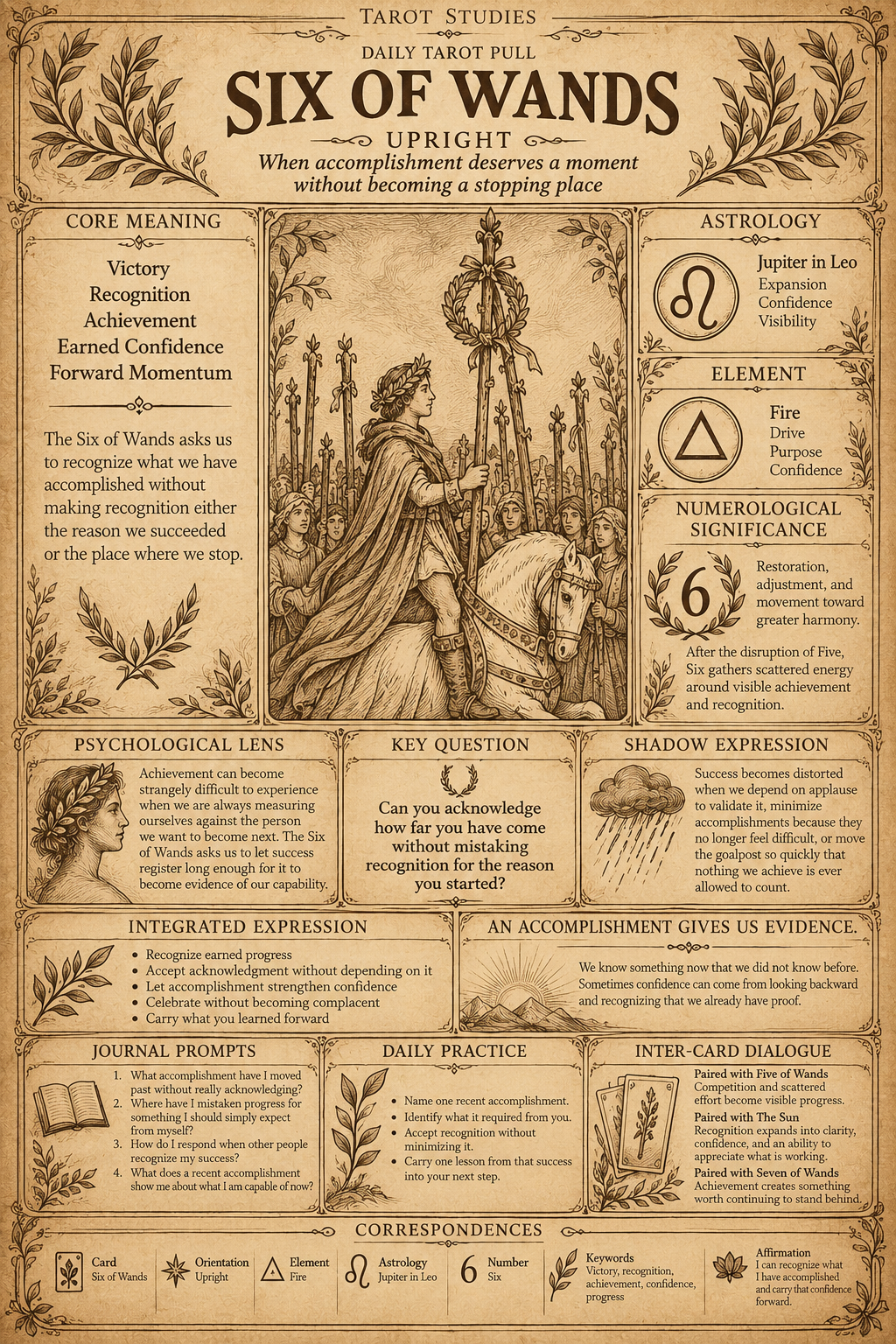
Daily Tarot Pull: Six of Wands
When accomplishment deserves a moment without becoming a stopping place
There should be a considerable feeling of a job well done when the Six of Wands appears. There should be a little celebration of accomplishment, a moment to recognize that the work paid off and that something has been achieved. You made it somewhere. That matters.
But I have always had a slightly complicated relationship with this part of the Six of Wands.
I am not particularly good at making my successes or goals something that need to be recognized by other people. My goals tend to be very personal endeavors, probably because most of the time I am only competing with myself. I don’t need much outside validation to know whether I have accomplished what I set out to do.
And that makes me look at the figure in the Six of Wands a little differently.
He is riding through the crowd with the victory wreath raised above him. People are there to recognize what has happened. Traditionally, that recognition is an important part of the card. But when I look at him, part of me is already wondering: Okay, but where are you going next?
Because recognition can become a holding place. Sometimes it can even become a stalling place.
There is nothing wrong with stopping long enough to say, I did that. In fact, some of us probably need to get considerably better at it. Accomplishment deserves acknowledgment, even when nobody else is standing around waving a wand and cheering.
But I also don’t want to spend so much time standing beside what I have already accomplished that I forget there is still road ahead of me.
For me, the Six of Wands feels less like reaching the finish line and more like realizing I have made it into the second half. Something worked, and I should probably give myself credit for it.
And then?
I still have work to do.
Traditional Foundation
Traditionally, the Six of Wands is associated with victory, triumph, good news, and expectations successfully realized. Modern interpretations often extend that victory into themes of recognition, confidence, achievement, and acknowledgment.
In the Rider-Waite-Smith image, a figure rides through a crowd on a white horse. He carries a wand topped with a laurel wreath, while another wreath rests on his head. Around him are figures on foot carrying wands of their own. The scene gives us something the earlier Five of Wands did not: instead of everyone appearing caught up in competing movements, attention has gathered around one central figure.
That public recognition matters to the way the card has come to be interpreted. This is not simply the private satisfaction of knowing you did something well. The Six of Wands explores what happens when achievement becomes visible. Someone else sees the effort, the progress, the leadership, or the result.
But there is another detail in the artwork that becomes especially interesting when we connect it to today’s pull. The rider is being celebrated, but the scene has not become static.

He is still mounted on the horse, still moving through the crowd, carrying the symbols of victory with him. The celebration and the movement are happening at the same time.
That changes the way I think about victory in this card. The Six of Wands sits at six, not ten. Within the numbered sequence of the Wands, Seven, Eight, Nine, and Ten still follow.
From a Tarot Studies perspective, that placement matters. The accomplishment represented here exists within a larger progression.
That does not make the victory less meaningful. If anything, it gives it a different purpose. The Six of Wands can offer a moment to recognize what has been accomplished without requiring us to confuse that accomplishment with completion.
Maybe the wreath is not where we stop.
Maybe it is something we are allowed to carry with us.
Sometimes the Struggle Is
Sometimes the struggle is:
- accomplishing something and immediately moving the goalpost
- feeling uncomfortable when other people recognize your success
- believing private satisfaction should be enough, even when acknowledgment would actually feel good
- treating celebration as wasted time
- measuring yourself almost entirely against your previous performance
- accepting praise without minimizing what it took to get here
- knowing the difference between staying motivated and never allowing yourself to arrive anywhere
- letting a victory be meaningful without needing it to become the final destination
There is independence in being able to recognize your own success without depending entirely on outside validation. But there can also be a strange trap hidden inside that independence.
If I am always competing with myself, then there is always another version of myself waiting a few steps ahead.
The finish line moves.
That can be incredibly motivating. It can keep us learning, building, improving, and asking what comes next. But it can also mean that accomplishments barely have time to register before they become evidence that we should be capable of doing even more.
The Six of Wands interrupts that cycle for a moment. Not necessarily because we need to stop progressing, but because constantly moving the goalpost can make it remarkably difficult to tell when we have actually reached one.
The Key Question
The Six of Wands asks an important question:
Can you acknowledge how far you have come without mistaking recognition for the reason you started?
There is a difference between needing applause in order to believe we have succeeded and allowing ourselves to receive acknowledgment when we genuinely have.
For someone who is primarily motivated from within, it can be easy to dismiss the celebration altogether. I know what I accomplished. I know what it took. That’s enough. Now, what’s next?
And sometimes it is enough.
But the Six of Wands suggests that receiving recognition does not have to mean becoming dependent on it. Nor does celebrating an accomplishment mean we have lost our momentum. We can appreciate the wreath without building a house underneath it.
Maybe the harder practice is learning to hold both.
I can be proud of what I have accomplished, and I can still want to accomplish more.

That Distinction Matters
For those of us who are internally motivated, the more complicated question may not be whether other people recognize our accomplishments at all. It may be whether we allow ourselves to recognize them before moving the standard again.
Success can become a holding place if we become too attached to what we have already accomplished. But constantly moving forward creates its own kind of stalling place when nothing we accomplish is ever allowed to count for very long.
Every achievement becomes the new minimum expectation. Yesterday’s “I can’t believe I actually did that” has a suspicious habit of becoming today’s “Well, obviously I should be able to do that.”
What once required effort becomes something we tell ourselves we should be able to do. What once felt difficult becomes ordinary. Eventually, we can become so focused on the person we are trying to become that we stop noticing the person we have already become. The Six of Wands offers another possibility.
Take the victory. Let yourself know that you earned it. Let other people celebrate with you if they want to, and carry the wreath for a while. Being proud of what you have done and wanting more from yourself are not opposing ideas. Recognition does not have to become the destination.
It can simply tell us where we are.
The Hidden Gift
There is also something deeply affirming hidden inside the Six of Wands. An accomplishment gives us evidence.
Not evidence that everything from this point forward will be easy, or that every decision we make will work out beautifully. The Six of Wands is still only the Six. The cards that follow will bring their own challenges. But we know something now that we did not know before.
We know we can do this.
We have evidence of our effort, our growth, our persistence, or our ability to figure something out along the way. That matters because confidence does not always have to come from convincing ourselves that we are capable. Sometimes confidence can come from looking backward and recognizing that we already have proof.
That may be especially important for those of us who tend to move quickly from one goal to the next. If every accomplishment immediately becomes yesterday’s news, we lose the opportunity to let our own history strengthen us.
The Six of Wands gives us a moment to collect that evidence. We do not have to merely hope we are becoming more capable.
Sometimes we can look at what we have already done and say, there’s the proof.
Bringing the Six of Wands Into Today
Today may not be about throwing yourself a victory parade or waiting for someone else to notice everything you have accomplished.
It may simply be about recognizing one thing you have done well before immediately asking yourself what still needs to be done.
That might mean finishing something and actually allowing yourself to feel finished for a moment. It might mean accepting a compliment without explaining why the accomplishment really was not that impressive. It might mean looking at something you can do easily now and remembering how difficult it once felt.
For those of us who are always trying to outperform yesterday’s version of ourselves, there is another possibility worth considering: Yesterday deserves a little credit too.
That earlier version of you did some of the work that made today’s version possible.

So today, take inventory of one success. Name what you did, consider what it required from you, and let yourself enjoy it without immediately adding a but. Then ask what that accomplishment has taught you about what you are capable of doing next.
The Six of Wands does not require us to stop moving in order to celebrate. Sometimes acknowledgment is simply how we make sure our progress does not disappear behind us.
Until Next Time
The Six of Wands does not ask us to turn every accomplishment into a finish line. It asks us to recognize when we have done something worth recognizing.
There will always be another goal. Another project. Another challenge waiting farther ahead. For some of us, that next thing is probably already sitting in the back of our minds tapping its watch.
But moving forward does not require us to dismiss what came before.
Maybe that is the balance I need from the Six of Wands today. I do not need the crowd to convince me that I have succeeded, but I also do not need to hurry past success simply because I am already thinking about the second half.
I can acknowledge what I have done.
I can be proud of it.
And then I can keep going.
And honestly?
The wreath was never meant to become a resting place. It was meant to remind us what we are capable of carrying into whatever comes next.
Until Next time…
Misti
Sources & Further Study
Waite, Arthur Edward. The Pictorial Key to the Tarot. 1911.
Waite’s original discussion of the Six of Wands provides the historical foundation for the traditional interpretation used in this article, including the victorious horseman, laurel imagery, and associations with triumph, good news, expectation, and desire fulfilled. The volume also credits Pamela Colman Smith with the 78 card designs.
The Rider-Waite-Smith Tarot, illustrated by Pamela Colman Smith.
The Six of Wands itself serves as the primary visual source for the discussion of the mounted figure, laurel wreaths, surrounding figures, and movement within the scene.
The historical sources give us the card’s imagery and traditional associations. The discussion of internal motivation, moving personal goalposts, recognition versus validation, and accomplishment as evidence of capability represents the Tarot Studies interpretive lens developed from that foundation.
Those reflections are not presented as meanings prescribed by Waite or Smith. They are an exploration of what the Six of Wands can help us notice about our own relationship with achievement, acknowledgment, and what happens after we have done something worth celebrating.