
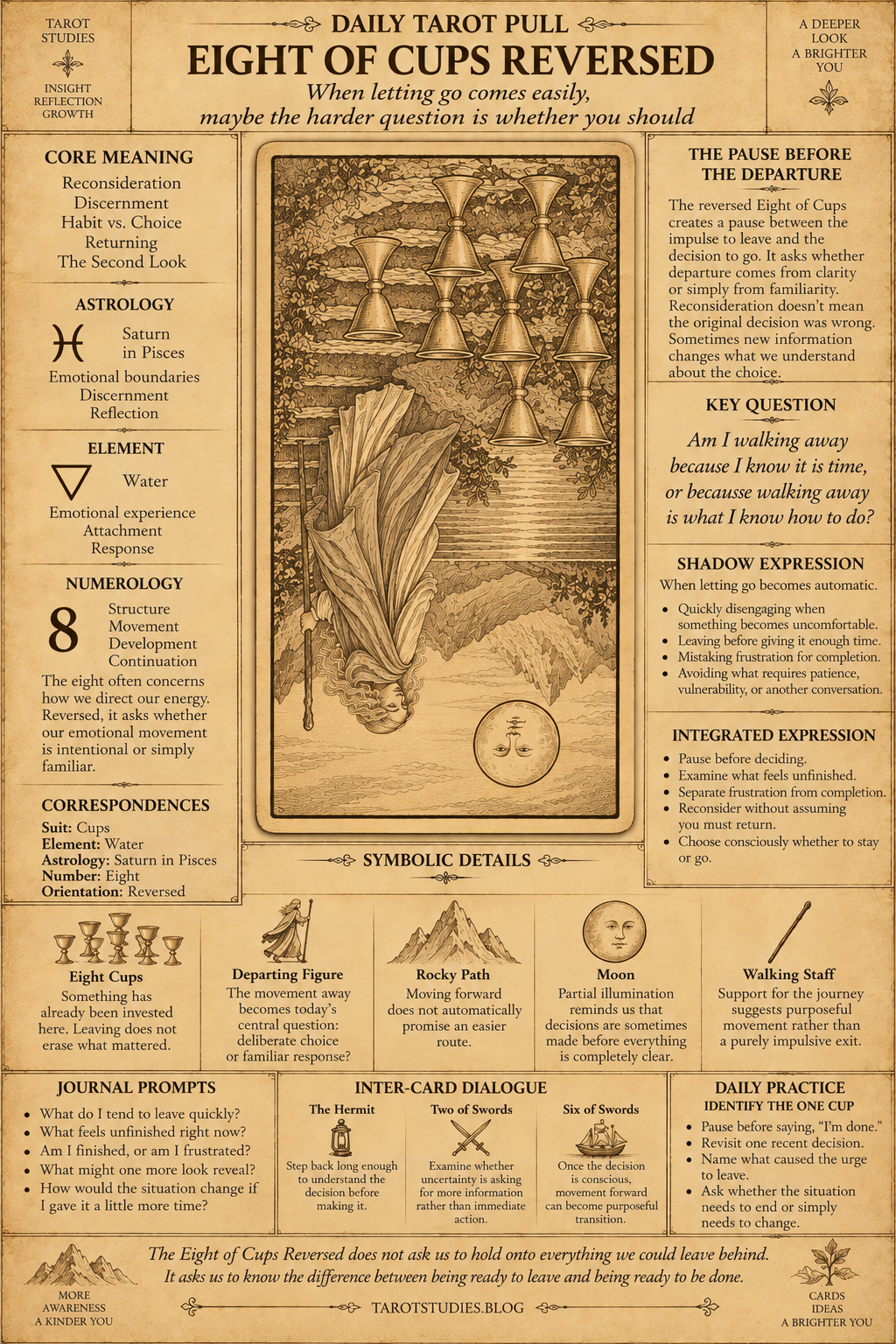
Daily Tarot Pull: Eight of Cups Reversed
When letting go comes easily, maybe the harder question is whether you should
My first response when I turned over the Eight of Cups Reversed this morning was, “Ah, darn it.”
Not because I particularly dislike the Eight of Cups. Actually, quite the opposite. This card has shown up again within about a week, so we’re not quite to card-stalking territory, but we are getting close enough that I probably need to pay attention.
Before deciding what to make of it today, I went back and reviewed the last Eight of Cups Reversed pull. That reading spent quite a bit of time exploring the difference between genuinely being ready to let something go and simply wanting to stop feeling uncomfortable about it. Before walking away, maybe we need to understand exactly what we are trying to leave behind.
But as I reread it, something else occurred to me.
I really, really enjoy the Eight of Cups.
There is something about that figure turning away from those carefully stacked cups and heading toward the mountains that works remarkably well with my natural temperament. When I decide something needs to go, I can usually just… whoo. Let it go. Walk away. Move forward. And quite possibly never think about it again.
There are certainly times when that is a strength. Not everything requires another round of analysis, another conversation, another chance, or six months of emotional committee meetings before we are allowed to move on.
But strengths have a funny way of becoming habits when we stop examining them.
So maybe the Eight of Cups Reversed isn’t asking me whether I am capable of letting go. I already know the answer to that. Maybe today it is asking something considerably less comfortable:
Am I sometimes too quick to decide that letting go is the answer?
Because there is a difference between knowing when to walk away and simply being very comfortable with walking away.
And apparently the Eight of Cups Reversed thought that distinction deserved another visit.
Traditional Foundation
In the Rider-Waite-Smith Eight of Cups, a cloaked figure has turned away from eight cups arranged in the foreground and is walking toward a rocky, mountainous landscape. A staff supports the journey, while the moon hangs above the scene.
Traditionally, the Eight of Cups is associated with withdrawal, departure, emotional transition, and recognizing that something we have invested in may no longer be enough. The figure leaves the cups standing rather than destroying them. Whatever those cups represent, they existed. They mattered. Something was built here.
That detail becomes especially important when we start thinking about leaving too quickly, because the artwork itself doesn’t necessarily look impulsive. This isn’t someone dramatically flipping the table, kicking over the cups, and storming off while everybody else wonders what just happened.
The figure simply leaves, and the landscape ahead doesn’t look particularly easy. There are rocks, water, uneven ground, and mountains in the distance. Moving on may be necessary, but the card doesn’t pretend that doing so automatically makes everything simpler.

Turn the card upside down, and our relationship with that departure changes.
The Eight of Cups Reversed can point toward difficulty leaving, returning to something we thought we had left behind, reconsidering a departure, or questioning whether moving on is actually the right response. But reversal doesn’t have to mean that leaving was a mistake. It can simply interrupt the movement long enough for us to look again.
That interruption feels particularly important today.
If leaving is already difficult for you, the reversed Eight of Cups may raise questions about what keeps pulling you back. But if letting go comes relatively easily, the card can raise almost the opposite question.
What happens when the person who is perfectly capable of leaving pauses long enough to ask whether they have actually finished?
Maybe there is nothing left to do. Maybe those cups really have given everything they can give.
But maybe one of them deserves another look before we disappear over the mountain.
Sometimes the Struggle Is
Sometimes the struggle isn’t figuring out how to let go. Sometimes we’re actually pretty good at that part.
The harder work may be recognizing when moving on has become our default response instead of a carefully considered decision. There is a certain confidence that comes with knowing, I don’t have to stay here. And sometimes that confidence is exactly what allows us to make healthy choices.
But being capable of leaving doesn’t mean every uncomfortable situation needs an exit plan.
Sometimes the struggle is:
- deciding quickly that something isn’t worth the effort
- mistaking discomfort for evidence that something isn’t working
- leaving before giving a situation enough time to develop
- assuming that reconsidering a decision means we made the wrong decision
- protecting our independence so fiercely that we don’t notice when it becomes avoidance
- being better at closing doors than sitting with uncertainty
- moving forward before asking whether there is anything unfinished behind us
There is also a strange vulnerability in reconsidering something once we have decided we are done with it.
Being decisive can feel reassuring. Turning around and looking again can feel considerably messier. It might require admitting that we don’t have all the information yet. It might mean having another conversation, giving something more time, changing our approach, or acknowledging that what we dismissed still matters to us.
None of those things necessarily mean we should stay. They simply mean we haven’t confused the ability to leave with the wisdom of knowing when to do it.
And for someone who finds letting go relatively easy, that may be exactly where the Eight of Cups Reversed becomes uncomfortable enough to be useful.
The Key Question
This card asks an important question:
Am I choosing to walk away because I know it is time, or because walking away is what I know how to do?
Those can look almost identical from the outside.
In both cases, we may stop investing energy. We may close the door, change direction, end the conversation, abandon the plan, or simply decide that whatever was taking up so much mental space yesterday isn’t getting any more of it today.
The difference is what happens before that decision.
Discernment requires us to look at what is actually in front of us. Have I given this enough time? Have I communicated what needs to be communicated? Is the problem the situation itself, or am I frustrated because the situation requires something from me that doesn’t come naturally? Is there another approach worth considering?
Habit doesn’t necessarily ask those questions. Habit already knows the route.
The Eight of Cups Reversed creates a pause between the impulse to leave and the decision to actually go. Maybe the purpose of that pause isn’t to convince us to stay. Maybe it’s simply to make sure that whatever we choose next is actually a choice.

That Distinction Matters
We tend to pay attention to the things that are difficult for us. If we struggle with boundaries, we work on boundaries. If we have trouble leaving situations that no longer serve us, we learn to recognize when enough is enough. If we hold onto everything long past its expiration date, the Eight of Cups can become a lesson in trusting ourselves enough to move forward.
But we don’t always examine our strengths with the same suspicion. When something comes naturally, we are more likely to assume we’re doing it well.
The ability to release something without endlessly replaying it can be incredibly healthy. It can keep us from pouring energy into situations simply because we’ve already invested energy in them. It can help us accept that not everything needs to be repaired, recovered, or carried forward.
The problem comes when that strength stops being something we consciously choose. Leaving before resentment builds is different from leaving because frustration showed up. Recognizing that something no longer fits is different from deciding it doesn’t fit because making it work would require
patience, vulnerability, compromise, or another uncomforable conversation.
The Eight of Cups Reversed doesn’t have to drag the figure all the way back to those cups and insist that they stay there. It can simply interrupt the journey long enough for the figure to turn around and look again. Is there actually something unfinished? Is there something worth approaching differently?
Or, after looking carefully, do you still know that it is time to go?
Either answer can be valid.
The important part is knowing that you chose it.
The Hidden Gift
There is also something deeply liberating hidden inside the Eight of Cups Reversed. We are allowed to reconsider.
That sounds simple, but reconsideration can be surprisingly difficult once we have made a decision. There is often a little pride attached to being decisive. We said we were done. We chose the direction. We started walking. Turning around can feel suspiciously like admitting we got something wrong. But reconsidering a decision isn’t the same thing as reversing it.
Sometimes we look back and realize there really is something unfinished. Maybe another conversation needs to happen. Maybe we acted on incomplete information. Maybe the problem wasn’t what we originally thought it was. Maybe something deserves more time. And sometimes we look back and think, Nope. Still good with this decision. That is useful information too.
The gift of the Eight of Cups Reversed may be the freedom to examine a decision without immediately putting that decision on trial. We don’t have to defend it simply because we made it, and we don’t have to overturn it simply because we’re willing to question it. That creates room for something more useful than certainty: discernment.
We can return mentally to those eight cups without automatically picking them back up. We can examine what we left, what it meant, what we learned, and whether anything has changed. Then we get to choose again.
There is a particular kind of confidence in being able to say, I made the best decision I could with what I knew then. Now I know something more, so I’m willing to look again. For a card so closely associated with walking away, perhaps one of the Eight of Cups Reversed’s quieter gifts is reminding us that changing our minds and examining our choices are not signs that we don’t trust ourselves.
Sometimes they are exactly what self-trust looks like.
Bring the Eight of Cups Reversed Into Your Day
If reconsideration can be part of self-trust, then today’s practice can be surprisingly small: pause before turning an impulse into a decision. Today may not be about going back. It may simply be about looking back long enough to understand why you left, or why you’re thinking about leaving in the first place.
That doesn’t require reopening every closed door or digging through decisions that have already been settled. We could make ourselves absolutely bonkers doing that. Some things are finished, some decisions were sound, and some cups can remain exactly where we left them. Instead, the Eight of Cups Reversed may be useful when we notice that familiar impulse to say, I’m done.
Before acting on it, we can give ourselves a little space to ask what is actually happening. Am I finished, or am I frustrated? Has this genuinely stopped working, or has it become harder than I expected? Have I given it enough time? Have I said what needs to be said? Is there another approach I haven’t tried because ending this feels easier?

Today could be about:
- waiting before making a decision that doesn’t actually need to be made immediately
- having one more conversation before deciding the conversation is over
- noticing when frustration creates an urge to abandon something
- asking whether the situation needs to end or simply needs to change
- revisiting a decision without assuming you have to reverse it
- giving something enough time to show you what it actually is
- recognizing when letting go is a conscious choice and when it is simply familiar
There is an important difference between dragging something out long after we know it is finished and giving something enough attention to know whether it is finished. For some of us, the Eight of Cups Reversed may simply ask us to slow down at the moment when leaving feels easiest and make sure we’re not using one of our strengths to avoid something that deserves a little more of our attention.
Then, if it’s still time to go, we can go.
Only this time, we know why.
Until Next Time
There will always be things worth leaving behind. Relationships change. Plans stop fitting. Goals evolve. Situations reach their natural ending. Sometimes recognizing that something is finished and allowing ourselves to move forward is one of the healthiest choices we can make. But today I’m reminded that the things we are good at deserve examination too.
If walking away comes naturally, there may be wisdom in occasionally turning around before disappearing over the mountain. Not because every cup needs to be recovered, and certainly not because leaving means we failed to try hard enough. Sometimes the second look simply confirms what we already knew. Sometimes it shows us something we missed. Either way, we have made room for choice instead of relying on habit.
The Eight of Cups Reversed does not ask us to hold onto everything we could leave behind. It asks us to know the difference between being ready to leave and being ready to be done.
And honestly?
Sometimes self-trust isn’t knowing exactly when to walk away. Sometimes it’s trusting yourself enough to turn around, look one more time, and then decide.
Until next time…
Misti
Sources & Further Study
Waite, A. E. The Pictorial Key to the Tarot. William Rider & Son, 1910.
Waite’s original companion text for the Rider-Waite-Smith Tarot provides the historical foundation for the Eight of Cups. His description emphasizes a figure leaving behind something that had previously held importance, while his original reversed meaning is notably different from many contemporary interpretations: “Great joy, happiness, feasting.”
Smith, Pamela Colman. Eight of Cups, Rider-Waite-Smith Tarot, 1909.
The original artwork provides the visual foundation for this Daily Pull: eight upright cups remain behind as a cloaked figure travels away through a landscape of water and rocky terrain beneath the moon. The image is especially useful for studying departure as an action rather than reducing the card to a memorized keyword.
Biddy Tarot. “Eight of Cups Tarot Card Meanings.”
For a contemporary comparison, modern reversed interpretations frequently frame the Eight of Cups around the question of whether to stay or leave, including reconsidering a departure or deciding whether something deserves another attempt. This Daily Pull develops that idea through a different psychological question: what happens when leaving itself has become the familiar response?
A Note on the Reversal
Tarot meanings have never been quite as fixed as a guidebook can make them appear. In The Pictorial Key to the Tarot, A. E. Waite gave the reversed Eight of Cups the rather unexpected meaning of “Great joy, happiness, feasting.”Contemporary RWS-based interpretations often take a different direction, exploring hesitation, return, reconsideration, and the tension between staying and leaving. Wikisource
For this Daily Pull, I’m approaching the reversal as a changed relationship to the upright card’s existing symbolism. The figure who ordinarily moves away gives us an opportunity to pause that movement and ask whether departure comes from discernment or simply from familiarity.
That is the Tarot Studies question at the center of today’s reading..
Next: Knight of Cups