
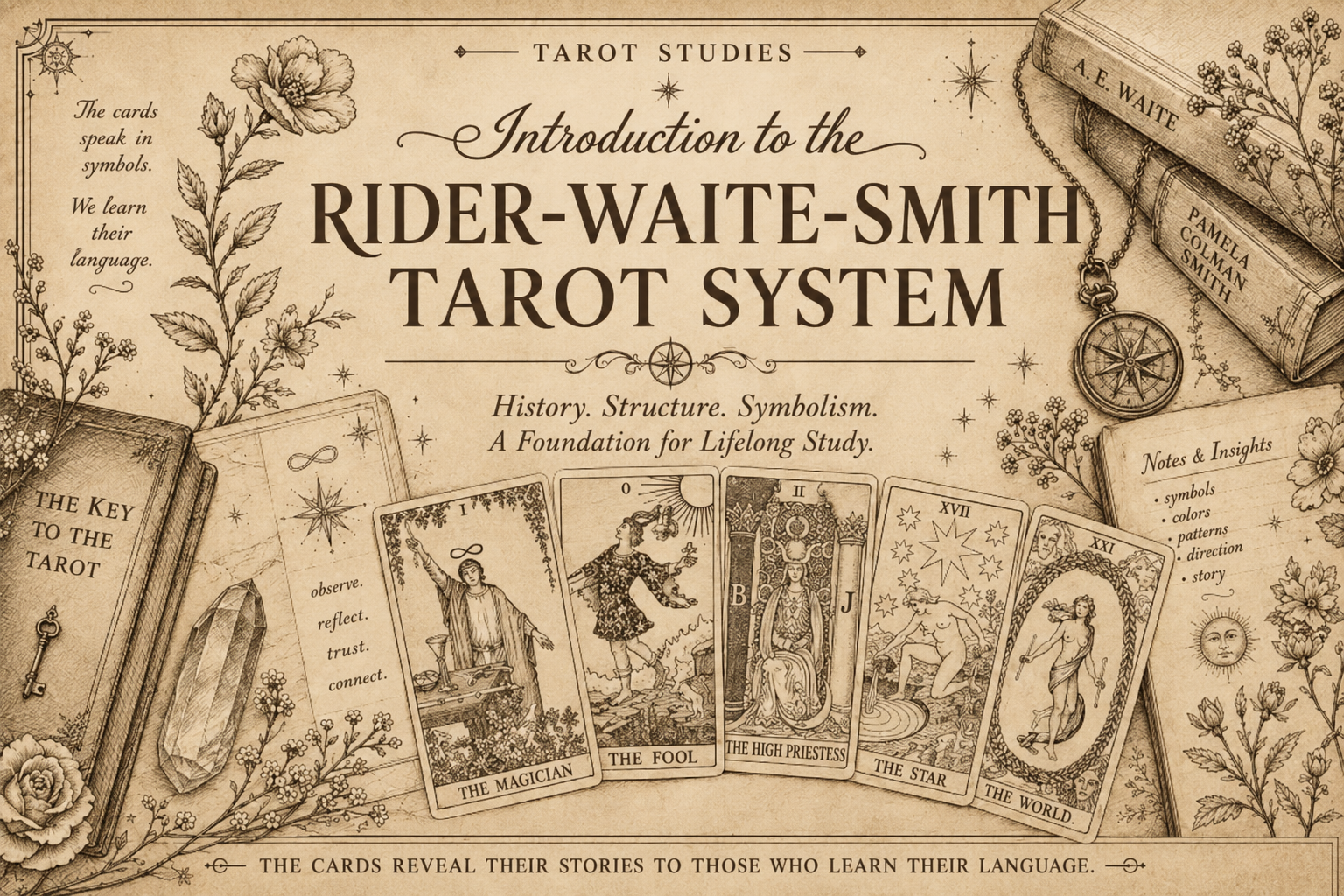
What Is the Rider-Waite-Smith Tarot System?
Post 2 of the Rider-Waite-Smith Foundations Series
Before you can read Tarot fluently, it helps to understand the language that shaped modern Tarot. Throughout this series, we’ll explore the history, structure, symbolism, and visual storytelling of the Rider-Waite-Smith system, building a foundation that will support every deck you study afterward.

When I first began learning Tarot, I assumed the hardest part would be remembering what seventy-eight cards meant. I imagined that if I memorized enough keywords, spent enough time with my guidebooks, and practiced often enough, everything else would naturally fall into place.
It didn’t take long to discover that memorization wasn’t the hardest part at all.
The real challenge was understanding why everyone seemed to be reading the same cards so differently.
Like many people discovering Tarot for the first time, I created what I imagined was the perfect place to study. Candles flickered nearby, soft music played in the background, crystals surrounded my reading space, and an ever-growing stack of guidebooks sat within easy reach. I moved back and forth between the cards and the books, convinced there had to be one correct definition hidden somewhere in those pages. Yet every author seemed to describe the same card a little differently. Some emphasized psychology, others spirituality, while still others focused on fortune telling or symbolism. Before long, I found myself wondering if perhaps I had chosen the wrong deck altogether.
Convinced the problem was the deck rather than my understanding, I did what many new readers do. I bought another deck, and then another. Each one was beautiful. Each one promised a fresh perspective. Yet every new purchase also introduced another collection of artwork, another symbolic language, and another visual world to learn. Instead of becoming more confident, I became increasingly overwhelmed.
Looking back, I realize I wasn’t struggling because Tarot was too complicated. I was struggling because I didn’t yet understand what I was actually learning.
I wasn’t memorizing seventy-eight individual cards.
I was learning an entire symbolic system.
That realization eventually led me back to the deck where countless readers begin their Tarot journey: the Rider-Waite-Smith Tarot.
More Than a Deck
Returning to the Rider-Waite-Smith deck changed more than the cards I was using. It changed the questions I was asking.
Instead of wondering whether I owned the right deck, I began wondering what made this particular deck so influential in the first place. The more time I spent with it, the more I realized that the Rider-Waite-Smith was far more than a collection of illustrated cards.
It is a complete visual language.
Every color, gesture, landscape, object, number, and relationship between the figures contributes to a larger symbolic conversation. Once you begin recognizing that language, the cards stop feeling like seventy-eight isolated pictures and begin revealing a connected system of ideas.
This is one of the reasons the Rider-Waite-Smith deck has remained the foundation of modern Tarot for well over a century. Even readers who eventually explore the Tarot de Marseille, the Thoth Tarot, or contemporary artistic decks often discover that much of their understanding can be traced back to the symbolic framework established here.
Learning the Rider-Waite-Smith system reminds me of learning to read music or becoming fluent in a new language. At first you recognize individual notes or words. With practice, you begin seeing patterns. Eventually those patterns become stories, and those stories begin connecting to one another. The cards stop feeling like isolated lessons and start revealing a larger conversation that stretches across the entire deck.
That shift changed everything about the way I approached Tarot.
It also changed the way I understood learning itself.
Why Is It Called the Rider-Waite-Smith Tarot?
One of the first surprises for many new readers is discovering that the name itself tells part of the deck’s story.
For many years, the deck was commonly known as the Rider-Waite Tarot. Today, however, many teachers intentionally use the full name, Rider-Waite-Smith (RWS), to recognize the contributions of the three people whose work brought the deck into existence.
Arthur Edward Waite developed the symbolic and esoteric framework for the deck. A scholar of mysticism and a member of the Hermetic Order of the Golden Dawn, Waite envisioned a deck that would communicate deeper spiritual ideas through symbolism rather than relying solely on traditional card meanings.

Pamela Colman Smith, an accomplished illustrator and theatrical artist, transformed those ideas into the artwork we still recognize today. Her contribution extended far beyond simply drawing the cards. Every card, including the numbered Minor Arcana, became a complete scene filled with movement, emotion, symbolism, and narrative. Once you begin studying her artwork closely, it becomes difficult to imagine modern Tarot without it. Her illustrations remain one of the primary reasons the Rider-Waite-Smith system continues to be so approachable for new readers more than a century later.
Finally, William Rider & Son, the London publishing company, printed and distributed the deck in 1909. Although Rider served as the publisher rather than the creative force behind the project, the company’s name became permanently associated with the deck through its publication.
Today, using the full name, Rider-Waite-Smith, not only acknowledges the collaborative effort behind one of Tarot’s most influential works but also gives Pamela Colman Smith the recognition her extraordinary artistic contribution deserves.
Why This Deck Became the Standard
Before the Rider-Waite-Smith deck appeared, many Tarot decks illustrated only the Major Arcana and the Court Cards with detailed scenes. The numbered Minor Arcana often consisted of little more than arrangements of cups, swords, wands, or coins, leaving much of their interpretation to established tradition.
Pamela Colman Smith changed that forever by transforming every numbered card into a story.

Rather than illustrating arrangements of suit symbols, she illustrated moments unfolding before the reader. Instead of five swords arranged in a pattern, readers encountered a figure gathering abandoned weapons after a conflict. Instead of six cups standing in neat formation, two children shared flowers in a quiet village scene. The artwork invited observation before memorization.
That single creative decision transformed how people learned Tarot.
Rather than asking, “What does this card mean?”, readers could begin asking a different question.
“What is happening here?”
That simple shift opened the door to intuition, symbolism, storytelling, and personal reflection. Readers weren’t abandoning traditional meanings. They were discovering them through observation.
For me, that question changed everything. It shifted my attention away from searching for perfect definitions and toward learning to see what the card was already showing me. Over time, I discovered that careful observation often revealed the heart of a card before I ever reached for a guidebook. The books didn’t become less valuable. They simply became companions to my own discoveries instead of replacing them.
The Rider-Waite-Smith deck isn’t simply teaching you the meanings of seventy-eight cards.
It is teaching you how to read a symbolic language.
That understanding becomes the foundation for everything that follows. Once you begin seeing the cards as an interconnected language rather than seventy-eight separate definitions, you’ll also begin to understand why the Rider-Waite-Smith system continues to influence so many modern Tarot decks and why it remains the starting point for generations of readers.

Why the Rider-Waite-Smith System Became the Foundation of Modern Tarot
Walk into almost any bookstore, browse an online Tarot shop, or spend a few minutes scrolling through social media, and you’ll quickly notice something interesting. The decks may look completely different from one another. Some are whimsical, others are dark and gothic, while many draw inspiration from mythology, fantasy, animals, or contemporary life. Every artist brings a unique vision to the cards, creating artwork that reflects a different style, culture, or perspective.
Yet beneath those artistic differences, many of them are quietly speaking the same visual language.
That language is the Rider-Waite-Smith system.
Whether the artwork depicts dragons instead of knights or woodland creatures instead of kings and queens, experienced readers can often recognize the familiar structure underneath. The symbolism may be reimagined, but the relationships between the cards, the progression of the suits, and the visual storytelling frequently trace their roots back to the Rider-Waite-Smith deck. Once you begin learning this system, you’ll start seeing its influence almost everywhere.
This is one of the reasons I encourage new readers to begin here. Learning the Rider-Waite-Smith system isn’t about limiting yourself to a single deck forever. It’s about learning a symbolic language that countless other decks continue to speak. Once you understand that language, exploring new decks becomes an adventure rather than starting over from the beginning each time.

A Revolutionary Way of Teaching Through Pictures
Today, it’s easy to overlook just how revolutionary this deck was when it first appeared in 1909. Modern Tarot readers are surrounded by richly illustrated decks, so it is easy to assume that Tarot has always looked this way. In reality, the Rider-Waite-Smith deck represented a remarkable shift in how people learned to read the cards.
Before its publication, many Tarot traditions illustrated the Major Arcana and Court Cards with detailed scenes, while the numbered Minor Arcana often displayed little more than arrangements of cups, swords, wands, or coins. Experienced readers could interpret those cards through established traditions, numerology, and elemental associations, but beginners were given very little visual guidance within the artwork itself.
Pamela Colman Smith changed that forever by transforming the numbered Minor Arcana into illustrated stories. Rather than arranging objects across the card, she created moments unfolding in time. Every illustration invited the reader to observe people, relationships, movement, emotion, and consequence before ever reaching for a guidebook.
Instead of simply seeing suit symbols, readers encountered scenes such as:
- A traveler pausing before setting out on a new journey.
- A child offering flowers to another child.
- A weary figure struggling beneath the weight of ten wands.
- Someone quietly slipping away with five swords while others remain unaware.
Suddenly, the cards became more than illustrations. They became stories waiting to be explored.
Rather than asking, “What does the book say this card means?”, readers could begin asking a different question.
“What is happening in this picture?”

That simple shift transformed the learning process. Observation came before memorization, curiosity came before certainty, and the artwork itself became one of the reader’s greatest teachers. It opened the door to intuitive reading while still honoring the rich symbolic traditions that came before it.
Every Card Is Telling a Story
One of the greatest strengths of the Rider-Waite-Smith system is that every card feels alive. The figures are rarely standing still. They are walking, climbing, celebrating, grieving, defending, offering, waiting, or searching. Even when nothing appears to be happening, the artwork often creates the feeling that something has just happened or is about to unfold.
Once I realized this, my readings began to change.
I stopped trying to memorize seventy-eight separate definitions and started paying attention to the story unfolding within each card. Instead of searching for the “correct” meaning, I found myself asking questions that invited me into the scene rather than keeping me outside of it.
Questions such as:
- Who is this person?
- What are they experiencing?
- Where are they looking?
- What happened just before this moment?
- What might happen next?
Those simple questions transformed the cards from flashcards into conversations. The meanings no longer felt like isolated keywords to be memorized. Instead, they became stories unfolding one image at a time. Ironically, the more closely I observed the artwork, the less often I needed to reach for a guidebook because I was learning to trust what the cards were already showing me.
A Visual Language That Rewards Careful Observation

As I continued studying the Rider-Waite-Smith deck, I began noticing that the same visual ideas appeared again and again. Certain symbols quietly repeated throughout the deck, creating connections between cards that I had never recognized when I was focused solely on memorizing meanings.
For example, I began noticing patterns like these:
- Mountains often symbolized challenge, perspective, or spiritual ascent.
- Water frequently reflected emotion, intuition, or the unconscious.
- Yellow backgrounds suggested clarity, awareness, or illumination.
- The direction a figure faced often changed the emotional tone of an entire card.
These weren’t random artistic choices. Together, they formed a visual vocabulary that quietly repeated throughout the deck, encouraging me to see relationships I had overlooked before.
Like learning any new language, fluency didn’t happen overnight. At first I recognized only a few familiar “words.” Over time those words became sentences, those sentences became stories, and eventually those stories began connecting to one another across the entire deck. The artwork continued teaching me long after I thought I had learned the traditional meanings.
Even today, after years of studying Tarot, I still notice details I somehow missed before. A gesture. A small flower tucked into the background. A distant mountain. A subtle expression on someone’s face.
The cards haven’t changed.
I’ve simply learned to see more.
Building a Foundation Before Exploring Other Decks
One of the questions I’m asked most often is whether beginners should buy several Tarot decks while they’re learning.
I understand the temptation because I did exactly that.
Every beautiful illustration promised a fresh perspective, a different energy, or a more intuitive experience. Before long, I had collected several decks, each wonderful in its own way. Looking back, though, I wish someone had told me that learning several symbolic systems at the same time is far more difficult than learning one deeply.
Once I developed a solid understanding of the Rider-Waite-Smith system, exploring other traditions became exciting rather than confusing. Instead of starting over with every new deck, I could appreciate what each artist had changed while still recognizing the familiar language beneath the artwork. The differences became opportunities for discovery rather than obstacles to understanding.
For me, that is the greatest gift of beginning with the Rider-Waite-Smith system. It doesn’t limit where your Tarot journey can take you. Instead, it provides a foundation sturdy enough to support every deck you choose to explore afterward.
The Rider-Waite-Smith system doesn’t ask us to memorize pictures. It teaches us to notice patterns, and those patterns become the language of Tarot.

Understanding the Structure of the Rider-Waite-Smith Tarot
One of the most significant turning points in my own Tarot journey came when I stopped thinking about the deck as seventy-eight separate cards and began seeing it as a single, interconnected system.
At first, every card felt like its own lesson. Each one came with a list of meanings, symbols, and keywords that I believed I needed to memorize before I could move forward. It was overwhelming because I treated every card as though it existed in isolation. The more I tried to remember each definition, the more difficult Tarot seemed to become.
Over time, however, something began to change.
The cards started talking to one another.
I began noticing familiar themes appearing throughout the deck. Numbers repeated recognizable patterns. Similar symbols appeared across multiple suits. Cards that had once felt completely unrelated suddenly seemed connected, as though they were all contributing to one larger conversation. Instead of seventy-eight separate lessons, I was beginning to see one symbolic language unfolding across the entire deck.
That realization transformed the way I studied Tarot.
Rather than carrying around seventy-eight independent meanings, I began learning how those meanings related to one another. The deck immediately felt less intimidating because every new card helped me understand another. Once I understood the structure behind the cards, studying Tarot became less about memorization and more about recognizing patterns.
Understanding that structure is one of the greatest gifts the Rider-Waite-Smith system offers new readers because it gives every card a place within the larger story.
The Two Great Divisions of the Deck
The Rider-Waite-Smith Tarot contains seventy-eight cards, but those cards are not arranged randomly. Like any well-designed language, the deck has an underlying structure that helps everything fit together. The cards are divided into two distinct groups, each serving a different purpose while supporting the other.
The first group is known as the Major Arcana, consisting of twenty-two cards. These are often the cards that first capture our imagination because they speak to life’s defining experiences and the deeper lessons that shape who we become. Cards such as The Fool, The Magician, Death, The Star, and The World explore themes of identity, transformation, purpose, challenge, healing, and fulfillment. They remind us that life unfolds through seasons of growth rather than isolated moments.
The remaining fifty-six cards form the Minor Arcana. While they may seem less dramatic at first glance, they often appear much more frequently in everyday readings. Rather than focusing on life’s major turning points, they illuminate the countless experiences that quietly shape us over time. Relationships, conversations, work, family, decisions, successes, disappointments, and ordinary moments all find their place within the Minor Arcana.
Over time, I came to appreciate that neither group is more important than the other. The Major Arcana reminds us of the larger journey we are traveling, while the Minor Arcana teaches us that the smallest daily choices often determine the direction of that journey.
The Four Suits: Four Ways of Seeing Life
Within the Minor Arcana, the cards are organized into four suits, each exploring a different aspect of human experience. When I first encountered the suits, I treated them as categories I simply needed to memorize. Eventually, I realized they were much more helpful when I thought of them as four different lenses through which the same situation could be viewed.
Every reading contains practical, emotional, intellectual, and creative dimensions. The suits help us recognize which of those dimensions is asking for our attention.
Wands are often associated with energy, creativity, inspiration, ambition, and purpose. They encourage us to ask where our enthusiasm is leading us, what we are building, and what new possibilities are beginning to take shape.
Cups invite us into the emotional landscape. Relationships, compassion, intuition, joy, grief, and connection all find expression here. Whenever several Cups appear together, I find myself paying closer attention to what is happening within the heart before trying to solve the situation with logic alone.
Swords explore the world of thought. They speak through communication, decisions, truth, perspective, and conflict. Although they sometimes carry a reputation for difficulty, I have come to appreciate them as cards of honesty. They encourage us to face reality with clarity, even when that truth is uncomfortable.
Pentacles return us to the physical world. They remind us that spirituality isn’t separate from everyday life. Work, health, finances, practical skills, our homes, and our relationship with the natural world all become meaningful parts of the journey. Some of Tarot’s deepest lessons are found in the ordinary rhythms of daily living.
The longer I studied the suits, the less interested I became in deciding whether one was “good” or “bad.” Instead, I found myself asking a different question.
What part of life is this suit inviting me to understand more deeply?
Meeting the Court Cards
If there was one part of the Rider-Waite-Smith deck that puzzled me most as a beginner, it was the Court Cards.
Pages.
Knights.
Queens.
Kings.
At first, I wanted each one to represent a specific person. Sometimes they certainly do, but I gradually realized that limiting them to literal individuals prevented me from seeing the richness they offered.
The Court Cards can represent people, but they can also describe attitudes, stages of growth, ways of responding to challenges, or qualities we are being encouraged to develop within ourselves.
Rather than memorizing four fixed personalities, I began thinking about the roles they play.
- Pages often invite curiosity, openness, and a willingness to learn.
- Knights reflect movement, determination, and purposeful action.
- Queens embody wisdom, compassion, and quiet confidence.
- Kings symbolize responsibility, leadership, and mature understanding.
The longer I studied Tarot, the more flexible these cards became. Instead of asking, “Who is this?”, I often found myself asking, “What quality is this card encouraging me to cultivate?”
That single shift opened an entirely new way of understanding the Court Cards.
Seeing the Whole Picture
The structure of the Rider-Waite-Smith Tarot provides a framework, but it is only the beginning.
Every card also carries layers of meaning through color, number, symbolism, posture, direction, landscape, and composition. Those elements work together like the vocabulary and grammar of a language, quietly shaping the message each card communicates.
The more I studied the deck, the more convinced I became that very little had been placed within the artwork by accident. A mountain rising in the distance, a figure glancing over one shoulder, a river flowing quietly through the background, or the repeated appearance of a single flower could all contribute another layer of understanding. The longer I looked, the more connections I discovered.
That realization changed the way I approached every reading.
Instead of asking,
“What does this card mean?”
I found myself asking a different question.
“What is this card showing me?”
It remains one of the most important questions I ask whenever I sit down with the cards because that question reminds me to observe before I interpret.
Beginning Your Study of the Rider-Waite-Smith System
When I first started learning Tarot, I believed success depended on memorization. If I could remember every keyword, every upright interpretation, and every reversed meaning, I assumed I would eventually become a confident reader. It seemed like a sensible approach. Learn the definitions, practice the spreads, and everything else would naturally fall into place.
It didn’t take long to discover that learning Tarot wasn’t nearly that simple.
The harder I tried to memorize the cards, the more overwhelmed I became. Every book described them a little differently. Every website offered another list of keywords, and every teacher emphasized a different philosophy or reading style. Instead of feeling more confident, I felt as though I was collecting puzzle pieces without ever seeing the picture they were meant to create.
Looking back, I realize I wasn’t really studying Tarot. I was studying other people’s interpretations of Tarot.
There is tremendous value in learning from experienced readers, and many authors have profoundly shaped my own understanding of the cards. Rachel Pollack helped me appreciate the richness and depth of Tarot symbolism. Joan Bunning offered practical methods that made the deck feel approachable without sacrificing its complexity. Later, Beneabelle Wen encouraged me to think more deeply about Tarot as an interconnected symbolic system rather than simply a collection of individual meanings.
Each of those teachers became an important part of my education, but none of them could replace the experience of sitting quietly with the cards themselves. Eventually I realized that every guidebook could point me toward the language of Tarot, but no book could learn that language for me.
Learning to Observe Before Interpreting
One of the most valuable habits I ever developed was learning to slow down.
Instead of immediately reaching for a guidebook, I began spending a few quiet minutes simply looking at the card in front of me. I wasn’t trying to prove my intuition was correct or searching for the “right” interpretation. I simply gave myself permission to observe before I analyzed.
That small change transformed the way I studied Tarot.
Rather than rushing toward answers, I began asking questions.
- What catches my eye first?
- Where does my attention naturally settle?
- Who appears comfortable?
- Who appears uneasy?
- Which direction are the figures moving?
- What colors dominate the scene?
- What emotions seem present?
- What story appears to be unfolding?
Those questions rarely produced immediate answers, but that was never their purpose. They trained me to notice details I had previously overlooked and encouraged me to remain curious a little longer before reaching a conclusion.
Over time, I discovered that the artwork often revealed insights before I ever opened a book. The guidebooks didn’t become less important. Instead, they became conversation partners rather than instruction manuals. They helped me deepen my observations instead of replacing them, and that shift transformed my entire relationship with Tarot.
Building Your Own Tarot Practice
Every reader eventually develops a personal way of studying, and mine certainly evolved over time. I began keeping journals after nearly every reading. Some entries filled only half a page, while others stretched across several pages as I explored symbolism, personal experiences, historical references, and recurring themes. Those journals gradually became much more than study notes. They became a record of my own relationship with the cards and a reminder that learning Tarot is never really finished.
Looking back through those journals has become one of the greatest gifts Tarot has given me. The cards haven’t changed, but I have. When I revisit older entries, I often discover meanings I simply couldn’t have understood years earlier because I hadn’t yet lived the experiences those cards were reflecting. Tarot has a remarkable way of growing alongside the reader, revealing new layers of understanding as our own lives continue to unfold.
For me, that has become one of the most rewarding aspects of studying the Rider-Waite-Smith system. The cards continue teaching, not because they have changed, but because I continue to change.
Give Yourself Permission to Learn Slowly
If you’re just beginning your Tarot journey, let me leave you with one piece of encouragement I wish someone had shared with me years ago.
You do not have to master Tarot all at once.
You don’t need to memorize every symbol this week, understand every spread before your first reading, or own ten different decks before you’ve become comfortable with one. You certainly don’t need to compare your progress with someone who has spent years, or even decades, studying the cards.
Tarot isn’t a race.
It’s a relationship.
Like any meaningful relationship, it develops through curiosity, patience, trust, and repeated conversation. Some cards will feel familiar almost immediately. Others may remain mysterious for years before suddenly revealing why they have continued appearing throughout your readings. That gradual unfolding isn’t a weakness of Tarot. It is one of the reasons so many of us continue returning to the cards year after year.
Where to Go Next
By now, you’ve seen that the Rider-Waite-Smith Tarot is much more than a collection of seventy-eight illustrated cards. It is a carefully constructed symbolic system that has shaped generations of readers and continues to influence the vast majority of modern Tarot decks.
Throughout this article, we’ve explored the people who created the deck, discovered why it became the foundation of contemporary Tarot, and examined the structure that gives the system its remarkable depth. More importantly, we’ve begun shifting our perspective from memorizing meanings to recognizing a symbolic language that unfolds through images, patterns, and relationships.
That foundation is where every Tarot reader begins.
The next step is learning how to read that language with confidence.
How do colors influence interpretation? Why does posture matter? What role do recurring symbols play? How do numbers, direction, movement, and composition shape the story unfolding within a card? Most importantly, how do all of those elements work together to create a reading that is both meaningful and deeply personal?
Those questions lead naturally into the next stage of the journey.
If you want to revisit the history behind the system first, return to Part I: How the Rider-Waite-Smith Tarot System Changed Everything. When you are ready to continue, move into Part III: Anatomy of the Rider-Waite-Smith Tarot System, where we take a closer look at the deck’s anatomy and visual language before moving into interpretation.
Because the goal isn’t simply to know what the cards mean.
It’s to become fluent in the language they speak.