
Daily Tarot Pull: Knight of Cups
When feeling the feels doesn’t mean getting swept away by them
The Knight of Cups lands me right headfirst into let’s feel the feels.
I’m just hoping the creek is shallow.
This card shows up today when I have been a bit hard on my expectations of myself. You know the routine. You expect yourself to do something, be something, accomplish something, or handle something a certain way, and then somehow become both the person taking the test and the person grading it. And apparently, the grader woke up cranky.
So the Knight of Cups feels a little like he is saying, Hey, let’s take this on and wash some of it off in that creek.
Because feeling our feelings isn’t necessarily about wallowing in them. Sometimes it is about finally admitting that disappointment, frustration, insecurity, or whatever else we have been carrying around deserves to be acknowledged. We can examine it without immediately deciding it proves something terrible about us.
The only problem is that once you step into the creek, you don’t always know how deep it is.
One feeling connects to another. Disappointment bumps into an old expectation. Frustration uncovers self-criticism. Something that seemed fairly small suddenly has a whole emotional backstory attached to it. I am willing to get in there and wash some of this stuff off. I would simply prefer not to be swept downstream in the process.
And maybe that is where today’s Knight of Cups begins. There is a difference between allowing ourselves to feel something and surrendering control to everything we feel. The Knight of Cups doesn’t ask us to stand safely on the bank pretending the water isn’t there. He approaches what is there with his cup in hand.
Maybe today the invitation is simply to meet what we are feeling with enough compassion to understand it, enough honesty to acknowledge it, and enough steadiness to keep our feet underneath us while we do.
Traditional Foundation
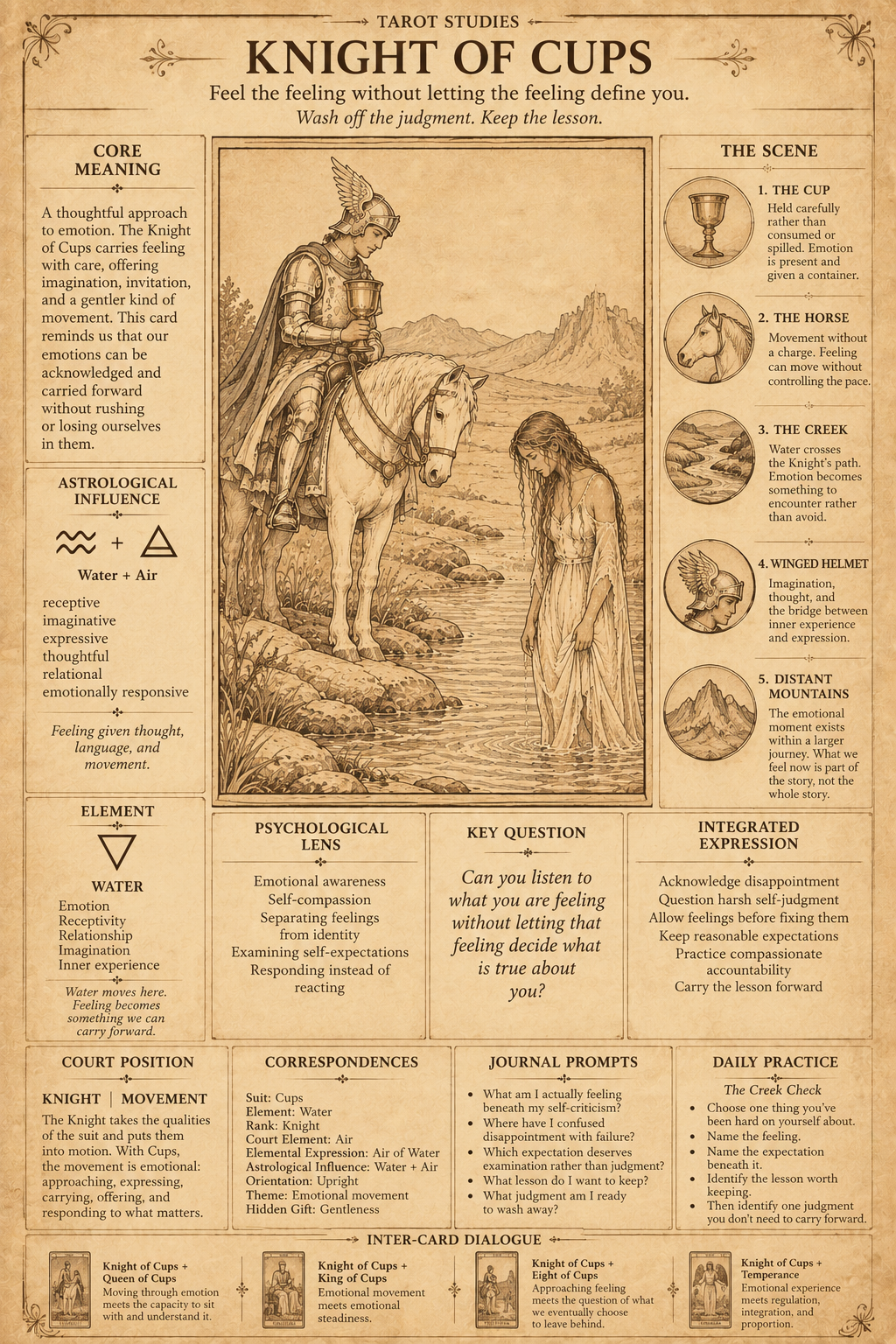
In the Rider-Waite-Smith Knight of Cups, a knight sits on a white horse and holds a golden cup carefully in front of him. Unlike some of his fellow Knights, he isn’t charging anywhere. His horse moves at a measured pace, and even the landscape seems quieter. Mountains rise in the distance while a stream crosses the landscape.
That difference in movement matters because the Knights bring action to their suits, and Cups bring us into the territory of emotion, relationships, imagination, intuition, and the ways we respond to what matters to us. Traditionally, the Knight of Cups is associated with approach, invitation, proposition, imagination, and a quieter kind of movement than we see in some of the other Knights.
But look at how he carries the cup.
He isn’t drinking from it. He isn’t dumping it out. He isn’t holding it carelessly while his horse races forward. The cup stays upright in his hand as he moves toward whatever comes next. There is something deliberate about that posture. Emotion is present, but it doesn’t have to become chaos.
Even the white horse adds something to the story.

A horse gives a Knight movement and momentum, but this one appears controlled rather than hurried. The Knight can move with what he feels without allowing every feeling to determine his speed or direction.
And then there is that creek. Water belongs naturally to the suit of Cups, but here it doesn’t consume the entire landscape. It moves through it. The Knight has to encounter the water without becoming the water.
The goal isn’t to avoid the creek. It is learning how to approach it while still carrying the cup steadily.
Sometimes the Struggle Is
Sometimes the struggle isn’t whether we have feelings. We are generally quite talented at having those, whether we scheduled them or not. The harder part is figuring out what to do with them once they arrive.
Sometimes the struggle is:
- expecting more from ourselves than we would reasonably expect from anyone else
- turning disappointment into evidence that we aren’t doing enough
- criticizing ourselves before we’ve taken time to understand what actually happened
- mistaking self-compassion for making excuses
- trying to think our way out of something that needs to be felt first
- worrying that acknowledging one difficult feeling will uncover several more
- letting a temporary emotion become a permanent opinion about ourselves
The Knight of Cups offers another way to approach those moments. We don’t have to pretend the feeling isn’t there, but we also don’t have to hand it the reins.
We can carry the cup without spilling it everywhere. And maybe we can step into that creek long enough to wash off some of the expectations, judgments, and stories that became attached to the original feeling.
The Key Question
This card asks an important question:
Can you listen to what you are feeling without letting that feeling decide what is true about you?
That can be harder than it sounds, especially when the feeling is attached to our expectations of ourselves. Disappointment can quickly become I should have done better. Frustration becomes I should be handling this better. One unfinished thing somehow produces an entire performance review nobody requested.
But feelings aren’t necessarily conclusions.
They can tell us that something matters. They can point toward disappointment, desire, hurt, hope, fear, or an expectation we didn’t realize we were carrying. What they cannot always tell us accurately is what any of those things mean about our worth, capability, or progress.
The Knight of Cups seems willing to listen before deciding. Maybe that is why he moves so slowly. There is no need to race toward a verdict when we are still figuring out what the feeling is trying to tell us.

That Distinction Matters
I feel disappointed and I am a disappointment are two very different statements. Somewhere between those two sentences, emotion stopped describing an experience and started defining a person.
The Knight of Cups can help us stay in that space long enough to notice the difference. His cup gives the emotion somewhere to be held. His horse gives it movement. The creek gives it somewhere to flow. None of those things require the Knight to become the water himself.
That may be especially important when our expectations of ourselves are involved. Expectations can be useful. They can help us grow, set standards, and recognize where we genuinely want to do something differently. But once self-criticism gets involved, an expectation can quietly stop being a guide and become a measuring stick we use mostly to whack ourselves over the head.
The Knight of Cups doesn’t necessarily ask us to throw the measuring stick into the creek. He asks us to examine what we’re doing with it.
Maybe the espectation is reasonable and something needs to change. Maybe we really did
fall short of what we wanted from ourselves. We can recognize that without turning the experience into a judgment about who we are. We can feel the disappointment, listen to it, and learn from it before deciding what might be ready to wash downstream.
The Hidden Gift
There is also something deeply gentle hidden inside the Knight of Cups.
Gentle does not mean letting ourselves off the hook. It doesn’t mean lowering every expectation because meeting them became uncomfortable. Sometimes we need to recognize that we could have handled something differently, made another choice, tried harder, or followed through better.
But gentleness can help us understand ourselves more accurately.
If every mistake immediately receives criticism, we don’t leave ourselves much room to become curious about why it happened. The frustration deserves curiosity. The disappointment deserves context. Even the voice saying you should have done better deserves a closer look.
Underneath it may be ambition, responsibility, pride in our work, or simply the desire to keep growing. Those aren’t necessarily things we need to wash away.
The Knight’s gentleness gives us enough room to separate those useful messages from all the judgment that accumulated around them. Sometimes we hear ourselves more clearly when we aren’t yelling.
Bringing the Knight of Cups Into Your Day
Today may not be about lowering our expectations, pretending everything is fine, or convincing ourselves that whatever happened doesn’t matter.
It may simply be about changing the way we respond to ourselves when reality doesn’t quite match those expectations.
That might mean noticing when I wish I had done that differently turns into I should have known better. It might mean giving ourselves a little time to feel disappointed before immediately creating a corrective action plan. It could be asking whether an expectation is actually reasonable or whether we quietly moved the finish line again the moment we got close to it.
The Knight of Cups also reminds us that not every feeling needs immediate action. Sometimes the practical thing is to sit with what we feel long enough to understand it. Write about it. Talk it through. Take a walk. Give the emotional water somewhere to move before deciding what needs to happen next.

Then we can separate what needs to stay from what needs to go. Keep the lesson. Keep the accountability. Keep the ambition, responsibility, and desire to grow. But maybe the harsh judgment doesn’t need to make the trip.
For me, that is where the creek becomes particularly useful today. I can take those expectations down to the water, look at them honestly, and wash off some of the stuff that accumulated around them. I don’t have to throw everything into the current. I just need to be a little lighter when I reach the other side.
Until Next Time
The Knight of Cups does not ask us to stop having expectations for ourselves simply because falling short of them can hurt. It asks us to become a little more thoughtful about what we do with the feelings that follow.
We can admit that we want to do something differently without turning that realization into a character assessment. We can hold ourselves accountable without making self-criticism the price of admission.
Maybe that is why I keep returning to the creek in this card today. The Knight isn’t standing on the bank trying to convince himself that the water isn’t there. He is willing to meet the emotional landscape in front of him.
I think I can step into the creek.
I can feel the feels, wash off some of the judgment, and keep the lesson.
I’m just still hoping the creek is shallow.
Until next time…
Misti
References & Further Study
The Knight of Cups in this Daily Pull is interpreted through the Rider-Waite-Smith tradition, beginning with Pamela Colman Smith’s original artwork and Arthur Edward Waite’s description of the card. The psychological discussion throughout the article builds from those traditional foundations while using the imagery as a starting point for reflection rather than prediction.
Primary Source
Waite, Arthur Edward. The Pictorial Key to the Tarot. London: William Rider & Son, 1911.
Waite describes the Knight of Cups as a graceful rather than warlike figure who rides quietly. He associates the card with imagination and dreaming, while his traditional divinatory meanings include arrival, approach, advances, proposition, invitation, and incitement.
This description is particularly useful when comparing the Knight of Cups with the more visibly forceful movement of other Knights. His quieter approach supports close study of how Pamela Colman Smith used posture, pace, landscape, and the carefully held cup to distinguish this Knight.
Rider-Waite-Smith Artwork
Smith, Pamela Colman. Rider-Waite-Smith Tarot. William Rider & Son, 1909.
Smith’s illustration provides the visual foundation for this Daily Pull. The Knight’s cup, white horse, measured movement, distant landscape, and water are treated as parts of a connected symbolic scene rather than isolated keywords.
The creek receives particular attention in today’s interpretation. Its role as a metaphor for encountering emotion, washing away judgment, and continuing forward is a Tarot Studies interpretation of the artwork, not a traditional meaning assigned to the stream by Waite.
Further Study
When studying the Knight of Cups, try comparing the card with the other three Knights before reaching for a list of meanings. Notice how each Knight moves, what each carries, where attention is directed, and how the surrounding landscape contributes to the card’s atmosphere.
Then return to the Knight of Cups and ask what changes when action belongs to the suit of Cups. How does emotion move? What happens when imagination becomes action? What is the difference between acknowledging a feeling and allowing that feeling to determine direction?
For today’s particular reading, another useful comparison is between feeling and identity:
I feel disappointed.
I am a disappointment.
The emotional experience in the first statement may contain useful information. The second turns that experience into a conclusion about the self. The Knight of Cups gives us an opportunity to study the space between those two statements.
That is where today’s creek becomes more than scenery.
We can enter the emotional experience, pay attention to what it contains, and decide what deserves to travel forward with us.
Keep the lesson. Wash off the judgment.
Next: Seven of Swords