
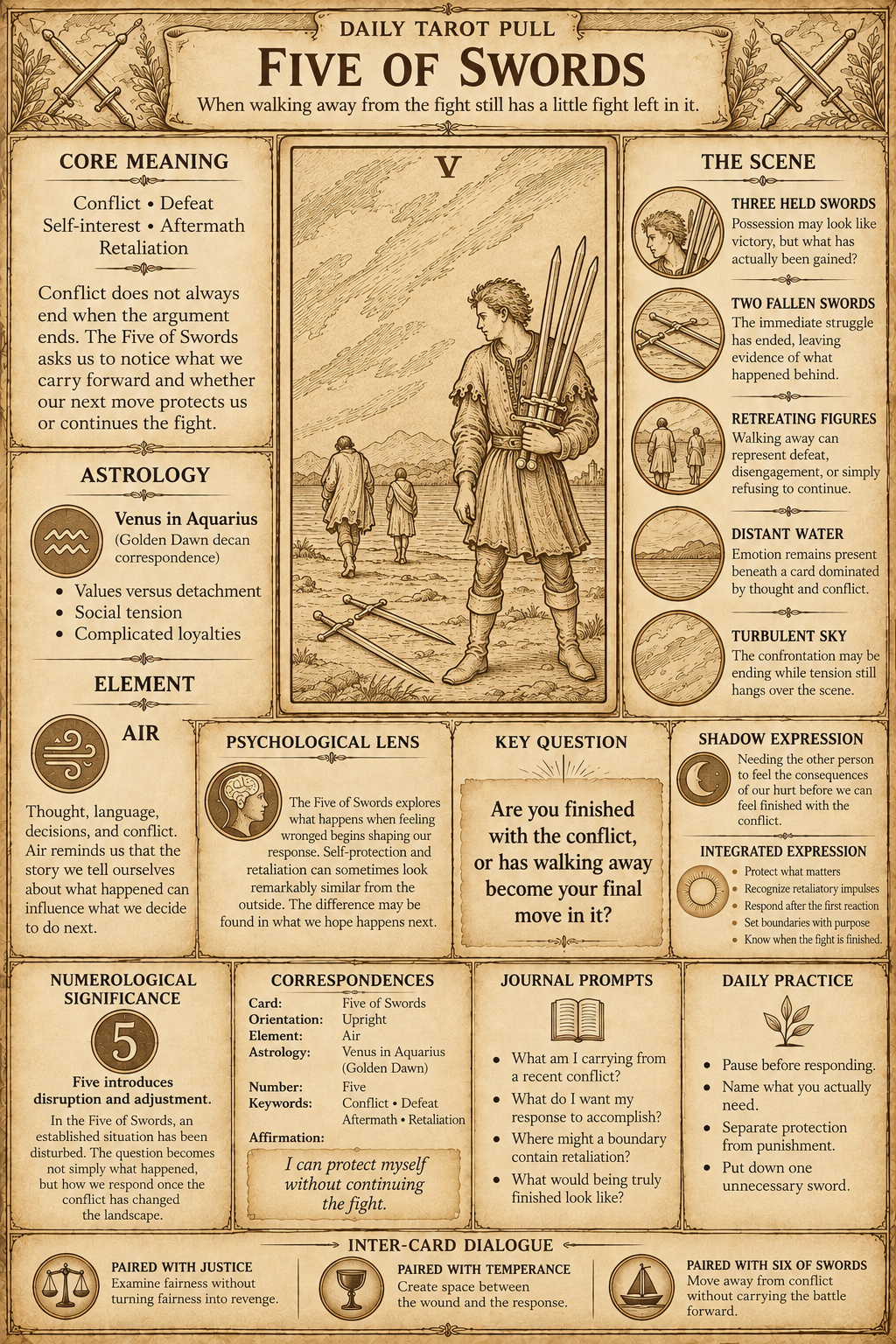
Daily Tarot Pull: Five of Swords
When walking away from the fight still has a little fight left in it
There is conflict, and then there is what happens when you feel like the conflict was handled unfairly. Those are not necessarily the same thing.
The Five of Swords can certainly feel hostile and aggressive. There is tension in this card. Someone has maybe won, or thinks they have won. Someone has lost, and feels it, and nobody looks particularly thrilled about how the whole thing went down. But today, I keep coming back to something slightly different: retaliation.
It is that moment when you have been in a difficult situation long enough that you finally decide, Fine. I don’t want to play this way anymore. I’m walking away.
And I’m taking my ball with me.
There is something almost satisfying about that response. If the situation feels unfair, why should you continue participating? If someone else gets to behave badly, why should you be the one expected to remain reasonable, cooperative, and accommodating? Except the Five of Swords has a way of making that question a little uncomfortable.
There is a difference between deciding you will no longer participate in unhealthy conflict and deciding that, before you leave, you are going to make absolutely certain the other person knows they lost something too. That is where retaliation enters the picture.
Sometimes walking away really is walking away. Other times we walk away carrying a few swords with us. And the Five of Swords asks us to notice the difference.
Traditional Foundation
The Rider-Waite-Smith Five of Swords gives us a scene where the conflict itself appears to be over, but the emotional aftermath is still very much alive.
In the foreground, one figure holds three swords. Two more lie on the ground nearby. Behind him, two other figures are walking away toward the water, their backs turned to whatever has just happened. One appears particularly defeated, with their head lowered. The figure remaining behind wears an expression that can easily be read as smug or satisfied.
That expression matters, because it complicates the idea of victory.
Traditionally, the Five of Swords carries difficult associations with defeat, loss, dishonor, hostility, and conflict. Those traditional meanings give us the foundation, but modern readings often take the card a little further, asking what happens when winning comes at someone else’s expense.
Through a numerological lens, Five can also be read as disruption: the stability that existed before has been disturbed, and something now has to adjust.

But the artwork does not actually tell us the entire story.
We don’t know what started the conflict. We don’t know who was right. We don’t know whether the people walking away surrendered, chose to disengage, or simply realized that continuing was no longer worth it. And although the foreground figure possesses the swords, even that doesn’t necessarily tell us whether he has truly won anything.
What we can see is the aftermath. Someone remains with the swords. Someone else leaves without them.
And that leaves us with an interesting question:
What are we taking with us when the conflict ends?
Because the aftermath may tell us as much about the conflict as the conflict itself.
Sometimes the Struggle Is…
Sometimes the struggle is:
- knowing whether you are setting a boundary or trying to make a point
- wanting the other person to understand exactly how badly they handled the situation
- walking away but still wanting the last word
- withdrawing your cooperation because continuing no longer feels fair
- feeling justified in retaliating because you did not start the conflict
- deciding, Fine, if that’s how we’re going to play this
- protecting yourself without becoming as hostile as the situation you are trying to leave
- realizing that being treated unfairly does not automatically make every response to it fair
That last one can sting a little.
The Five of Swords does not require us to pretend that unfair treatment did not happen. There are situations where walking away, withdrawing participation, or saying I am not doing this anymore is exactly what needs to happen.
The harder part is recognizing what we are trying to accomplish when we do it.
Are we leaving because the conflict no longer deserves our participation? Or are we leaving in a way designed to make sure the other person feels our absence?
Those actions can look remarkably similar from the outside. The difference may only become visible when we are honest about what we hope happens next.
The Key Question
The Five of Swords asks an important question:
Are you walking away because you are finished with the conflict, or because walking away has become your final move in it?
When we feel unfairly treated, we naturally want some recognition that what happened was not okay. We may want an apology, accountability, a correction, or simply for the other person to understand that their actions had consequences.
The trouble begins when we cannot get that recognition. That is where I don’t want to play anymore can quietly become and now I want you to know what it costs to lose me as a player.
Maybe the action itself is completely reasonable. Maybe leaving really is necessary. The harder question is whether leaving is enough.

That Distinction Matters
A boundary changes what you are willing to participate in. Retaliation is still interested in what happens to the other person afterward. Did they notice? Do they understand why I’m doing this? Are they frustrated now? Do they finally realize what they lost? If those answers still matter to us, we may not be quite as finished with the conflict as we thought.
The person walking away from the conflict may have every reason to leave, just as the person holding the swords may believe they have every reason to keep them. Each person can construct a perfectly convincing explanation for why their response is justified, and that is often how real conflict works. We rarely experience ourselves as the unreasonable person in the story because we know everything that came before our reaction.
We know our intentions. We remember what happened before things reached this point. We know which comment was the final straw and which frustration had already been simmering underneath it. Our own behavior arrives with footnotes, while everyone else’s behavior tends to arrive without them.
The Five of Swords asks us to examine those footnotes without automatically using them as permission. Being treated unfairly matters. Anger matters. Protecting yourself matters. Choosing not to continue participating matters. None of that disappears simply because we are also willing to examine our own response.
But if the goal has shifted from I need to protect myself to I need you to feel what you did to me, the conflict may not actually be over. At that point, we may have stopped participating in the original fight while still finding another way to continue it.
We may have simply changed weapons. From the swords to the ball.
The Hidden Gift
There is also something deeply liberating hidden inside the Five of Swords. You do not have to win the conflict in order to be finished with it. That sounds simple until you have been genuinely hurt, dismissed, undermined, or treated unfairly. Then walking away without making your point one more time can feel suspiciously like letting someone get away with something.
We want the scales balanced somehow. We want them to understand. We want that final conversation where everything is explained perfectly, the evidence is presented, the jury nods thoughtfully, and someone finally says, You know what? You were right. Real life is terribly inconsiderate about providing those moments.
Sometimes the other person never understands your perspective. Sometimes they remain completely convinced that you were the problem. Sometimes you leave knowing that the story they tell about what happened will be very different from yours. Maybe freedom begins when your next decision no longer depends on correcting their version of the story.
You can acknowledge that something was unfair without making your healing dependent on the other person’s response. You can be angry and still choose what you do with the anger. You can remove yourself from a situation without turning your departure into one final weapon. That does not erase what happened. It simply means the conflict no longer gets to choose your next move.
Maybe that is the hidden gift in those figures walking toward the water. We cannot know exactly why they are leaving, but they remind us that there comes a point when continuing to fight costs more than putting down the sword. Sometimes the most powerful thing you can take with you is nothing at all.
Bring the Five of Swords Into Your Day
Today may not be about resolving every conflict, forgiving everyone involved, or pretending that something unfair suddenly feels acceptable. It may simply be about noticing what you are tempted to do next.
Maybe you need to walk away. Maybe you need to say no. Maybe you need to stop volunteering your time, energy, or cooperation in a situation where those things have been taken for granted. Maybe there is a conversation that needs to happen, or one that absolutely does not need another round.
Before making the next move, it may be worth asking: What am I hoping this accomplishes? Then give yourself enough space to answer honestly.
Pause before sending the message. Let the first wave of anger pass before making the permanent decision. Decide what you actually need from the situation. If you need a boundary, set it because it

protects something important to you. And sometimes we need a minute or ten to simply be angry.
The practice is not becoming perfectly reasonable while everyone around you behaves badly. It is creating enough space between feeling wronged and responding to decide what belongs to you. And if walking away really is the healthiest choice, walk away.
You can also walk away with the ball, if it is yours, of course, and feel perfectly okay knowing they can go find another one.
Until Next Time
The Five of Swords does not ask us to pretend conflict did not happen or that unfair treatment should simply be accepted. It asks us to decide what happens after it. There will always be moments when anger is justified. There will be situations we need to leave, boundaries we need to establish, and people who may never understand why we made those choices.
The challenge is not allowing someone else’s behavior to determine the kind of person we become while responding to it. Because retaliation can keep us connected to the very conflict we are trying to leave. We may have walked away physically, but we are still watching over our shoulder to see whether the other person noticed.
The Five of Swords does not ask us to surrender every sword. It asks us to recognize when we no longer need to use one. There is a particular kind of freedom in realizing that you can take your ball and go home without throwing it through somebody’s window first.
Until next time…
Misti
Sources & Further Study
Waite, A. E. The Pictorial Key to the Tarot. 1911.
A primary historical source for the Rider-Waite-Smith Five of Swords, including Waite’s description of the figures and his traditional divinatory associations for the card.
Mathers, S. L. MacGregor, et al. Book T: The Tarot. Golden Dawn tradition.
Useful for examining the esoteric framework that preceded and influenced the Rider-Waite-Smith system, including the Five of Swords as the Lord of Defeat.
Thierens, A. E. The General Book of the Tarot. 1930.
An early twentieth-century comparison source preserving traditional associations with loss, dishonor, degradation, and defeat.
A Note on This Daily Pull
The discussion of retaliation, boundaries, punishment, and choosing what happens after conflict is a Tarot Studies interpretation developed from the card’s imagery and traditional themes. It is offered as a framework for reflection rather than as a fixed historical meaning of the Five of Swords.