
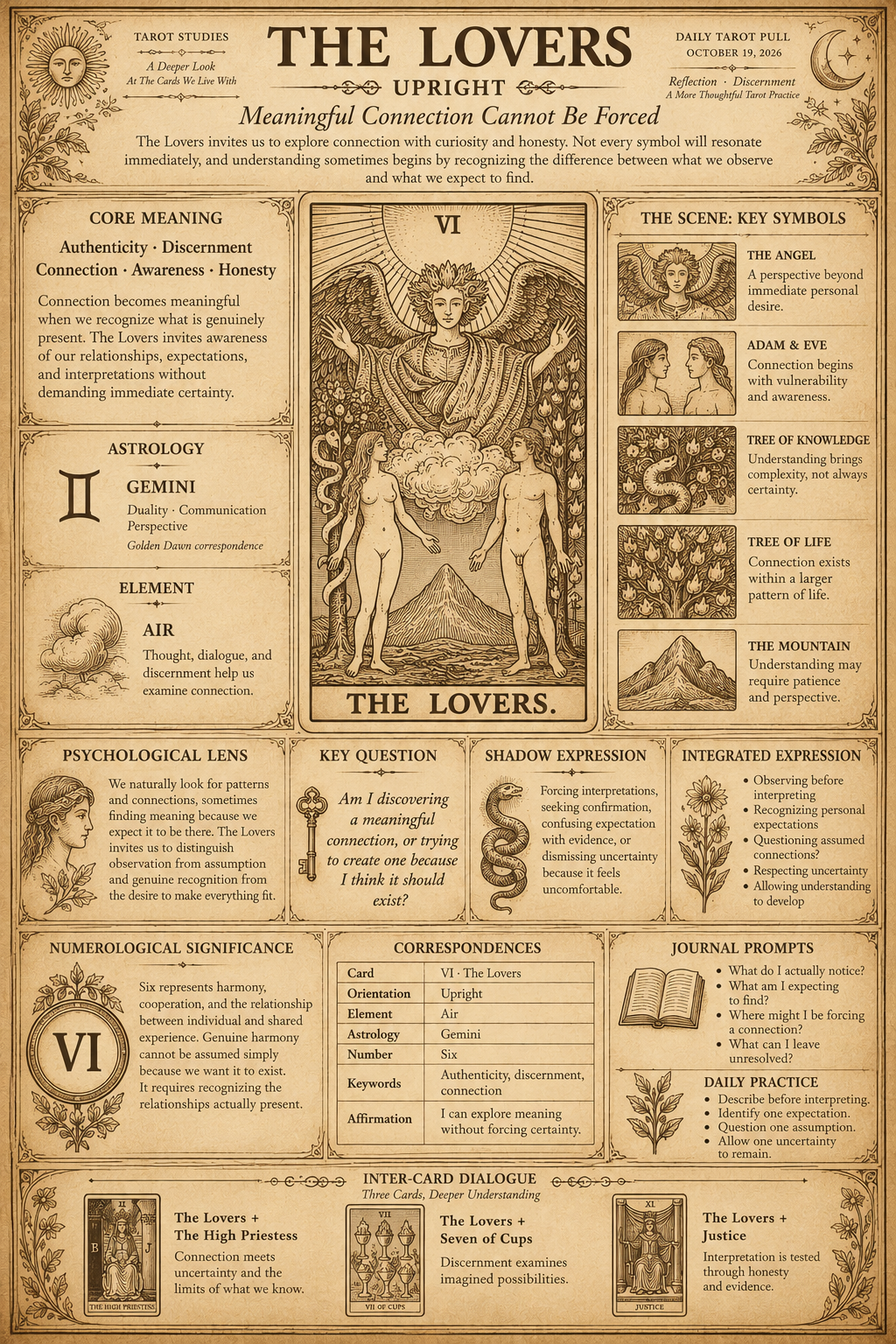
Daily Tarot Pull: The Lovers
When a card keeps showing up, but you’re still not feeling the love
Within a week, The Lovers has once again decided to check in with me. And I have to admit, I’m not particularly thrilled about it. The last time I pulled The Lovers, my response was pretty simple: I don’t feel it. I wasn’t feeling the love, the harmony, the connection, or whatever wonderful sense of alignment this card was supposedly bringing to the conversation. And now, eight days later, here it is again. Only this time, I’m feeling it even less.
So what am I thinking? Well, apparently we’re going to have to do some more exploring, whether I’m particularly interested in the conversation or not.
Stupid Lovers.
But perhaps that’s exactly where today’s study needs to begin. Not with the assumption that The Lovers must represent something wonderful happening in our relationships, or that we should somehow be feeling more connected, loving, or harmonious simply because this particular card has appeared. Maybe we need to look at what The Lovers is actually asking us to examine, especially when its traditional meanings feel so far removed from our current experience.
After all, tarot isn’t particularly useful if we only explore the cards that agree with how we’re feeling. Sometimes the interesting work begins when we look at a card and think, “Nope. Not seeing it.” We can recognize the traditional symbolism, understand what the card generally represents, and still find ourselves wondering what any of it has to do with our lives at that particular moment.
And apparently, The Lovers and I are going to have that conversation again.
Traditional Foundation
When we see The Lovers, it’s pretty easy to jump straight to romance. After all, the card features a naked man and woman standing beneath an angel, surrounded by imagery that practically announces we’re dealing with love, relationships, and some rather significant human connections.
But The Lovers has always been a little more complicated than a romantic greeting card.
In the Rider-Waite-Smith tarot, The Lovers is the sixth card of the Major Arcana. The scene depicts two figures commonly understood as Adam and Eve standing in a garden beneath a radiant angel, traditionally identified as Raphael. Behind the woman stands the Tree of Knowledge, with a serpent winding around its trunk. Behind the man is a tree bearing twelve flame-like forms, often associated with the twelve signs of the zodiac. Between them rises a mountain, while the angel extends its arms above the scene.
There is a great deal happening here, and very little of it is limited to romantic love.
The biblical imagery introduces themes of

innocence, awareness, temptation, and the consequences of choice. Adam and Eve stand in a world where knowledge and experience are about to complicate what once seemed relatively simple. The serpent introduces questions about knowledge, desire, and the boundaries of innocence, while the mountain suggests that meaningful connection and understanding may involve challenges that cannot simply be wished away.
Even the figures’ gazes are worth examining. The man looks toward the woman, while the woman looks upward toward the angel. This visual relationship is often interpreted as a movement between physical awareness, emotional or intuitive understanding, and a higher guiding principle. Whether we approach that principle spiritually or psychologically, the composition encourages us to consider how different parts of our experience influence one another.
Traditionally, The Lovers represents love, attraction, union, harmony, and meaningful relationships. It is also associated with choices, particularly decisions involving our values and the commitments we are willing to make. In the Golden Dawn correspondence system, The Lovers is associated with Gemini, an air sign whose symbolism introduces duality, communication, and the relationship between different perspectives.
And then there is the number six. In tarot numerology, six is commonly associated with harmony, cooperation, responsibility, and the effort to restore balance. But harmony is not necessarily something we already possess. Sometimes it is something we are learning to create, and that process can begin by recognizing where things do not fit together particularly well.
Looking at the artwork this way gives me something more substantial to consider than whether I’m feeling particularly loving today. The card places connection alongside knowledge, awareness, and choice. It gives us a scene filled with relationships between different elements, and asks us to consider how those relationships influence one another.
Which, I suppose, is more interesting than simply being told to feel the love.
Sometimes the Struggle Is…
Sometimes the struggle isn’t that we don’t understand what a card represents. It’s that we understand its traditional meanings perfectly well, and they still don’t seem to have much to do with where we are right now.
The Lovers is a particularly interesting card in that respect. Love, harmony, connection, alignment, meaningful choices. These are all wonderful concepts, but knowing what they mean doesn’t necessarily mean we’re experiencing them. And pulling a card associated with those qualities certainly doesn’t manufacture the feelings to go along with them.
Sometimes the struggle is:
- Recognizing the importance of connection without particularly feeling connected.
- Knowing what matters to us but questioning whether our choices reflect those values.
- Wanting harmony while acknowledging that some things simply aren’t harmonious.
- Confusing what we believe we should feel with what we’re actually experiencing.
- Assuming that meaningful relationships should always produce positive feelings.
- Struggling to distinguish between a temporary emotional state and a deeper sense of alignment.
- Feeling pressured to find a meaningful message in something that simply isn’t resonating.
That last one deserves a little more attention.
There is an interesting temptation in tarot to make every card fit. We pull something, look up its traditional meaning, and begin searching our lives for evidence that supports the interpretation. Sometimes those connections are genuinely useful. Other times, we may be doing a remarkable amount of mental gymnastics to make a square peg fit into a very uncooperative round hole.
And here’s the thing: if we search long enough, we can probably find something in our lives that resembles almost any tarot card. That doesn’t automatically make the connection meaningful. It may simply mean we’ve become very good at finding evidence for an interpretation we’ve already decided should be true.
The Lovers appearing twice in eight days doesn’t automatically mean there’s an important relationship decision waiting to be made or some hidden emotional truth demanding attention. It does, however, give me an opportunity to revisit a question I wasn’t particularly interested in answering the first time.
And maybe that’s enough for now.
The Key Question
This card asks an important question:
Can we recognize what matters to us even when we aren’t feeling particularly connected to it?
I think that’s worth considering, especially with The Lovers making its second appearance in just over a week. My initial reaction hasn’t changed much, and if anything, I’m even less enthusiastic about the card this time around. But perhaps I’ve been expecting The Lovers to describe a particular feeling rather than considering the relationships and choices represented in its imagery.
We tend to associate connection with an emotional experience. We recognize the excitement of a new relationship, the comfort of familiarity, or the satisfaction of making a decision that feels right. But those feelings can change, sometimes for reasons that have very little to do with the actual value of what we’re connected to.
A lack of connection can tell us something important, just as enthusiasm can. The challenge is understanding what we’re responding to before deciding what that response means.
Am I genuinely disconnected from something that matters to me, or am I expecting connection to feel a certain way?
I don’t know that I have an answer to that today. But I do think it’s a more useful question than trying to convince myself that I’m supposed to be feeling the love simply because The Lovers showed up again.

That Distinction Matters
There is a difference between knowing something matters to us and feeling connected to it in any particular moment. We often treat those two experiences as though they should naturally accompany one another. If we value something, shouldn’t we feel good about it? If we’re making the right choices, shouldn’t there be some reassuring sense of harmony that lets us know we’re on the right track?
It would certainly make things easier. A little internal confirmation light would be nice. Preferably one that comes with clear instructions and doesn’t require three additional tarot cards to interpret.
But human experience rarely works that neatly.
The Lovers introduces an interesting relationship between awareness and choice. In the Rider-Waite-Smith imagery, Adam and Eve stand in a garden where innocence, knowledge, desire, and consequence all exist within the same scene. The symbolism invites us to consider what happens when we become aware of different possibilities and must decide how to respond to them.
We can love something and still feel frustrated by it. We can value a relationship and recognize that something within it needs attention. We can make a thoughtful decision without feeling particularly confident or enthusiastic about it. Our feelings are part of the information we have available, but they aren’t the entire picture.
That distinction matters.
Alignment isn’t necessarily the absence of discomfort. Sometimes it involves recognizing discomfort, understanding what it might be telling us, and deciding whether our current choices still reflect what matters to us. But I think there’s another distinction here that deserves just as much attention, particularly when we’re working with tarot.
There is a difference between discovering meaning in a card and creating an interpretation simply because we believe there must be one.
Tarot encourages us to make connections. We observe the artwork, consider traditional symbolism, and explore how those ideas might relate to our experiences. That’s part of what makes the practice interesting. But if we approach every card with the assumption that it must contain a personally relevant message, we risk overlooking the possibility that our interpretation is being shaped more by expectation than observation.
The Lovers can offer a framework for examining connection, values, and choice without requiring me to conclude that something is missing from my life. I can explore the symbolism, consider what feels relevant, and leave the rest alone.
And perhaps that’s where the card’s lesson becomes particularly useful. Meaningful connection, whether with another person, our own values, or even a tarot interpretation, requires some degree of honesty about what is actually there.
The Hidden Gift
There is also something deeply liberating hidden inside this card.
The Lovers is often presented as a beautiful picture of harmony, connection, and meaningful union. And while those interpretations certainly have their place, I think there is something equally valuable in recognizing that genuine connection requires honesty. Not just honesty with other people, but honesty about our own experiences, expectations, and desires.
After all, what good is harmony if we have to pretend we’re experiencing it?
The Rider-Waite-Smith imagery offers an interesting perspective here. Adam and Eve stand exposed beneath the angel, without clothing, armor, or anything to conceal who they are. Their nakedness is traditionally associated with innocence and openness, but it also gives us an opportunity to consider vulnerability. They are standing as they are, not as they believe they should appear.
And perhaps that’s the part of The Lovers I can appreciate today.
I can acknowledge that the card isn’t particularly resonating with me and still be curious about what its symbolism has to offer. I can question whether a traditional interpretation fits my experience without dismissing the tradition itself. And I can recognize that finding an interesting connection doesn’t necessarily mean I’ve discovered some hidden truth about my life.
There is a certain freedom in that kind of honesty.
When we stop requiring every interpretation to produce a personal revelation, we create room for genuine curiosity. We can study the artwork, examine its history, compare different meanings, and consider possibilities without needing to arrive at a predetermined conclusion.
Sometimes that process reveals something worth exploring. Sometimes it changes our understanding of a familiar symbol. And sometimes we finish with a better appreciation of the card itself, even if it doesn’t seem particularly relevant to our circumstances.
The hidden gift of The Lovers may be the opportunity to approach connection as something authentic rather than something we have to perform.
That includes our relationship with ourselves, and perhaps even our relationship with the practice of tarot.
Because the freedom to question an interpretation is also the freedom to recognize when something genuinely resonates. One becomes more meaningful when we aren’t required to manufacture the other.
And for someone who has now pulled The Lovers twice in eight days and responded with decreasing enthusiasm, I suppose that’s a fairly reasonable place to begin.
I’m still not feeling particularly romantic about this card.
But I might be developing a little more respect for it.
Bringing the Lovers Into Your Day
Today may not be about finding love, repairing a relationship, or making some significant decision that changes the direction of our lives. It may not even be about discovering why we aren’t feeling particularly connected to something that supposedly matters to us.
It may simply be about paying attention to the relationship between what we value, what we feel, and how we choose to respond.
The Lovers gives us an opportunity to examine those relationships without assuming they should always be perfectly harmonious. We can appreciate the people in our lives and still need some space. We can enjoy our work and occasionally wonder why we agreed to take on quite so much of it. We can believe in something deeply and still have days when our enthusiasm has apparently taken an unscheduled vacation.

None of those experiences automatically cancels out the connection underneath them.
One way to work with The Lovers today is to notice an expectation we’re carrying. Perhaps we believe a meaningful relationship should always feel comfortable, or that a good decision should produce immediate certainty. We can examine where those expectations came from and whether they’re helping us understand our experiences or simply making those experiences harder to appreciate.
We might also examine one ordinary choice we’re making today. Nothing dramatic. Perhaps it’s deciding how to spend our time, whether to accept another responsibility, or how honestly to communicate what we need. Rather than searching for the choice that feels most reassuring, we can consider what matters to us and whether our actions reflect those priorities.
And perhaps we can practice allowing conflicting feelings to exist without immediately trying to resolve them. We can care about someone and feel irritated with them. We can be grateful for an opportunity and still find it exhausting. We can recognize the value of connection while not particularly wanting to socialize with another human being for the rest of the afternoon.
Very romantic. The Lovers would be delighted, I’m sure.
There is also a practical lesson here for anyone studying tarot. When a card doesn’t resonate, we can return to the artwork and begin with what we actually observe. We can distinguish traditional meanings from our personal associations, notice where an interpretation seems to fit, and acknowledge where it doesn’t.
We can even leave a question unanswered.
For me, today’s practical application may be considerably simpler. I can stop trying to figure out why The Lovers keeps appearing and spend a little time examining what the card actually represents. I can consider the symbolism, question the interpretations that don’t fit, and remain curious about the ones that do.
And if I finish that exploration still feeling relatively unimpressed? Well, at least I’ll have given the Stupid Lovers a fair hearing.
Until Next Time
I started today’s exploration feeling even less enthusiastic about The Lovers than I did when it appeared eight days ago. And while I can’t say I’ve experienced some remarkable transformation in my feelings toward this card, I do think I’ve found something worth considering.
Perhaps I’ve been expecting The Lovers to describe an experience rather than recognizing that it offers an opportunity to examine one. Love, harmony, connection, and alignment are complicated parts of being human, shaped by our relationships, values, choices, and the expectations we bring to them.
But what I find most interesting is that I didn’t have to change how I felt about the card to discover something useful within it. I could question its relevance, challenge my assumptions about its meaning, and consider the symbolism without forcing myself into a conclusion that didn’t feel genuine.
And perhaps that’s where The Lovers and I have finally found a little common ground.
The Lovers does not ask us to manufacture connection where we don’t experience it. It asks us to examine what connection means, how our choices reflect our values, and whether we’re being honest about the relationships we have with ourselves and others.
And honestly?
I still think the Stupid Lovers could have waited a little longer before showing up again.
But maybe that’s the most useful thing I’ve learned from this particular encounter. I don’t have to agree with a card’s apparent message to take its symbolism seriously, and I don’t have to discover a personal revelation to make the exploration worthwhile.
Sometimes the most meaningful connection begins with being honest enough to say, “I’m just not feeling it.”
Until next time…
Misti
Sources & Further Study
The Lovers has a long interpretive history, and its familiar associations with love, relationships, harmony, and choice come from several overlapping tarot traditions. The following resources offer a foundation for exploring the card’s symbolism while leaving room for personal observation and critical interpretation.
A. E. Waite, The Pictorial Key to the Tarot (1910). Waite’s description of The Lovers provides an important primary source for understanding the Rider-Waite-Smith card. His discussion emphasizes human love, innocence, and the relationship between the earthly and the spiritual. It also helps distinguish the intentions expressed in the original accompanying text from meanings developed by later interpreters.
Pamela Colman Smith, The Lovers, Rider-Waite-Smith Tarot (1909). Smith’s illustration is the primary visual reference for this study. The two figures, angel, serpent, symbolic trees, and mountain provide a rich composition for examining awareness, vulnerability, relationships, and the consequences of choice.
Rachel Pollack, Seventy-Eight Degrees of Wisdom. Pollack offers a psychologically informed exploration of tarot symbolism, including the Major Arcana as a framework for examining human development, relationships, and self-awareness. Her work provides useful additional context for studying The Lovers beyond its most familiar romantic associations.
Tarot Studies, When a Tarot Card Makes No Sense. For readers interested in what happens when a card’s traditional meaning doesn’t seem relevant, this related article explores the importance of observation, interpretation, and resisting the temptation to force a card into a predetermined explanation.
A Note on Historical Interpretation
Some familiar explanations of The Lovers reflect interpretive traditions that developed around the Rider-Waite-Smith deck rather than statements made explicitly by Waite. For example, the angel is traditionally identified as Raphael, although Waite does not name the figure in his description. Similarly, the twelve flame-like forms on the Tree of Life are frequently associated with the zodiac in later interpretations.
Recognizing these distinctions does not make the symbolism less valuable. It helps us understand where an interpretation comes from, what the original artwork actually shows, and where our own observations begin.
That distinction is especially relevant to this Daily Pull. Studying a card seriously does not require us to accept every interpretation offered or manufacture a personal connection that isn’t there.
Next: Four of Cups