
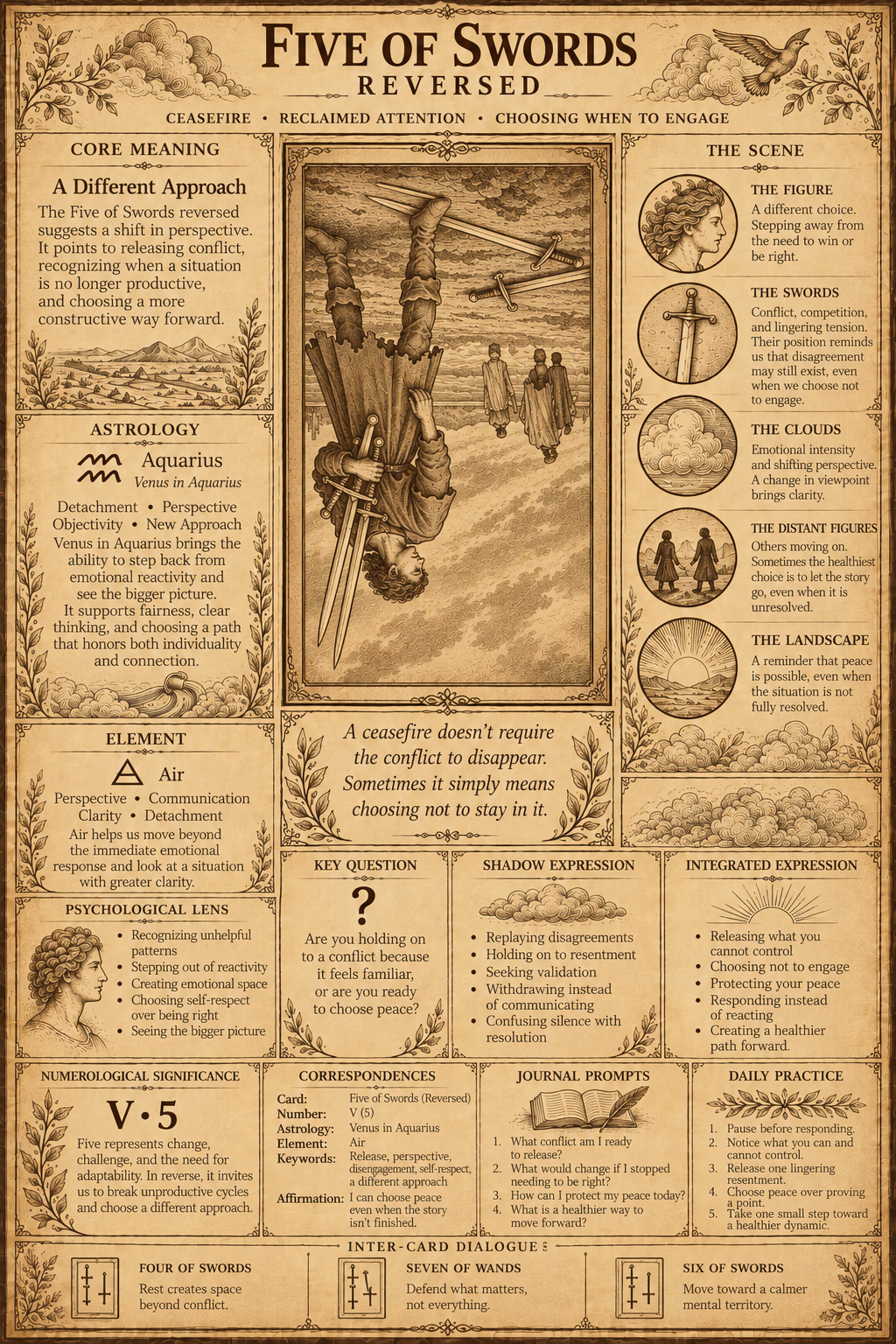
Daily Tarot Pull: Five of Swords Reversed
When even your inner strategist deserves a day off
Well, it’s not The Sun, which would have been awesome to pull on my birthday. A little sunshine, happiness, and general celebration would have been perfectly appropriate. But apparently, the cards had something else in mind. Today, I pulled the Five of Swords reversed. And strangely enough, I’m not particularly disappointed.
The Five of Swords is one of those cards that can make you feel like you need to prepare for battle. There are arguments to win, positions to defend, strategies to consider, and perhaps a little counterplotting for good measure. Very “I’ll show them!” energy. Even when the actual conflict has ended, we can keep rehearsing conversations, defending decisions, and imagining all the wonderfully clever things we should have said. Or, better yet, the equally clever things we’ve already prepared, polished, and tucked away, just waiting for precisely the right moment to unleash them.
But today, with the card reversed, I’m getting something considerably less dramatic.
A ceasefire.
Take the day off. No diabolical plans, no scheming, no counterplotting. Nothing to prove and absolutely no need to show anyone anything. Whatever battles are waiting, real or imagined, can remain exactly where they are for another twenty-four hours.
I suppose you could consider that a birthday gift from me to myself. Permission to put down the swords without having to settle every argument, repair every disagreement, or prove that I was right in the first place. I’m not promising I’ve retired from strategic thinking altogether. I’m just saying the swords can stay on the table while I enjoy my birthday.
And perhaps that’s where the Five of Swords reversed becomes interesting. Sometimes choosing peace isn’t about finally winning the battle.
Sometimes it’s about realizing you don’t have to participate in it today.
Traditional Meaning
In the traditional Rider-Waite-Smith Five of Swords, we see a figure standing in the foreground holding three swords. Two more swords lie on the ground, apparently abandoned, while two other figures walk away toward the water. The central figure wears an expression that could be interpreted as smug satisfaction. Whatever confrontation has taken place, he appears rather pleased with himself.
But it’s an interesting picture of victory, isn’t it? He has the swords, but the other people are leaving. There is no celebration, no gathering of supporters, and certainly no indication that everyone has agreed he was right. He may have won the confrontation, but we’re left wondering what that victory actually cost him.
For a closer examination of the card’s traditional tensions, explore our Tarot Talk discussion of the Five of Swords.
The suit of Swords is traditionally associated with the element of Air, connecting it to thought, communication, reasoning, and conflict. The number five often introduces disruption or

or instability into the relative structure established by the four. In the Five of Swords, that disruption plays out through competing perspectives, disagreements, and the desire to come out on top. The card challenges us to consider whether winning an argument necessarily means we’ve accomplished something worthwhile.
In Arthur Edward Waite’s original account, the reversed Five of Swords retains the difficult upright associations and adds references to burial and funeral rites. Contemporary interpretations sometimes approach the reversal differently, exploring reconciliation, unresolved resentment, or the possibility of disengaging from conflict. Those are interpretive developments rather than Waite’s stated reversed meaning.
When the Five of Swords appears reversed, those same themes remain, but our relationship to them may begin to change. The reversal is often interpreted through reconciliation, lingering resentment, unresolved conflict, or the decision to disengage from a struggle that has become exhausting. It can also describe the mental aftermath of disagreement, when the outward confrontation has ended but our thoughts continue revisiting it.
What I find particularly interesting is that reversing the card doesn’t automatically turn the apparent victor into a gracious loser or the departing figures into returning friends. Nothing in the original scene guarantees that anyone has apologized, forgiven, or even reconsidered their position.
Perhaps the figure holding the swords is beginning to question whether he needs all of them. Perhaps the people walking away have decided the argument is no longer worth their participation. Or perhaps everyone still believes they’re right, but they’ve finally recognized that continuing the confrontation isn’t accomplishing much.
For today’s interpretation, that last possibility feels particularly appropriate. The disagreement may remain, but the people involved don’t necessarily have to keep participating in it.
Of course, deciding to stop arguing with someone else is often considerably easier than convincing ourselves to stop.
Sometimes the Struggle Is…
Sometimes the struggle isn’t the disagreement itself. It’s everything we continue doing with it afterward. The conversations we replay, the arguments we refine, and the imaginary confrontations where we finally deliver that perfectly constructed response. Naturally, in these imaginary exchanges, we’re exceptionally articulate, our opponent has absolutely no comeback, and everyone recognizes the brilliance of our reasoning.
Unfortunately, real conversations rarely cooperate quite so nicely.
Sometimes the struggle is:
- Replaying an argument long after everyone else has moved on.
- Preparing responses to conversations that may never happen.
- Feeling compelled to defend a position even when nobody is challenging it anymore.
- Mistaking the decision not to engage for admitting defeat.
- Holding on to resentment because letting it go feels suspiciously like letting someone get away with something.
- Waiting for the perfect opportunity to deliver a response we’ve been mentally rehearsing for days.
The Five of Swords reversed can reflect how easily conflict becomes a mental habit, particularly when we feel misunderstood, dismissed, or treated unfairly. We may continue preparing for another confrontation because being ready gives us a sense of control. There is something reassuring about knowing exactly what we’ll say if the opportunity presents itself.
But there is also something exhausting about remaining mentally prepared for a battle that isn’t currently taking place. Our attention stays occupied with what happened, what might happen next, and all the possible ways the disagreement could return. Meanwhile, the present moment carries on without our full participation.
The Nine of Swords offers another perspective on how our thoughts can keep difficult experiences active long after the original moment has passed.
And that may be the struggle worth recognizing. We’ve become so practiced at preparing our defense that we don’t always notice when there’s nothing immediately requiring one.
The Key Question
This card asks an important question:
Can you choose not to engage in a conflict without feeling as though you’ve lost something?
There is an interesting tension in the Five of Swords reversed. We might recognize that an argument isn’t worth continuing, yet still feel uncomfortable walking away from it. Somewhere in the back of our minds is the suspicion that if we don’t defend ourselves, correct the misunderstanding, or deliver that exceptionally clever response we’ve been saving, the other person might believe they’ve won.
And wouldn’t that be irritating?
But another person’s interpretation of a disagreement doesn’t necessarily have to determine our next action. We can disagree without accepting every invitation to argue, and we can recognize unfairness without immediately turning our attention toward correcting it. Some situations deserve a response, while others become more manageable when we give ourselves enough distance to decide what actually matters.
The challenge is recognizing whether we’re responding because something genuinely needs our attention or because we cannot tolerate the possibility that someone else might have the last word.

That Distinction Matters
There is a difference between surrendering because we believe we have no choice and choosing to step away because we recognize that continuing the fight serves no useful purpose. One leaves us feeling powerless. The other reminds us that we still have some authority over where we direct our attention, energy, and time.
The Five of Swords reversed invites us to consider how much of our identity can become wrapped up in being right. Sometimes an argument stops being about the original disagreement and becomes something much more personal. We want acknowledgment. We want someone to recognize that our position was reasonable, our intentions were misunderstood, or our response was justified. And preferably, we’d like them to arrive at that realization entirely on their own, accompanied by a sincere apology and perhaps a written statement admitting we were correct.
I’m not saying that would be unpleasant.
But when our peace depends on someone else reaching the conclusion we want, we’ve handed them considerable influence over our emotional
wellbeing. We may spend hours preparing arguments, anticipating objections, and revisiting conversations in the hope of achieving a resolution that requires another person’s cooperation.
The reversed Five of Swords offers another possibility. We can acknowledge our feelings and maintain our boundaries while deciding how much attention the disagreement deserves. Choosing not to engage is not the same as being unable to defend ourselves. In fact, having the ability to respond while recognizing that a response isn’t always necessary can be an expression of self-control.
A ceasefire, after all, is not a peace treaty. It doesn’t guarantee that everyone has changed their minds or that tomorrow won’t bring another round of negotiations. It simply establishes that, for the moment, the fighting has stopped.
Sometimes the victory isn’t getting the last word. It’s recognizing that our sense of self doesn’t have to depend on getting it.
The Hidden Gift
There is also something deeply liberating hidden inside this card.
The Five of Swords reversed offers the possibility of stepping outside the familiar roles we assume during conflict. We don’t have to be the victor, the defeated opponent, the misunderstood participant, or the person responsible for making everyone see reason. For a little while, we can simply be ourselves, without an argument attached to our identity.
And that can be surprisingly difficult when a disagreement has occupied so much of our attention that we’ve begun organizing our thoughts around it. We anticipate what someone might say, interpret new information through the lens of the previous conflict, and sometimes find ourselves reacting to situations that haven’t actually happened. The disagreement becomes a reference point for experiences that might otherwise have nothing to do with it.
But there is an entire life taking place outside that conflict.
There are people who enjoy our company without requiring us to defend our position. There are interests, conversations, experiences, and ordinary pleasures that have nothing to do with who was right or wrong. We have qualities and relationships that exist independently of whatever disagreement has been occupying our thoughts.
Perhaps the hidden gift is the opportunity to remember those parts of ourselves. To recognize that we are more than the positions we defend, the arguments we construct, or the misunderstandings we want corrected.
For me, today’s Five of Swords reversed feels less like a grand lesson in forgiveness and more like an invitation to spend time being someone other than the person preparing for the next confrontation. There are parts of my life that have nothing to do with disagreements, misunderstandings, or proving a point, and I’d rather give those parts of myself a little attention today.
I haven’t suddenly developed an unlimited capacity for patience and understanding, and I’m certainly not suggesting that everyone involved in every disagreement has magically become reasonable. But I can still have a good day, even when everything in my life hasn’t been neatly resolved.
And perhaps that’s worth more than another perfectly delivered argument.
Bringing the Five of Swords Reversed Into Your Day
Today may not be about resolving every disagreement, repairing every relationship, or reaching some extraordinary level of emotional maturity where nothing anyone says or does can possibly irritate us.
That sounds lovely, of course, but it also sounds like a rather ambitious birthday project.
It may simply be about noticing when an old disagreement begins intruding on an otherwise enjoyable moment. Perhaps we’re spending time with someone we care about, working on something meaningful, or finally enjoying a little quiet when our thoughts wander back to an argument we’ve already had. Suddenly, we’re mentally somewhere else entirely.
When that happens, we can practice something simple: noticce the thought, acknowledge that the

issue may still matter, and decide whether it genuinely needs our attention right now. If it does, we can consider what action would be useful. If it doesn’t, we can return to whatever we were doing before the imaginary debate began.
Perhaps today that means leaving a message unanswered until we’ve had time to consider what we genuinely want to say. It might mean resisting the temptation to revisit a conversation simply because we’ve thought of a better response. Or perhaps it means recognizing that we’re rehearsing a confrontation that hasn’t happened and may never happen.
There is a practical difference between postponing a necessary conversation and avoiding it indefinitely. If something needs to be addressed, we can acknowledge that responsibility and choose a reasonable time to approach it. We don’t have to resolve the entire situation in the moment simply to prove that we’re taking it seriously.
And sometimes, the most useful practice is considerably simpler. Put down the phone. Stop checking whether someone has responded. Resist the urge to explain yourself one more time. Allow an unfinished conversation to remain unfinished long enough to enjoy something else.
The Four of Swords offers a related opportunity to explore rest, recovery, and the value of stepping away from constant mental activity.
None of this requires us to pretend we’re no longer upset or that our concerns have somehow become unimportant. We can still feel frustrated, disappointed, or convinced that we have a perfectly reasonable argument. The practice is recognizing that those feelings don’t have to dictate how we spend every available moment.
For today, I’m choosing to give my inner strategist the day off. Whatever requires my attention can be considered when I’m ready to give it some. In the meantime, I have a birthday to enjoy.
Until Next Time
The Five of Swords reversed reminds us that there will probably always be another argument to consider, another misunderstanding to clarify, or another opportunity to demonstrate just how thoroughly we’ve thought something through. If we’re determined to find a battle, life generally provides plenty of material.
But there are also birthdays, celebrations, quiet afternoons, conversations worth enjoying, and ordinary moments that deserve our attention. It would be a shame to miss those experiences because we’re too busy preparing for a confrontation that might never happen.
The Five of Swords reversed does not ask us to abandon our convictions or pretend every disagreement has been settled. It asks us to recognize that knowing when to put down the swords can be just as important as knowing how to use them.
And honestly?
I think that’s a perfectly reasonable birthday gift to give myself. One day without plotting, counterplotting, defending, or proving anything to anyone. The world can carry on with its disagreements while I enjoy the occasion.
After all, tomorrow is another day.
And I never said this was a permanent ceasefire.
Until next time…
Misti
Sources & Further Study
The Five of Swords has a long interpretive history, and its traditional meanings are not always as reassuring as our modern conversations about boundaries, emotional regulation, and choosing peace. The following sources provide historical context for the card’s imagery, symbolism, and correspondences.
Arthur Edward Waite, The Pictorial Key to the Tarot (1911). Waite describes a foreground figure holding three swords while two other figures retreat, leaving two swords on the ground. His traditional interpretation emphasizes defeat, dishonor, and loss. For the reversed card, Waite retains the upright meanings and adds associations with burial and funeral rites. He does not explicitly interpret the reversal as reconciliation or peaceful disengagement.
Read Waite’s Five of Swords entry
Pamela Colman Smith and Arthur Edward Waite, Rider-Waite-Smith Tarot (1909). Smith’s original illustration provides the visual foundation for this study. The foreground figure, abandoned swords, retreating figures, and unsettled sky invite consideration of victory, competition, interpersonal consequences, and the emotional cost of conflict. These reflective possibilities arise from examining the artwork rather than from a single prescribed meaning.
Explore the Rider-Waite-Smith Five of Swords
Hermetic Order of the Golden Dawn, Book T. Within the Golden Dawn’s system of tarot correspondences, the Five of Swords is associated with Venus in Aquarius and bears the title Lord of Defeat. These associations provide historical esoteric context for exploring tension between relationships, individual perspectives, and competing interests. They are symbolic correspondences, not established psychological mechanisms.
Explore the Golden Dawn manuscripts
A Note on the Tarot Studies Interpretation
The psychological discussion in this Daily Pull is a contemporary reflective interpretation, not a claim that historical tarot authors described mental rehearsal, emotional regulation, or personal boundaries in these terms.
Tarot Studies uses traditional symbolism as a foundation for exploring recognizable human experiences. In this reading, the Five of Swords reversed becomes an opportunity to consider how we participate in conflict, what we continue carrying after a disagreement, and whether every invitation to engage deserves a response.
The card does not establish what will happen next. It offers another way to examine what may already be happening within us.
Next: