
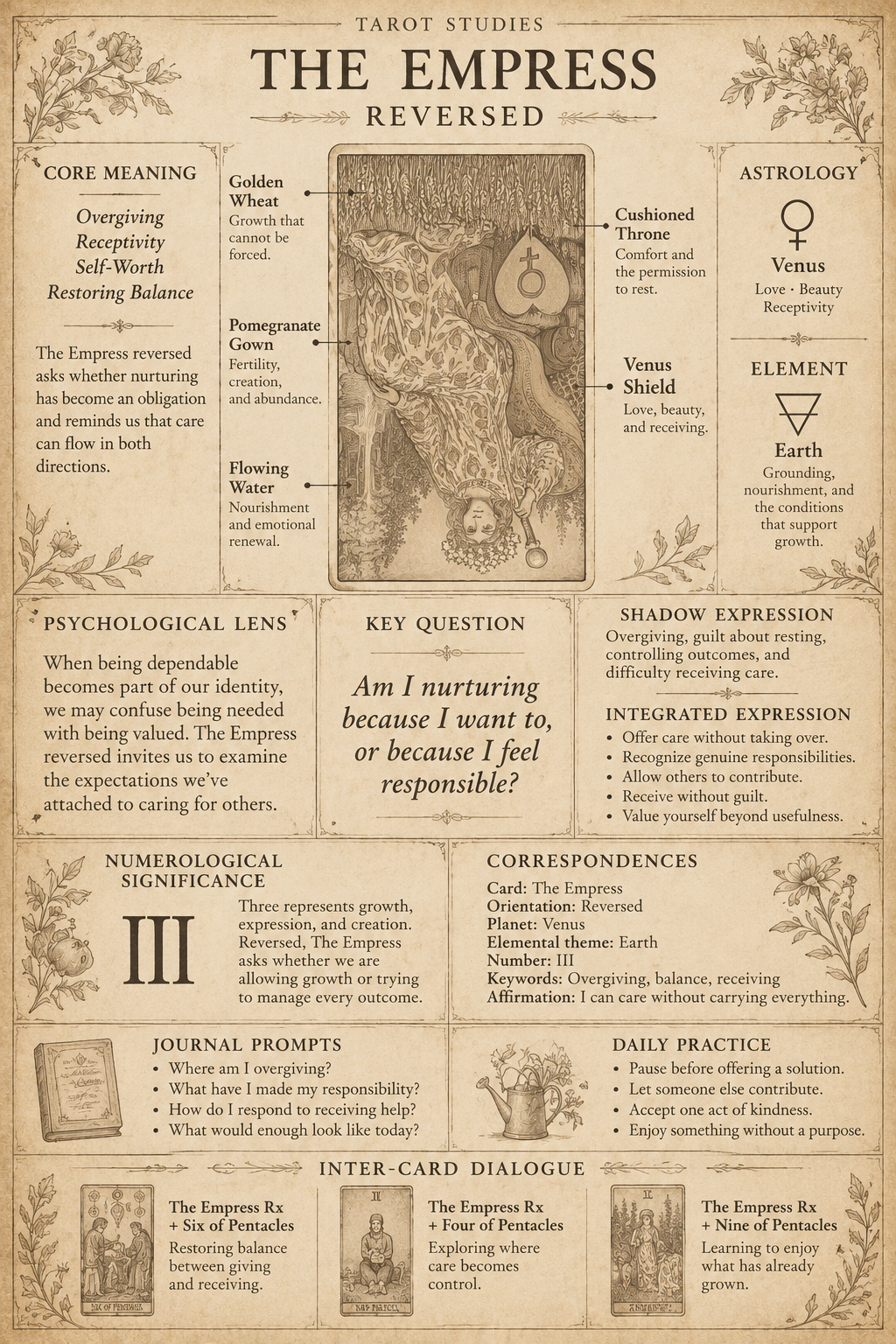
The Empress Reversed|Today’s Insight and Intention
When being nurturing stops meaning being responsible for everything
When I turned over The Empress reversed this morning, I let out a rather large sigh of relief.
Which is interesting, considering that The Empress is traditionally such a beautiful card of abundance, nurturing, creativity, and growth. She’s the mother figure of the Tarot, surrounded by everything she’s helped cultivate. She’s warm, generous, supportive, and apparently quite comfortable being responsible for making sure everything around her flourishes.
And ordinarily, that’s wonderful.
But sometimes I look at The Empress and think about just how exhausting it can be to be the person who nurtures everyone and everything. The person who makes sure everyone has what they need, who notices when something isn’t quite right, who encourages growth, provides support, and somehow keeps everything moving along.
It’s a lovely quality to have. It’s also a rather impressive job description for one person.
So when The Empress appeared reversed today, my first thought wasn’t that something was wrong. It was that perhaps I didn’t have to be all of those things for everyone today.
Perhaps I could put down some of that responsibility. Perhaps I could let someone else do a little nurturing. Or perhaps I could simply exist without feeling obligated to make everything around me better.
Because there’s something worth considering about The Empress reversed: What happens when the person who spends so much time nurturing everyone else finally gives herself permission to stop?
Not because she doesn’t care, but because caring doesn’t have to mean carrying everything.
Traditional Foundation
Traditionally, The Empress is the embodiment of abundance, nurturing, creativity, fertility, and the natural processes of growth. She represents our ability to cultivate something meaningful, whether that’s a relationship, a family, a creative project, or even our own sense of well-being. She reminds us that growth requires care, patience, and an environment where something has the opportunity to flourish.
In the Rider-Waite-Smith illustration, The Empress sits on a comfortable, cushioned throne surrounded by a lush landscape. A field of golden wheat grows before her, trees flourish behind her, and water flows through the scene. Her gown is decorated with pomegranates, traditionally associated with fertility and abundance, while the Venus symbol on her heart-shaped shield connects her to love, beauty, pleasure, and the capacity to receive as well as give.
One detail I find particularly interesting is that The Empress isn’t actually working in this picture. She’s not planting the wheat, watering the trees, or running around making sure everything grows according to schedule. She’s sitting comfortably amid the abundance depicted in the landscape, surrounded by the natural growth and beauty that characterize the card.

There’s something rather wonderful about that. The Empress represents nurturing, but the artwork doesn’t suggest that nurturing requires constant activity. Nature is growing around her without her personally supervising every blade of wheat.
When The Empress appears reversed, contemporary tarot interpretations often explore difficulties with nurturing, creative blocks, neglecting personal needs, or becoming overly involved in caring for others. Sometimes that takes the form of giving so much that little remains for ourselves. Other times, it can involve becoming so invested in someone else’s growth that we struggle to allow them the independence to develop on their own.
Interestingly, A. E. Waite’s original reversed meanings were somewhat different, including clarity, the resolution of complicated matters, celebration, and, alternatively, indecision. The emphasis on overgiving and neglected personal needs reflects a more contemporary psychological approach to the card.
This is also why learning to move from observation to interpretation matters: the traditional foundation gives us something to work with without requiring every reading to reach the same conclusion.
The reversal doesn’t necessarily remove the qualities of the upright Empress. Instead, it can change our relationship with them. Nurturing may become obligation, generosity may turn into overextension, and receiving care may feel uncomfortable when we’re accustomed to being the one who provides it. The same qualities that make The Empress so abundant can become difficult to experience when giving and receiving fall out of balance.
And that brings me back to the relief I felt when I saw her reversed this morning.
Perhaps I’ve been thinking about nurturing as something I have to do rather than something I can also experience.
Perhaps I’ve forgotten that the person who helps create abundance deserves to enjoy it, too.
Sometimes the Struggle Is
Sometimes the struggle isn’t that we don’t know how to nurture. It’s that we’ve become so good at it that everyone, including ourselves, has come to expect it.
We become the person who notices what needs to be done before anyone else realizes there’s a problem. We anticipate needs, smooth over difficulties, encourage people through their challenges, and somehow find ourselves responsible for things we never actually agreed to take on.
And because we’re capable of doing those things, we keep doing them. Somewhere along the way, being good at caring for others can quietly turn into feeling obligated to care for everyone.
Sometimes the struggle is:
- Feeling responsible for other people’s happiness, comfort, or success.
- Saying yes because it’s easier than explaining why we need to say no.
- Recognizing everyone else’s needs while overlooking our own.
- Feeling guilty when we rest because there’s always something else that could be done.
- Offering help before considering whether someone actually needs it.
- Struggling to let others make mistakes, solve problems, or find their own way.
- Measuring our value by how useful we are to the people around us.
There’s an interesting trap hidden in all of this. The more capable we become, the easier it is to assume that everything within our ability is also our responsibility.
But sometimes those expectations aren’t coming entirely from the people around us. We may have created them ourselves, gradually building an identity around being dependable, helpful, and available. When everyone knows we’re the person who can handle things, it becomes surprisingly difficult to admit that we don’t always want to.
And perhaps even more difficult to recognize that we don’t always have to.
The Key Question
The Empress reversed asks an important question:
Am I nurturing others because I genuinely want to, or because I’ve come to believe that their well-being is my responsibility?
It’s an uncomfortable question in some ways, particularly when caring for others is such a natural part of who we are. We don’t necessarily stop to consider why we’re helping. We see something that needs attention, recognize that we have the ability to make it better, and step in. Most of the time, our intentions are good.
But somewhere between wanting to help and feeling obligated to help, the experience of nurturing can change. What once brought satisfaction begins to feel like another responsibility. We may even find ourselves resenting the very things we willingly took on, then feeling guilty because nurturing is supposed to be something we enjoy.
Perhaps the more interesting question is whether we can continue being caring, generous, and supportive without assuming responsibility for every outcome.
Can we love someone without solving their problems? Can we encourage growth without directing every step? Can we recognize that something needs attention and still decide that we’re not the person who has to provide it?
The answers may tell us something about the expectations we’ve attached to nurturing, and whether those expectations still reflect the kind of care we actually want to give.

That Distinction Matters
Because nurturing someone and taking responsibility for their growth are two very different things. One offers the conditions in which something can flourish. The other assumes that we must somehow guarantee the outcome. And I think that’s where The Empress reversed becomes particularly interesting.
When we think about nurturing, we often associate it with doing something. Providing support, solving problems, anticipating needs, encouraging progress, and making sure everyone has what they need to succeed. There’s nothing inherently wrong with any of those things. In fact, they’re often expressions of genuine love, generosity, and commitment.But nurturing also requires knowing when to step back.
Consider the garden surrounding The Empress. We can prepare the soil, plant the seeds, provide water, and make sure the plants have access to sunlight. We can create favorable conditions for
growth. What we canot do is reach into the ground and make the roots develop faster simply because we’re impatient to see the results. And yet, when it comes to people, relationships, and responsibilities, we sometimes behave as though we should be able to do exactly that.
We take on someone else’s worries because we want them to feel better. We solve problems before others have the opportunity to work through them. We become so invested in helping something succeed that we forget growth is a process that doesn’t belong entirely to us.
Sometimes our involvement is necessary. Sometimes it’s appreciated. And sometimes, without realizing it, we may be taking away the very opportunities that allow someone else to develop confidence, independence, and responsibility.
The Empress reversed invites us to recognize that stepping back isn’t necessarily neglect. Allowing someone to struggle with a manageable challenge isn’t automatically a failure to support them. And choosing not to intervene doesn’t mean we’ve stopped caring.
Of course, there are responsibilities we genuinely cannot put down. Children need care, commitments matter, and some situations require our active involvement. The lesson isn’t to abandon those responsibilities or pretend that everyone can manage without us.
It’s to recognize the difference between what genuinely belongs to us and what we’ve simply become accustomed to carrying. Perhaps that’s the deeper meaning behind the relief I felt when I turned over The Empress reversed this morning. I didn’t suddenly stop wanting to nurture the people and things that matter to me. I simply recognized that I don’t have to be personally responsible for every part of their growth.
The Empress doesn’t lose her nurturing nature when she stops tending the garden for a moment. She allows herself to be part of it.
Hidden Gift
There is also something deeply liberating hidden inside The Empress reversed. The possibility that we can stop being the person who provides everything and discover what it feels like to simply receive.
When we’re accustomed to being the person who takes care of everyone else, receiving care can feel surprisingly uncomfortable. Someone offers to help, and we immediately explain why we don’t need it. Someone takes responsibility for something, and we find ourselves checking whether they’ve done it correctly. We finally have an opportunity to rest, and our minds begin compiling a list of everything we could be accomplishing instead.
Apparently, even relaxing can become another task we’re determined to manage efficiently. But I think there’s something deeper happening here than simply being uncomfortable with accepting help.
When being the dependable person becomes part of our identity, we can begin to associate our value with how much we’re needed. We know who we are when we’re solving problems, providing support, or making life easier for someone else. We’re useful. We’re contributing. We have a purpose.
So what happens when nobody needs anything from us?
For some of us, that can feel strangely unsettling. Without a problem to solve or someone to care for, we may find ourselves wondering what we’re supposed to be doing. We might even create another task because simply being present doesn’t feel quite productive enough.
But being needed and being valued aren’t the same thing.
Our relationships don’t have to depend entirely on what we provide. Our worth doesn’t disappear when we aren’t accomplishing something, and we don’t have to earn kindness by immediately finding a way to repay it. There is a quiet generosity in allowing other people to give, contribute, and care for us, too. It creates relationships where nurturing can move in more than one direction rather than becoming the permanent responsibility of one person.
Perhaps the hidden gift of The Empress reversed is discovering that we don’t have to be useful every moment to be worthy of love, comfort, or consideration. We can be appreciated for who we are, not simply for what we do.
And maybe learning to believe that is its own kind of growth.
Bringing the Empress Reversed Into Your day
Today may not be about finding new ways to nurture, support, encourage, or take care of everyone around us. We probably already have a fairly impressive collection of those skills, along with a running list of people, projects, and responsibilities that could benefit from our attention.
It may simply be about noticing the moments when we automatically assume responsibility and considering whether that response is necessary.
When someone shares a problem, pay attention to what happens inside you. Do you immediately begin developing solutions? Do you feel uncomfortable simply listening? Does another person’s frustration create an urgency to make everything better, even when they haven’t asked you to?
Sometimes people need our help. Other times, they may simply need someone willing to hear them.

We can also notice what happens when another person offers to contribute. Do we accept their help, or do we immediately explain why it isn’t necessary? Do we allow them to complete something in their own way, or do we quietly take over because we know how we’d prefer it done? These small reactions can reveal quite a bit about how comfortable we are with sharing responsibility. And then there’s the matter of enjoying ourselves.
For those of us who tend to measure a productive day by how much we’ve accomplished for everyone else, doing something simply because it’s pleasant can feel surprisingly difficult. We might sit down to read a book and immediately remember three things that need attention. We might take a walk and mentally organize tomorrow’s responsibilities instead of noticing what’s around us.
Perhaps today we can experiment with enjoying something without turning it into another opportunity for productivity or personal improvement.
Read something simply because it’s interesting. Accept a kindness without immediately planning how to return it. Appreciate something you’ve worked hard to create without identifying what still needs to be improved.
And when the familiar impulse to take care of everything appears, perhaps we can pause long enough to ask whether our involvement is genuinely needed. Not every situation requires us to step in, and not every quiet moment needs to be filled with something useful.
Sometimes enough really is enough.
Until Next Time
I keep coming back to that sigh of relief I felt when I turned over The Empress reversed this morning.
It’s interesting how a card traditionally associated with blocked creativity, neglected needs, or an imbalance in nurturing could feel so reassuring. But perhaps that’s the beauty of looking beyond the immediate keywords and considering what the symbolism means in our own lives.
For me, The Empress reversed didn’t feel like something was missing. It felt like permission to put something down.
Permission to recognize that I can be a caring person without being responsible for everyone’s happiness. That I can encourage growth without managing every outcome. And that I can be valued for who I am, even when I’m not doing something for someone else.
The Empress reversed does not ask us to stop nurturing the people and things we love. She asks us to recognize that nurturing was never supposed to require losing ourselves in the process.
And honestly?
Maybe the garden doesn’t need me to do anything else today. Maybe it’s finally my turn to sit among the flowers.
Until next time…,
Misti
Sources & Further Study
A. E. Waite, The Pictorial Key to the Tarot (1910). The historical foundation for the Rider-Waite-Smith system, including Waite’s description of The Empress, her symbolism, and the original upright and reversed divinatory meanings.
Pamela Colman Smith, The Empress, Rider-Waite-Smith Tarot (1909). The original card artwork provides the visual foundation for the discussion of wheat, water, vegetation, pomegranates, the Venus symbol, and the Empress’s seated posture.
Further reflection: The discussion of overgiving, identity, responsibility, receiving care, and self-worth represents the Tarot Studies psychological interpretation of The Empress reversed. These ideas are offered as possibilities for personal reflection rather than historical definitions or predictions.