
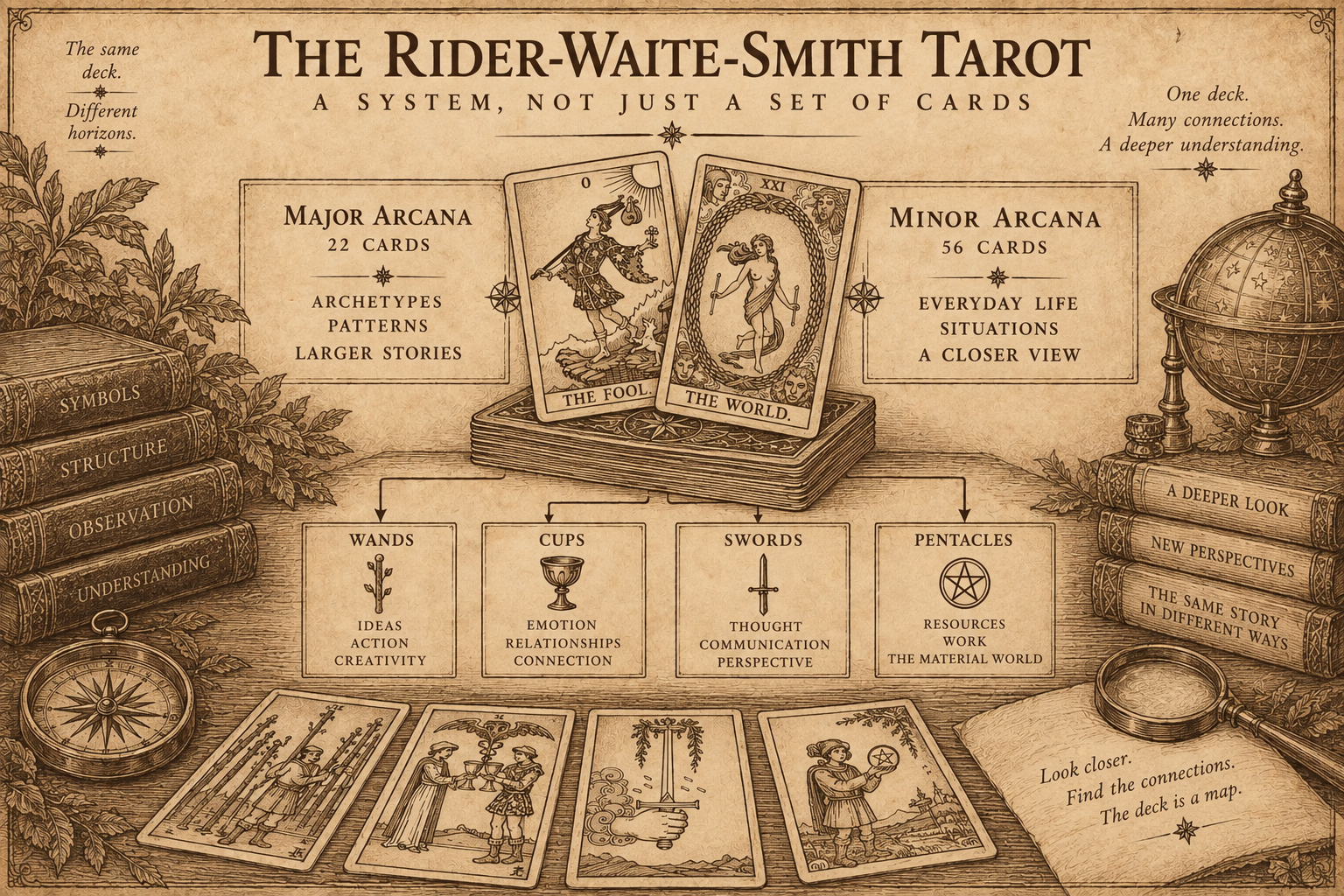
78 Cards is the Wrong Way to Think About It
Rider-Waite-Smith Series|Part III-A
Seventy-eight cards sounds like a lot.
If you approach the Rider-Waite-Smith Tarot as seventy-eight separate images, each with its own collection of meanings, symbols, keywords, reversals, and interpretations, it can quickly begin to feel like studying for an exam you never agreed to take.
The good news is that the Rider-Waite-Smith Tarot is not really seventy-eight unrelated lessons. It is a system.
Once we begin looking at the deck that way, something shifts. Instead of asking ourselves to memorize one card and then another and then another, we can start looking for the structures that connect them. Some cards share a suit. Some share a number. Some share a Court rank. Others belong to the Major Arcana and participate in a different kind of sequence altogether. Symbols and visual ideas can also appear, disappear, and resurface across the deck.
Those relationships give us a way into the cards before we have memorized everything there is to know about them. We can recognize where a card belongs, what it shares with other cards, and what makes its particular image different.
That is the work of this part of our Rider-Waite-Smith study. Before we ask what a card means, we are going to look at where it lives.
About Part III: A Series Within the Series
When I first began thinking about this part of our Rider-Waite-Smith study, it was tempting to put the entire structure of the deck into one article. After all, we could introduce the Major Arcana, move through the four suits, talk about numbers and Court Cards, add a few notes about symbolism, and technically cover the anatomy of the deck.
But covering something and actually giving ourselves time to study it are not quite the same thing.
The more closely we look at the Rider-Waite-Smith, the more apparent it becomes that its structure is not one subject. The Major Arcana has its own sequence and symbolic relationships. The Minor Arcana introduces four repeating suits. The numbered cards create another pattern as Ace through Ten moves across those suits, while the Court Cards add yet another relationship through Page, Knight, Queen, and King. Trying to explain all of that in a single article would give us a tour of the building without much time to open any of the doors.
So Part III has become a small series within our larger Rider-Waite-Smith series. The letters are simply there to help us keep our place as we move through it:
- Part III-A gives us the architecture of the full 78-card system.
- Part III-B takes us into the Major Arcana.
- Part III-C explores the Minor Arcana through the four suits.
- Part III-D follows Ace through Ten across those suits.
- Part III-E gives the sixteen Court Cards the space they deserve.
There is a reason for that order. We are moving from the largest structure toward its smaller repeating patterns. First we see the whole deck. Then we can take apart its major components, study how each one works, and understand how they relate without asking one article to carry everything at once.
It also protects an important boundary in this study. These Part III articles are primarily about understanding the system itself: what its components are, how they are organized, what repeats, and what relationships we can observe among them. We are building knowledge without pretending that structure automatically produces interpretation.
That next step belongs to Part IV: Interpreting the Rider-Waite-Smith: From Observation to Meaning. Once we have spent time with the architecture, Majors, suits, numbers, and Courts, we can bring those pieces back together and ask a different question: What matters when this particular card appears in this particular reading?
For now, we begin with the view from above. Before wandering into individual rooms, we are going to look at the floor plan.
One Deck, Several Interlocking Systems
Once you stop looking at the Rider-Waite-Smith Tarot as seventy-eight separate cards, its structure becomes much easier to see. The deck is made of several smaller systems layered together, and any one card can belong to more than one of those systems at the same time. Instead of having to approach each card as an entirely new piece of information, we can begin by asking where it belongs and what relationships are already waiting there.
At the broadest level, every card belongs to either the Major Arcana or the Minor Arcana. That gives us our first clue about where the card sits within the deck. Within the Minor Arcana, another layer appears through Wands, Cups, Swords, and Pentacles. Then we find another repeating structure in the numbers, from Ace through Ten, along with the four Court ranks of Page, Knight, Queen, and King. These are not separate filing cabinets where we tuck the cards away and forget about them. The structures overlap, and that overlap is where studying the deck starts to become much more interesting.
Take the Five of Cups. We can identify it first as a Minor Arcana card, then place it within the suit of Cups. Its number connects it to the Five of Wands, Five of Swords, and Five of Pentacles. At the same time, we still have the particular scene depicted on the card itself: the cloaked figure, the overturned cups, the two cups that remain standing, the river, the bridge, and the distant structure. All of that information belongs to the same card, but it is not all the same kind of information.
Its place in the Minor Arcana gives us one layer of structure. Its suit gives us another, while its number creates a relationship with three cards elsewhere in the Minor Arcana. Then the image gives us visual evidence particular to the Five of Cups itself. None of those pieces has to carry the entire interpretation on its own, and that distinction changes the way we can study the card. Instead of asking one detail to provide the answer, we begin noticing how several kinds of information can work together.
The same principle carries across the deck. A Major Arcana card belongs to a sequence of twenty-two cards and may echo symbols, numbers, figures, gestures, or visual ideas that appear elsewhere in that sequence. A numbered Minor Arcana card belongs simultaneously to a suit and to a numerical family. A Court Card combines its suit with a rank that appears in each of the other three suits. Once we begin seeing those relationships, a card that seemed isolated suddenly has neighbors.
That also gives us two useful ways to move through the deck. We can study vertically, following one family through its progression, such as moving from the Ace of Cups to the Two of Cups, Three of Cups, and onward through the suit. Or we can turn the deck sideways, conceptually speaking, and study horizontally, placing cards with the same structural feature beside one another. The Five of Wands, Five of Cups, Five of Swords, and Five of Pentacles may look quite different, but their shared number gives us a reason to put them on the table together and start looking.
Neither direction is inherently better. They simply allow us to notice different kinds of relationships, many of which are easy to miss when every card is studied in isolation. Following a suit lets us watch what changes as the number changes. Comparing a number across suits lets us hold one structural feature steady while everything around it shifts. Later, we can do something similar with the Court Cards by following a rank across all four suits.
This is where the Rider-Waite-Smith begins to feel less like a collection of separate pieces and more like a language. We are not abandoning individual cards or replacing them with a tidy formula. We are learning to recognize the patterns that connect them, which gives us more ways to approach a card when we encounter it again.
Before we explore any one of those patterns in depth, though, we need to see the larger map they belong to. So let’s spread all seventy-eight cards out, figuratively at least, and look at the basic architecture of the deck.
The Architecture of the 78 Cards
At its most basic level, the Rider-Waite-Smith Tarot contains seventy-eight cards divided into two main groups: the Major Arcana and the Minor Arcana. That first division gives us the broadest view of the deck, but once we look inside each group, the architecture becomes much easier to recognize.
The Major Arcana contains twenty-two cards, beginning with The Fool and continuing through The World. These are the individually named cards many people recognize first when they encounter Tarot: The Magician, The High Priestess, The Lovers, Strength, Death, The Tower, The Star, and the rest of the sequence. Each has its own name and imagery, and together they form a distinct branch of the Rider-Waite-Smith system.
The remaining fifty-six cards make up the Minor Arcana, and this is where the architecture becomes more visibly repetitive. The Minor Arcana is divided into four suits: Wands, Cups, Swords, and Pentacles. Each suit contains fourteen cards, with ten numbered cards running from Ace through Ten and four Court Cards: Page, Knight, Queen, and King.
That gives us a much more manageable structural map. The seventy-eight cards divide into twenty-two Major Arcana and fifty-six Minor Arcana. Within those fifty-six Minor Arcana cards, we find forty numbered cards and sixteen Court Cards. Those forty numbered cards are created by the same Ace-through-Ten sequence appearing across four suits, while the sixteen Courts come from the same four ranks appearing across those suits.

78 → 22 Major / 56 Minor → 40 Numbered / 16 Courts
The arithmetic itself is simple. What matters is what the structure reveals. We are not actually dealing with forty completely unrelated numbered cards. Every numbered Minor Arcana card participates in two repeating structures at once: suit and number. The Four of Wands belongs to the Wands family, connecting it to the other cards in that suit, but it also belongs to the family of Fours alongside the Four of Cups, Four of Swords, and Four of Pentacles. We can therefore approach the same card from more than one direction.
The Court Cards give us a similar arrangement. The Queen of Cups belongs with the other Cups cards because they share a suit, but she also belongs with the Queen of Wands, Queen of Swords, and Queen of Pentacles because they share a rank. Depending on what we want to investigate, we can follow the Cups through their progression or place the four Queens beside one another and look at what remains consistent and what changes.
The Major Arcana works differently, and that difference is part of what makes it its own branch of the system. Its twenty-two cards do not repeat through four suits, nor do they follow the same number-and-suit architecture we find in the numbered Minor Arcana. Rather than trying to squeeze the Majors into a framework that does not belong to them, we will give that sequence its own attention in the next part of this series.
For now, what matters is seeing the shape of the deck clearly. Seventy-eight cards become twenty-two Majors and fifty-six Minors. The fifty-six Minors become forty numbered cards and sixteen Courts, and those groups become even easier to navigate once we recognize the repeating suits, numbers, and ranks within them.
Seen this way, the numbers are doing more than telling us how many cards are in the box. They are revealing the architecture underneath the deck. What first looked like seventy-eight separate things to learn begins to resolve into a handful of repeating structures and relationships.
Suddenly, seventy-eight is not quite as unruly as it first appeared.
Major and Minor: Two Different Scales of Experience
Dividing the deck into Major and Minor Arcana gives us our first major structural distinction, but the names themselves can be misleading. Major does not automatically mean important, nd Minor does not mean unimportant. It is more useful to think about the two groups as giving us different scales or layers from which to consider experience.

The Major Arcana often brings us into contact with broader patterns: identity, transformation, choice, attachment, courage, uncertainty, endings, beginnings, upheaval, integration, and other experiences that can take on an archetypal or developmental quality. These cards can invite us to step back from the immediate situation and consider the larger pattern moving through it rather than focusing only on what is happening in front of us.
The Minor Arcana generally brings us closer to how life is being lived. Here we encounter actions and reactions, thoughts and conversations, emotional experiences, relationships, conflicts, responsibilities, resources, work, creativity, decisions, and the practical conditions surrounding us. Its suits, numbers, Court ranks, and illustrated scenes give structure to those experiences, bringing our attention closer to the circumstances through which a larger issue may actually be unfolding.
The difference becomes easier to understand when we stop trying to turn Major and Minor into a hierarchy. Imagine someone facing a difficult decision at work. A Major Arcana card might draw attention toward a larger developmental question underneath that decision: independence, responsibility, values, identity, change, or perhaps the need to reconsider an established way of doing things. The card widens the lens so we can consider what the situation may represent within a larger pattern of experience.
A Minor Arcana card might bring us closer to the way that same issue is actually being lived. Perhaps there is a disagreement with a colleague, anxiety surrounding the decision, a question about available resources, competing priorities, or an action that needs attention. We have not necessarily moved to a less important issue. We have changed the distance from which we are looking at it.
This is why Major and Minor can be particularly interesting when they appear together. One does not cancel out the other, nor does the Major automatically outrank the Minor. Instead, the deck can move between the larger pattern and its everyday expression, allowing us to consider both the broader theme and the circumstances through which that theme is being experienced.
For now, however, we do not need to decide exactly what a Major or Minor Arcana card means when it appears in a reading. That question belongs later, when we begin working with interpretation and context. At this stage of our study, we are learning to recognize the first structural question we can ask of any card: Where does this card belong in the deck?
If the card belongs to the Major Arcana, we know which branch of the system we are entering. If it belongs to the Minor Arcana, we know there are additional structures waiting underneath it: suit, number or Court rank, and the individual image. Recognizing that location does not give us a finished interpretation, but it does give us somewhere to begin.
And from here, our map can become more detailed as we move inside the Minor Arcana and look at the repeating architecture that holds its fifty-six cards together.
The Structure Inside the Minor Arcana
Once we move into the Minor Arcana, another organizing principle becomes visible: repetition with variation. The fifty-six Minor Arcana cards are divided among Wands, Cups, Swords, and Pentacles, with each suit containing ten numbered cards from Ace through Ten and four Court Cards: Page, Knight, Queen, and King. We have already seen that basic architecture. What becomes more interesting now is what the repetition allows us to notice.
Every numbered card participates in two relationships at the same time. It belongs to a suit, connecting it to the other cards within that family, and it belongs to a number, connecting it to the three cards carrying that same number in the other suits. The Court Cards create a similar arrangement through suit and rank. A Queen belongs to her particular suit, but she can also be placed beside the other three Queens and studied as part of a repeating rank.
This means that something is almost always staying the same while something else changes. A suit can remain constant while the number changes. A number can remain constant while the suit changes. A Court rank can remain constant while the suit changes. Through all of those combinations, the individual imagery gives each card its own scene, figures, movement, atmosphere, and visual character.
That combination gives us something useful to investigate because we are no longer comparing cards at random. If the Four of Wands and Four of Cups share a number but depict very different scenes, both the similarity and the difference are worth our attention. We can ask what connects them structurally while also noticing what changes when we move from one suit into another.
The same approach works with the Court Cards. The Queen of Swords and Queen of Pentacles share a rank but belong to different suits, giving us another stable point for comparison. We do not need to decide yet what being a Queen means or how Swords and Pentacles alter that rank. At this stage, simply recognizing that the relationship exists is enough to give us a more deliberate way of studying the cards.
This is why repetition does not make the Minor Arcana less interesting. Quite the opposite. Repetition gives us a stable point from which to notice variation. Instead of seeing the repeated numbers, suits, and ranks as more information to memorize, we can use them as points of comparison and begin watching what the deck does differently each time the pattern appears.

Later in this series, we will take each of these relationships further. We will spend time with the four suits and their elemental associations, then look across the numbered Minor Arcana to explore what happens when the same number appears in different suits. The Court Cards will have room of their own as well, because the relationship between rank and suit introduces another layer of structure worth examining carefully.
For now, we do not need all of those answers. What matters is recognizing the architecture underneath the cards and understanding why it gives us more than one way to study them. Once we know what is repeating, we have a stable point of comparison. From there, the differences in image, setting, figure, movement, and circumstance become much easier to see.
And those differences are where our next experiment begins. Instead of talking about repetition with variation in the abstract, we can put four cards on the table that share the same number and see what actually happens.
The Same Pattern, Expressed Differently
Let’s see what repetition with variation actually looks like by considering the four Fives: the Five of Wands, Five of Cups, Five of Swords, and Five of Pentacles. At first glance, these cards do not look particularly alike, which is precisely what makes them useful for comparison.
The Five of Wands depicts figures engaged with one another through raised staffs. The Five of Cups centers on a cloaked figure facing overturned cups while two remain standing behind. The Five of Swords gives us another kind of interaction, with figures separated across the scene and swords gathered in the foreground. The Five of Pentacles shifts again, depicting two figures moving through a difficult environment beneath an illuminated window. We have four distinctly different scenes, yet the deck has given all four cards the same number.
That shared number is worth noticing, but we do not have to decide yet what the number Five contributes to these cards. In fact, doing that too quickly would defeat the purpose of the exercise. At this stage, we are simply recognizing that the Rider-Waite-Smith has created a structural relationship among the four cards. Because one part of their structure remains the same while other parts change, we have something specific to compare.

Five of Wands / Cups / Swords / Pentacles
Put the four cards beside one another and begin with observation. Look at the figures, movement, objects, settings, and relationships within the scenes, asking yourself what seems to repeat and what changes. One card may appear more active while another seems more still. One may focus attention on interaction among several figures, while another draws our attention toward separation, environment, or an individual’s response to what is happening.
The purpose is not to decide immediately what all four cards must mean simply because they share the number Five. Instead, we are using that shared number as a stable point from which to investigate their differences. We know why these four cards belong together structurally, so we can turn more of our attention toward what the individual images are doing differently.
We can also turn the experiment around. Instead of comparing the four Fives, place several Cups cards beside one another. This time, the suit remains constant while the number changes. The imagery changes, the figures change, and the circumstances depicted in each card change, but the shared suit gives us a stable relationship against which those differences can be compared.
This gives us a simple set of questions we can carry into structural study: What does this card share with other cards? What makes it different? Which part of its structure is repeating, and which part is changing? These questions keep us looking closely at the cards rather than rushing toward a predetermined meaning.
Later, when we study the numbered Minor Arcana in greater depth, we will return to these relationships and ask the question we are deliberately leaving unanswered here: What does a shared number contribute, and how does each suit change the way that pattern is expressed? For now, we have discovered something more foundational. A repeated structure gives us a point of comparison, and comparison gives us another way to learn the deck.
Why Structure Makes Tarot Easier to Learn
Understanding structure gives us somewhere to begin, but it does not replace the value of studying individual cards. In fact, once we understand something about the system surrounding a card, we can return to its individual image with more interesting questions. We are no longer asking memory to do quite so much of the work because the card already has relationships we can recognize.
When Tarot knowledge is stored as disconnected information, recognizing a card can depend heavily on remembering what we have previously read about it. Did I memorize the right keyword? What did that book say? Was this the card associated with one idea or another? Structure gives us another route into the card because we can begin by locating it within relationships we already understand, even when the complete traditional meaning does not immediately come to mind.
We can start with fairly simple questions. Is the card Major or Minor? If it is Minor, which suit does it belong to? Is it a numbered card or a Court Card? What structural features does it share with other cards, and what is distinctive about the particular scene in front of us? Each question gives us another foothold without requiring us to produce an interpretation before we have really looked at the card.
This does not require us to forget everything we already know. Traditional meanings, previous study, personal experience, and familiarity with the deck still matter. We are simply giving that knowledge an underlying framework so that individual pieces of information have somewhere to connect. Instead of collecting more and more facts about Tarot, we begin recognizing how some of those facts relate to one another.
I think of this as learning the grammar of the deck rather than collecting vocabulary without knowing how the words relate. Knowing grammar does not tell you exactly what every sentence will say, nor does it make every sentence predictable. It gives you a way to understand how the pieces can work together. Tarot structure functions in much the same way. A suit, number, rank, or category gives us information about how a card participates in the larger system without deciding everything that card can communicate.
This becomes particularly helpful when we encounter a card we do not remember as well as we would like. You may not recall everything you have ever read about the Three of Swords, for example, but if you can recognize where it sits within the deck, you are not beginning from nothing. You know it belongs to the Minor Arcana, to Swords, and to the numerical family of Threes. That gives you a structural foothold. From there, you can return to the image, notice what is happening, draw on what you already know, and begin asking better questions rather than scrambling for a memorized definition.
Over time, these relationships become part of how you recognize the deck. Cards sharing a number begin to speak to one another in interesting ways. You start noticing how the atmosphere shifts as you move between suits, how Court ranks can be compared across those suits, and how symbols that once seemed like isolated decorations appear elsewhere in the deck. One relationship leads to another, and gradually the deck becomes less like a collection of separate rooms and more like a building whose hallways you have finally begun to notice.
That is why learning structure does not make Tarot smaller by stripping away its complexity. It does almost the opposite. The complexity remains, but we have more ways to move through it. We can follow a suit, compare a number, trace a rank, return to an image, and recognize where one card connects with another without expecting any single piece of information to provide the whole answer.
Structure makes the complexity easier to navigate, and that is its real value.
Structure Is a Framework, Not a Formula
Knowing where to begin is not the same as knowing where a reading will end. Once we begin seeing the structure underneath the Rider-Waite-Smith, there is another temptation waiting for us: turning that structure into a formula. If a number contributes one thing, a suit contributes another, and the card belongs to a particular part of the deck, it can seem reasonable to put those pieces together and expect a finished meaning to appear.
Tarot rarely behaves that neatly. Structure gives us a framework for understanding a card, but a framework is not the same thing as an answer. It can tell us where a card sits within the larger system and reveal relationships worth investigating, but it cannot do all of the interpretive work for us.
Consider the Seven of Pentacles. We can locate it within the Minor Arcana, identify Pentacles as its suit, and recognize Seven as its number. Those structural coordinates connect the card to the other Pentacles and to the other Sevens, giving us useful relationships to explore. But none of that makes the individual image unnecessary.
The figure, the cultivated growth, the pentacles gathered within it, the figure’s posture, the pause in activity, and the atmosphere of the scene all contribute information that its structural categories alone cannot provide. This is where the individual card begins to distinguish itself from the larger families to which it belongs. Structure helps us locate the Seven of Pentacles, while the image gives us something more particular to observe.
Even that does not finish the interpretation. The Seven of Pentacles can appear in readings about work, relationships, creative efforts, money, long-term plans, or something else entirely. The question being explored matters, the surrounding cards matter, and what the reader notices within the image matters. The same card can participate in different conversations without becoming a completely different card each time.
This is why I think of Tarot structure as a set of coordinates rather than instructions.

Minor Arcana → Pentacles → Seven → Seven of Pentacles
Coordinates help us locate where we are, but they do not tell us what we will find when we get there. Learning that distinction protects us from simply replacing one rigid system with another. If we move away from fixed definitions only to create a new formula of number + suit + symbol = meaning, we have changed the method without really changing the problem.
The goal is not to find a faster route to the correct keyword. It is to understand the card well enough that we can investigate what it is doing. Structure gives us relationships to examine, traditional knowledge gives us another layer, and the image provides visual evidence. Our own response to the card may raise possibilities worth exploring, while the question and context of a reading will eventually help us decide which of those possibilities deserves more attention.
That distinction betweenpossibility and interpretation is important enough to have its own place in this series. When we reach Part IV: Interpreting the Rider-Waite-Smith, we will move from knowing the architecture to actually working with it. Observation, discernment, context, visual evidence, traditional knowledge, and reflection will begin coming together through the Lantern Method. That is where the question shifts from Where does this card belong? towardmWhat matters here, in this reading, and why?
We are not trying to answer that question yet. At this stage, our task is more foundational: to understand the architecture well enough that we can move around the deck without expecting the architecture to make every decision for us.
We are learning the map without mistaking the map for the journey.
Your Map of the Rider-Waite-Smith
At this point, we have not learned the meanings of seventy-eight cards, and that is exactly as it should be. What we have instead is a map. We know that the Rider-Waite-Smith is divided into the Major Arcana and Minor Arcana, and that the Minor Arcana contains four suits, a repeating sequence of numbered cards, and four Court ranks. More importantly, we know that these structures allow us to study cards in relationship with one another rather than treating every card as an isolated meaning to memorize.
From here, we can slow down. Each part of that architecture deserves its own attention, and the next stages of this series will allow us to explore those relationships one at a time before bringing them back together for interpretation.

The twenty-two Major Arcana cards, running from The Fool through The World, are often approached through archetypal and developmental themes. In the next part of this series, we will look more closely at their sequence, numbers, recurring imagery, and symbolic relationships. Rather than reducing the Major Arcana to twenty-two individual keywords, we will begin looking at the connections that emerge when these cards are studied as a larger group.
The fifty-six Minor Arcana cards bring us into the repeating structure of Wands, Cups, Swords, and Pentacles. Our first step inside that structure will be to look at the suits themselves and the elemental language associated with them. This gives us a foundation for recognizing what remains consistent within a suit before we begin examining how its individual cards change.
Within those four suits are the forty numbered Minor Arcana cards, created as Ace through Ten repeats across Wands, Cups, Swords, and Pentacles. This is where our horizontal and vertical comparisons become particularly useful. We can follow a number across all four suits, follow a suit from Ace through Ten, and investigate what stays constant as other parts of the structure change.
The remaining sixteen Minor Arcana cards are the Courts: Page, Knight, Queen, and King appearing once within each suit. Their repeating ranks give us another opportunity to study variation within a stable structure. We will look at how rank and suit work together, while also making room for Court Cards to represent more than rigid descriptions of particular kinds of people.
Once those pieces are familiar, we can ask a different kind of question: How do we decide which parts of all this knowledge actually matter when a card appears in a reading?
That is where structure begins to become interpretation. In Part IV: Interpreting the Rider-Waite-Smith: From Observation to Meaning, we will bring the pieces back together and begin working with observation, visual evidence, traditional knowledge, context, card relationships, discernment, and reflection. Instead of simply identifying where a card belongs, we will begin considering which possibilities are relevant to the question in front of us and why.
For now, you do not need to hold the entire deck in your head. That was never the point of building this map. The purpose was to make the Rider-Waite-Smith easier to navigate by recognizing the pathways already built into it. We can explore one branch at a time, knowing how it connects to the larger system.
Our first path takes us into the twenty-two cards that stand apart from the repeating four-suit structure of the Minor Arcana. We have looked at the architecture from above. Now it is time to step inside it, beginning with the Major Arcana.
Next: Entering the Major Arcana
The architecture we have uncovered is beautifully repetitive until we reach the Major Arcana, where the pattern changes. There are no four suits carrying the same twenty-two cards and no repeating Court ranks. Instead, we encounter twenty-two individually named and numbered cards, each with its own scene and symbolic landscape.
That does not mean the relationships disappear. They simply take a different form. Symbols, figures, gestures, numbers, and visual ideas can create connections across the Major Arcana even when the cards themselves look quite different. The infinity symbol above The Magician, for example, appears again above the woman in Strength, giving us a visual thread we can follow from one card to another.
These relationships invite us to study the Major Arcana differently from the repeating architecture of the Minor Arcana. Instead of following a suit across ten numbered cards or comparing the same number across four suits, we can begin looking at sequence, recurring imagery, symbolic relationships, and the larger themes that emerge among these twenty-two distinctive cards.
That is where our next stage of study begins. We have the map, and now we can enter the first territory on it, exploring what happens when the repeating architecture of the Minor Arcana gives way to the distinctive structure of the Majors.
Continue to Part III-B: Understanding the Major Arcana: Archetypes, Sequence, Symbols, and the Larger Story.
References & Further Study
Arthur Edward Waite, The Pictorial Key to the Tarot (1911).
Waite’s accompanying text for the Rider-Waite-Smith Tarot remains an important primary source for studying the deck and its original published framework.
The Metropolitan Museum of Art, “Immaterial: Tarot.”
Useful historical context for Tarot’s development and the much longer history surrounding the cards before the Rider-Waite-Smith deck.
Rachel Pollack, Seventy-Eight Degrees of Wisdom.
A valuable further study for readers interested in exploring the cards as interconnected symbolic and interpretive systems.
Mary K. Greer, Tarot for Your Self.
A practical resource for moving from Tarot study into personal exploration and reflective practice.