
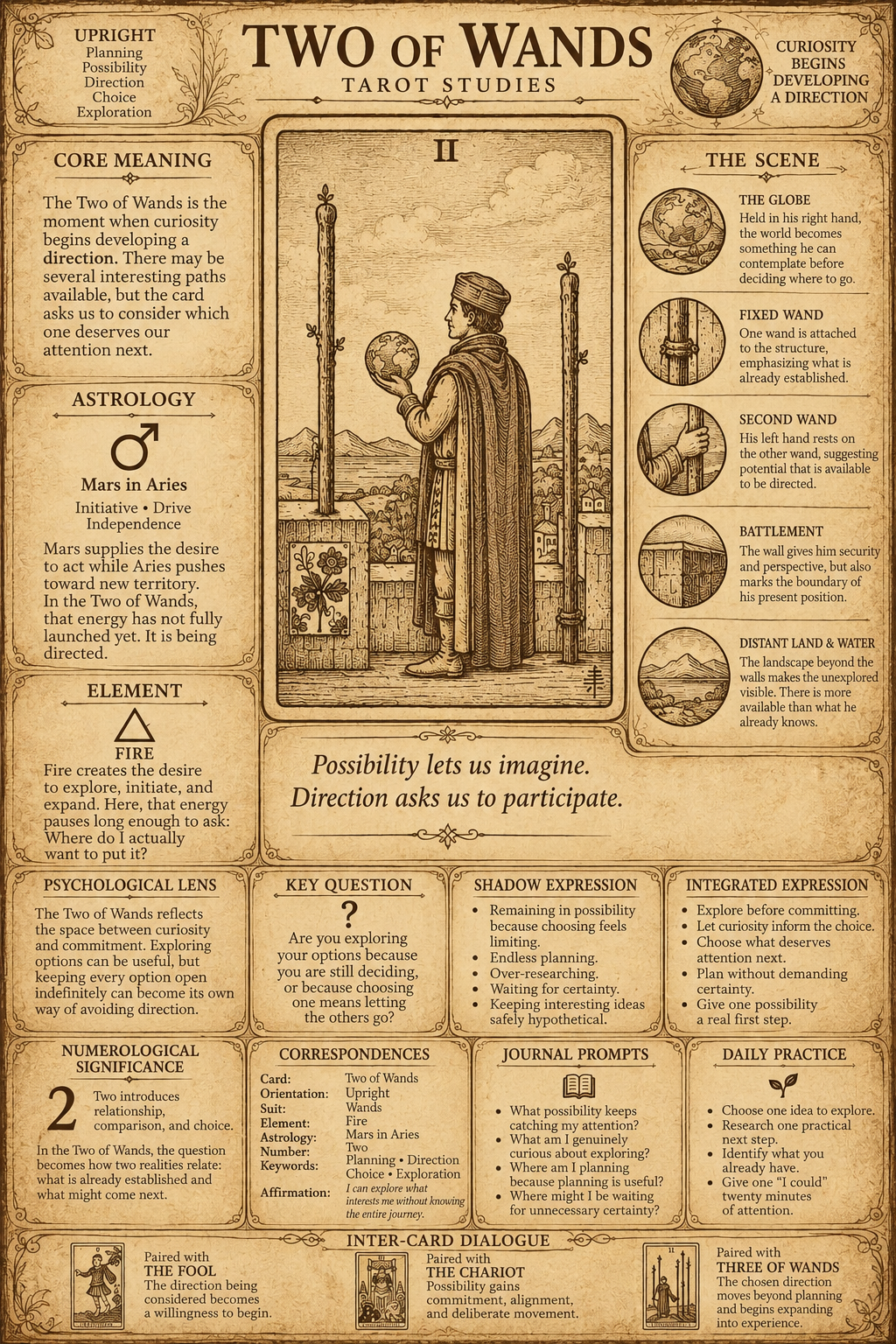
Daily Tarot Pull: Two of Wands
When having options is exciting until you have to choose one
Today’s card is the Two of Wands, and my first reaction was a little, yay, Two of Wands. I get to start planning.
Where would I like to go now? Would I like to travel? Would I like to learn something new? Is there something I’ve been thinking about trying that I could finally start exploring? There are options here, and honestly, that is usually someplace I get excited about.
There is something wonderful about standing at the beginning of possibility. Nothing has been completely decided yet, which means almost anything still feels available. You can look around, imagine different directions, make plans, change those plans, and entertain a few versions of what might come next.
And the Two of Wands gives us plenty of room for that excitement.
But there is also something interesting about the figure in the Rider-Waite-Smith card. He has a whole world in his hand, quite literally, and yet he is not going anywhere. Not yet.
Maybe that is where the Two of Wands becomes more interesting than simply, Yay, I get to make plans.
Because having possibilities and choosing what to do with them are two very different experiences.
Traditional Foundation
In contemporary Rider-Waite-Smith reading, the Two of Wands is commonly associated with planning, future possibilities, personal direction, and deciding what comes next. Waite’s original published meanings were considerably more complicated, ranging from wealth and magnificence to sadness and dissatisfaction. But Smith’s image gives us something especially useful to work with: a figure who possesses something already established while looking beyond it toward a larger world.
As a Two, the card introduces choice and comparison. As a Wands card, those choices are connected with desire, initiative, creativity, ambition, and the things that make us want to move.
The Rider-Waite-Smith image captures that strange little space between wanting something and actually pursuing it. A well-dressed figure stands high on a battlement, looking across the landscape toward distant water and mountains. One wand is fixed to the structure behind him, while his left hand rests on the other. In his right hand, he holds a small globe.

That globe is difficult to ignore. He appears to have the world available to him, or at least the ability to imagine a much larger world than the one immediately surrounding him. The distant landscape reinforces that sense of opportunity. There are places beyond the walls. There are things he has not experienced yet.
But notice where he is standing. He is still inside the structure.
That does not necessarily make him hesitant or afraid. Planning is part of movement too. Before we choose a direction, we often need a moment to look beyond what we already know and consider what is actually available to us.
The two wands make that moment especially interesting. One is fixed in place while the other is available to him. Visually, the card holds stability and exploration together. There is something already established around him, while something beyond it is beginning to attract his attention.
The Two of Wands therefore isn’t simply about having options. It is about becoming aware that the life, project, idea, or direction we already have may not be the only one available.
Sometimes that realization is exciting enough all by itself.
The harder part comes when all those interesting directions eventually ask us to decide which one deserves our attention.
Sometimes the Struggle Is…
The Two of Wands can be a wonderfully optimistic card because it gives us room to imagine. But there is a funny thing about options: they are often much more enjoyable before we have to eliminate any of them.
As long as I am planning a trip, I can theoretically go anywhere. As long as I am thinking about what I want to learn, I can imagine learning everything. As long as the new project exists entirely in my head, it can be brilliant, perfectly organized, and completed without a single irritating logistical problem.
Reality has not gotten its fingerprints on it yet.
Sometimes the struggle is:
- enjoying the planning more than taking the first step
- having several good options and not wanting to give any of them up
- waiting for one choice to feel completely certain
- researching long after we already have enough information
- mistaking endless preparation for useful planning
- staying with what is familiar while imagining something different
- wanting to know exactly where a path leads before agreeing to take it
None of those things automatically mean we are procrastinating. The figure in the card is standing still for a reason. Looking ahead, comparing possibilities, and deciding what deserves our energy can be valuable work.
The question is whether we are using the pause to develop a direction or using all those interesting options to avoid choosing one.
That difference can be surprisingly difficult to spot when planning itself feels productive.
The Key Question
The Two of Wands brings us to that point where imagining what could happen begins to bump into deciding what we actually want to pursue. We can look toward the horizon for a long time, considering one direction and then another, but eventually all that curiosity needs somewhere to go.
This card asks an important question:
Are you exploring your options because you are still deciding, or because choosing one means letting the others go?
There is a difference between needing more time and wanting to keep every door open. Choosing one direction does mean that, at least for now, we are not choosing another. That can make even an exciting decision feel strangely uncomfortable.
The figure in the Two of Wands doesn’t need to know everything waiting beyond those walls before he moves. He probably couldn’t know anyway. He only needs enough information to decide which direction deserves the next step.
Maybe that is part of what makes this card feel exciting to me. The world in his hand isn’t necessarily a promise that he can have everything. It is the realization that there is more available than what he has already known, and now he gets to decide what he wants to explore.

That Distinction Matters
There is a difference between having possibilities and having direction. Possibility lets us imagine. Direction asks us to participate.
The Two of Wands doesn’t suggest that we should rush through the planning stage just so we can say we did something. The figure is looking carefully at what lies beyond the walls, and there is value in that pause. We need time to consider what interests us, what fits, what resources we have, and what we might actually want enough to pursue.
But eventually, a plan has to become more specific than I could.
I could travel. I could take the class. I could start the project. I could change something. I could learn something completely new. There is energy in every one of those ideas, but keeping all of them available is not the same thing as developing a direction.
The artwork gives us a beautiful picture of that tension. One wand remains attached to the structure around him. The other is available to him. He does not have to abandon everything established in order to explore what else might be possible.
He can stand within what he already knows while beginning to decide what he wants to reach toward next.
Once we say, this is the direction I want to explore, planning can become more specific. We can make the reservation, sign up for the class, open the document, set aside the money, ask the question, or take whatever small first step belongs to that particular path.
And choosing one thing does not mean we have made a permanent declaration about the rest of our lives. Sometimes we treat decisions as though a committee will arrive with paperwork and permanently revoke all our other options. Usually, they won’t.
Sometimes choosing simply means deciding where we are going to put our attention next.
That may be the deeper movement inside the Two of Wands. The figure does not need to conquer everything he can see. He needs to begin deciding what deserves his attention.
The Hidden Gift
There is also something deeply liberating hidden inside the Two of Wands.
You do not have to know exactly where a path will lead before deciding that it is worth exploring. That can be easy to forget when we are planning. We start with something that sounds interesting, and five minutes later we’re trying to determine whether it will still be the right decision three years from now. Suddenly, I’d like to try this has become a full strategic review complete with imaginary consequences, projected outcomes, and possibly a spreadsheet.
The Two of Wands gives us a little more breathing room than that.
The figure isn’t being asked to experience everything he can see at once. He is looking outward and considering what might be worth moving toward. There is curiosity in that position, but there is also agency. A larger world may be available, but he still gets to decide which parts of it matter to him.
That is an important part of planning that can get lost when we become too focused on making the right choice. A good decision doesn’t always begin with certainty. Sometimes it begins with interest.
I’d like to know more about that. I’d like to see what happens if I try this. That direction feels worth exploring.
Those aren’t insignificant thoughts. They are often the beginning of direction.
Maybe the hidden gift of the Two of Wands is permission to let curiosity participate in the decision. We can consider the practical pieces, look at what we already have, think about what a choice might require, and still leave a little room for the simple fact that something interests us.
We don’t have to figure everything out before we begin. Sometimes we just have to notice what keeps catching our eye.
Bring the Two of Wands Into Your Day
Today may not be about making a huge decision, booking a flight, changing careers, or announcing that you have finally figured out what you’re doing with the rest of your life.
It may simply be about taking one of those I could thoughts and giving it a little more substance.
If you’ve been thinking about traveling somewhere, look at what the trip would actually require. If you’ve been wanting to learn something new, find the class or book. If you’ve been considering a project, write down what the first few steps might be. If an idea keeps returning, give yourself twenty minutes to explore it instead of immediately deciding whether it deserves the next five years of your life.
The Two of Wands gives us permission to be curious, but it also asks us to notice where that curiosity is beginning to develop a direction.

That might mean:
- choosing one possibility to investigate more closely
- gathering the information needed to make a decision
- identifying what you already have available to you
- noticing which option keeps pulling your attention back
- taking one small action that lets you explore an idea further
There is no requirement that today’s step be dramatic. The figure in the card hasn’t crossed the ocean yet either. He is still standing at the wall, looking outward. But looking outward can be meaningful when we are beginning to see where we want to go.
Maybe today’s practice is simply to ask yourself, Of all the things I could do, what am I genuinely interested in exploring next?
Then give that interest a little room to develop.
Until Next Time
I started today with a little yay, Two of Wands. I get to plan. I get to think about where I might go, what I might learn, what I might try, and what could come next.
And I still think that excitement belongs here.
The Two of Wands doesn’t need us to become suspicious of planning just because eventually we will have to choose. There is value in looking beyond what we already know and realizing that our current circumstances are not necessarily the boundaries of what comes next.
But the card also reminds us that the globe in the figure’s hand is not the journey itself. At some point, something that interests us has to become something we are willing to explore.
The Two of Wands does not ask us to have the whole journey figured out.
It asks us to look at what is available and decide what deserves a closer look.
And honestly?
Maybe “I wonder what would happen if I tried that” is enough of a reason to take the first step.
Until next time…
Misti
Sources & Further Study
Waite, Arthur Edward. The Pictorial Key to the Tarot. William Rider & Son, 1911. Primary historical source for Waite’s description and published divinatory meanings for the Two of Wands.
Pamela Colman Smith. Two of Wands, Rider-Waite-Smith Tarot. The card artwork serves as the primary visual source for the globe, battlement, two wands, landscape, and figure discussed throughout this Daily Pull.
Golden Dawn, Book T: The Tarot. Useful historical context for the Two of Wands as the “Lord of Dominion” and its Mars in Aries correspondence.
Next: