
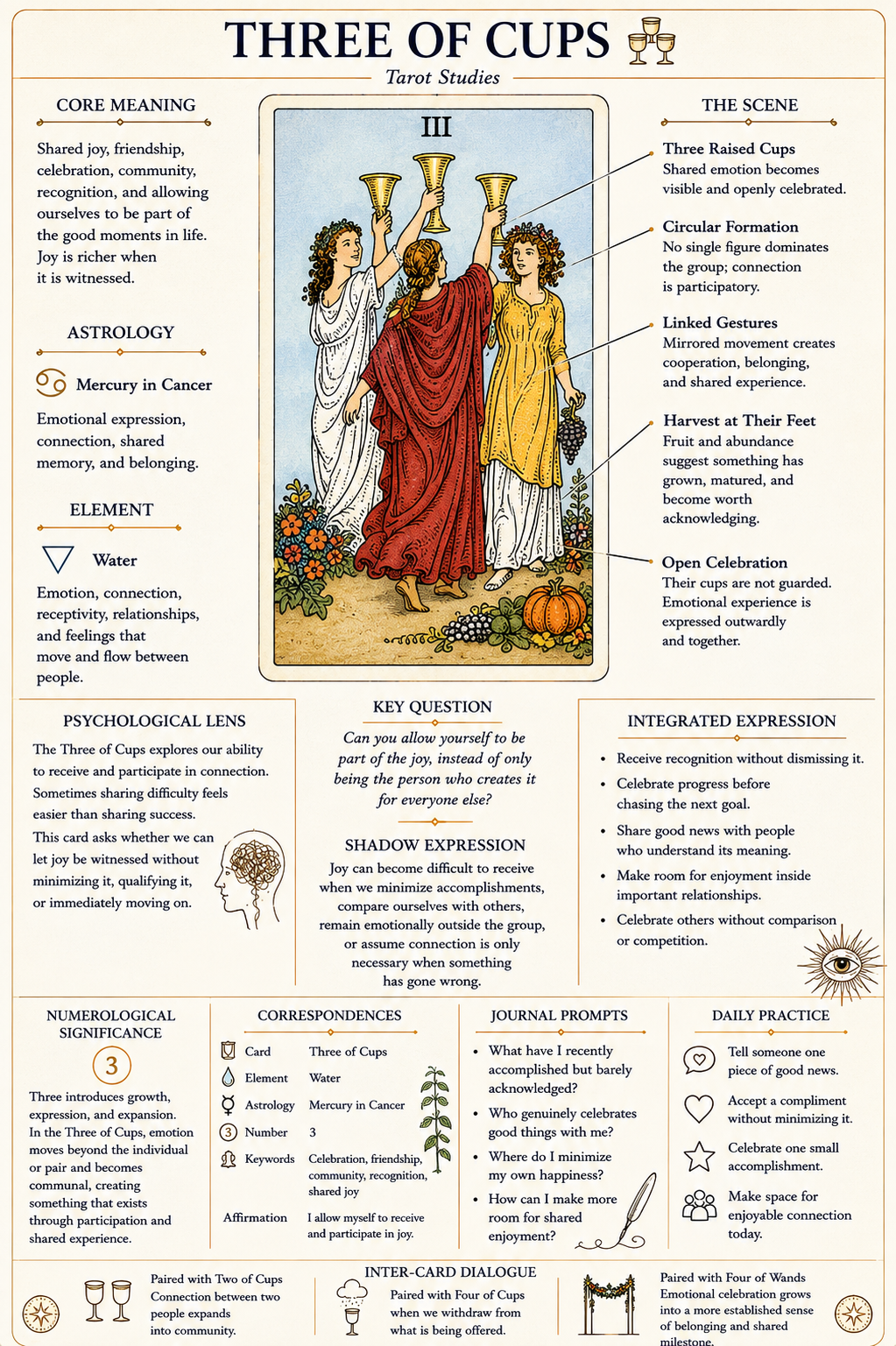
Daily Tarot Pull: Three of Cups
When joy becomes something we make room for together
It seems we’ve recovered from “The Hangover” feeling of just a couple of days ago with the Reversed Three of Cups.
You can attend the party, answer the group chat, sit through the family dinner, and participate in every conversation. You can laugh when everyone else laughs, help clean up afterward, and leave having technically been included in the entire thing.
And still drive home feeling strangely alone.
Then there are the people around whom you don’t have to work quite so hard. You don’t have to be entertaining, useful, agreeable, or particularly interesting. You can show up tired. You can tell the story badly. You can admit that you don’t know what you’re doing. Somehow, there is still a place for you.
The Three of Cups is usually called a card of friendship, celebration, and community. That makes sense. Three people are literally standing around with cups in the air. This is not Tarot being particularly subtle.
But look a little longer, and the celebration may not be the most interesting thing happening in the card.
Maybe the Three of Cups isn’t only showing us people who have something to celebrate.
Maybe it is showing us what becomes possible when people know they don’t have to celebrate alone.
Traditional Foundation
In the Rider-Waite-Smith Three of Cups, three women stand together with their cups raised above them. They appear to be celebrating, and that is where most traditional interpretations of the card begin: friendship, community, reunion, collaboration, and shared joy. But before reaching for any of those meanings, it is worth spending a little time with what is actually happening in the image.
The three women form a loose circle, facing one another rather than facing us. No one appears to be the center of attention. There is no obvious leader, no throne, and no single figure receiving everyone else’s admiration. Each woman holds her own cup and raises it toward the others. Their individual gestures come together to create the celebration. Whatever is happening here belongs to all three of them.
Around their feet are grapes, flowers, pumpkins, and other signs of harvest and abundance. Something has grown.

Something has ripened. Something is ready to be gathered and enjoyed. That helps explain why the Three of Cups can represent celebration, but it also adds an important layer to the meaning. This isn’t simply happiness appearing out of nowhere. The imagery suggests enjoying something that has developed enough to be shared.
The number three reinforces that idea of growth. One begins. Two creates relationship. Three expands what has been created into something new. In the suit of Cups, where we are working with emotion, relationship, intuition, and connection, that expansion becomes shared emotional experience. The joy of the Three of Cups doesn’t stay inside one person’s cup. It moves around the circle.
And perhaps that is the first thing worth carrying forward from the traditional image:
The Three of Cups isn’t simply showing us three happy people. It is showing us what three people can create between them.
Sometimes the Struggle Is…
For a card filled with friendship, celebration, and connection, the Three of Cups can bring up some surprisingly complicated feelings. Most of us want to belong somewhere, but belonging also requires us to participate in relationships rather than simply stand near them. We have to let people know us, allow ourselves to receive as well as give, and occasionally admit that we actually need other people. For those of us who are much more comfortable being the dependable one, that last part can get a little inconvenient.
Sometimes the struggle is:
- being surrounded by people but still feeling strangely alone
- being everyone’s dependable person while struggling to ask for support yourself
- confusing being included with actually belonging
- feeling more comfortable celebrating other people than allowing them to celebrate you
- believing your place in a group depends on how useful, helpful, or agreeable you are
- keeping relationships pleasant while rarely allowing them to become vulnerable
- assuming independence means you shouldn’t need anyone
- participating in relationships where the emotional exchange mostly travels in one direction
- wanting deeper connection while still keeping enough distance to avoid being truly seen
- forgetting that friendship and community require receiving as well as giving
The Three of Cups can look wonderfully uncomplicated at first. Three people, three raised cups, good company. What’s the problem?
But perhaps that simplicity is exactly what makes the card useful. It gives us a picture of connection that looks mutual and easy enough that we can begin noticing where our own relationships feel different. Sometimes the struggle isn’t finding people. Sometimes it is allowing ourselves to participate fully once we’ve found them.
The Key Question
The Three of Cups invites us to look beyond how many people are in our lives and become curious about how we experience ourselves when we’re with them. Where can we relax? Where can we contribute without feeling responsible for everything? Where can we receive support without immediately feeling that we owe something in return?
Where in your life do you feel that you genuinely belong, and what is it about those relationships that makes belonging possible?

That Distinction Matters
Being needed can feel a lot like belonging. People call you. They depend on you. They ask for your advice, trust you to organize things, and know that when something needs to be handled, you will probably be the person who handles it. There is connection in that, certainly. But being valuable to a group because of what you provide is not quite the same as feeling that you belong there simply because you are you.
That distinction matters because the Three of Cups gives each figure her own cup. No one arrives empty-handed, but no one appears responsible for filling everyone else’s cup either. Each person contributes to the moment, and each person receives something from it. The emotional exchange moves around the circle rather than permanently traveling in one direction.
That is what reciprocity can look like in everyday relationships. It doesn’t mean everyone contributes eactly the same amount of
time. Sometimes one person needs more support. Sometimes another person has more to give. Healthy relationships can shift and adjust without keeping a running spreadsheet of who owes whom what. Over time, though, there is a sense that everyone has permission to need, give, celebrate, struggle, speak, and occasionally just show up without being particularly useful.
This is where belonging becomes different from simply being included. Inclusion gives us a place in the circle. Belonging allows us to relax once we’re there. We don’t have to constantly prove why we deserve the chair, keep everyone happy, or make ourselves indispensable enough that no one could possibly ask us to leave.
The Three of Cups reminds us that healthy community does not require us to become less independent or lose ourselves in other people. It asks for something a little more vulnerable: allowing other people to bring their cups toward ours and trusting that whatever is created between us does not have to be carried by one person alone.
The Hidden Gift
There is also something deeply restorative hidden inside the Three of Cups. For all the attention we give to friendship and celebration, I think one of the quieter gifts of this card is permission to enjoy what is good while it is actually happening. To live in the moment and actually be present for it.
We are remarkably talented at postponing joy. I’ve got to do laundry. I’ve had such a busy week. I’m just so tired. We’ll celebrate later, and continue pushing off enjoyment until the project is finished, the problem is solved, the bills are paid, the house is clean, or life finally settles down enough for us to enjoy it properly. Unfortunately, life seems completely uninterested in cooperating with that schedule. There is almost always another responsibility waiting somewhere nearby. If you’re like me, I only have to look up from my writing for a few minutes to find something else to add to my to-do list.
The harvest imagery in the Three of Cups offers another way of looking at celebration. A harvest does not mean nothing will ever need planting again. It simply recognizes that something has grown enough to be gathered and appreciated. Maybe our lives deserve the same consideration. We can acknowledge progress without pretending the work is finished. We can celebrate something good without needing everything else to be good at the same time.
There is something restorative about allowing other people into those moments too. A shared laugh, someone remembering something important to you, a friend genuinely celebrating your success, or a conversation that leaves you feeling a little lighter may not look particularly profound. But these small experiences remind us that life contains more than responsibilities, problems, and the next thing waiting to be accomplished.
Perhaps that is the hidden gift of the Three of Cups. Joy does not have to be the prize we receive after surviving everything else. Sometimes joy, friendship, and connection are part of what helps us keep going in the first place.
Bringing the Three of Cups Into Your Day
Today may not be about throwing a party, gathering twelve friends for brunch, or suddenly becoming the most social person you know. The Three of Cups can show up in much smaller ways. It may simply be about noticing where connection, support, and a little enjoyment are already available to you.
Maybe you send the message you’ve been meaning to send instead of thinking, I’ll do that later. Maybe you tell someone that something they did mattered to you. Maybe you share a small success without immediately following it with all the reasons it really wasn’t that big of a deal. Or maybe, when someone offers to help, you resist the automatic No, I’m finelong enough to consider letting them.
It may also be worth paying attention to the relationships themselves. Notice where conversation feels easy. Notice who can celebrate your success without turning it into a competition

It may also be worth paying attention to the relationships themselves. Notice where conversation feels easy. Notice where you can disagree, have a bad day, or admit that you don’t have everything figured out without worrying that your place in the relationship is suddenly at risk. Those are often the quieter signs of belonging.
And maybe the Three of Cups is also asking us to make a little room for enjoyment today simply because something is worth enjoying. Have the coffee with someone. Take the longer lunch. Laugh at something completely ridiculous. Celebrate the small win before adding three more things to the list. Life will almost certainly provide another load of laundry tomorrow.
Today may not be about doing more.
It may simply be about allowing yourself to notice the people, moments, and small pockets of joy that make everything else a little easier to carry.
Until Next Time
The Three of Cups does not ask us to collect more people.
It asks us to notice what happens between the people who are already there.
The raised cups may be the obvious symbol of celebration, but perhaps the real abundance is the circle beneath them: three individuals, each bringing something of their own, choosing to share the moment anyway. Belonging is not about finding people who are exactly like us. It is about finding the relationships where we no longer feel as though we have to earn our place.
And honestly?
Sometimes the celebration is simply realizing that there are people beside us who make life feel a little lighter.
Until next time.
Misti
Next: Stay tuned for 9/3