
Daily Tarot Pull: Ten of Pentacles
When stability finally feels real, and then you remember it has to go somewhere
Today I pulled the Ten of Pentacles, and when I saw it, I breathed a little sigh of relief.
My life has been living on the side of chaos a little bit lately. Not necessarily everything-falling-apart chaos, but enough movement, uncertainty, and juggling that seeing a card built around stability made me think, Oh. Good. A few things actually are sitting on the stable side.
And that feels pretty good.
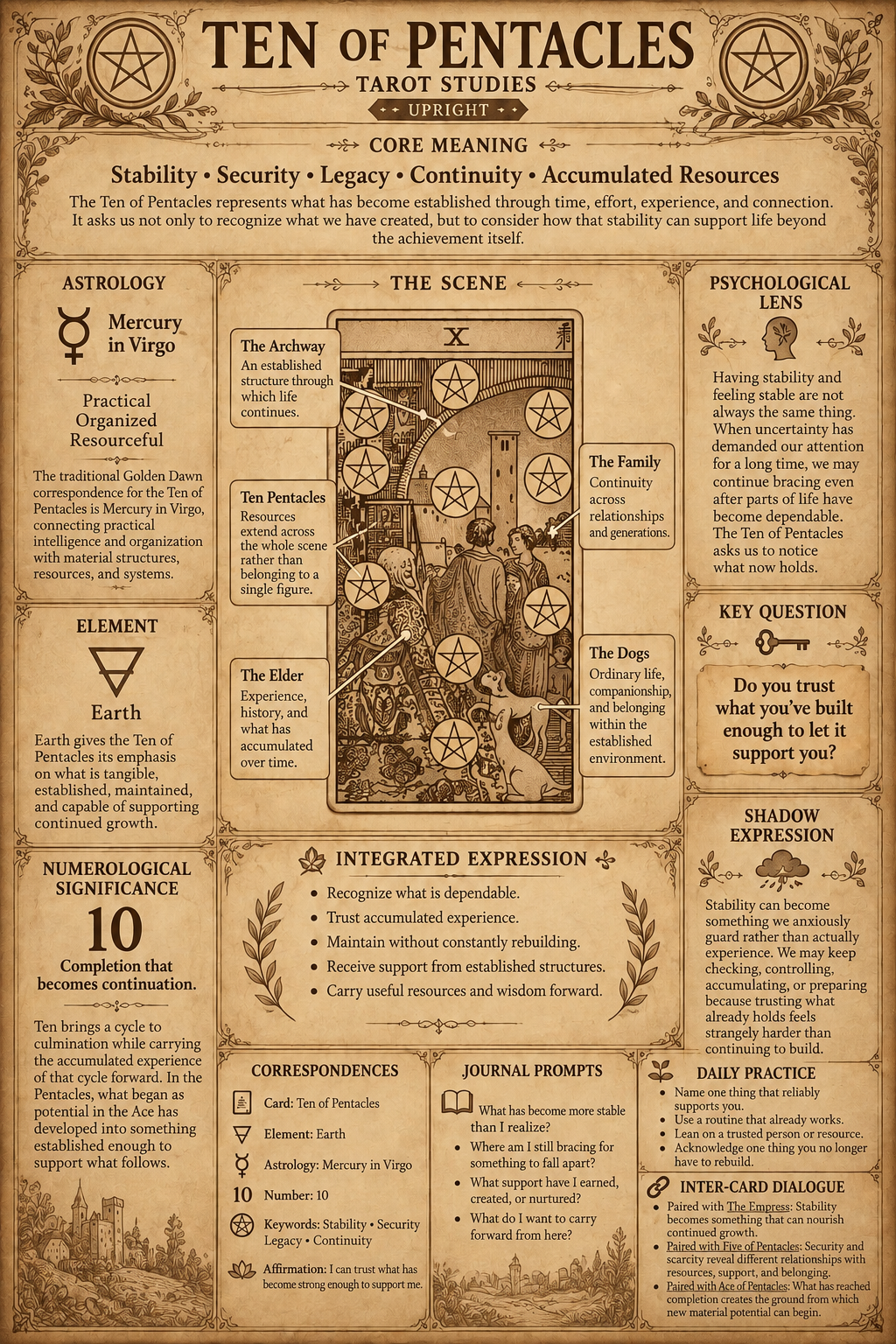
There is something comforting about the Ten of Pentacles because this card looks established. Things have been built. There are people gathered together, structures surrounding them, dogs wandering through the scene, and ten pentacles filling the card. This isn’t the beginning of an idea or the excitement of wondering what something could become. We are looking at what has already taken shape.
For a moment, that feels like permission to notice what is working instead of immediately searching for the next thing that needs fixing.
But then another thought creeps in.
It’s a Ten.
And here we go.
Because Tens in Tarot have an interesting relationship with completion. They can show us what has developed through the entire journey of a suit, but completion doesn’t necessarily mean everything freezes in place exactly as it is. Sometimes reaching Ten means we finally have enough distance to look at what we’ve built and ask what happens to it next.
That makes the Ten of Pentacles feel a little different today. Maybe the relief isn’t simply, Everything is finally stable.
Maybe it’s also the realization that some things have become stable enough that I can stop bracing for them to fall apart and start thinking about what I want to build from here.
Traditional Foundation
Traditionally, the Ten of Pentacles is associated with material security, family, accumulated resources, and established structures. Waite’s own divinatory meanings emphasize gain, riches, family matters, lineage, and the family home. Modern interpretations often extend those ideas into legacy, inheritance, and long-term stability.
As the final numbered card in the suit of Pentacles, it brings the practical journey of the suit to a point of completion. What began with the potential held in the Ace has become something established.
The Rider-Waite-Smith artwork makes that sense of establishment difficult to miss. We aren’t standing in an open landscape wondering where the road leads. We are inside a settled community, surrounded by stone structures, an archway, people, animals, and signs of ordinary life continuing around us.
An older man sits in the foreground wearing an elaborate robe while two dogs gather near him. Beyond him, two adults and a child occupy the scene. The figures are not dramatically interacting with one another, which is interesting in itself. This isn’t a card showing one triumphant moment. It looks much more like life already in progress.

Then there are the ten pentacles arranged across the scene. They don’t belong to one person. They almost overlay the entire environment, which shifts the emphasis away from individual possession and toward something larger: accumulated resources, established structures, family systems, traditions, knowledge, security, and the things that can move from one generation or stage of life into another.
That is part of what makes the Ten important here. Pentacles build slowly. Read as a developing sequence, the Pentacles can show resources being acquired, developed, exchanged, protected, lost, regained, practiced with, and eventually integrated into something larger than a single achievement. By Ten, the question is no longer simply, Can I build something stable?
We are looking at what happens after stability has been built.
And that brings us right back to that sigh of relief I felt when I pulled the card this morning. The Ten of Pentacles can absolutely invite us to recognize what is secure, established, or working. But because it is a Ten, it also quietly asks us to notice what our stability is becoming. Because eventually, what we build becomes the foundation for whatever comes next.
Sometimes the Struggle Is…
Sometimes the struggle is:
- recognizing stability when chaos has been getting most of your attention
- trusting something that has finally become dependable
- immediately looking for the next problem instead of noticing what is working
- believing that if you stop managing everything for five minutes, the whole thing might wobble
- overlooking how much progress you’ve made because you’re focused on what still needs work
- protecting what you’ve created so carefully that you forget to enjoy it
- reaching a milestone and immediately asking, Okay, what’s next?
- remembering that security isn’t only something we create for ourselves; sometimes it is something we share, pass along, and allow other people to build upon
The Ten of Pentacles doesn’t suggest that reaching stability means there will never be another disruption. Life would like a word with that particular interpretation.
Instead, it asks us to become aware of what has already become solid enough to support us. Sometimes the difficult part isn’t creating the foundation. Sometimes it’s finally putting some weight on it.
The Key Question
This card asks an important question:
Do you trust what you’ve built enough to let it support you?
There is a difference between knowing that something is stable and allowing yourself to depend on that stability.
Sometimes we keep behaving as though everything is temporary because, at one point, maybe it was. We keep checking, preparing, fixing, and reinforcing long after some parts of our lives have become much sturdier than we give them credit for.
The Ten of Pentacles invites us to look at the evidence. What is working now that wasn’t working before? What have you learned that you don’t have to relearn every time something becomes difficult? Which relationships have proven dependable? What routines, resources, skills, or structures have become part of the foundation beneath you?
Those things don’t guarantee that life will remain perfectly orderly. They simply mean you aren’t standing in the same place you once were.
Maybe that’s part of reaching Ten. You don’t just have more than you had at the beginning. You have something to stand on.

That Distinction Matters
Stability does not mean nothing changes. It doesn’t mean we finally arrange our lives perfectly and then somehow convince everyone, including ourselves, not to touch anything. Stability means there is enough underneath us that change doesn’t automatically send us back to the beginning.
That is an important difference in the Ten of Pentacles. The card represents culmination, but the scene itself is still full of life. There are different generations, relationships, animals, buildings, and activity. What has been established isn’t separate from life continuing. It is what allows life to continue.
And perhaps the Ten of Pentacles asks us not to confuse the existence of uncertainty with the absence of stability.
There can still be something wobbling on one side of life while something else has become remarkably solid on the other. The goal isn’t to reach a point where nothing ever wobbles again. It’s to recognize that when something does, we may no longer be starting from zero.
The Hidden Gift
There is also something deeply reassuring hidden inside the Ten of Pentacles. Not everything we create requires the same amount of effort forever.
Think about how many things in life once required your full attention simply because they were new. A skill had to be practiced. A relationship had to develop trust. A routine had to become a routine. A difficult experience had to be lived through before it could become experience you could actually draw from. Eventually, some of those things become part of us.
That doesn’t mean we stop caring for them. The Ten of Pentacles isn’t suggesting that stability maintains itself while we wander off and forget about it. But there is a difference between maintaining something and constantly rebuilding it.
That may be the hidden gift in this card: we are allowed to benefit from what we have already done.
The knowledge we gained during a difficult season doesn’t disappear when the season changes. The relationships we have nurtured can become places of support. The routines we created can carry us through days when we don’t have much extra energy. Even the mistakes we’ve made can become part of the wisdom we bring into the next decision.
Yes, something comes next. Something always comes next. But whatever comes next doesn’t meet the version of us who started at the Ace. It meets the person who made it all the way to Ten.
Bring the Ten of Pentacles Into Your Day
Today may not be about building something new. It may simply be about using what is already there.
Look around your life and notice the things that have become more stable than they once were. Maybe it’s a relationship you can trust a little more. Maybe it’s a skill you’ve practiced enough that you no longer have to think through every step. Maybe it’s a routine that keeps the day moving when everything else gets hectic. Maybe it’s financial progress, a home that feels more settled, knowledge you’ve accumulated, or people who have consistently shown up.
Then use some of it. Lean on the routine that works. Ask the dependable person for help. Trust the skill you’ve developed. Enjoy something you’ve worked hard to create. Let the structure do some of the work it was built to do.
And if life has been hanging out on the side of chaos lately, maybe today’s practice is even simpler. Find one thing that isn’t chaotic. Notice it.

Not because noticing it guarantees that everything else will settle down, but because uncertainty doesn’t deserve exclusive rights to your attention. Sometimes stability is already there. We just have to remember to count it.
Until Next Time
Maybe that is why the Ten of Pentacles felt like such a relief today.
When life has been leaning a little heavily toward chaos, it is easy to let the unsettled things become the measure of everything. We notice what still needs fixing, what hasn’t quite worked itself out, and what might be waiting around the next corner.
The Ten of Pentacles gives us another measurement. Look at what has held. Look at what you’ve learned. Look at the relationships, routines, resources, skills, and pieces of your life that have become stronger while you were busy paying attention to everything that wasn’t settled yet.
And yes, it’s a Ten. Here we go. Something comes after this. Something always does. But moving forward doesn’t erase what has already been built, and change doesn’t automatically send us back to the beginning.
The Ten of Pentacles does not ask us to make everything permanent.
It asks us to recognize what has become strong enough to carry forward.
And honestly?
Sometimes the most reassuring thing about reaching Ten is realizing that whatever comes next doesn’t have to begin at One.
Until next time…
Misti
Sources & Further Study
Waite, A. E. The Pictorial Key to the Tarot. William Rider & Son, 1911.
Waite’s original companion text to the Rider-Waite-Smith Tarot provides the historical description and divinatory meanings used as the foundation for the Ten of Pentacles discussion in this article. His description identifies the family group beneath the archway, the child, two dogs, and the older seated figure, while his divinatory meanings emphasize gain, riches, family matters, lineage, and the family home.
Smith, Pamela Colman. Ten of Pentacles, Rider-Waite-Smith Tarot, 1909.
Smith’s original artwork is the primary visual source for the symbolism discussed throughout this Daily Pull. The card’s multigenerational scene, architecture, animals, figures, and ten pentacles provide the visual starting point from which the Tarot Studies interpretation develops. An original 1909 printing of the card is preserved in the public-domain record.
A Note on Interpretation
The historical sources establish the artwork and traditional foundation of the card. The discussion in this article about having stability versus feeling stable, learning to trust what has become dependable, and allowing an established foundation to support what comes next represents the Tarot Studies interpretive and psychological lens.
Tarot Studies approaches the cards as tools for observation, reflection, and self-awareness rather than fixed predictions. The goal is not simply to memorize what the Ten of Pentacles means, but to look closely at the card, understand the traditions surrounding it, and consider how its patterns might appear in lived experience.
Next: Nine of Pentacles