
Calm Is My Cover Story: Two of Swords
Welcome to Tarot Talk, where sometimes the most dramatic thing in the room is what doesn’t happen. I’m your host MLH, and today’s guest is The Two of Swords, whom I’ve nicknamed The Power Pause. She arrives quietly, takes her seat without fuss, and somehow convinces the entire room to lower its voice. No grand entrance, no claims, just a calm that feels intentional, maybe even a touch defensive.
The Two of Swords speaks in measured intervals. She listens longer than she talks. Her energy moves at the speed of restraint, holding the line between thought and feeling with impressive posture. This card lives inside the core tension of clarity vs. avoidance, asking whether balance is being practiced or postponed.
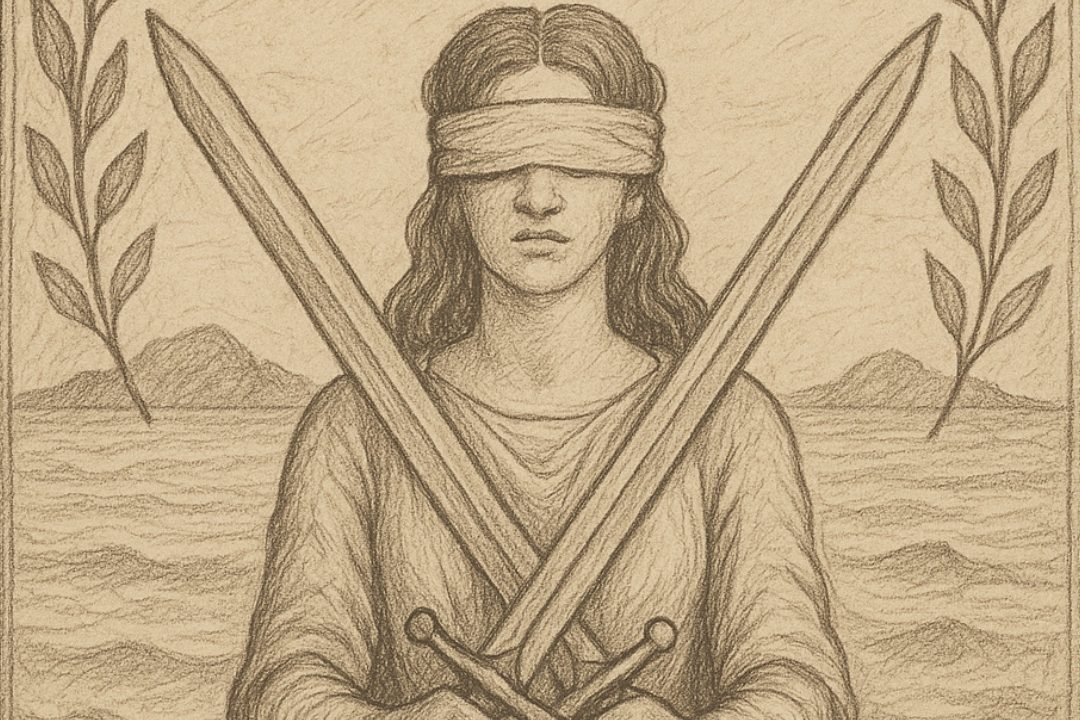
Think of her as the click of “snooze” on an important internal alarm, or the meeting that gets rescheduled three times because no one wants to be the first to say the hard thing. She’s mediation without mediation, a ceasefire that works until it doesn’t. The crossed swords suggest a guarded equilibrium; the blindfold hints that neutrality sometimes requires selective vision. (Yes, she noticed that contradiction. No, she’s not ready to address it yet.)
Here’s the thesis: stillness can protect you, but it can’t decide for you. The Two of Swords doesn’t fear action. She fears premature clarity. And honestly, she’s not wrong. She’s just… lingering.
“Sit with the stillness, and decide where too start in your Tarot Talk with the Two of Swords.”
Table of Contents
Two of Swords Quick Reference
Here’s the thesis: stillness can protect you, but it can’t decide for you. The Two of Swords doesn’t fear action—she fears premature clarity. And honestly, she’s not wrong. She’s just… lingering.
Card: Two of Swords
Suit: Swords / Minor Arcana, Air
Keywords: pauses, stabilizes, withholds, balances, guards, neutralizes, delays
Theme:
A controlled pause in the decision-making field. This card holds tension without resolution, maintaining equilibrium through restraint, selective listening, and deliberate non-response.
Vibe:
Still and vigilant—the quiet hum of crossed lines holding just long enough to keep the peace.
One-Line Truth:
Stillness is a strategy, but it becomes a problem when silence replaces choice.

Setting the Scene
Stepping into the Tarot Talk studio feels less like entering a room and more like crossing an invisible line. The air stills on contact—cool, measured, oddly deliberate. Sound softens, edges blur. Even my thoughts seem to lower their voices as a muted, lunar glow settles over the space, revealing not scenery so much as balance. A hush with posture.
The Two of Swords is already here. Blindfolded, composed, unmistakably present. Their posture is exact, economical—nothing wasted, nothing rushed. The energy arrives before any words could: a pause stretched so carefully it feels intentional, not awkward. Time doesn’t stop; it waits. Somewhere behind us, there’s the faintest sense of movement, like water adjusting its weight without asking permission. I don’t turn to look. That would miss the point.
This card communicates by not reacting. Every silence feels curated. Every non-response says, “I’m listening—selectively.” The tension in the room isn’t sharp; it’s contained. clarity vs. avoidance hums beneath the surface, held in perfect suspension. It’s the psychological equivalent of holding two truths without letting them touch. Impressive. Unsustainable. Familiar.
I notice how stillness here isn’t passive—it’s muscular. Maintained. Disciplined. There’s a subtle suggestion that this equilibrium has been working… just long enough. (If balance had a user manual, this card would be ignoring the chapter on time limits.)
I take my seat opposite them. The studio doesn’t react, which feels intentional. A test, maybe. I steady my breath to the room’s rhythm and place the mic gently between us.
I nod—not for confirmation, just acknowledgment.
Let’s begin.
Interview
MLH: Welcome back to Tarot Talk. Today I’m sitting with the Two of Swords (though “sitting with” might be generous. It feels more like speaking at a statue.) You’ve settled in already—perfect posture, no wasted movement. People often say you freeze a reading. Are you aware you make readers profoundly uncomfortable?
Two of Swords: (a deliberate pause; even tone) Discomfort is usually where the rushing stops. I don’t freeze anything. I stabilize the field so something honest can finally surface.
MLH: Stabilize? It often feels more like avoidance—or indecision—especially when emotions are already running high.
Two of Swords: (still, unruffled) Avoidance shuts things down. I prevent overflow. High emotion narrows perception; I widen it by slowing the pace. Indecision refuses the cut. I hold the blade until the hand is steady. I keep the tide slow—and deliberate.
MLH: You show up when I’m having one of those “damned if I do, damned if I don’t” life moments. The assumption is that you’re about indecision. I tend to agree—both options feel equally terrible.
Two of Swords: (tilts head slightly; voice steady) Equally loud, perhaps. Not equally true. What you’re feeling isn’t indecision—it’s overload. When everything feels urgent, discernment disappears. I step in to lower the volume so you can hear yourself think.
MLH: That’s generous of you—because most readers groan when you appear. (I release a long, huffy sigh and close my eyes in resignation.) You’ve got a reputation for stalling the narrative. Stalling isn’t even the right verb, but I don’t have another for the utter stillness you radiate. Honestly—aren’t you tired? Those swords are… substantial. Why so large? Wouldn’t two modest daggers do?
Two of Swords: (a pause; unwavering) Daggers suggest skirmishes. I preside over thresholds. These aren’t weapons; they’re weights. The size matters because the decision does. If it were small, it would already be resolved.
MLH: Let’s talk about that weight. I recently had a conversation with the Page of Pentacles. He slows things down too—probably to make a list—but his energy is so much lighter. So if you both show up in a reading, can I assume a decision is finally surfacing and plans are in the works? And—(I hesitate, then think it anyway)—I get the sense you might find the Page a bit… exuberant. Possibly annoying.
Two of Swords: (stillness holds; then, evenly) The Page slows to learn. I slow to decide. We’re not doing the same work.
MLH: So his pause is curiosity. Yours is containment—maybe even damage control?
Two of Swords: (a measured pause; tone steady) Containment, yes. Damage control implies catastrophe. I arrive earlier than that. I step in before enthusiasm hardens into regret. My work isn’t to clean up the mess—it’s to keep the table from tipping in the first place.
MLH: That sounds like you standing between inspiration and action with your arms crossed—taking all the fun out of it. Basically saying, “If you run with a stick, you’re going to poke your eye out.”
Two of Swords: (a faint exhale—almost a sigh) Someone has to notice the stick. Fun is rarely the problem. Momentum is. I don’t cancel joy; I make sure it survives. Running headlong might feel exhilarating, but sight is harder to recover than excitement.
MLH: So you’re not trying to kill the curiosity—just give it enough information to make an informed decision.
Two of Swords: (still, precise) Exactly. Curiosity asks what if. I ask at what cost. When those questions meet, the decision stops being reactive and starts being yours.
MLH: I have to ask—(lowering my voice, a little fearful)—if you and Judgement ever sit down together for a lunchtime reading… should I just pack it in and go home to recover emotionally?
Two of Swords: (a pause; almost considerate) That depends on your relationship with honesty.
MLH: That sounds like a yes.

Two of Swords: Judgement doesn’t tolerate prolonged hesitation. I don’t tolerate unexamined action. Together, we create a very narrow corridor—quiet, unavoidable, and deeply clarifying.
MLH: Oh good. A hallway I can’t emotionally sidestep.
Two of Swords: (dry) You could sidestep it. You simply wouldn’t feel very good about yourself afterward.
MLH: (nodding slowly) So—you’re not a softening blow. You’re a precise slice. When Judgement arrives, there’s no gray area left, is there?
Two of Swords: (a measured pause) Gray exists before Judgement, not during it. My role is to examine it honestly while there’s still room to choose. Once Judgement speaks, ambiguity has already expired.
MLH: Which means if I ignore you—
Two of Swords: (cuts in gently) —then Judgement doesn’t ask. It announces.
MLH: That explains the fear response. You’re the last chance to think clearly before the truth gets a microphone.
Two of Swords: I give language to what’s already known but not yet acknowledged. I don’t soften the truth. I shape the encounter with it.
MLH: So your stillness isn’t mercy—it’s preparation.
Two of Swords: Exactly. Silence sharpens perception. Noise dulls it. When Judgement arrives, whatever hasn’t been faced comes roaring back amplified.
(I suddenly respect the pause a lot more.)
MLH: (gently redirecting) Time to move on from that visual. So when you land between action-heavy cards, you’re not contradicting them—you’re regulating them?
Two of Swords: (a small, deliberate pause) Regulating is the right word. I don’t oppose momentum; I adjust its trajectory. Action without calibration wastes force. I arrive to make sure the movement that follows is intentional, not just loud.
MLH: Can you give me a few examples of how that works with other cards?
Two of Swords: (considers; voice even) When I sit beside the Knight of Wands, I temper urgency into direction. I slow the charge so it doesn’t burn itself out on the first obstacle.
With the Eight of Wands, I reduce scatter. The message still moves—but it moves cleanly instead of everywhere at once.
Next to The Magician, I insist on intention. Power is present, yes—but I ask whether it’s aligned before it’s deployed.
And when I rest between the Ace of Cups and any call to action, I keep feeling from spilling into decision before it understands itself.
MLH: You’re less of a speed bump and more of a tuning fork.

Two of Swords: (a faint nod) Precisely. I don’t stop the music. I bring it back into key.
MLH: Final question, then. If I see you in a spread and feel that deep, involuntary sigh—the unmistakable weight settling in—what do I need to understand about that moment? Do you affect the whole spread, or just the cards nearest you?
Two of Swords: (a longer pause; steady, attentive) The sigh is recognition. Your system knows something important has arrived.
MLH: That doesn’t exactly narrow it down.
Two of Swords: I don’t localize well. (a faint, dry note) When I appear, I set the tone of consent. The neighboring cards speak through me—but the entire spread adjusts its volume.
MLH: So I’m not just buffering one conversation. I’m resetting the room.
Two of Swords: Exactly. I create conditions. Decisions elsewhere in the spread will echo my restraint or my avoidance, depending on how I’m handled.
MLH: Meaning if I rush past you…
Two of Swords: The rest of the story rushes with you. Poorly.
MLH: And if I stay?
Two of Swords: Then every card gets cleaner lines. Even the difficult ones. Especially the difficult ones.
MLH: So that sigh isn’t dread. It’s gravity.
Two of Swords: (measured, unmistakable) Gravity reminds you what matters before you leap.
MLH: Then let me ask it plainly—what do you want from me when I pull you?
Two of Swords: (stillness settles; voice calm and final)
Don’t decide yet. Decide deliberately.
Reflection and Meaning Breakdown—Two of Swords
What surprised me most after the interview was how active the Two of Swords really is. I expected restraint; I didn’t expect regulation. The card didn’t hedge or evade—it calibrated. Its presence clarified that stillness here isn’t about fear or indecision, but about holding pressure without letting it distort the truth. The pauses weren’t empty. They were doing work. This card listens longer than it speaks, tightens when emotions surge, and becomes firmer—not colder—under demand.
Upright, the Two of Swords reflects a psychological pattern of deliberate containment. It marks the moment when awareness has arrived, but acceptance hasn’t fully settled yet. The invitation is not to choose quickly, but to stay with the tension long enough for integrity to take root. This is discernment under pressure: a conscious slowing of emotional and mental momentum so clarity can remain intact. In readings, the card often reframes the question itself, shifting attention from “What should I do?” to “What am I honestly ready to accept?”
In its reversed or shadow expression, the same restraint loses flexibility. The pause becomes a shield rather than a preparation. Silence stretches too long. Feelings are managed instead of met. The energy moves from containment into avoidance, where equilibrium is preserved at the cost of engagement. What was meant to steady the process now stalls it. The cue here isn’t urgency, but curiosity—why is the pause being maintained, and what truth is being kept at arm’s length?
Relationally, the Two of Swords alters the behavior of the entire spread. It softens emotional cards by lowering reactivity, slows action-driven cards so impulse doesn’t outrun awareness, and gently contradicts narratives that push for premature resolution. Paired with Justice or Temperance, its restraint feels supported; alongside the Tower or fast-moving Knights, it sharpens into a pressure point. Appearing alone, it highlights a threshold moment—acceptance before consequence. Working with this card means respecting the pause it creates, not trying to override it. The clarity it protects doesn’t come from force, but from staying present long enough for the truth to hold.
Upright
Keywords
- regulates
- stabilizes
- contains
- moderates
- holds tension
- clarifies quietly
Interpretation
Upright, the Two of Swords represents disciplined stillness. The moment when opposing truths are held in careful balance so clarity can form without distortion. This card is not about avoiding choice, but about preparing for one with integrity. Its archetypal function is regulation: slowing the emotional and mental field just enough for discernment to survive.
In lived experience, this appears as a pause that feels heavy but necessary—a deep internal breath before action. You may feel pulled in more than one direction, sensing that any decision carries a cost. The Two of Swords teaches that restraint is sometimes the most active move available.
Thesis: Stillness becomes wisdom when it serves conscious choice.
Reversed
Keywords
- suppresses
- over-controls
- avoids engagement
- delays excessively
- disconnects emotionally
- stalls movement
Interpretation
Reversed, the Two of Swords points to a pause that has outlived its usefulness. Discernment hardens into avoidance; containment becomes emotional disconnection. Rather than holding tension to clarify, the energy resists engagement altogether, often out of fear of consequence or discomfort.
Working with this shadow requires honesty about the function of the delay. Is the silence still serving clarity. Is it protecting against feeling ? Are you controling the issue, out of avoiding the inevitable. Integration comes from allowing measured movement: naming what you are avoiding. Letting choice re-enter the field gradually, without urgency but with mindfulness and presence.
Relational Meaning
In relationship to other cards, the Two of Swords regulates the field. It stabilizes emotionally charged cards, slows impulsive ones, and subtly contradicts forces that push for premature action. It harmonizes with cards that value balance and timing, deepens the quiet of introspective energies, and sharpens under pressure from catalytic or disruptive cards. When honored, it brings coherence to the spread; when ignored, unresolved tension often resurfaces elsewhere—louder, sharper, and less contained.
Tarot Talk Bonus — Two of Swords
Mini-Spread: The Acceptance Pause
Pull three cards, letting the Two of Swords anchor the conversation.
- What I’m Holding in Tension — the opposing forces currently demanding attention.
- Two of Swords (The Pause Itself) — how restraint, silence, or containment is functioning right now.
- What Acceptance Makes Possible — not what happens next, but what becomes internally available once the pause is honored.
Read this spread slowly. If you feel rushed, that’s the point—slow it down again.
Journal Prompt
- Where am I confusing hesitation with listening?
- What truth am I already aware of—but not yet willing to accept?
Let the answers arrive without commentary. Notice what stays quiet after you write.
Tarot Talk Flashback
This conversation kept reminding me of something the Page of Pentacles once said about curiosity leading the way. The Page pauses to learn; the Two of Swords pauses to accept. When they appear together, curiosity wants to build, but the Two asks a harder question first: Can you live with the cost of knowing? One gathers information. The other weighs consequence. Together, they prevent enthusiasm from outrunning truth.

Personal Note
The Two of Swords shows up for me when I’ve already circled the issue ten times and sighed about it at least twice. That sigh is the tell. Not dread—gravity. It’s the moment I stop asking what should I do? and start admitting this is real. Once I honor that pause, the next step doesn’t feel easy—but it does feel honest
Reference Details
• Published: December 8, 2025
• Deck Reference: Rider–Waite–Smith, classic coloration
• Context: Part of the Tarot Talk conversational series; Behavior Codex–aligned interpretation
Tags: Minor Arcana · Two of Swords · Air · Silencer · Contradictor · introspective · steady · clarity · acceptance · discernment
Archive: Explore more card personalities in the Tarot Talk Archive —
Author Note:
This conversation reminded me that not every pause is avoidance—some are necessary acts of care. Sometimes the quiet is the work.