
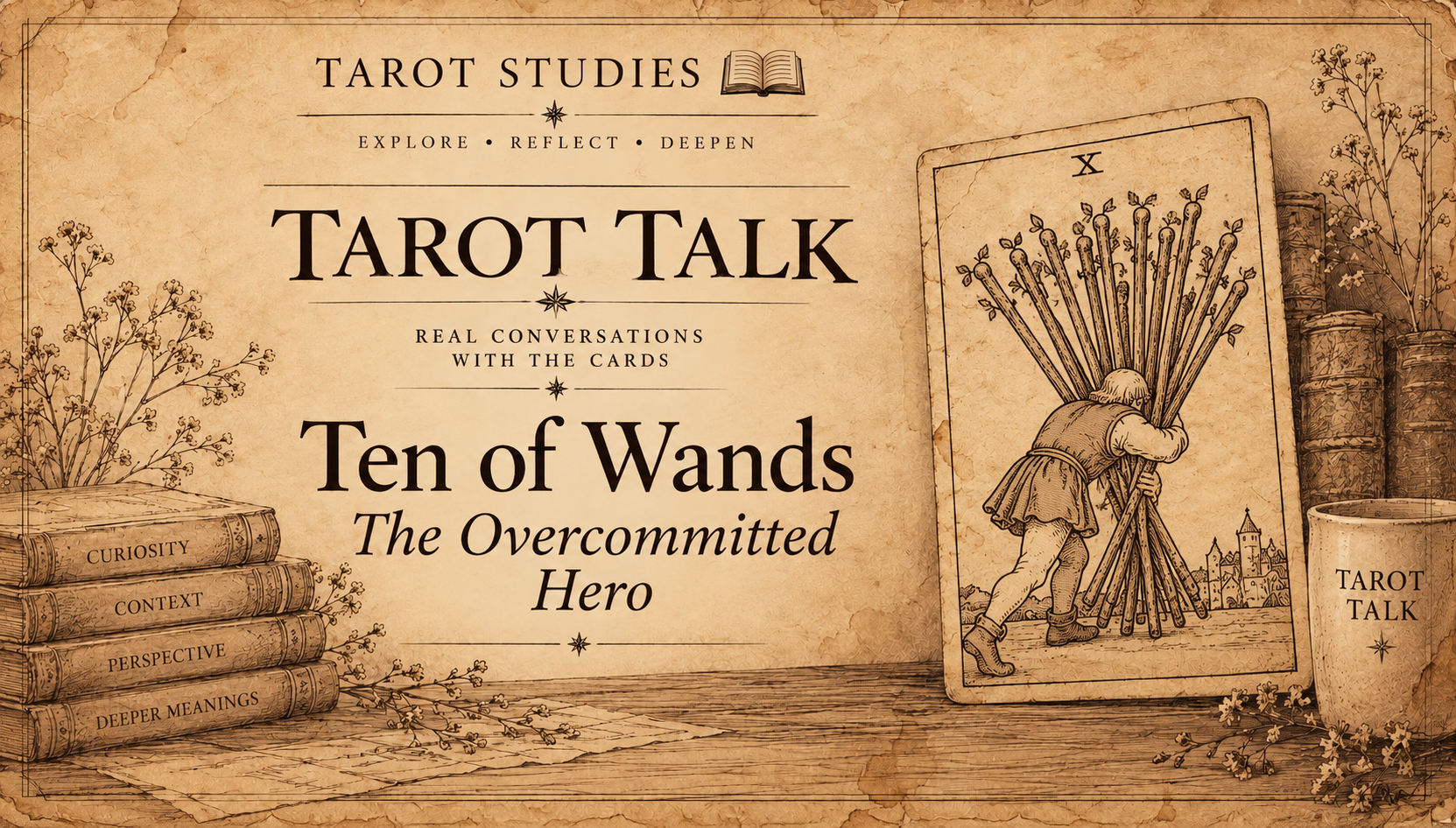
Tarot Talk: Ten of Wands
The Overcommitted Hero
There is something about this card that makes me tired before we have even started the conversation. Ten has gathered up every wand, has all ten of them clutched against their body, and is still moving forward. Apparently, we are going the distance.
But why does the Ten of Wands have to do all the heavy lifting?
Can some of this be delegated? Can somebody else grab a wand or two? Better yet, did Ten actually ask anyone for help before deciding the entire bundle was theirs to carry?
And please don’t tell me the lesson is that I now have to be stoic and power through. I’m already tired. I don’t need a motivational speech about perseverance while watching someone stagger toward the finish line with ten wands blocking the view.
That’s what makes this card more complicated for me. I understand commitment. I understand finishing what we start. There are times when the work really does have to get done, and sometimes we are the person responsible for doing it. But I also know how easily I can handle this turns into I’ll just do it myself.
So when the Ten of Wands appears, I don’t only want to know what I’m carrying. I want to know why I’m carrying all of it.
What genuinely belongs to me? What could be delegated? What did I pick up because nobody else did? And how much of this load am I still carrying simply because I’ve gotten very good at being the person who carries things?
Ten, I can see that you can make it to the finish line.
I’m asking why you think you have to get there carrying everything yourself.
Welcome to Tarot Talk
Tarot Talk is where we invite the cards out of the deck and give them a chair at the table.
Instead of asking a card to recite its list of meanings, we let it talk. We pay attention to its personality, its contradictions, the choices it makes in the Rider-Waite-Smith scene, and the parts of its story that become easier to see once we start asking better questions.
But there is another seat at the table too: the reading itself.
Because knowing a card is not the same thing as knowing how to read it.
A familiar keyword can give us somewhere to begin, but the question being asked, the imagery in front of us, and the cards surrounding it help determine which part of the card’s range actually matters. Sometimes they confirm our first impression. Sometimes they complicate it. Occasionally they make us admit that our favorite keyword has wandered into the wrong conversation entirely.
That is what we are practicing here.
We are not trying to find the one correct meaning hidden inside a card. We are learning how to look at the evidence on the table, consider more than one reasonable interpretation, and decide which one best fits the reading in front of us.
So pull up a chair.
The Ten of Wands already brought everything else.
Quick Reference
Card: Ten of Wands
Arcana: Minor Arcana
Suit: Wands
Element: Fire
Number: Ten
Astrological Correspondence: Saturn in Sagittarius
Five Key Words: Responsibility • Burden • Endurance • Completion • Overcommitment
Core Meaning: The accumulation of responsibility, effort, or obligation that has become significant enough to demand our full attention.
Integrated Expression: Taking responsibility for what genuinely belongs to us, recognizing the cost of the effort involved, and continuing with purpose when the destination still matters. Integrated Ten of Wands energy also knows that commitment does not require carrying every part of the load alone.
Shadow Expression: Taking on more than we can reasonably carry, struggling to delegate, confusing capability with obligation, or continuing to shoulder responsibilities simply because we have become accustomed to being the person who handles them.

Central Tension: Commitment vs. self-erasure. The Ten of Wands asks us to distinguish between the difficult effort required to complete something meaningful and a burden that has grown beyond what we need, should, or were ever meant to carry.
Traditional Scene: In Pamela Colman Smith’s Rider-Waite-Smith Ten of Wands, a figure moves forward carrying all ten wands in a large bundle. His body bends beneath their weight, his hands are occupied, and the wands partially obstruct his view. Buildings stand ahead of him, giving the scene both burden and destination. The image shows considerable effort, but the scene alone does not tell us why the figure is carrying the load or what should happen next.
Today’s Conversation
Carrying It Isn’t the Same as Owning It
Question on the Table: When the Ten of Wands appears in a reading, how do we determine whether the load represents necessary effort approaching completion, responsibility that genuinely belongs to us, or a burden we have continued carrying simply because we are capable of carrying it?
The Interview
MLH: I have to ask before we get into anything else. Why are you carrying all ten?
TEN OF WANDS: Because they need to get where they’re going.
MLH: That wasn’t quite what I asked.
TEN OF WANDS: It was the practical answer.
MLH: The practical answer would involve nine other people each carrying one.
TEN OF WANDS: Coordinating nine other people does not sound particularly practical.
MLH: And there it is.
TEN OF WANDS: What?
MLH: The assumption that doing everything yourself is somehow easier.
TEN OF WANDS: I didn’t say easier.
MLH: You’re carrying ten wands at once. I think the visual is making an argument. What is the difference between practical and easier?
TEN OF WANDS: Practical gets the job done.

MLH: And easier?
TEN OF WANDS: Easier makes the process less difficult.
MLH: Those sound suspiciously related.
TEN OF WANDS: They can be. They aren’t always.
MLH: Explain.
TEN OF WANDS: If I stop, find nine people, explain where everything needs to go, decide who carries what, and make sure everyone understands the plan, I’ve created an entirely different task.
MLH: So instead, you picked up all ten.
TEN OF WANDS: I knew where they needed to go.
MLH: Which was practical.
TEN OF WANDS: Yes.
MLH: But not easier.
Ten adjusts the bundle.
TEN OF WANDS: No.
MLH: And definitely not lighter.
TEN OF WANDS: I never said it was.
MLH: So something can be the fastest way to get it done without actually being the easiest way to carry it.
TEN OF WANDS: Exactly.
MLH: And I’m noticing that your definition of practical seems to depend heavily on getting to the destination.
TEN OF WANDS: Shouldn’t it?
MLH: Maybe. But I came into this conversation looking at you and thinking, This person is carrying too much.
TEN OF WANDS: Reasonable observation.
MLH: And my next question was fairly obvious: What needs to be put down?
TEN OF WANDS: That’s a reasonable question too.
MLH: I hear a “but.”
TEN OF WANDS: But you’ve asked it before you know what I’m carrying, why I’m carrying it, or how close I am to where I’m taking it.
MLH: So I’m already trying to solve the problem before I’ve established what the problem is.
TEN OF WANDS: There you are.
MLH: What am I missing?
TEN OF WANDS: The town.
MLH: The town in the distance.
TEN OF WANDS: Not terribly distant, actually. Everyone gets so fascinated by what I’m carrying that they forget to look at where I’m going. If I’m three steps from finishing something important, telling me to drop everything because I look tired is not particularly useful advice.
MLH: But you do look tired.
TEN OF WANDS: I am tired. Tired and wrong are not the same thing.
MLH: So when you appear, the first question shouldn’t automatically be, What do I need to put down?
TEN OF WANDS: No. Start with Why is this being carried? Then ask where it is going and what carrying it this way is costing.
MLH: And if the answer is, “Because nobody else will do it”?
TEN OF WANDS: Then we have a much more interesting interview.
MLH: I suspected we might.

MLH: All right. You’ve made the destination part of the argument, so let’s test it. Suppose the question is about work. Someone asks whether they should keep pushing through a demanding project, and you appear.
TEN OF WANDS: Then I want to know what they’re pushing toward.
MLH: A deadline?
TEN OF WANDS: Maybe. A finished project. A meaningful result. Something that tells us this effort is actually taking them somewhere.
MLH: Because if there’s a recognizable finish line, your Ten matters.
TEN OF WANDS: Exactly.
MLH: And if there isn’t one?
TEN OF WANDS: Then I’d start wondering whether the person is completing something or simply maintaining an unsustainable system.
MLH: So this is where the distinction we just made between practical and easier starts to matter.
TEN OF WANDS: How?
MLH: Carrying everything yourself might have been practical when you were trying to get something across the finish line. But if there is no finish line, “practical” starts looking suspiciously like a system you’ve gotten used to.
Ten considers that.
TEN OF WANDS: Fair.
MLH: I’m writing that down.
TEN OF WANDS: Don’t get excited.
MLH: Too late.
MLH: So a destination changes how I understand the burden. But that still leaves another question: does the responsibility actually belong to the person carrying it?
Ten pauses.
TEN OF WANDS: Now we’re getting somewhere.
MLH: Then let’s change the question. This time it’s about a relationship. Someone feels responsible for keeping everything together, and you appear.
TEN OF WANDS: Now I want to know who handed them the other nine wands.
MLH: That sounds suspiciously like blame.
TEN OF WANDS: It’s an inventory.
MLH: Fair enough.
TEN OF WANDS: Responsibility in a relationship can be meaningful. People carry more for one another sometimes. But if one person is handling the difficult conversations, making the plans, repairing every rupture, remembering what needs to happen next…
MLH: Carrying the relationship.
TEN OF WANDS: Exactly. Then the question may not be whether they can keep doing it.
MLH: It may be whether the arrangement itself needs examining.
TEN OF WANDS: Capability is not proof of ownership.
MLH: So we’ve established that having a destination matters, and that being capable of carrying something doesn’t necessarily mean it belongs to you. But let’s say we’ve done the inventory and the responsibility really does belong to me.
TEN OF WANDS: Congratulations.
MLH: That sounded ominous.
TEN OF WANDS: Because belonging to you doesn’t make it weightless.
MLH: Fair. And I’m guessing this is where we have to look at how you’re carrying it.
TEN OF WANDS: Now you’re looking at the whole picture.
MLH: Both of your hands are occupied.
TEN OF WANDS: Yes.
MLH: Your view is partially blocked.

TEN OF WANDS: Also yes.
MLH: You’re bent under the weight.
TEN OF WANDS: I’m aware.
MLH: But you’re still moving.
TEN OF WANDS: Very observant.
MLH: You’re getting sarcastic.
TEN OF WANDS: I’m carrying ten wands while being interviewed about carrying ten wands. Allow me something.
MLH: Fine. But all of those details matter, don’t they?
TEN OF WANDS: They can.
MLH: Because the question might not be whether the responsibility is mine. We may have already established that it is. The question could be what carrying it this way is doing to everything else.
TEN OF WANDS: Exactly.
MLH: You can keep moving, but your hands aren’t available for anything new.
TEN OF WANDS: Correct.
MLH: Your view is restricted.
TEN OF WANDS: Yes.
MLH: And changing direction with that bundle would be difficult.
TEN OF WANDS: Possible. Not convenient.
TEN OF WANDS: I can still move, but I have very little room to respond to anything else. Reaching for something new is difficult. So is changing direction. The more of my attention the bundle requires, the less capacity I have for anything beyond it.
MLH: So a Ten of Wands reading doesn’t necessarily have to tell me, This responsibility is wrong.
TEN OF WANDS: No.
MLH: It could simply be showing me the cost of carrying it in its current form.
TEN OF WANDS: There you are.
MLH: Let’s make that practical. Someone asks, “Should I take on this new opportunity?” and you appear.
TEN OF WANDS: Then I’m very interested in what they’re already carrying.
MLH: Even if the opportunity itself looks good?
TEN OF WANDS: Especially then.
MLH: Why especially?
TEN OF WANDS: Because whether something is worthwhile and whether you have room for it are two different questions.
MLH: So you might not be describing the opportunity at all.
TEN OF WANDS: I might be describing the conditions surrounding the decision.
MLH: That changes the reading quite a bit.
TEN OF WANDS: It should. If you decide I mean “burden,” then immediately conclude the new opportunity will become a burden, you’ve skipped a step.
MLH: Because the burden could already be here.
TEN OF WANDS: Exactly.
MLH: The card could be saying, Look at your current capacity before you add anything else.
TEN OF WANDS: Now you’re reading instead of matching keywords.
MLH: So before asking whether the new wand is worth taking, I should probably look for a free hand.
TEN OF WANDS: That would be practical.
MLH: I knew you were going to say that.
TEN OF WANDS: And yet it worked.
MLH: Which means before I interpret you, I need to ask what job you’re doing in the reading. Are you describing the thing I’m asking about, or are you showing me the conditions around it?
TEN OF WANDS: Now you’re asking a useful question.

MLH: All right. We’ve looked at destination, ownership, and capacity. But most readings don’t give us the luxury of interviewing one card for twenty minutes.
TEN OF WANDS: Their loss.
MLH: Usually, you have neighbors.
TEN OF WANDS: I prefer supporting evidence.
MLH: Of course you do. Let’s test that. Suppose you appear with the Three of Pentacles.
TEN OF WANDS: Finally. Someone brought coworkers.
MLH: Then my first thought would be fairly obvious. You’re carrying too much, the Three of Pentacles brings in collaboration, so stop doing everything yourself and delegate.
TEN OF WANDS: Would you?
MLH: You disagree.
TEN OF WANDS: You saw the Three of Pentacles and assumed nobody was helping me.
MLH: Fair.
TEN OF WANDS: What if everyone already has a job?
MLH: Then you could be carrying your part while everyone else carries theirs.
TEN OF WANDS: Exactly.
MLH: So the Three of Pentacles doesn’t prove collaboration is missing.
TEN OF WANDS: No.
MLH: It tells me collaboration is something I need to investigate.
TEN OF WANDS: Much better.
MLH: Fine. Let’s try another one. Ten of Wands with the Chariot. Clear direction. Determination. Movement toward a goal. That seems to strengthen the case for pushing through.
TEN OF WANDS: Maybe.
MLH: I’m beginning to distrust that word.
TEN OF WANDS: Healthy development.
MLH: Fine. What am I missing?
TEN OF WANDS: Where are the wands going?
MLH: To the town.
TEN OF WANDS: All ten?
MLH pauses.
MLH: I assumed so.
TEN OF WANDS: There’s your problem.
MLH: Because direction only helps if what I’m carrying actually belongs to the destination.
Ten gives her a small nod.
MLH: So the Chariot doesn’t automatically tell me to persevere.
TEN OF WANDS: No.
MLH: It makes me ask whether all this effort is actually moving toward the same thing.
TEN OF WANDS: Or?
MLH: Whether I’m carrying ten different destinations and calling them one.
TEN OF WANDS: There you are.
MLH: That one stings a little.
TEN OF WANDS: Not my department.
MLH: You’re literally the card carrying all ten.
TEN OF WANDS: Still not my department.
MLH: Fine. Four of Pentacles beside you makes me wonder about control.
TEN OF WANDS: Good.
MLH: Security too.
TEN OF WANDS: Better.
MLH: Maybe fear of letting go. The belief that everything falls apart unless I personally hold it together.
Ten shifts the bundle in his arms.
TEN OF WANDS: Now ask whether anyone actually required that.
MLH: There it is again. Ownership.
TEN OF WANDS: With a complication.
MLH: Because sometimes nobody handed you all ten wands.
TEN OF WANDS: Sometimes I collected them.
MLH: Because you didn’t trust anyone else with them?
TEN OF WANDS: Maybe. Or because being needed feels good. Or because I’m competent and saying yes was easier the first few times. Or because I genuinely cared about every single thing I agreed to.
MLH: Until ten separate yeses became one very heavy bundle.
TEN OF WANDS: That is how it happens. Nobody wakes up and says, “I would like to become chronically overcommitted by lunchtime.”
MLH: So none of those cards gave me an answer. They changed what I needed to investigate.
TEN OF WANDS: Exactly.
MLH: They changed which part of you needed my attention.
TEN OF WANDS: Now you understand what supporting evidence is for.
MLH: I think there’s something else happening with that Four of Pentacles example, though.
TEN OF WANDS: What?
MLH: If I keep collecting responsibilities because I’m competent, because I like being needed, or because I don’t trust anyone else to handle them, eventually this stops being only about what I’m carrying.
Ten looks at her.
MLH: It starts becoming about who I think I have to be.
TEN OF WANDS: Now we’re ready for the uncomfortable part.
MLH: All right. Let’s go there. When does responsibility stop being something you carry and start becoming part of who you think you have to be?
TEN OF WANDS: Are you asking about responsibility, or are you asking about being the responsible one?
MLH: There’s a difference.
TEN OF WANDS: A large one. Responsibility is something you carry. The responsible one can become an identity you feel obligated to protect.
MLH: The person who remembers everything. Fixes everything. Finishes everything.
TEN OF WANDS: Covers the shift. Makes the call. Takes the extra assignment because explaining it to somebody else would take longer.
MLH: There’s practical again.
TEN OF WANDS: I knew you were going to do that.

MLH: Because we started with you telling me that carrying all ten was practical. Now I’m wondering how often practical becomes the reason the same person keeps getting another wand.
TEN OF WANDS: More often than I would like to discuss.
MLH: Convenient.
TEN OF WANDS: Efficient.
MLH: That word isn’t helping your case.
TEN OF WANDS: I’m aware.
MLH: But I think I see the pattern. If I’m good at handling things, taking care of something myself really can be the fastest option in the moment.
TEN OF WANDS: Yes.
MLH: And then I do it again.
TEN OF WANDS: Yes.
MLH: And eventually everyone knows I’ll handle it.
TEN OF WANDS: Including you.
MLH: That might be the dangerous part.
TEN OF WANDS: It can be. At some point you may stop asking, Is this mine? because being the person who handles things has already answered the question for you.
MLH: So capability starts making decisions before I do.
TEN OF WANDS: Exactly.
MLH: And somewhere along the way, “I can do this” becomes “I should do this.”
TEN OF WANDS: And then “I should do this” becomes “This is what I do.”
MLH: Until finally we arrive at “This is who I am.”
Ten shifts the bundle against his shoulder.
TEN OF WANDS: Now you understand why putting down one wand can be harder than picking up the tenth.
MLH: Because putting it down might feel like I’m failing at something I’ve built part of my identity around.
TEN OF WANDS: Or disappointing someone. Or becoming less dependable. Or admitting that you have limits.
MLH: Or trusting someone else to do it differently.
TEN OF WANDS: There it is.
MLH: Which takes us back to the Four of Pentacles.
TEN OF WANDS: Exactly. Control doesn’t always look like control. Sometimes it looks remarkably like competence.
MLH: That’s uncomfortable.
TEN OF WANDS: I warned you.
MLH: But I want to be careful here. If someone is carrying too much, I don’t want the reading to immediately turn around and say, Well, you created this.
TEN OF WANDS: Good. Because that would be lazy.
MLH: Sometimes other people really are taking advantage.
TEN OF WANDS: Yes.
MLH: Sometimes expectations really are unfair.
TEN OF WANDS: Absolutely.
MLH: Sometimes someone has been handed responsibilities they never should have had to carry in the first place.
TEN OF WANDS: Which is why you investigate before you assign responsibility for the burden.
MLH: So agency isn’t the same thing as blame.
TEN OF WANDS: No. You’re trying to understand how the load got here and what keeps it here.
MLH: Because sometimes the answer is external pressure.
TEN OF WANDS: Sometimes.
MLH: Sometimes it’s necessity.
TEN OF WANDS: Absolutely.
MLH: And sometimes I participated in building the bundle.
Ten glances down at the wands in his arms.
TEN OF WANDS: That possibility tends to be less popular.
MLH: Because it’s harder to admit.
TEN OF WANDS: Especially when your reasons were good.
MLH: Explain that.
TEN OF WANDS: Maybe you cared. Maybe someone genuinely needed help. Maybe you were the most capable person available. Maybe saying yes solved an immediate problem. None of those decisions has to be foolish for the accumulated result to become unsustainable.
MLH: Ten separate reasonable decisions can still become one unreasonable load.
Ten instinctively readjusts the bundle before answering.
TEN OF WANDS: Precisely.
MLH: And then resentment shows up.
TEN OF WANDS: Frequently.
MLH: Even when nobody technically forced me to take everything on.
TEN OF WANDS: Resentment can grow around responsibilities we volunteered for, especially when everyone becomes accustomed to our volunteering.
MLH: So eventually I’m thinking, Why does everyone expect me to do everything?
TEN OF WANDS: While everyone else may be thinking, You always said you had it.
MLH: That’s messy.
TEN OF WANDS: Most patterns involving other people are.
MLH: So the reader needs to be careful about assigning villains.
TEN OF WANDS: Please. Sometimes the pattern has been built collaboratively. One person keeps saying yes, other people learn that the answer will be yes, and eventually everyone forgets there was ever another option.
MLH: Including the person carrying the wands.
TEN OF WANDS: Especially that person.
MLH: Then delegation isn’t really just a time-management question.
TEN OF WANDS: Not always.
MLH: It can challenge identity.
TEN OF WANDS: And control.
MLH: Because someone else might do it differently.
TEN OF WANDS: Yes.
MLH: And if I secretly believe nobody can do it the way I can…
TEN OF WANDS: Then the burden may be doing something for you too.
MLH: Giving me a sense of usefulness. Control. Maybe even importance.
TEN OF WANDS: Possibly. But don’t turn those possibilities into conclusions without evidence.
MLH: Right. We’re investigating again.
TEN OF WANDS: You’re learning.
MLH: Slowly.
TEN OF WANDS: I have ten wands. I’m not going anywhere quickly.
MLH: Fair.
MLH: And none of this makes the exhaustion less real.
TEN OF WANDS: No. That matters. The load can be genuinely exhausting even when you participated in building it.
MLH: So if I’m reading this card, the question isn’t Why did you do this to yourself?
TEN OF WANDS: Please don’t ask that.
MLH: Better question?
TEN OF WANDS: How did this become mine?
MLH: That leaves room for more than one answer.
TEN OF WANDS: Which is usually where a reading becomes useful.
MLH: But there’s still something bothering me.
TEN OF WANDS: What?
MLH: We’ve spent a lot of time figuring out why someone might keep carrying the load. But you’re still a Ten. There’s still a destination ahead of you.
TEN OF WANDS: Yes.
MLH: So what happens when the burden is real, the cost is real, and the person really is almost finished?
TEN OF WANDS: Then we have to decide whether finishing is still the right question.

MLH: All right. Let’s say we’ve done the work. The responsibility really does belong to me. I understand what carrying it is costing me. The destination still matters. And I really am almost finished.
TEN OF WANDS: Then please stop trying to rescue me from the last hundred yards.
MLH: Even if I’m exhausted?
TEN OF WANDS: You can acknowledge exhaustion without assuming the correct response is abandonment.
MLH: That sounds reasonable coming from someone who has spent this entire interview defending his right to carry ten wands.
TEN OF WANDS: I have not defended carrying ten wands.
MLH: You opened with a logistical argument for doing exactly that.
TEN OF WANDS: I explained why it might be practical.
MLH: There’s that word again.
TEN OF WANDS: And you keep proving my point.
MLH: Which point?
TEN OF WANDS: That you want the burden itself to make the decision. Heavy means stop. Tired means stop. Difficult means something has gone wrong.
MLH: And you don’t think that follows.
TEN OF WANDS: Not automatically.
MLH: Because some things are difficult at the end.
TEN OF WANDS: Some things are difficult all the way through.
MLH: Comforting.
TEN OF WANDS: You invited me.
MLH: Fair. But neither are almost finished and keep going no matter what the same thing.
TEN OF WANDS: Precisely.
MLH: Because sometimes completion itself needs to be questioned.
TEN OF WANDS: Now give me the Eight of Cups.
MLH: I was wondering when you’d ask for another card.
TEN OF WANDS: You keep making me carry this interview alone.
MLH: The irony is becoming aggressive.
TEN OF WANDS: Eight of Cups.
MLH: Fine. Ten of Wands beside the Eight of Cups.
TEN OF WANDS: Now we have a problem.
MLH: One card is carrying everything toward a destination. The other is willing to walk away from something that has already been built.
TEN OF WANDS: Exactly.
MLH: So we can’t say, “Ten means finish, Eight means leave,” and vote.
TEN OF WANDS: Please don’t.
MLH: Then what breaks the tie?
TEN OF WANDS: The question. The position. The rest of the reading. And something else.
MLH: What?
TEN OF WANDS: What would completion actually accomplish, and is reaching that destination still important enough to justify what it costs to get there?
MLH pauses.
MLH: That changes the question.
TEN OF WANDS: It should.
MLH: Because now I’m not asking whether I can finish.
TEN OF WANDS: You’ve already demonstrated that you probably can.
MLH: I’m asking whether finishing still matters.
TEN OF WANDS: Yes.
MLH: So “I’m almost finished” can be evidence.
TEN OF WANDS: Absolutely.
MLH: But it can also become an excuse.
TEN OF WANDS: Also yes.
MLH: I’ve already put this much into it. I might as well keep going.
TEN OF WANDS: And now I want to know whether you’re describing commitment or defending an investment you no longer believe in.
MLH: That’s considerably less comfortable.
TEN OF WANDS: You were warned.
MLH: But this is where the Eight of Cups really changes the evidence. Without it, I might look at the town ahead of you and think the destination strengthens the case for finishing.
Ten looks toward the town.
TEN OF WANDS: Reasonable.
MLH: Then the Eight of Cups appears and makes me reconsider whether reaching that destination is still the point.
For the first time, Ten stops moving.
TEN OF WANDS: Exactly.
MLH: It doesn’t automatically tell me to leave.
TEN OF WANDS: No.
MLH: And you don’t automatically tell me to stay.
TEN OF WANDS: Correct.
MLH: The tension between the two cards forces me to investigate what completion means in this particular reading.
TEN OF WANDS: Now you’re reading the spread instead of assigning each card a side in an argument.
MLH: So even if the town made me lean toward finishing earlier, another card can make me reconsider that.
TEN OF WANDS: Of course. New evidence is allowed to change your interpretation.
MLH: Even after I thought I had you figured out.
TEN OF WANDS: Especially then.
MLH: Annoying.
TEN OF WANDS: Reading usually gets harder right around the point where the keywords stop helping.
MLH: Which means I have to resist choosing whichever card supports the advice I already wanted to give.
TEN OF WANDS: Now we are getting somewhere.
MLH: You know, for someone whose view is obstructed, you’re surprisingly opinionated about where everyone else is going.
TEN OF WANDS: I contain multitudes.
MLH: You contain ten sticks.
TEN OF WANDS: Wands.
MLH: Sorry.
TEN OF WANDS: Some of us respect the system.
MLH: I think I see what changed.
TEN OF WANDS: Enlighten me.
MLH: I started this conversation looking at the weight and asking what should be put down.
Ten glances at the bundle in his arms.
MLH: But the weight only told me where to start looking. It wasn’t the answer.
TEN OF WANDS: That’s considerably better.
MLH: Don’t sound so surprised.
TEN OF WANDS: I’m carrying a lot. I don’t have room for unnecessary optimism.
MLH: There he is.
MLH: So maybe the first question isn’t What should I put down?
TEN OF WANDS: No.
MLH: It’s Why is this being carried?
TEN OF WANDS: Start there.
MLH: Then where is it going?
TEN OF WANDS: Yes.
MLH: Does it actually belong to me?
TEN OF WANDS: Yes.
MLH: What is carrying it this way costing me?
TEN OF WANDS: Keep going.
MLH: And what does the rest of the reading tell me that I couldn’t know from you alone?
Ten finally smiles.
TEN OF WANDS: Now you can decide what the evidence supports.
MLH: Keep carrying it.
TEN OF WANDS: Maybe.
MLH: Share it.
TEN OF WANDS: Maybe.
MLH: Question whether it belongs to me.
TEN OF WANDS: Maybe.
MLH: Put something down.
TEN OF WANDS: Maybe.
MLH: Or recognize that I’m simply in the difficult final stretch of something worth finishing.
TEN OF WANDS: Exactly.
MLH: You make that sound very simple.
TEN OF WANDS: I didn’t say easy.
MLH: Fair enough.
Ten shifts the bundle and starts toward the door.
MLH: You know, after all of that, you could still leave one here.
Ten stops.
He looks at the ten wands.
Then at MLH.
TEN OF WANDS: Does it belong to you?
MLH: No.
TEN OF WANDS: Then why would I?
And he keeps walking.
After the Mic
I came into this conversation thinking I understood the obvious question the Ten of Wands asks: What needs to be put down?
I still think that question belongs to the card. There are times when the Ten of Wands appears because too much has accumulated, because responsibility needs to be shared, or because being capable has quietly turned into being expected to handle everything. I don’t want to soften that part of the card until overcommitment somehow becomes admirable. But I wouldn’t begin there anymore. I would begin with: Why is this being carried?
That question slows the reading down just enough to keep me from turning the visible burden into an immediate instruction. The figure is carrying a lot, but that fact alone doesn’t tell me whether the load is necessary, temporary, unfair, self-created, poorly shared, or part of the difficult final stretch of something that still matters. From there, I can start looking for the rest of the evidence.
Where is it going? The town matters because destination changes how I understand the effort. A demanding final push toward something meaningful is different from maintaining a system that has no recognizable finish line.
Does the responsibility actually belong to the person carrying it? Capability is not proof of ownership. Sometimes the load genuinely belongs to us. Sometimes part of it does. Sometimes we have become so accustomed to being the person who handles things that we stopped checking where one responsibility ended and another began.
Then there is the question I think I overlooked most when I first looked at the card: What is carrying it this way costing?
Both hands are occupied. The figure’s view is partially obstructed. There is very little room for anything else. That doesn’t automatically make the responsibility wrong, but it tells me something important about capacity. The Ten of Wands may not be commenting on the opportunity, relationship, or decision I asked about directly. It may be showing me the conditions under which that decision is being made.
The surrounding cards matter because they can change which part of the Ten of Wands deserves my attention. The Three of Pentacles made us investigate collaboration rather than simply prescribe delegation. The Chariot made us test whether all that effort was actually moving toward the same destination. The Four of Pentacles raised questions about control, security, and why the load might remain in our hands. The Eight of Cups challenged the assumption that being close to completion automatically means completion is still worth pursuing. That may be the biggest change in my reading. I started with the burden and treated it almost like the answer. By the end of the conversation, the burden had become evidence.
Sometimes that evidence will lead toward delegation. Sometimes it will expose a pattern in which competence, control, and identity have become tangled together. Sometimes it will show that the responsibility never really belonged to us. Sometimes another card will make us reconsider a destination we thought mattered.
And sometimes the Ten of Wands really is the difficult final stretch.
The work of reading the card is figuring out which possibility the question, image, position, and surrounding cards actually support.
Until Next Time
The Ten of Wands walked out carrying exactly what he carried in. I think that matters.
At the beginning of our conversation, I was fairly certain I knew what needed to happen. Ten was carrying too much, so surely something needed to be put down. By the end, I was still aware of the weight, but I was much less willing to let the weight make the decision for me.
Some things are difficult because they matter. Some seasons ask more of us because we are finishing what we chose to begin. Being tired does not automatically mean we took the wrong road. But being capable of carrying something does not automatically make it ours either.
Maybe the better practice is to notice what is in our hands before deciding what should happen next. Why is this being carried? Where is it going? Does it actually belong to me? What is carrying it this way costing me? Then we can look at the rest of the reading and see what changes.
What happens next will depend on the evidence in front of us. Maybe the load changes. Maybe the destination does. And sometimes, after looking carefully at both, we realize we really are in the difficult final stretch of something worth finishing.
The Ten of Wands does not make that decision for us. It makes the load visible enough that we can finally examine it. And I keep thinking about his last question: Does it belong to you?
No.
That may be the point. Before we put something down, pick something up, hand it to someone else, or carry it all the way to the finish line, we should probably know whose wand it is.
Until next time, pay attention to what is in your hands. Not everything heavy needs to be abandoned. And not everything you can carry needs to come with you.
MLH
Sources & Further Study
The Ten of Wands has a long interpretive history, but some of the ideas explored in this Tarot Talk episode belong specifically to our contemporary Tarot Studies reading of the card. The sources below help separate the historical record from the interpretive framework developed in the conversation.
Arthur Edward Waite, The Pictorial Key to the Tarot
Waite’s published discussion of the Ten of Wands emphasizes oppression while also including fortune, gain, and success complicated by the burden associated with them. That makes his treatment broader than the modern shorthand that reduces the card simply to being overworked or overwhelmed.
This historical tension supports holding burden and accomplishment in the same interpretive frame. It does not, however, establish our specific interpretation that the town represents an approaching finish line. That final-stage reading belongs to the contemporary Tarot Studies interpretation of Pamela Colman Smith’s composition.
Further study: Arthur Edward Waite, The Pictorial Key to the Tarot (1911), particularly the Minor Arcana material concerning the Ten of Wands.
Pamela Colman Smith and the Rider-Waite-Smith Ten of Wands
Pamela Colman Smith created the illustrations for the Rider-Waite-Smith deck under Waite’s direction. The deck was first published by William Rider & Son in 1909.
Smith’s Ten of Wands supplies the visual evidence at the center of this episode: a figure carries all ten wands while leaning beneath the bundle and continuing toward buildings ahead.
Our questions about occupied hands, obstructed vision, remaining capacity, destination, and the cost of carrying the load in this particular way are contemporary interpretive readings of Smith’s composition. They should not be presented as meanings Smith herself explicitly assigned to those individual visual details.
Golden Dawn, Book T
The Golden Dawn tradition assigns the Ten of Wands the title Lord of Oppression and associates it with Saturn in Sagittarius, 20°–30°.
Its description emphasizes force and energy that can become oppressive, overbearing, or difficult to control. This provides historical context for the card’s longstanding associations with pressure, limitation, and accumulated force.
Tarot Talk does not treat the Golden Dawn’s astrological correspondence as a deterministic description of a person, situation, or outcome.
Further study: Book T: The Tarot, particularly the material concerning the numbered Minor Arcana and the Ten of Wands.
About the Tarot Studies Interpretation
The Overcommitted Hero is a Tarot Studies archetypal nickname developed for this Tarot Talk exploration.
Likewise, the episode’s distinction between carrying something because it matters and carrying it because we have become accustomed to being the person who carries it belongs to our contemporary psychological and interpretive study of the card.
Within the Tarot Studies numerology framework, Ten draws attention to culmination, consequence, and what has accumulated by the end of a cycle. This framework should not be mistaken for a direct historical statement from Waite, Smith, or the Golden Dawn.
The interpretive framework developed during the episode can be summarized as six places to investigate:
Load → Destination → Ownership → Capacity → Cost → Context
These are not six traditional meanings of the Ten of Wands. They are six places to look for evidence when the card appears in an actual reading.
The same distinction applies to our conversations involving the Three of Pentacles, Chariot, Four of Pentacles, and Eight of Cups. Those combinations are not fixed historical correspondences. They are interpretive tests used to demonstrate how another card can strengthen, challenge, redirect, or overturn an initial reading.
The goal is not to replace Ten of Wands = burden with a longer list of meanings to memorize. It is to use the card’s imagery, the question being asked, its position in the spread, and the surrounding cards to determine which part of the Ten of Wands is actually active in the reading.