
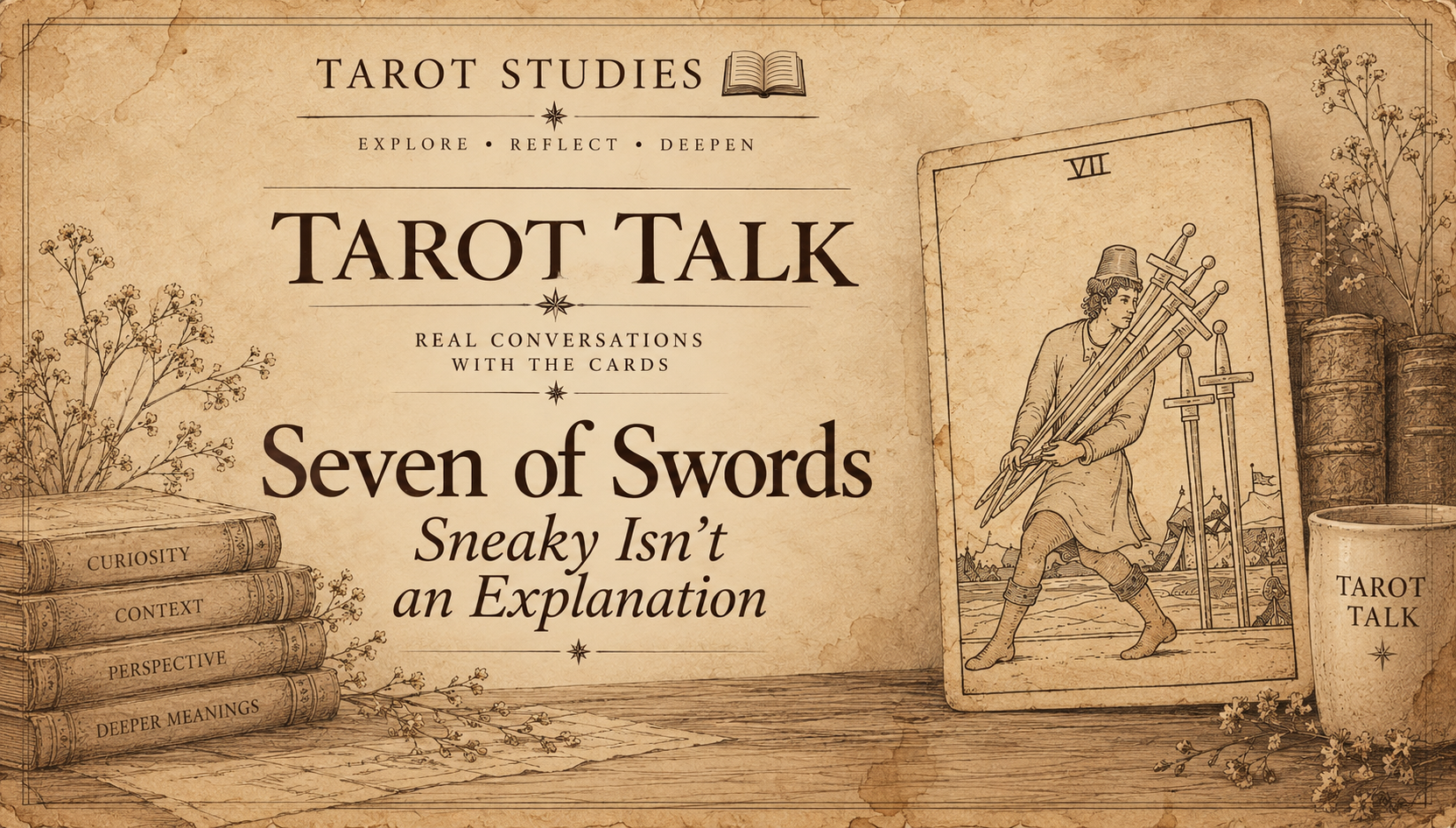
Tarot Talk: Seven of Swords
Sneaky Isn’t an Explanation
My first impression of the Seven of Swords is almost always the same: sneaky.
It is difficult not to go there. The scene puts me there almost immediately. A figure is carrying five swords while looking back over their shoulder, with two swords left standing behind. There is something about the posture, the backward glance, and the entire composition that makes it feel as though we have caught this person in the middle of something they may not want everyone else to see.
But sneaky isn’t an explanation.
That’s what keeps pulling me back to this card. Once I get past my immediate reaction to the scene, I realize how much of the story I have supplied myself. I can see what the figure is doing, but I don’t actually know why they are doing it.
Is this person stealing something? Are they quietly solving a problem? Have they found a creative workaround that doesn’t require everyone else’s cooperation? Is this a joke? Are they avoiding a confrontation? Or are they deliberately manipulating the situation for their own benefit?
Those possibilities don’t mean the Seven of Swords can’t indicate deception or questionable behavior. It certainly can. But they do remind me that seeing something that looks suspicious and understanding the motivation behind it are two different things.
Maybe that is where I want to begin with the Seven of Swords.
Not by asking whether this card is sneaky.
By asking why it is sneaky at all.
Welcome to Tarot Talk
Welcome to Tarot Talk, a place where we get to know the cards a little differently.
Tarot gives us images, symbols, traditional meanings, and familiar keywords, but sometimes the best way to understand a card is to stay curious about what those meanings actually look like in a reading. Instead of stopping with a definition, Tarot Talk invites the card into the conversation and gives us room to ask questions, challenge assumptions, and explore the places where interpretation becomes a little less tidy.
Each conversation focuses on one part of a card rather than trying to explain everything the card can mean at once. A card may visit Tarot Talk more than once, because there is always another question to ask and another side of the card worth getting to know.
So pull up a chair. Today, we’re meeting the Seven of Swords.
Seven of Swords Quick Reference
Card: Seven of Swords
Arcana: Minor Arcana
Suit: Swords
Element: Air
Number: Seven
Astrological Correspondence: Moon in Aquarius
Five Common Keywords: Strategy • Deception • Secrecy • Resourcefulness • Avoidance
Core Meaning: Strategy, discretion, independent action, indirect approaches, and situations in which not everything is being openly shown, shared, or addressed.
Integrated Expression: Resourcefulness, strategic thinking, discretion, adaptability, creative problem-solving, and recognizing when a direct approach may not be the most effective one.
Five Common Keywords: Strategy • Deception • Secrecy • Resourcefulness • Avoidance
Core Meaning: Strategy, discretion, independent action, indirect approaches, and situations in which not everything is being openly shown, shared, or addressed.

Integrated Expression: Resourcefulness, strategic thinking, discretion, adaptability, creative problem-solving, and recognizing when a direct approach may not be the most effective one.
Shadow Expression: Deception, manipulation, avoidance, evasion, dishonesty, secrecy, or acting primarily for one’s own advantage.
Central Tension: The Seven of Swords asks us to pay attention not only to what someone is doing, but why they are doing it that way. Strategy and deception can look surprisingly similar from the outside. Context, motivation, and the surrounding cards help us determine which expression may be present.
Traditional Scene: In the Rider-Waite-Smith image, a figure carries five swords while looking back toward an encampment. Two swords remain standing behind. The unusual posture and backward glance contribute to the card’s long association with stealth, strategy, concealment, and actions taken outside the direct or expected route.
Today’s Conversation
Sneaky Isn’t an Explanation
Question on the Table: When the Seven of Swords appears in a reading, how much can we actually conclude from a scene that looks suspicious, and what should we examine before deciding why someone is taking the indirect route?
The Interview
MLH: Seven of Swords, welcome to Tarot Talk.
Seven of Swords: Thanks. Although, judging by your notes, I’m not entirely sure this was a friendly invitation.
MLH: It’s the word sneaky, isn’t it?
Seven of Swords: Underlined twice.
MLH: In my defense, you don’t exactly make it difficult. But sneaky also has some nuance to it, much like you do.
Seven of Swords: I’m carrying swords and looking over my shoulder. You’re the one who turned that into a confession.
MLH: Fair. But that is exactly why I wanted to talk to you. When I see your card, my first reaction is almost always sneaky. Before I’ve considered the question, the surrounding cards, or much of anything else, your image has already started telling me a story.
Seven of Swords: Or you’ve started telling yourself one.

MLH: Probably some of both. But I do pause, because there is more here than a quick-glance interpretation. Like I said, sneaky can mean different things.
Seven of Swords: That’s a better answer.
MLH: But let’s not pretend the image has nothing to do with it. You’re carrying five swords, two are left behind, and you’re looking over your shoulder. You look like you don’t want anyone to notice what you’re doing.
Seven of Swords: I look like I don’t want anyone to notice.
MLH: Yes. Sneaky.
Seven of Swords: And what am I doing?
MLH: Taking the swords.
Seven of Swords: You can see that.
MLH: Sneaking away with the swords.
Seven of Swords: You added something.
MLH: Did I? Actually, there is no movement. I’ve already turned sneaky into sneaking.
Seven of Swords: Exactly. You went from what you could see to telling yourself what I was doing.
MLH: All right. Then let me try again. You’re carrying five swords, you’ve left two behind, and you’re looking back.
Seven of Swords: Better.
MLH: You’re going to make me work for every word of this interview, aren’t you?

Seven of Swords: I thought that was the point.
MLH: It is. Because once I stop at sneaky, I’ve already decided quite a lot about you. Sneaky can very quickly become secretive. Secretive becomes dishonest. Dishonest becomes deceptive. And before long, I’m looking at you in a reading and wondering who is lying to whom. Unless you’re telling me you’re gathering swords for a medieval surprise birthday party.
Seven of Swords: You laugh, but at least that would explain the swords.
MLH: It would not explain why you look like you don’t want anyone to catch you with them.
Seven of Swords: Surprise party.
MLH: You have an answer for everything, don’t you?
Seven of Swords: No. I have possibilities. That’s rather the point.
MLH: Fair. Because there’s your expression, what looks like intent, and you are still carrying five swords.
Seven of Swords: You seem very attached to that detail.
MLH: Seven, they take up most of the card.
Seven of Swords: And yet you still don’t know why I have them.
MLH: No. I don’t.
Seven of Swords: There’s your question.
MLH: Why are you doing it this way?
Seven of Swords: Exactly.
MLH: So when you appear in a reading, what can I actually say with confidence before I know the answer to that?
Seven of Swords: That something isn’t being handled directly.
MLH: That’s all you’re giving me?
Seven of Swords: You asked what you could say with confidence. Confidence should require a little restraint.
MLH: Explain.
Seven of Swords: You can notice that I appear to be acting independently. You can notice that there is something indirect about the scene. You can notice what I’m carrying, what I’ve left behind, and the fact that I’m looking back. Those observations give you somewhere to begin.
MLH: But not necessarily somewhere to finish.
Seven of Swords: Now we understand each other.
MLH: Because deception could still be the answer.
Seven of Swords: Absolutely.
MLH: Manipulation?
Seven of Swords: Could be.
MLH: Avoidance?
Seven of Swords: Certainly.
MLH: Strategy?
Seven of Swords: Yes.
MLH: A creative workaround?
Seven of Swords: Now you’re getting interesting.
MLH: Even a joke?
Seven of Swords: Depends who owns the swords.
MLH: There you are. That sounded sneaky.

Seven of Swords: I never said your first impression was impossible.
MLH: Just incomplete.
Seven of Swords: Exactly.
MLH: So, the next time I pull you, Seven, I am still going to say sneaky. But then I’m going to wonder about what isn’t being talked about.
Seven of Swords: I can live with that.
MLH: That easy?
Seven of Swords: You’re noticing what caught your attention without pretending it told you the whole story. That’s progress.
MLH: So sneaky gets to stay.
Seven of Swords: I never asked you to get rid of it.
MLH: You objected pretty strongly.
Seven of Swords: I objected to what you did with it.
MLH: Fair. Because if something feels sneaky, maybe the next question is what is happening outside the obvious conversation. What isn’t being said? What isn’t being handled directly? What might someone be trying to accomplish without putting it plainly on the table?
Seven of Swords: And why.

MLH: And why. Because that changes everything.
Seven of Swords: It can.
MLH: It could lead me toward deception or manipulation.
Seven of Swords: Yes.
MLH: Or toward privacy, strategy, avoidance, independence, even a creative workaround.
Seven of Swords: Or a surprise party.
MLH: I knew you were going to bring that back.
Seven of Swords: Five swords, MLH. It’s going to be quite a party.
MLH: And two left behind.
Seven of Swords: Someone has to bring the cake.
MLH: I’m not even going to ask.
Seven of Swords: See? You’re learning.
MLH: Seven of Swords, thanks for talking with me.
Seven of Swords: Anytime. Just try not to underline sneaky twice before my next interview.
MLH: No promises.
After the Mic
I started this conversation with the same word that usually comes to mind when I see the Seven of Swords: sneaky.
I’m leaving the conversation with that word still intact. What changed is what I do with it.
The Seven of Swords reminded me how quickly an observation can become a story when I am reading Tarot. I see the backward glance, the five swords being carried, the two left behind, and the expression on the figure’s face. Those details create an immediate impression. There is nothing wrong with noticing that impression. In fact, it may be exactly where the reading needs to begin.
The problem comes when I allow that first impression to answer questions the card has not answered yet. Sneaky can become secretive. Secretive can become dishonest. Dishonest can become deceptive. Before long, I can build an entire narrative around a figure whose actual motivation I still do not know.
That may be what I am taking away most from this conversation. The Seven of Swords does not necessarily ask me to distrust my first reaction. It asks me to become curious about it.
If something feels sneaky, what is not being talked about?
What is happening indirectly? What is being kept private or withheld? Why might someone be avoiding the obvious route? Is there something they do not want discovered, or is there simply something they do not want discussed? Are they protecting themselves, avoiding accountability, thinking strategically, working independently, manipulating the situation, or finding a way around an obstacle?
The card alone may not settle that question. The reason I am reading, the position of the card, the surrounding cards, and the larger pattern of the spread all have something to contribute before I decide which story fits.
And I think that is where the Seven of Swords became more useful to me during this interview. I do not need to erase sneaky from my vocabulary to read this card with more nuance. I just need to remember that sneaky is where I noticed something. It is not necessarily where the interpretation ends.
Although, for the record, I still do not believe there was a medieval surprise birthday party.
Until Next Time
One conversation was never going to explain everything about the Seven of Swords, and I don’t think it should.
Today, we followed one thread: that immediate sense of sneaky and what happens when we slow down long enough to ask what is actually creating that impression. We did not settle every question about deception, secrecy, strategy, avoidance, independence, or the many other ways this card can show up in a reading.
We weren’t trying to.
That is part of what Tarot Talk is becoming. A card does not have to tell us everything it knows the first time it sits down at the table. We can follow one question, see where the conversation takes us, and leave the rest for another day.
The Seven of Swords will have plenty to talk about when it comes back. And apparently, we still need to find out what happened to those other two swords.
Until next time, keep looking at the cards, keep asking questions, and when your first interpretation arrives a little too quickly, give it a second look.
Sometimes the most interesting part of a card begins just after you think you know what you are looking at.
Sources & Further Study
Tarot Talk uses traditional Tarot sources as a foundation while leaving room to examine how interpretation develops through imagery, context, and conversation. If you’d like to explore some of the history behind the Seven of Swords and the Rider-Waite-Smith tradition more deeply, these are useful places to continue.
Waite, Arthur Edward. The Pictorial Key to the Tarot. William Rider & Son, 1910/1911.
Waite’s companion text to the Rider-Waite-Smith deck provides his description of the Seven of Swords and the divinatory meanings he associated with it. His entry is particularly interesting alongside this conversation because the meanings he records are broader and less tidy than reducing the card to a single modern keyword such as deception.
Hermetic Order of the Golden Dawn. Tarot correspondence material, commonly preserved in published collections of the Golden Dawn teachings.
Within the Golden Dawn correspondence system, the Seven of Swords is assigned to the Moon in Aquarius, 20°–30°, and given the title Lord of Unstable Effort. Tarot Studies treats this astrological association as part of the Golden Dawn-derived esoteric system rather than as a universal property of Tarot.
Place, Robert M. The Tarot: History, Symbolism, and Divination. Jeremy P. Tarcher/Penguin, 2005.
Place provides broader historical context for the development of Tarot, later occult interpretations, and the Waite-Smith tradition. It is useful further reading for separating the history of the cards themselves from systems and interpretations that developed around them.
A Note on Interpretation
Historical sources can tell us how earlier writers described a card and which correspondences they assigned to it. They cannot determine every meaning the card must have in every reading.
That distinction matters particularly with the Seven of Swords. Its image may create an immediate impression, traditional sources provide several interpretive possibilities, and modern Tarot practice has added still more associations. The purpose of studying those layers is not to find the one interpretation that eliminates all the others. It is to understand where our interpretations come from so we can recognize when we are observing the card and when we have begun telling its story.