

We’ve all been there, the card flips over, you stare at it, and your inner monologue sounds something like:
“Uh… what? I don’t understand. What are you trying to tell me?” That moment of doubt is universal. Every Tarot reader, no matter how seasoned, has encountered it. And here’s the truth: confidence in Tarot doesn’t come from memorizing all 78 cards. You can rattle off upright or reversed keywords like you’re auditioning for Tarot Jeopardy! But that’s not confidence.
True confidence is when you stop asking, “What does the card mean?” and start asking, “What does my intuition see here?” Tarot confidence is quieter. It’s sturdier. It’s not about flawless recall, it’s about trust. Trust that you can interpret what’s before you. Trust that even if the reading takes you into uncharted waters, you won’t sink.
This post is your guide to walking that path: from hesitation, self-doubt, and the dreaded “What if I’m wrong?” spiral, to a place where your readings flow like a conversation with an old friend.
What Is Tarot Confidence, Really?
Tarot confidence isn’t perfection. It’s not flawless recall of keywords or neat predictions on command. Instead, it’s a deeper kind of Tarot mastery (more than just confidence), a blend of trust, intuition, and steady practice that allows you to speak the language of the cards with clarity. It looks like trusting your intuition when a card feels layered or mysterious, leaning on your knowledge base when intuition needs a framework, and believing in your process even when the reading isn’t “storybook perfect.”
Think of Tarot as a language. At first, you memorize vocabulary: Fool, Cups, numerology, reversals. But self-confidence grows when you move beyond word-for-word translation and start forming full sentences. That’s when you feel secure. Apprehension shifts from keyword recall into real conversation, true mastery.

A Brief Historical Backdrop
Within Tarot’s own history, you can see how the cards evolved to help readers find greater confidence. In the 18th century, Etteilla introduced structured keyword systems an early attempt to give readers certainty and stability when facing the unknown. His work made Tarot feel less like guesswork and more like a method.
By the late 19th century, the Golden Dawn expanded that foundation with astrology, numerology, and Kabbalah. This made readings dazzlingly rich but also intimidating, leaning heavily on scholarship. Confidence at this stage often came through intellectual mastery, memorizing complex correspondences to feel secure in interpretation.
Then came the early 20th century and a shift in emphasis. Arthur Edward Waite envisioned Tarot as a spiritual tool for insight, not just an occult puzzle. Pamela Colman Smith brought that vision to life through the Rider–Waite–Smith deck, giving the Minor Arcana pictorial scenes for the first time. Suddenly, readers didn’t need to rely solely on memorized systems; they could look at the image itself and trust their intuitive impressions.
This was a turning point. Tarot moved from rigid scholarship toward a balance of knowledge and intuition, offering both structure and freedom. That balance remains the foundation of Tarot confidence today: enough framework to feel anchored, enough imagery to invite personal insight. When you lean on both your studies and your intuition, you’re continuing the same evolution that reshaped Tarot centuries ago.
The Psychology of Building Confidence
Confidence isn’t something you wake up with one day like a new pair of shoes. We often assume that people who are really good at something must have been born with it, a natural gift, some kind of magic others don’t have. But the truth is, most of those “naturals” got there the old-fashioned way: through practice, persistence, and a lot of imperfect attempts. Tarot is no different. The readers who seem effortless are usually the ones who have spent years stumbling, second-guessing, and showing up anyway until skill transformed into fluency.
Psychologists define confidence as a mix of self-efficacy (the belief in your ability to perform a specific task) and self-trust (Bandura, 1997). In Tarot terms, confidence is the moment you realize: “I can interpret these cards meaningfully, even if I don’t know everything.”
Tarot learning often mirrors the four stages of competence model (Howell, 1982):
- Unconscious Incompetence – You don’t know what you don’t know. Tarot looks fun and mystical… until you realize there are 78 cards, reversals, spreads, and symbolic systems.
- Conscious Incompetence – The humbling stage: “Oh wow. I know nothing.” This is where imposter syndrome shows up, making readers feel “fake” because they rely on books or freeze mid-reading.
- Conscious Competence – You can read, but it takes effort. You pause, you check notes, you second-guess—but you’re actually doing the work.
- Unconscious Competence – The fluent stage. You read effortlessly, naturally, without having to “translate” every symbol. The story flows.
Tarot confidence begins to grow between stages two and three, when you’re no longer overwhelmed by what you don’t know, but not yet fully fluent. Here, practice and reflection turn raw knowledge into embodied skill.
Why Tarot Triggers Self-Doubt
Tarot uniquely combines symbol interpretation (a cognitive task) with intuition (a less tangible skill). This duality can spark self-doubt. Cognitive psychology tells us that when learners encounter ambiguity, they often default to either:
- Over-reliance on external authority (the book meaning is “right,” so my impression must be wrong).
- Overconfidence in intuition without grounding (ignoring the card’s symbolic roots entirely).
Real confidence emerges when these two sides integrate, creating what psychologists call adaptive expertise, the ability to flex between rules and creativity depending on the situation (Hatano & Inagaki, 1986).
The Role of Feedback
Albert Bandura’s research on self-efficacy highlights that mastery experiences (actually doing the thing and surviving it) are the strongest builders of confidence. In Tarot, this means:
- Doing readings, even if imperfect.
- Receiving supportive feedback from querents or peers.
- Reflecting afterward: what worked, what didn’t, what surprised me?
The more you accumulate these experiences, the stronger your “Tarot self-efficacy” becomes. Be optimistic, everyone gets a little sideways sometimes when it comes to learning tarot.
The Confidence Spiral
Think of confidence as a spiral, not a finish line:
Learn → Practice → Doubt → Reflect → Try again → Improve.
Each loop strengthens your belief that you can handle uncertainty. Over time, the spiral shifts you from hesitant to fluent.
Educational theory backs this up. Kolb’s learning cycle shows that real growth comes from looping through experience, reflection, and trying again. Vygotsky reminds us that the sweet spot of learning is in the almost-there zone, where you can’t do it perfectly yet, but you can stretch into it with support. And Bandura’s research on self-efficacy? He proved that confidence builds through mastery experiences, actually doing the thing, even clumsily, until your brain starts believing you can.
Tarot confidence works the same way: each spiral through practice, doubt, and reflection is stacking proof that you’re capable. Growth isn’t a straight line. It’s a spiral that curves you closer and closer to fluency.
Practical Steps on the Path
Confidence doesn’t appear all at once — it grows step by step, just as psychologists describe in the four stages of competence (Howell, 1982). Here’s how those stages translate into Tarot practice, with concrete steps and activities to try at each level:
Stage 1: Unconscious Incompetence – “I don’t know what I don’t know.”
At this stage, Tarot feels exciting but overwhelming. The best step here is building a strong foundation and competence so you don’t get lost in the shuffle.
- Learn the symbolic anchors (numbers, elements, archetypes).
- Keep a simple reference journal for card meanings.
- Allow yourself to be a beginner without pressure to “get it right.”
Pull one card daily. Instead of interpreting, write down everything you see: colors, objects, body language, expressions, background details.
Lay out the Minor Arcana by suits. Notice how Cups, Wands, Swords, and Pentacles differ in tone. Write one word to capture the “energy” of each suit.
Pull out all the “threes” or “sevens” in the deck. Compare them across suits. What themes repeat? What shifts?
Stage 2: Conscious Incompetence – “Oh wow, I know nothing.”
This is where self-doubt creeps in. But here’s the good news: this is also the richest learning stage.
- Create intimacy with your deck by journaling impressions before checking a guidebook.
- Normalize mistakes: reframe them as lessons, not failures.
- Remind yourself that uncertainty is a sign of growth, not weakness.
Pull a card, write your first intuitive impression in one column, and the guidebook meaning in another. Compare and highlight overlaps.
Do a three-card reading for yourself. Write two versions: one with intuition only, one with book knowledge. Then weave them together.
After a reading, note one strength and one challenge. This shifts focus toward growth instead of only “getting it wrong.”
Pull two cards and write a “mini story” of 5–6 sentences connecting them. Then add a third card as a “plot twist.” This strengthens your ability to see cards in relation, not isolation.
Stage 3: Conscious Competence – “I can read, but it takes effort.”
Here’s where the training wheels are on — you can read, but it requires focus and intention.
- Practice storytelling between cards. Instead of memorizing isolated definitions, notice how two or three cards form a narrative together.
- Read for friends, peers, or study groups to practice articulating your thoughts aloud.
- Pause during readings if needed — fluency develops through repetition, not speed.
Pull two cards and write a 5–6 sentence story linking them. Add a third card as a twist.
Give yourself 10 minutes for a three-card spread. This teaches you to trust first impressions without overthinking.
Trade readings with a friend or peer. Ask them to reflect back what resonated. This strengthens articulation and confidence in real time.
Stage 4: Unconscious Competence – “I just read. It flows.”
Eventually, Tarot becomes second nature. You weave knowledge and intuition without forcing it. Confidence here looks like quiet assurance, not arrogance.
- Read regularly to stay in flow.
- Continue refining your knowledge (history, symbolism, psychology) so your intuition has strong roots to draw from.
- Share your skills: teaching, journaling, or mentoring deepens your own mastery.
Guide a beginner through one exercise, like a daily card pull. Teaching consolidates mastery.
Blend Tarot with another practice—art, poetry, storytelling, or movement. Pull a card and express it creatively to deepen intuition.
Offer a reading without using a spread — just lay the cards freely and let them speak as a conversation. Or, teach a beginner one simple exercise (like daily pulls). Sharing knowledge at this stage reinforces mastery and reveals new insights.
The Takeaway
Every reader passes through these stages. Confidence isn’t about skipping steps. It’s about embracing them. Each stage has a role in shaping you into the reader who doesn’t just know Tarot, but lives it with trust and fluency.
Tarot Confidence as a Spiritual Milestone
Confidence in Tarot isn’t only about skill; it’s a rite of passage through the Major Arcana. Each archetype you meet along the way teaches something about trust, voice, and flow.
You begin as The Fool, stepping into Tarot with curiosity and maybe a bit of nervous excitement. Confidence here doesn’t come from mastery. It comes from daring to take the first step, to read before you feel ready.
Reflection: Where are you still The Fool in your Tarot journey, stepping forward without knowing what comes next?
Then comes The Magician, laying out the tools before you: the suits, numbers, spreads, and symbols. In this stage, confidence grows from realizing, “I already have what I need. I just need to practice using it.”
Reflection: What tools or knowledge already rest on your table, waiting for you to trust them?
But tools alone don’t make a reader. The High Priestess reminds you that confidence is also listening inward. She whispers that the wisdom you seek is already in you, waiting for trust. Here, confidence means letting intuition guide you when logic stalls.
Reflection: When was the last time you trusted your intuition over “the book,” and how did it change your reading?
When self-doubt claws at you, Strength arrives not as a roaring lion but as quiet persistence. Strength teaches that confidence is not the absence of fear, but the courage to keep showing up even when you question yourself.
Reflection: What does self-compassion look like in your Tarot practice when doubt creeps in?
Finally, The Sun breaks through. This stage isn’t about flawless performance it’s about warmth, clarity, and joy. You begin to read not from fear of being wrong, but from the steady radiance of trust in your process.
Reflection: When do you feel most like The Sun in your readings clear, open, and shining with trust in your voice?
The Shadow Side of Confidence
Every archetype has its light and its shadow. Tarot confidence, too, can tilt out of balance. Sometimes it swells into arrogance, sometimes it collapses into doubt, and sometimes it performs for approval instead of truth. Walking with the shadow archetypes shows us where confidence needs recalibration.
You may first encounter The Magician reversed, dazzling with surface tricks but hollow underneath. Here, confidence mutates into overconfidence: skipping depth, projecting certainty, or speaking too quickly just to fill the silence.
Reflection: Where in your Tarot practice do you risk rushing or assuming too much instead of pausing for depth?
Then comes The Moon, with its shifting light and distorted reflections. Under her spell, confidence dissolves into self-doubt. Every impression feels uncertain; every card requires a second opinion from a guidebook or a peer. It’s easy to mistake fear for caution in her landscape.
Reflection: How do you tell the difference between your intuition speaking and fear disguising itself as “being careful”?
If you chase external approval, you’ll meet The Tower a confidence built like scaffolding on shaky ground. Here, readings become performance: impressive spreads, dramatic delivery, or answers shaped to please rather than to reveal. The Tower reminds us that false structures always collapse, often at the worst possible moment.
Reflection: In what ways might you be reading to impress, rather than reading to uncover truth?
But then, suspended in quiet surrender, waits The Hanged Man. He isn’t here to punish or to scold. He simply invites a pause. True confidence is not about control but perspective, the humility to release the need to be right or dazzling. In stillness, trust returns.
Reflection: Where could you let go of control, shift perspective, or simply pause to find steadier confidence in your readings?
Together, these archetypes remind us: confidence isn’t a static achievement. It’s a dance of light and shadow, presence and surrender. The key is not eliminating shadow, but learning to recognize it and choosing to return, again and again, to the middle path.
Shadow & Middle Path Spread
This spread helps you explore where your confidence might be tipping into shadow and how to rebalance it through surrender and perspective.
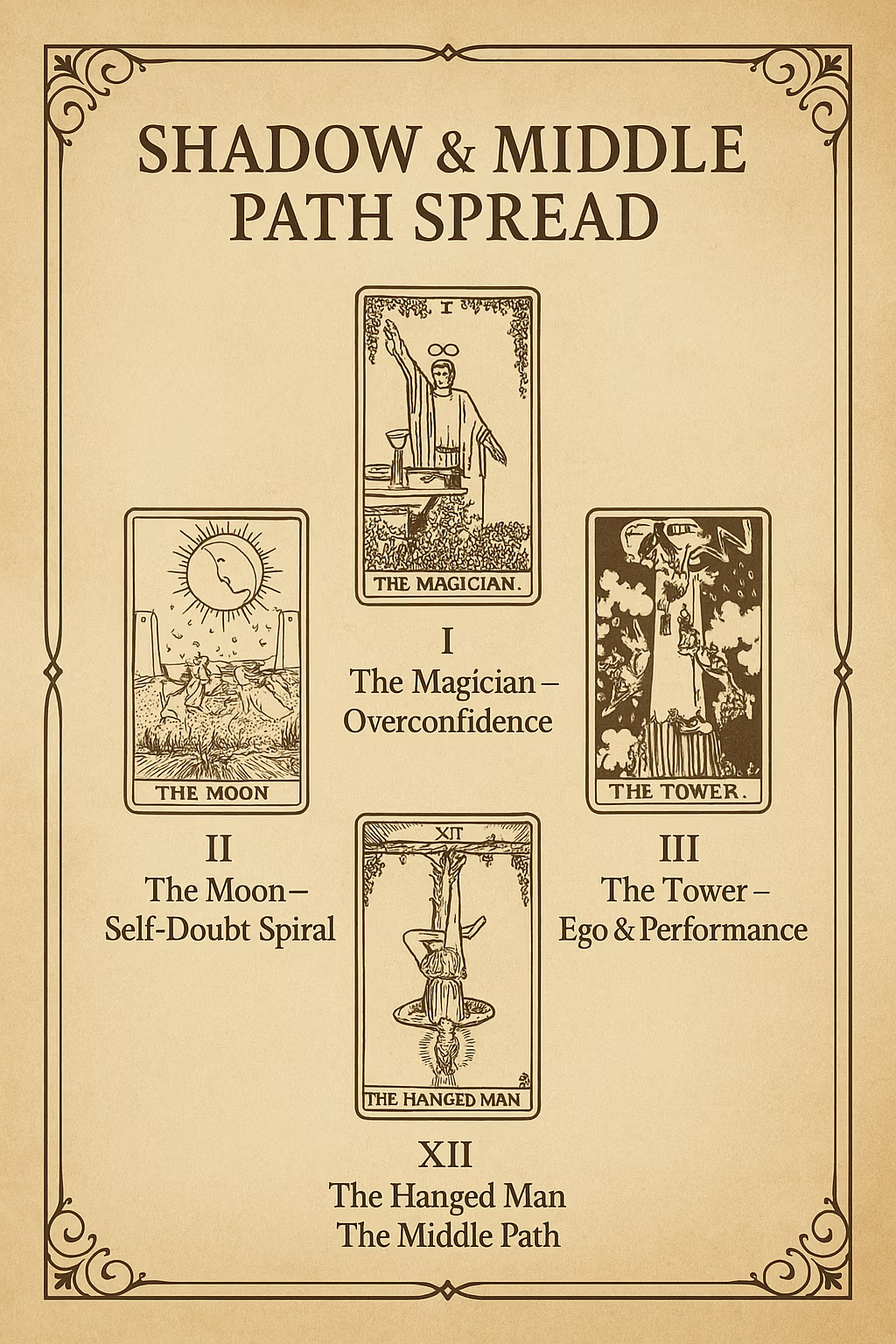
Card Positions
- Overconfidence
Where might I be speaking too quickly, projecting certainty, or skipping depth in my Tarot practice? - Self-Doubt Spiral
Where am I second-guessing myself, mistaking fear for caution, or leaning too heavily on external validation? - Ego & Performance
Where am I reading for approval, trying to impress, or clinging to a structure that isn’t serving truth? - The Middle Path
What perspective, surrender, or pause will help me return to balanced, steady confidence?
How to Work With It
Example Walkthrough: Shadow & Middle Path Spread
Let’s say I pull the same cards as the example in the visual. At first glance, the reading feels harsh: too much trickery, doubt, and collapse! But confidence work is about honesty, not comfort.
- Magician reversed tells me I’ve been rushing, speaking too quickly in readings just to fill space.
- Moon shows that underneath the speed is doubt. I second-guess myself and worry my intuition “isn’t enough.”
- Tower reveals the deeper truth: sometimes I’m performing for approval, trying to sound impressive instead of grounded.
- Hanged Man offers the shift. Instead of scrambling for certainty, I need to pause. Take a breath, name what I seebefore I rush to explain.
Suddenly, the spread doesn’t feel like criticism it feels like guidance. It’s not about being “wrong,” it’s about learning how to trust stillness as much as speech.
Exercises to Strengthen Confidence
Confidence isn’t something you think your way into, you build it by practicing, reflecting, and noticing your growth. These exercises are designed to help you strengthen your Tarot confidence from multiple angles: self-reflection, hands-on spreads, and creative embodiment.

Confidence Tarot Spread (5 cards)
I – What I already do well
II – My current block to confidence
III – The lesson hidden in this block
IV – How to nurture trust in myself
V – The confident reader I am becoming
Try this spread once a season. It’s a living record of your growth, almost like Tarot keeping a diary of your development.
Embodied Practice: The One-Card Pause
Before every reading (for yourself or others), pull one card and sit with it in silence for 3 minutes. No rushing, no interpreting — just observe and breathe. This trains patience, presence, and the confidence to let meaning arrive rather than forcing it.
Together, these exercises move you through the mind (journaling), the cards (spread), the imagination (visualization), creativity (art/poetry/movement), and the body (embodied pause). Confidence becomes not just a skill, but a practice that touches every layer of your Tarot relationship.
Journaling Prompts
- “What do I trust most about myself as a reader right now?”
- “Where do I still hesitate, and what story am I telling myself about that hesitation?”
- “If I met my future confident self, what advice would they give me today?”
Tip: Revisit these prompts every few months. You’ll see how your answers shift as your con
Creative Confidence Exercise
Pull one card and express it outside of words:
- Sketch or doodle the card in your own style.
- Write a poem or short story inspired by its imagery.
- Move your body in a way that expresses the card’s energy.
Confidence grows when you connect to the deck in multiple language
Walking the Path
Confidence in Tarot isn’t a destination you arrive at once and for all. It’s a relationship that unfolds each time you sit with your deck. Some days you’ll feel radiant like The Sun, other days you’ll stumble like The Tower, and sometimes you’ll pause in surrender like The Hanged Man. Each card reminds you that growth is cyclical, not linear.
What matters most is not flawless recall or dazzling performances. What matters is that you keep showing up: shuffling, drawing, reflecting, listening. Every reading, whether awkward or flowing, is part of your spiral of learning.
So if you find yourself staring at a card thinking, “I have no idea what this means,” take a breath. Trust that meaning can emerge slowly, like dawn breaking over a horizon. Confidence doesn’t ask you to be perfect. It asks you to be present.
Because Tarot confidence isn’t about having every answer. It’s about daring to read anyway.
“May your readings be steady, your intuition be trusted, and your confidence grow with each shuffle.”
References:
Bandura, A. (1997). Self-Efficacy: The Exercise of Control. New York: Freeman.
Howell, W. C. (1982). The Empathic Communicator. University of Minnesota.
Hatano, G., & Inagaki, K. (1986). Two Courses of Expertise. In H. Stevenson, H. Azuma, & K. Hakuta (Eds.), Child Development and Education in Japan. New York: Freeman.