
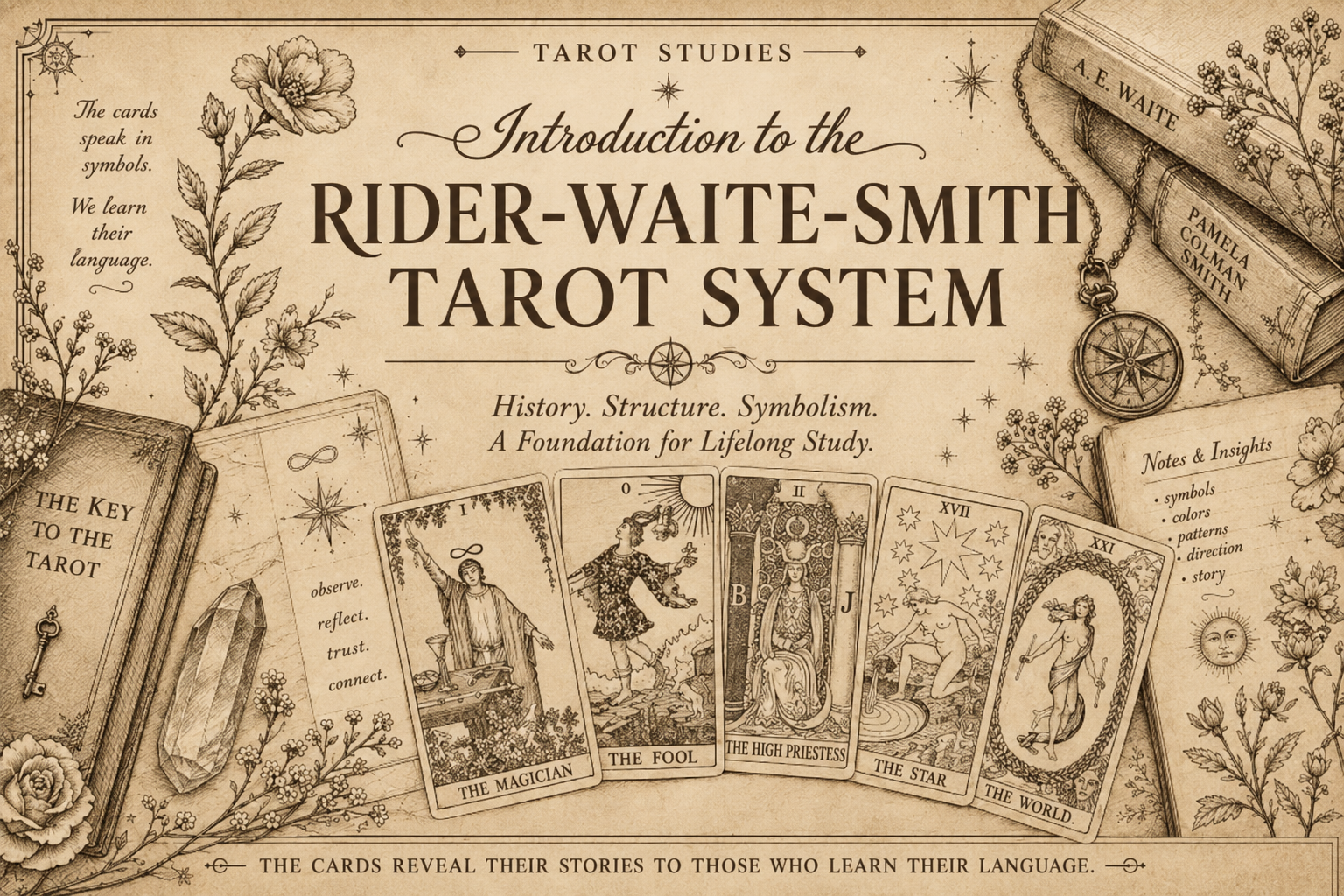

Understanding the Structure of the Rider-Waite-Smith Tarot
One of the most significant turning points in my own Tarot journey came when I stopped thinking about the deck as seventy-eight separate cards and began seeing it as a single, interconnected system.
At first, every card felt like its own lesson. Each one came with a list of meanings, symbols, and keywords that I believed I needed to memorize before I could move forward. It was overwhelming because I treated every card as though it existed in isolation. The more I tried to remember each definition, the more difficult Tarot seemed to become.
Over time, however, something began to change.
The cards started talking to one another.
I began noticing familiar themes appearing throughout the deck. Numbers repeated recognizable patterns. Similar symbols appeared across multiple suits. Cards that had once felt completely unrelated suddenly seemed connected, as though they were all contributing to one larger conversation. Instead of seventy-eight separate lessons, I was beginning to see one symbolic language unfolding across the entire deck.
That realization transformed the way I studied Tarot.
Rather than carrying around seventy-eight independent meanings, I began learning how those meanings related to one another. The deck immediately felt less intimidating because every new card helped me understand another. Once I understood the structure behind the cards, studying Tarot became less about memorization and more about recognizing patterns.
Understanding that structure is one of the greatest gifts the Rider-Waite-Smith system offers new readers because it gives every card a place within the larger story.
The Two Great Divisions of the Deck
The Rider-Waite-Smith Tarot contains seventy-eight cards, but those cards are not arranged randomly. Like any well-designed language, the deck has an underlying structure that helps everything fit together. The cards are divided into two distinct groups, each serving a different purpose while supporting the other.
The first group is known as the Major Arcana, consisting of twenty-two cards. These are often the cards that first capture our imagination because they speak to life’s defining experiences and the deeper lessons that shape who we become. Cards such as The Fool, The Magician, Death, The Star, and The World explore themes of identity, transformation, purpose, challenge, healing, and fulfillment. They remind us that life unfolds through seasons of growth rather than isolated moments.
The remaining fifty-six cards form the Minor Arcana. Because they make up fifty-six of the deck’s seventy-eight cards, they are more likely to appear in a reading when the deck is shuffled and drawn at random. While they may seem less dramatic at first glance, they offer a closer look at the experiences that shape our everyday lives. Relationships, conversations, work, family, decisions, successes, disappointments, and ordinary moments all find their place within the Minor Arcana.
Over time, I came to appreciate that neither group is more important than the other. The Major Arcana reminds us of the larger journey we are traveling, while the Minor Arcana teaches us that the smallest daily choices often determine the direction of that journey.

The Four Suits: Four Ways of Seeing Life
Within the Minor Arcana, the cards are organized into four suits, each exploring a different aspect of human experience. When I first encountered the suits, I treated them as categories I simply needed to memorize. Eventually, I realized they were much more helpful when I thought of them as four different lenses through which the same situation could be viewed.
Every reading contains practical, emotional, intellectual, and creative dimensions. The suits help us recognize which of those dimensions is asking for our attention.
Wands are often associated with energy, creativity, inspiration, ambition, and purpose. They encourage us to ask where our enthusiasm is leading us, what we are building, and what new possibilities are beginning to take shape.
Cups invite us into the emotional landscape. Relationships, compassion, intuition, joy, grief, and connection all find expression here. Whenever several Cups appear together, I find myself paying closer attention to what is happening within the heart before trying to solve the situation with logic alone.
Swords explore the world of thought. They speak through communication, decisions, truth, perspective, and conflict. Although they sometimes carry a reputation for difficulty, I have come to appreciate them as cards of honesty. They encourage us to face reality with clarity, even when that truth is uncomfortable.
Pentacles return us to the physical world. They remind us that spirituality isn’t separate from everyday life. Work, health, finances, practical skills, our homes, and our relationship with the natural world all become meaningful parts of the journey. Some of Tarot’s deepest lessons are found in the ordinary rhythms of daily living.
The longer I studied the suits, the less interested I became in deciding whether one was “good” or “bad.” Instead, I found myself asking a different question.
What part of life is this suit inviting me to understand more deeply?

Meeting the Court Cards
If there was one part of the Rider-Waite-Smith deck that puzzled me most as a beginner, it was the Court Cards.
Pages.
Knights.
Queens.
Kings.
At first, I wanted each one to represent a specific person. Sometimes they certainly do, but I gradually realized that limiting them to literal individuals prevented me from seeing the richness they offered.
The Court Cards can represent people, but they can also describe attitudes, stages of growth, ways of responding to challenges, or qualities we are being encouraged to develop within ourselves.
Rather than memorizing four fixed personalities, I began thinking about the roles they play.
- Pages often invite curiosity, openness, and a willingness to learn.
- Knights reflect movement, determination, and purposeful action.
- Queens embody wisdom, compassion, and quiet confidence.
- Kings symbolize responsibility, leadership, and mature understanding.
The longer I studied Tarot, the more flexible these cards became. Instead of asking, “Who is this?”, I often found myself asking, “What quality is this card encouraging me to cultivate?”
That single shift opened an entirely new way of understanding the Court Cards.

Seeing the Whole Picture
The structure of the Rider-Waite-Smith Tarot provides a framework, but it is only the beginning.
Every card also carries layers of meaning through color, number, symbolism, posture, direction, landscape, and composition. Those elements work together like the vocabulary and grammar of a language, quietly shaping the message each card communicates.
The more I studied the deck, the more convinced I became that very little had been placed within the artwork by accident. A mountain rising in the distance, a figure glancing over one shoulder, a river flowing quietly through the background, or the repeated appearance of a single flower could all contribute another layer of understanding. The longer I looked, the more connections I discovered.
That doesn’t mean every detail has one fixed meaning, or that we can always know exactly what Pamela Colman Smith intended when she illustrated a particular scene. Working in collaboration with A. E. Waite, Smith created artwork that continues to invite observation and interpretation more than a century later. While we can study the deck’s traditional symbolism and historical influences, we should also recognize that not every artistic decision can be explained with certainty. What matters is learning to recognize how the visual elements relate to one another and how those relationships might contribute to the card’s interpretation.
That realization changed the way I approached every reading.
Instead of asking,
“What does this card mean?”
I found myself asking a different question.
“What is this card showing me?”
It remains one of the most important questions I ask whenever I sit down with the cards because that question reminds me to observe before I interpret.
Beginning Your Study of the Rider-Waite-Smith System
When I first started learning Tarot, I believed success depended on memorization. If I could remember every keyword, every upright interpretation, and every reversed meaning, I assumed I would eventually become a confident reader. It seemed like a sensible approach. Learn the definitions, practice the spreads, and everything else would naturally fall into place.
It didn’t take long to discover that learning Tarot wasn’t nearly that simple.
The harder I tried to memorize the cards, the more overwhelmed I became. Every book described them a little differently. Every website offered another list of keywords, and every teacher emphasized a different philosophy or reading style. Instead of feeling more confident, I felt as though I was collecting puzzle pieces without ever seeing the picture they were meant to create.
Looking back, I realize I wasn’t really studying Tarot. I was studying other people’s interpretations of Tarot.
There is tremendous value in learning from experienced readers, and many authors have profoundly shaped my own understanding of the cards. Rachel Pollack helped me appreciate the richness and depth of Tarot symbolism. Joan Bunning offered practical methods that made the deck feel approachable without sacrificing its complexity. Later, Beneabelle Wen encouraged me to think more deeply about Tarot as an interconnected symbolic system rather than simply a collection of individual meanings.
Each of those teachers became an important part of my education, but none of them could replace the experience of sitting quietly with the cards themselves. Eventually I realized that every guidebook could point me toward the language of Tarot, but no book could learn that language for me.

Learning to Observe Before Interpreting
One of the most valuable habits I ever developed was learning to slow down.
Instead of immediately reaching for a guidebook, I began spending a few quiet minutes simply looking at the card in front of me. I wasn’t trying to prove my intuition was correct or searching for the “right” interpretation. I simply gave myself permission to observe before I analyzed.
That small change transformed the way I studied Tarot.
Rather than rushing toward answers, I began asking questions.
- What catches my eye first?
- Where does my attention naturally settle?
- Who appears comfortable?
- Who appears uneasy?
- Which direction are the figures moving?
- What colors dominate the scene?
- What emotions seem present?
- What story appears to be unfolding?
Those questions rarely produced immediate answers, but that was never their purpose. They trained me to notice details I had previously overlooked and encouraged me to remain curious a little longer before reaching a conclusion.
Over time, I discovered that the artwork often revealed insights before I ever opened a book. The guidebooks didn’t become less important. Instead, they became conversation partners rather than instruction manuals. They helped me deepen my observations instead of replacing them, and that shift transformed my entire relationship with Tarot.
[MEDIA PLACEHOLDER: WordPress #23244 | Optional, visual verification pending]
Building Your Own Tarot Practice
Every reader eventually develops a personal way of studying, and mine certainly evolved over time. I began keeping journals after nearly every reading. Some entries filled only half a page, while others stretched across several pages as I explored symbolism, personal experiences, historical references, and recurring themes. Those journals gradually became much more than study notes. They became a record of my own relationship with the cards and a reminder that learning Tarot is never really finished.
Looking back through those journals has become one of the greatest gifts Tarot has given me. The cards haven’t changed, but I have. When I revisit older entries, I often discover meanings I simply couldn’t have understood years earlier because I hadn’t yet lived the experiences those cards were reflecting. Tarot has a remarkable way of growing alongside the reader, revealing new layers of understanding as our own lives continue to unfold.
For me, that has become one of the most rewarding aspects of studying the Rider-Waite-Smith system. The cards continue teaching, not because they have changed, but because I continue to change.
If you’re beginning your own practice, I encourage you to keep things simple. You might start by recording your observations from a single card, noting the questions it raises and any connections you recognize between its artwork and traditional associations. As you continue studying, you can add reflections from your readings, compare interpretations from different sources, or return to earlier entries to see whether your understanding has changed. The purpose isn’t to create a perfect record of every card. It’s to give yourself a place where your observations, questions, and discoveries can develop over time.
Give Yourself Permission to Learn Slowly
If you’re just beginning your Tarot journey, let me leave you with one piece of encouragement I wish someone had shared with me years ago.
You do not have to master Tarot all at once.
You don’t need to memorize every symbol this week, understand every spread before your first reading, or own ten different decks before you’ve become comfortable with one. You certainly don’t need to compare your progress with someone who has spent years, or even decades, studying the cards.
Tarot isn’t a race.
It’s a relationship.

Like any meaningful relationship, it develops through curiosity, patience, trust, and repeated conversation. Some cards will feel familiar almost immediately. Others may remain mysterious for years before suddenly revealing why they have continued appearing throughout your readings. That gradual unfolding isn’t a weakness of Tarot. It is one of the reasons so many of us continue returning to the cards year after year
There will be days when a card seems to make perfect sense and others when you aren’t quite sure what you’re looking at. I’ve experienced both, and I suspect I always will. Sometimes I return to a card I’ve studied dozens of times and notice something I somehow managed to overlook. Other times, I recognize a familiar symbol but understand it differently because of something I’ve experienced since our last encounter. That’s part of what makes studying Tarot so interesting to me. There’s always something more to discover, even in the cards we think we know.
Where to Go Next
When we began this conversation, I talked about the moment I stopped seeing Tarot as seventy-eight separate cards and started recognizing the connections between them. That change didn’t happen overnight, and it certainly didn’t mean I suddenly understood everything about the deck. What changed was the way I approached learning.
Instead of treating each card as another definition to memorize, I began looking for relationships. I noticed how the suits approached different areas of life, how numbers introduced familiar themes, and how the artwork gave those themes a story of their own. The more connections I recognized, the less intimidating the deck became.
And that’s really what I hope you’ll take away from this part of our Orientation series.
You don’t need to understand every symbol before you begin exploring the cards. You don’t even need to know what every card means. What you need is a willingness to look, ask questions, and become curious about what you’re seeing.
The next time you sit down with your deck, try something simple. Choose one card and spend a few minutes looking at it before reaching for your guidebook. Notice the figures, the landscape, the colors, and anything else that catches your attention. Then ask yourself how those details might connect to the card’s suit, number, or place within the larger deck.
You may not arrive at a complete interpretation, and that’s perfectly fine. You’re beginning to recognize the language that makes interpretation possible.
As we continue through the Rider-Waite-Smith series, we’ll build on that foundation by exploring how observation, symbolism, and interpretation work together. We’ll look more closely at the relationships between cards and how those relationships can deepen our understanding of a reading.
Because ultimately, learning Tarot isn’t about having seventy-eight perfectly memorized answers waiting in your head.
It’s about learning to recognize the connections, ask better questions, and become comfortable with what you don’t yet understand.
The goal isn’t to memorize everything the cards might say.
It’s to become fluent in the language they speak.
Sources and Further Reading
Throughout my Tarot studies, I’ve found that different authors and historical resources offer valuable perspectives on the Rider-Waite-Smith system. The following books and collections provide opportunities to explore the deck’s structure, symbolism, history, and interpretation in greater depth.
Books for Further Study
Rachel Pollack, Seventy-Eight Degrees of Wisdom. A thoughtful exploration of Tarot symbolism, interpretation, and the larger themes that connect the cards.
Joan Bunning, Learning the Tarot. An approachable, lesson-based introduction to Tarot that offers practical exercises and a structured foundation for developing readers.
Benebell Wen, Holistic Tarot. A comprehensive resource exploring Tarot interpretation, symbolic systems, reading methods, and approaches to studying the cards.
Historical and Collection References
Whitney Museum of American Art. Rider-Waite-Smith Tarot Deck. https://library.whitney.org/bib/67344
Wellcome Collection. The Tarot Pack of Cards. https://wellcomecollection.org/works/vvhjuc5a
Johns Hopkins University Libraries. Rider-Waite-Smith Pam-A Deck. https://aspace.library.jhu.edu/repositories/3/archival_objects/330032
These historical collections offer additional context for studying the Rider-Waite-Smith deck and the artistic contribution of Pamela Colman Smith.
Continue Your Rider-Waite-Smith Study
You’ve explored how the Rider-Waite-Smith deck is organized and how its structure can support your studies. Continue through the series as we explore the connections between observation, symbolism, and interpretation.