
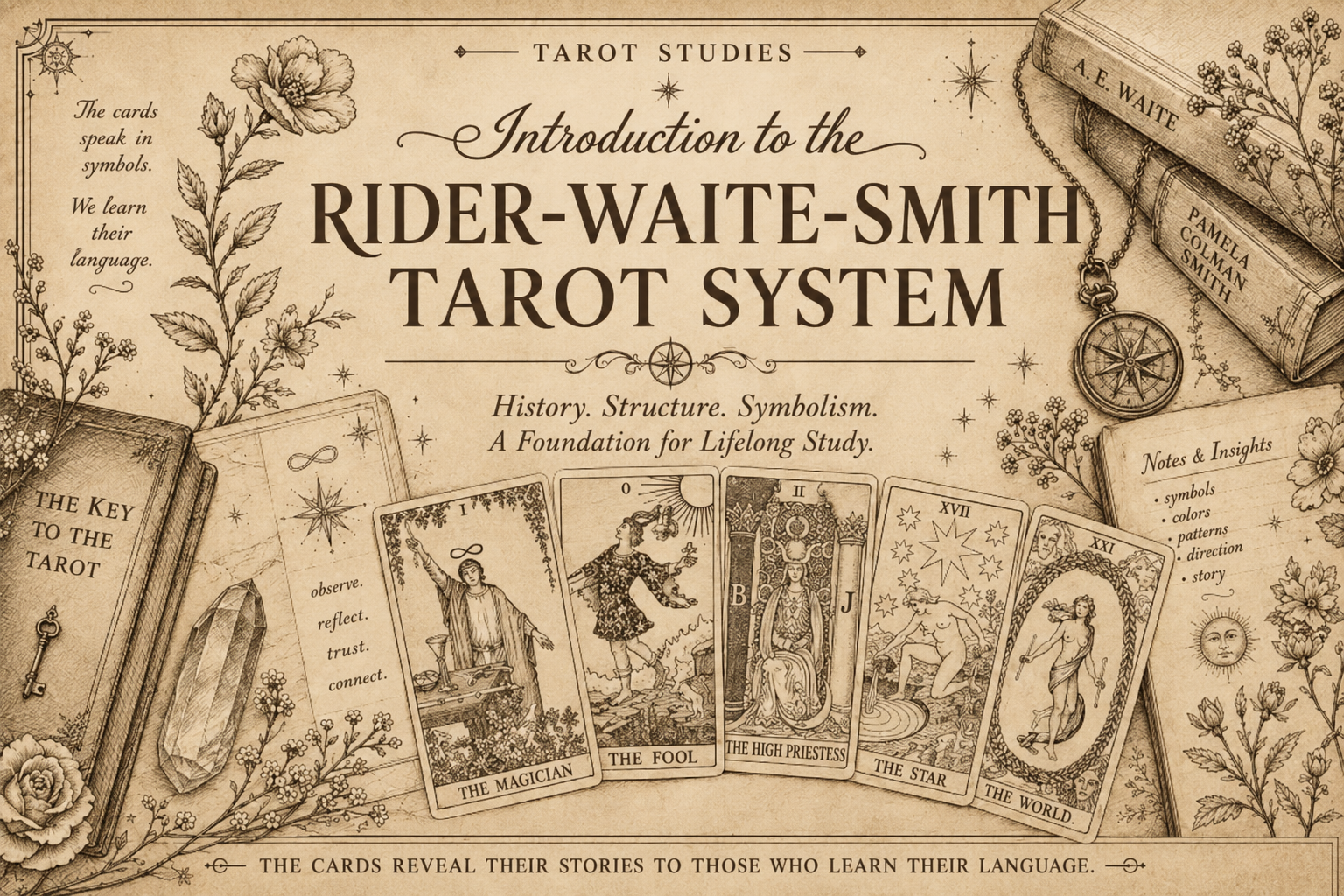
What Is the Rider-Waite-Smith Tarot System?

Before you can read Tarot fluently, it helps to understand the language that shaped modern Tarot. Throughout this series, we’ll explore the history, structure, symbolism, and visual storytelling of the Rider-Waite-Smith system, building a foundation that will support every deck you study afterward.
When I first began learning Tarot, I assumed the hardest part would be remembering what seventy-eight cards meant. I imagined that if I memorized enough keywords, spent enough time with my guidebooks, and practiced often enough, everything else would naturally fall into place. It didn’t take long to discover that memorization wasn’t the hardest part at all. The real challenge was understanding why everyone seemed to be reading the same cards so differently.
Like many people discovering Tarot for the first time, I created what I imagined was the perfect place to study. Candles flickered nearby, soft music played in the background, crystals surrounded my reading space, and an ever-growing stack of guidebooks sat within easy reach. I moved back and forth between the cards and the books, convinced there had to be one correct definition hidden somewhere in those pages. Yet every author seemed to describe the same card a little differently.
Some emphasized psychology, others spirituality, while still others focused on fortune telling or symbolism. Before long, I found myself wondering if perhaps I had chosen the wrong deck altogether.
Convinced the problem was the deck rather than my understanding, I did what many new readers do. I bought another deck, and then another. Each one was beautiful. Each one promised a fresh perspective. Yet every new purchase also introduced another collection of artwork, another symbolic language, and another visual world to learn. Instead of becoming more confident, I became increasingly overwhelmed.
Looking back, I realize I wasn’t struggling because Tarot was too complicated. I was struggling because I didn’t yet understand what I was actually learning. I wasn’t simply memorizing seventy-eight individual cards. I was learning an entire symbolic system.
That realization eventually led me back to the deck where countless readers begin their Tarot journey: the Rider-Waite-Smith Tarot.
And that is where I want to begin our conversation. Before we explore how the cards are organized or how their symbols contribute to interpretation, I think it’s worth understanding what makes the Rider-Waite-Smith Tarot more than just another deck, and why its visual language continues to influence the way we learn Tarot today.
That realization eventually led me back to the deck where countless readers begin their Tarot journey: the Rider-Waite-Smith Tarot.
More Than a Deck
When we talk about the Rider-Waite-Smith Tarot, we’re often referring to the familiar deck of seventy-eight cards illustrated by Pamela Colman Smith and developed in collaboration with Arthur Edward Waite. But the Rider-Waite-Smith system is more than the physical deck we hold in our hands. It is also a way of organizing and understanding Tarot through a shared collection of images, symbols, themes, and relationships.
Think about what happens when you begin studying a new language. At first, you’re learning individual words. You might recognize a few phrases or remember what something means when you see it written down. But eventually, you begin to notice how those words relate to one another. You recognize patterns, understand context, and discover that the meaning of a sentence depends on more than the definition of each individual word.
Learning the Rider-Waite-Smith system can be much the same.
Each card has its own imagery and traditional associations, but those details don’t exist in isolation. The four suits explore different areas of human experience. Numbers and recurring symbols help connect cards that might otherwise seem unrelated. The Major Arcana introduces broader themes of growth, challenge, and transformation, while the Minor Arcana brings many of those experiences into the situations and decisions of everyday life.
And then there are the illustrations themselves.
Pamela Colman Smith’s artwork gives us something to observe before we ever open a guidebook. We can notice where a figure is looking, what they’re holding, what surrounds them, and how the scene makes us feel. These details don’t automatically give us one fixed interpretation, but they provide a starting point for asking better questions about what a card might be communicating.
This is one reason the Rider-Waite-Smith system has remained such a valuable foundation for Tarot study. Once we become familiar with its visual language, we can begin recognizing elements of that language in other decks. An artist might change the setting, reinterpret a symbol, or approach a familiar card from an entirely different perspective, but understanding the underlying structure gives us something to compare those choices against.
That doesn’t mean every Tarot deck follows the Rider-Waite-Smith tradition, or that every card must be interpreted according to its imagery. Other Tarot traditions have their own histories, structures, and approaches to interpretation. Even decks inspired by RWS may deliberately change familiar symbols or meanings.
Instead, I think of the Rider-Waite-Smith system as a foundation. It gives us a place to begin, a common language for studying the cards, and a framework we can return to as our understanding develops.
And to understand how that framework became so influential, it helps to know a little about the people who created it.
Why Is It Called the Rider-Waite-Smith Tarot?
If you’ve spent much time exploring Tarot, you’ve probably encountered several names for what appears to be the same deck. Sometimes it’s called the Rider-Waite Tarot, sometimes the Waite-Smith Tarot, and increasingly, the Rider-Waite-Smith Tarot. You might even see it abbreviated as RWS.
So why all the different names, and does it really matter which one we use?
The answer begins with three individuals whose contributions helped bring one of the most recognizable Tarot decks into the world: Arthur Edward Waite, Pamela Colman Smith, and William Rider.
Arthur Edward Waite was a scholar, mystic, and influential figure within the Hermetic Order of the Golden Dawn and its later offshoots. He provided the conceptual direction for the deck, drawing upon established Tarot traditions, esoteric symbolism, and his own understanding of the cards. His work helped shape the symbolic framework that informed the deck’s creation.

Pamela Colman Smith was the artist who brought that framework to life. Her illustrations transformed abstract ideas and traditional associations into memorable visual scenes. Rather than simply presenting the numbered Minor Arcana as arrangements of suit symbols, she created images filled with figures, landscapes, gestures, and situations that readers could observe and explore. Although illustrated Minor Arcana cards existed before the Rider-Waite-Smith deck, Smith’s approach became particularly influential in modern Tarot.
William Rider was the London publisher whose company first released the deck in 1909. His contribution was different from Waite’s and Smith’s, but the publishing house played an important role in bringing the cards to the public.
Further reading: Historical publication reference.
For many years, the deck was commonly known as the Rider-Waite Tarot, a name that recognized the publisher and Waite while leaving Smith’s contribution largely unacknowledged in the title. As greater attention has been given to the history of Tarot and the artists who shaped it, the names Waite-Smith and Rider-Waite-Smith have become more widely used.
I prefer Rider-Waite-Smith because it acknowledges the three distinct contributions behind the deck. Waite helped develop its conceptual framework, Smith created the illustrations that made its visual language so recognizable, and Rider published the work that would go on to influence generations of Tarot readers.
When I look at the cards today, I find it difficult to imagine the deck having the same lasting influence without Smith’s artwork. We can study the symbolism, read Waite’s explanations, and explore the traditions that informed the deck, but it is often the illustrations themselves that first invite us into a conversation with the cards.
And that brings us to an important question: What was it about this particular deck that allowed it to become such a lasting influence on modern Tarot?
Why This Deck Became the Standard
When we look at the Rider-Waite-Smith Tarot today, it’s easy to take its illustrations for granted. We’re so accustomed to seeing fully illustrated Tarot cards that we might not stop to consider how influential this particular approach became. For many modern readers, a Tarot deck is expected to contain seventy-eight individual images, each offering something to observe, question, and interpret.
But that wasn’t always the expectation.
In many earlier Tarot decks, the numbered Minor Arcana cards were presented primarily through arrangements of suit symbols. A Five of Cups might show five cups, while a Seven of Swords might display seven swords. These cards certainly had meanings and traditions associated with them, but their illustrations did not necessarily provide the kind of narrative scene that many readers now associate with Tarot.
Pamela Colman Smith helped change that expectation.
Rather than relying primarily on arrangements of suit symbols, Smith illustrated the numbered Minor Arcana with recognizable human experiences. Her figures experience disappointment, celebrate accomplishments, face difficult decisions, carry responsibilities, and encounter moments of uncertainty. The cards became small visual stories that offered readers something to explore beyond a memorized definition.
Consider the Five of Cups. Instead of simply presenting five cups, Smith shows a cloaked figure standing before three overturned cups while two remain upright behind them. A river separates the figure from a distant building, and a bridge offers a possible way across. We can recognize disappointment in the figure’s posture, but we can also notice what remains standing and the possibility of moving forward.
The illustration doesn’t require us to abandon traditional meanings. Instead, it gives those meanings a visual context. We can begin with what we see, consider how the details relate to one another, and explore how that scene might connect to the question being asked.
Of course, Smith wasn’t the first artist to illustrate Tarot cards with narrative scenes. Earlier decks, including the Sola Busca Tarot, had already explored illustrated Minor Arcana. What made the Rider-Waite-Smith deck particularly influential was the way its imagery brought together esoteric symbolism, recognizable human experiences, and a consistent visual approach across the deck.
Further reading: Sola Busca historical comparison.
And that consistency matters.
As readers become familiar with the cards, they begin noticing recurring details. Mountains appear in different landscapes. Water flows through some scenes while remaining still in others. Figures look toward something, turn away, or stand at a crossroads. These details invite comparison, encouraging us to consider not only what an individual card might mean but also how its imagery relates to the rest of the deck.
This visual approach made the Rider-Waite-Smith Tarot especially useful as a teaching tool. Readers could begin studying a card by observing the illustration, even before they understood every symbolic association. Guidebooks remained valuable, but the artwork offered another way into the conversation.
Over time, the deck’s influence extended well beyond its original publication. Its imagery became a familiar reference point for Tarot books, courses, and newly created decks. Many contemporary artists continue to work within the Rider-Waite-Smith tradition, sometimes preserving its recognizable compositions and sometimes reimagining them through different cultures, experiences, and artistic perspectives.
That doesn’t mean the Rider-Waite-Smith Tarot is the only way to study or interpret Tarot. Other traditions, including the Tarot de Marseille and Thoth Tarot, offer their own approaches to symbolism and interpretation. But for readers working within the Rider-Waite-Smith tradition, its illustrated scenes provide an accessible foundation for understanding how imagery can communicate meaning.
I think that’s one of the reasons this deck has remained so important. It gives us something to study, but it also gives us something to notice. We can return to the same card many times and discover a detail we overlooked or a relationship we hadn’t considered before.
And once we begin recognizing those relationships, we start to understand why the Rider-Waite-Smith system became such an important foundation for modern Tarot study.
Different Tarot traditions also approach visual storytelling in different ways. Comparing the Marseille Tower with the Rider-Waite-Smith Tower reveals differences in artistic emphasis and symbolic presentation. This Major Arcana comparison helps us notice how artists interpret a shared subject, although it should not be confused with the separate history of illustrated Minor Arcana.

Why the Rider-Waite-Smith System Became a Foundation of Modern Tarot
One of the things I find interesting about the Rider-Waite-Smith Tarot is how often we encounter its influence without necessarily realizing it. We might be studying a completely different deck, reading a book about Tarot, or following along with a lesson online, and still find ourselves returning to the same familiar images, symbols, and interpretations.
That’s part of what makes the Rider-Waite-Smith system so useful. Its influence extends beyond the original seventy-eight cards, providing a common reference point that many modern readers recognize, even when they’re working with decks that look nothing like the original.
Over time, the Rider-Waite-Smith deck became an important foundation for Tarot education. Authors, teachers, and deck creators frequently used its imagery and symbolic associations to explain how cards could be understood and interpreted. As more learning materials developed around this tradition, readers gained access to a shared visual language that made it easier to study, compare interpretations, and discuss their experiences with others.
Think about what happens when you’re learning a new card and decide to look up its meaning. You might read several books, visit a few Tarot websites, or watch someone explain the card in a video. The interpretations won’t always be identical, and they shouldn’t have to be. Each reader brings their own experience, perspective, and understanding to the cards. But when those resources draw from the Rider-Waite-Smith tradition, they often begin with recognizable imagery and familiar symbolic relationships.
That shared foundation gives us something to work with. Instead of treating every interpretation as an entirely separate definition, we can begin asking how different readers arrived at their conclusions. Did they focus on a particular symbol? Were they considering the figure’s actions, the surrounding landscape, or the traditional associations of the card? Perhaps they were approaching the image through a psychological, spiritual, or practical perspective.
These differences become opportunities to deepen our understanding rather than reasons to assume that one interpretation must be correct and all the others are wrong.
The Rider-Waite-Smith system has also influenced generations of Tarot artists. Some decks remain closely connected to Smith’s original compositions, preserving familiar figures and arrangements while introducing new artistic styles. Others reinterpret the scenes through contemporary experiences, different cultural perspectives, or entirely new settings. A reader familiar with the original system can often recognize those connections while appreciating the choices an artist has made.
Of course, not every deck belongs to the Rider-Waite-Smith tradition. Tarot has a much longer and more varied history, and systems such as the Tarot de Marseille and Thoth Tarot have their own structures, symbolism, and interpretive approaches. Learning RWS doesn’t mean those traditions are less valuable, nor does it mean every deck should be measured against the same standard.
I think this is an important distinction, especially as we begin exploring decks beyond the one we first learned with. Having a foundation doesn’t mean we have to remain within it. In fact, understanding one system can make us more curious about the others. We begin noticing what has been preserved, what has changed, and what those differences might teach us.
For me, that is one of the greatest benefits of studying the Rider-Waite-Smith system. It provides a familiar place to return to when something feels confusing, but it also gives me the confidence to explore unfamiliar approaches. I don’t have to understand every symbol immediately, and I don’t have to force every deck into the same interpretation.
I can begin with what I know, remain curious about what I don’t, and allow my understanding to develop through continued study.
And perhaps that is why the Rider-Waite-Smith system has remained such an enduring part of modern Tarot education. It offers readers more than a collection of meanings to remember. It provides a framework for asking questions, recognizing connections, and developing an understanding of the cards that continues to grow with experience.
Every Card Is Telling a Story
One of the things I appreciate most about the Rider-Waite-Smith Tarot is that the illustrations give us something to explore before we ever begin thinking about what a card is supposed to mean. We can look at the figures, notice their surroundings, and begin asking questions about what might be happening. Sometimes the scene feels immediately familiar. Other times, we have to sit with it for a while before we begin recognizing the story it might be telling.
I think this is where Tarot becomes particularly interesting. We aren’t simply looking at pictures that represent predetermined definitions. We’re looking at carefully constructed scenes that bring together symbolism, human experiences, and traditional Tarot associations. The images provide a starting point for interpretation, but they also leave room for us to notice details and consider possibilities we might not have thought about before.
Take the Five of Cups, for example.

In Pamela Colman Smith’s illustration, a cloaked figure stands with their head lowered, facing three overturned cups. Two cups remain upright behind them, but the figure’s attention appears directed toward what has been spilled. A river separates the foreground from a distant building, and a bridge provides a possible way across.
Even without knowing the traditional interpretation of the Five of Cups, we can begin recognizing something about the experience being illustrated. The figure’s posture might suggest sadness, disappointment, or regret. The overturned cups draw our attention toward something that has been lost, while the two standing cups remind us that not everything is gone.
And then there’s the bridge.
It’s a detail that can be easy to overlook when we’re focused on the figure and the spilled cups. Yet it introduces another possibility into the scene. There may be a way forward, even if the figure isn’t ready to recognize it. The illustration doesn’t tell us exactly what happened or what the figure should do next, but it gives us enough information to begin exploring those questions.
This is what I mean when I say that every card is telling a story.
We can begin with a familiar keyword, such as disappointment, but the illustration invites us to consider the experience surrounding that word. What does disappointment look like? What might someone overlook when they’re focused on what went wrong? How might their understanding change if they turned around and noticed what remained?
Of course, this doesn’t mean every detail has one fixed meaning or that every reader will notice the same things. One person might be drawn immediately to the overturned cups, while another notices the bridge or the distant building. Those observations can lead to different questions, and the context of a reading will help determine which details are most relevant.
The important distinction is that we’re allowing the artwork to participate in the interpretation rather than treating it as decoration surrounding a memorized definition.
And this approach isn’t limited to cards that portray obvious emotions. Consider the Ten of Wands, where a figure carries a heavy bundle of wands toward a distant town. We might associate the card with responsibility, effort, or feeling overwhelmed, but the illustration gives us more to consider. The figure is still moving forward. Their destination appears within reach, even though the burden they’re carrying makes the journey difficult.

Is the figure taking on too much? Are they approaching the completion of something important? Have they accepted responsibilities that could be shared with someone else? The image allows us to explore those possibilities without assuming that every appearance of the Ten of Wands must mean exactly the same thing.
As we become more familiar with the Rider-Waite-Smith illustrations, these small observations begin to accumulate. We start noticing how figures respond to their circumstances, how landscapes contribute to the atmosphere of a card, and how familiar symbols appear in different situations. What once seemed like seventy-eight separate images gradually becomes a collection of connected experiences.
I still believe traditional meanings and guidebooks are valuable. They provide historical context, introduce symbolic associations, and help us recognize interpretations we might not arrive at on our own. But the illustrations remind us that understanding Tarot involves more than remembering what someone else has written about a card.
Sometimes the most useful place to begin is simply by looking at the image and asking, “What’s happening here?”
A Visual Language That Rewards Careful Observation
Have you ever noticed how certain details seem to appear again and again throughout the Rider-Waite-Smith Tarot? Perhaps you’ve noticed mountains rising in the background of several cards, or how water appears in some illustrations as a calm, reflective surface and in others as a moving river or a turbulent sea. You might even recognize similar colors, gestures, or objects appearing in cards that otherwise seem completely unrelated.
At first, these details might not seem particularly important. After all, landscapes need backgrounds, figures need something to stand on, and an artist has to make decisions about how to fill a scene. But as we spend more time with the cards, we begin noticing that many of these elements also contribute to the symbolic language of the deck.
Consider the mountains, for example. We encounter them in several Rider-Waite-Smith illustrations, but they don’t always appear in the same circumstances. In The Fool, distant mountains form part of the landscape beyond the figure standing near a cliff. In the Eight of Cups, a figure walks away from a carefully arranged collection of cups toward a rugged landscape beneath the moon. Both cards suggest movement toward something beyond the immediate scene, yet the experiences they portray are quite different.

The Fool might encourage us to think about beginnings, possibility, and stepping into the unknown. The Eight of Cups often invites reflection on leaving something behind in search of greater meaning or fulfillment. The mountains don’t carry one fixed interpretation that we can simply apply to both cards. Instead, their presence gives us another detail to consider within each card’s larger story.
Water offers another interesting example. In the Six of Swords, a boat carries its passengers across water, suggesting a journey from one place or circumstance toward another. In the Eight of Cups, a figure walks away from a collection of cups, leaving the water and familiar surroundings behind as they move toward a rugged landscape. Both cards can invite us to consider transition, but their illustrations approach that experience differently. One shows a journey across water, while the other emphasizes the decision to leave something behind. The surrounding imagery helps us explore those differences rather than assuming that every appearance of water must carry the same meaning.
And then there are the directions figures face and the gestures they make. Some characters appear focused on something directly in front of them, while others look toward the distance or turn away from what surrounds them. In the Four of Cups, a seated figure appears absorbed in contemplation while a hand emerging from a cloud offers another cup. In the Five of Cups, the cloaked figure faces the spilled cups while two upright cups remain behind them.
These scenes invite us to think about attention. What are the figures noticing? What might they be overlooking? Does their posture suggest movement, resistance, contemplation, or something else entirely?
Of course, we need to be careful not to turn every artistic detail into a rigid rule. A figure facing left doesn’t automatically mean the past, just as a mountain doesn’t always represent an obstacle. Symbols develop meaning through their historical associations, their placement within the artwork, and their relationship to the other elements of a card. The context matters.
This is one of the reasons I enjoy returning to cards I’ve already studied. I might know their traditional meanings and feel reasonably comfortable interpreting them, but that doesn’t mean I’ve noticed everything the artwork has to offer. Sometimes I’ll recognize a detail that connects two cards I hadn’t previously considered together. Other times, a familiar symbol will appear in a different setting and encourage me to question an assumption I’ve been making.
Those discoveries don’t necessarily change everything I know about a card. Often, they simply add another layer to my understanding.
As we become more familiar with the Rider-Waite-Smith system, we can begin looking beyond individual illustrations and noticing how symbols, numbers, suits, and recurring themes contribute to the deck as a whole. We start recognizing similarities without assuming that every similarity must produce the same interpretation.
And perhaps that’s the most useful thing about learning a visual language. We don’t have to memorize every possible meaning before we begin understanding what we’re seeing. We can start with observation, become familiar with the patterns, and gradually develop the confidence to explore how those patterns contribute to interpretation.
The more time we spend with the cards, the more familiar their visual language becomes. And that familiarity gives us a foundation we can carry with us, even when we begin exploring Tarot decks that look very different from the Rider-Waite-Smith original.
Building a Foundation Before Exploring Other Decks
Remember when I mentioned buying additional Tarot decks because I thought perhaps the problem was the one I was using? Looking back, I can laugh a little at that decision. I was already struggling to understand seventy-eight cards, and somehow I convinced myself that adding another seventy-eight would make everything easier.
Of course, it didn’t quite work that way.
Each new deck introduced artwork that I wanted to explore, symbols I didn’t immediately recognize, and sometimes interpretations that seemed to contradict what I had already learned. I would find myself comparing the new cards to the Rider-Waite-Smith illustrations, trying to figure out which details were familiar and which ones had changed. At the time, I often assumed that if a card looked different, I must be missing something important.
What I eventually began to understand was that those differences weren’t necessarily problems to solve. They were opportunities to learn.
The Rider-Waite-Smith system gave me a foundation I could return to when I encountered something unfamiliar. I knew the general structure of the deck, recognized many of the traditional associations, and had begun developing an understanding of how imagery could contribute to interpretation. That knowledge didn’t automatically explain every new deck I picked up, but it gave me a place to begin asking questions.
Sometimes I would encounter a card that followed the familiar Rider-Waite-Smith composition but changed the setting, clothing, or characters. Other times, the artist had reimagined the scene entirely while preserving its underlying themes. I began noticing how different artistic choices could emphasize aspects of a card that I hadn’t previously considered.
And then there were the decks that challenged my expectations a little more.
Some decks use different names for the court cards. Others replace the familiar suits with elements, seasons, or symbols drawn from a different tradition. A Page might become a Princess, or a Knight might be represented by a Prince. When that happens, it’s tempting to immediately search for the Rider-Waite-Smith equivalent and assume the two cards must mean exactly the same thing.
I’ve certainly done that myself.
But I’ve learned that recognizing a possible correspondence is only the beginning of understanding a different system. The creator may have changed more than the name. The court structure, elemental associations, or underlying philosophy might also be different. A Princess and a Page may share certain qualities in one deck, while representing different roles in another.
That’s why I think it’s important to approach unfamiliar decks with curiosity rather than assuming that everything needs to fit neatly into what we already know.
Understanding the Rider-Waite-Smith system doesn’t mean we have to interpret every deck through its symbolism. It simply means we have a familiar framework that can help us recognize similarities, notice differences, and ask more informed questions. When a deck follows the RWS tradition, that foundation can make its imagery easier to understand. When it follows another tradition, our knowledge of RWS can help us recognize where we need to learn something new.
And sometimes that means setting aside our familiar interpretations long enough to listen to what the new deck is actually trying to communicate.
I still enjoy exploring different Tarot
For a starting point on the differences between these traditions, see Rider-Waite-Smith, Marseille, and Thoth Tarot.
Learning the Language of Tarot
When I think back to those early days of learning Tarot, surrounded by guidebooks, candles, crystals, and more decks than I probably needed, I realize how much time I spent searching for the correct answer. I wanted to know what each card meant, which interpretation I should trust, and how I would ever remember enough information to feel confident reading for myself or someone else.
What I didn’t understand then was that learning Tarot wasn’t simply about collecting definitions. It was about developing a way of seeing the cards and recognizing how their images, symbols, and traditional associations worked together.
That’s one of the reasons I continue to return to the Rider-Waite-Smith system. Its illustrations provide a familiar place to begin, but they also encourage me to look a little closer. I can recognize a card I’ve studied countless times and still notice something that makes me reconsider an interpretation or ask a question I hadn’t thought about before. The more familiar I become with the cards, the more I appreciate that understanding them is an ongoing process rather than something I can check off a list.
And I think that’s an important thing to remember, especially when we’re just beginning.
You don’t have to memorize every meaning before you start exploring the cards. You don’t have to recognize every symbol or understand every historical association. Those things develop through study, practice, and the willingness to return to something familiar with a fresh perspective. Guidebooks can help us along the way, but they don’t have to provide the final word on everything we see.

The Rider-Waite-Smith system gives us a foundation for that exploration. It introduces a visual language that has influenced generations of Tarot readers, artists, and teachers, while offering a framework we can continue building upon as our understanding grows.
And once we begin recognizing that language, something interesting happens. Seventy-eight cards no longer feel quite so separate from one another. We begin noticing relationships between the suits, recurring patterns in the numbers, and larger themes that connect individual experiences to the broader journey represented throughout the deck.
That brings us to the next part of our study.
Now that we’ve explored what the Rider-Waite-Smith system is and why it remains such an influential foundation for Tarot, we can begin looking at how the deck is actually organized. In Part II, Understanding the Structure of the Rider-Waite-Smith Tarot System, we’ll explore the Major and Minor Arcana, the four suits, the numbered cards, and the court cards, and begin seeing how those different pieces fit together.
But for now, perhaps the most useful thing we can do is return to a card we already know, set aside what we think we’re supposed to remember, and spend a few moments simply looking at it.
We might be surprised by what we notice.