
Foundations of Tarot
Article 1 of the Rider-Waite-Smith Foundations Series
Before you can read Tarot fluently, it helps to understand the language that shaped modern Tarot. Throughout this series, we’ll explore the history, structure, symbolism, and visual storytelling of the Rider-Waite-Smith system, building a foundation that will support every deck you study afterward.
When I first started my journey with Tarot, I thought there was only one system: the Rider-Waite-Smith Tarot.
It took me more than a year to realize there were other Tarot systems, that the cards could be read differently, and that some decks were built around entirely different structures and philosophies.
Looking back, that raises an interesting question: Why did it take me so long to discover them? Part of the answer is simple. The Rider-Waite-Smith system is everywhere. It appears in beginner Tarot books, online courses, YouTube videos, study groups, and countless recommendations from experienced readers. Spend enough time learning Tarot and RWS can begin to feel less like one Tarot system and more like an unwritten rule of Tarot itself.
But why?
Why has a deck first published in 1909 remained the starting point for so many readers, especially when Tarot itself can be traced back to 15th-century Europe? Why does it continue to appear in classrooms, guidebooks, courses, and study groups more than a century later? And, perhaps more importantly, what made it so different from the Tarot decks that came before it?
The answer has very little to do with tradition for tradition’s sake.
The Rider-Waite-Smith deck fundamentally changed the way people could learn, teach, and interpret Tarot. Most importantly, it transformed the Minor Arcana from primarily numbered suit cards into illustrated scenes filled with people, movement, relationships, expressions, landscapes, colors, and symbols.
Suddenly, a reader had more than a number, suit, and memorized definition to work with. The cards offered another way into Tarot, one that made interpretation more visually accessible even for readers who were still learning its deeper traditions and symbolism.
There was a story to examine and explore.
A figure could turn away from something. Two people could face one another. Someone could guard what they possessed, mourn what had been lost, struggle beneath a heavy burden, or stare anxiously into the darkness.
Those visual choices gave readers another pathway into the cards. Instead of relying entirely on memorized meanings, they could begin asking questions:
What is happening here? Where is my attention being drawn? How do these figures relate to one another? What does their posture tell me? What symbols repeat? And what might all of that mean within this reading?
That shift helped make Tarot remarkably approachable without stripping away the layers of symbolism, esoteric correspondences, and historical influences that make it such a rich subject of study.
And its influence did not stop with the original deck.
Once you begin recognizing the visual language of the Rider-Waite-Smith system, you start seeing its fingerprints almost everywhere in modern Tarot. Contemporary decks reinterpret its scenes. Teachers reference its imagery. Guidebooks explain cards through its symbolism. Even readers who have moved on to completely different decks may still be using interpretive habits they first learned through RWS.
That is why understanding the Rider-Waite-Smith system is about much more than studying one famous Tarot deck.
It is about understanding the visual language that helped shape modern Tarot.
Before Rider-Waite-Smith: Tarot Looked Very Different
Before Rider-Waite-Smith: Tarot Looked Very Different
To understand why the Rider-Waite-Smith deck had me thinking it was the only system out there, we need to look at some history.
Tarot had already been around for centuries before Arthur Edward Waite and Pamela Colman Smith began working on their deck. The cards did not suddenly appear in 1909, complete with all the meanings and symbols we recognize today. There were already established Tarot traditions, including what we now commonly call the Tarot de Marseille.
And this is where things get interesting. If you learned Tarot with the Rider-Waite-Smith deck, as I did, looking at an earlier Tarot deck can be a little disorienting.
I discovered this accidentally when I bought a Tarot de Marseille deck. I didn’t realize I was buying a different Tarot system. I thought I had bought some exotic version of RWS. I looked through the cards, went, “Oh, my.” Put the deck away. And didn’t explore it again until I really started studying all aspects of Tarot.
The Major Arcana feels somewhat familiar. There is still a Fool, a Hermit, Death, and a World. The artwork and symbolism may be different, but there are recognizable figures and scenes to explore. Then you notice things aren’t quite where you expect them to be. Strength and Justice, for example, are numbered differently in the RWS and Marseille traditions, which can have you doing a double take.
Then you reach the Minor Arcana.
Imagine pulling the Five of Cups without the familiar figure standing in a black cloak. There are only five cups.
Now what?
We’ve already discussed how well I took to memorizing five keywords for every card.
Spoiler: I didn’t.
That is the difference that really caught my attention when I began looking beyond Rider-Waite-Smith. In many earlier decks, the numbered Minor Arcana were pip cards. Instead of the fully illustrated scenes RWS readers are accustomed to, the cards showed the number and suit through arrangements of cups, swords, coins, or staffs.
That does not mean these cards had no depth or that readers simply stared at five cups and hoped inspiration struck. Although, at the time, I might have wondered if that was where the divination and psychic ability were supposed to kick in.
They were read through their own systems and traditions. Number, suit, arrangement, pattern, surrounding cards, and the reader’s method could all contribute to interpretation. Tarot de Marseille readers today continue to demonstrate just how much information can be found in cards that may initially look simple to someone accustomed to scenic illustrations.
But it is a very different way of approaching a card, and I think this is easy to underestimate when Rider-Waite-Smith is the system you learned first.
Which is exactly why I couldn’t stop there. Once I realized how different Tarot de Marseille was, I wanted to understand it. I wanted to know how someone looked at those five cups and actually read them. So, I took the challenge and decided I was going to learn how to read Tarot de Marseille, too. That adventure into Tarot de Marseille is a future post.
Look at the RWS Five of Cups and Pamela Colman Smith has already given you something to investigate. Someone is grieving. Something has been lost. Three cups have fallen, but two remain. There is water separating the figure from a distant building, but there is also a bridge.
Before you ever look up the words grief, disappointment, or regret, you already have questions: What happened? Why is the figure focused on what spilled? What remains behind them? Where does that bridge lead?
Those questions are part of reading the card.
With a pip-style Five of Cups, the doorway into the card is different. The image doesn’t hand you the same little human drama and invite you to walk into it. You have to approach it through the visual and interpretive language of that particular Tarot system.
Neither approach is better, but they are not the same. Once I understood that, I began to understand why the Rider-Waite-Smith deck had become such a powerful teaching system.
The difference wasn’t simply that Pamela Colman Smith put more pictures on the cards.
She gave the Minor Arcana scenes we could enter.

Arthur Edward Waite Envisioned Something Different
Arthur Edward Waite Envisioned Something Different
By the beginning of the twentieth century, Tarot was certainly not new, and neither was using it for divination or exploring it through occult and esoteric traditions. Arthur Edward Waite was entering a conversation that had already been going on for a long time.
And it wasn’t exactly a peaceful conversation.
By this point, French occultists had already developed influential ideas about Tarot and its connections to esoteric traditions. Across the Channel in Britain, the Hermetic Order of the Golden Dawn had developed its own elaborate system of Tarot correspondences and teachings.
Then there was the Golden Dawn itself, which had factions, disagreements, competing philosophies, and eventually several splinter groups. Waite would end up leading one of those branches, favoring a more mystical approach over some of the ceremonial magic emphasized by other members.
Got to love some excellent Tarot drama.
All of that matters because Waite wasn’t sitting alone one afternoon thinking, I should invent a new Tarot deck.
Tarot was already being studied, debated, reorganized, and connected to larger occult systems. And some of the people involved in those debates would eventually take Tarot in very different directions.
Aleister Crowley is probably the best example. He and Waite both came through the Golden Dawn and worked with its Tarot teachings, yet the systems eventually associated with them became remarkably different. Crowley’s actual Thoth deck with Frieda Harris wouldn’t come until decades later, but his study of Tarot had begun during the same Golden Dawn era as Waite’s.
Apparently, one complicated occult Tarot system was not enough.
Waite was working within that larger debate about what Tarot was, where its symbolism came from, and what those cards were actually supposed to represent.
And Waite definitely had his own opinions.
Waite was a scholar, mystic, writer, and member of the Hermetic Order of the Golden Dawn. His interests stretched through mysticism, alchemy, Christian symbolism, Kabbalah, ceremonial traditions, and Western esotericism. To him, Tarot was much more than a deck of cards used to tell fortunes. He believed there was something deeper beneath the surface.
If you’ve ever tried reading Waite’s own writing, you also know he wasn’t exactly famous for saying things simply.
There are layers upon layers. Secrets behind symbols. Symbols behind other symbols. Occasionally, you may find yourself wondering whether he could have just said what he meant.
But maybe that is part of what makes the deck itself so interesting.
Waite understood that the Major Arcana already communicated through what he described as “living pictures.” You could look at The Fool, The Hermit, or Death and see something happening. The numbered Minor Arcana did not traditionally offer that same kind of visual doorway.
What if they could?
Instead of leaving the numbered cards as arrangements of suit symbols, the new deck could give them scenes. Those scenes could carry traditional meanings, esoteric ideas, human experiences, and symbolic clues within the artwork itself.
A reader could still study the deeper systems behind Tarot. In fact, there would be plenty to study. But now there could also be something right there on the card to observe.
Waite wasn’t trying to remove the mystery from Tarot. If anything, he was deeply interested in the mystery. He wanted the cards to contain layers that could be explored beyond their surface meanings.
But having an idea for a different Tarot deck and actually creating seventy-eight cards are two very different things. For Waite’s ideas to become something people could hold in their hands, he needed an artist who could translate all of that symbolism into images.
Not simply someone who could draw seventy-eight attractive cards, but someone who could take those ideas, symbols, traditions, and meanings and turn them into scenes that actually felt alive.
That artist was Pamela Colman Smith.

Pamela Colman Smith Changed Tarot Forever
Pamela Colman Smith Changed the Way We See Tarot
And this is where Pamela Colman Smith enters the story.
For a long time, I knew her name because I knew I was supposed to call the deck the Rider-Waite-Smith. Waite developed the deck, Rider published it (which took me even longer to figure out than there was more than one Tarot system), and Smith illustrated it.
Simple enough.
Except the more I learned about Pamela Colman Smith, the less the word illustrated seemed to explain what she actually brought to Tarot. She was a woman after my own heart: creative, a storyteller, and someone with a vivid imagination.
Smith was already an established artist before Waite commissioned her to create the seventy-eight images for his deck in 1909. She had studied art at Pratt Institute in Brooklyn, illustrated books, worked in theater and set design, told stories, published her own work, and moved within an incredible circle of writers, actors, artists, and occultists. W. B. Yeats, Bram Stoker, and actress Ellen Terry were among the people in her creative world.
And Pamela wasn’t simply hanging around people who belonged to the Golden Dawn. She was a member herself. W. B. Yeats introduced her to the teachings of the Hermetic Order of the Golden Dawn, and it was through that occult world that she met Arthur Edward Waite.
I think that’s an important distinction. Waite wasn’t handing his ideas to an artist who knew nothing about the symbolism or esoteric traditions behind them. Pamela had her own experience within that world, so she could understand the occult language Waite was working with while bringing something entirely her own to the project.
She was also a storyteller.
And that combination may be one of the reasons this deck became something extraordinary.
She Turned Meanings Into Stories
Pamela had spent years around theater, where a story isn’t told only through words. A person’s posture can tell you something. So can their clothing, expression, surroundings, where they are standing, what they are holding, and even which direction they are facing.
Sound familiar? These are some of the same things we look for when we’re learning to read a Rider-Waite-Smith Tarot card.
For the Major Arcana, Pamela worked with Waite’s instructions and incorporated many of the symbols and esoteric ideas he wanted represented. But when it came to the Minor Arcana, she appears to have had more freedom to interpret those meanings visually. This is where her storytelling ability really begins to show.
Instead of five cups, she could give us a person mourning three that had fallen while two remained standing behind them. Instead of ten staffs, she could show us someone physically struggling beneath their weight. Instead of four pentacles, she gave us someone clutching them so tightly that you don’t need the words possessiveness, control, or holding on to start wondering what is happening.
The cards became little stages.
Characters entered them. They celebrated, struggled, rested, fought, mourned, guarded what they had, walked away from things, stared off into the distance, and occasionally looked like they were having a much worse day than I was. Landscapes gave those characters somewhere to exist, while clothing, objects, expressions, colors, and gestures added more pieces to the story.
Suddenly, Tarot had body language.
Pamela didn’t invent the meanings of all these cards from nothing. Waite’s interpretations, Golden Dawn teachings, earlier Tarot traditions, and other artistic sources were part of the foundation she was working from. We also know that she drew inspiration from the fifteenth-century Sola Busca Tarot, an earlier deck with illustrated pip cards.
But inspiration and execution are two different things. Someone still had to decide what those meanings would look like.
What does disappointment look like? What does carrying too much look like? What does holding on too tightly look like? What does walking away look like?
Those sound like simple questions until you try to answer them without words.
Pamela answered them with pictures.
She Gave Readers Something to Explore
This is where Pamela Colman Smith’s contribution connects directly to the way many of us learn Tarot today. When I look at a Rider-Waite-Smith card, I don’t have to begin with five memorized keywords. I can begin with the card itself.
What is happening? Who is looking at whom? Where is the figure going? What are they holding? What seems out of place? What is happening in the background that I almost missed?
From there, I can bring in the traditional meaning, symbolism, numerology, elemental associations, and all the other layers that make Tarot worth studying. But the picture gives me somewhere to begin.
That is a very different experience from looking at five cups arranged on a card and wondering when my psychic abilities are supposed to kick in. And suddenly, my accidental encounter with Tarot de Marseille makes a lot more sense.
Waite may have envisioned a Tarot deck filled with deeper symbolic meaning, but Pamela Colman Smith helped make those meanings visible. She turned abstract ideas into human experiences that readers could observe, question, and interpret. More than a century later, we’re still looking at those same tiny figures and asking what they’re doing, why they’re doing it, and what their stories might mean in our readings.
That is why I don’t think illustrator is quite enough to describe Pamela Colman Smith’s contribution to modern Tarot.
She didn’t just illustrate the cards. She imagined the story they would tell.
The Major Arcana Became a More Connected Symbolic Journey
The Minor Arcana may be where Pamela Colman Smith’s storytelling changed Tarot most dramatically, but the Major Arcana deserves another look, too.
At first, the changes don’t seem quite as revolutionary. The Major Arcana already had characters, scenes, and recognizable symbols long before the Rider-Waite-Smith deck. The Fool, Magician, Hermit, Death, and World weren’t new characters Pamela dreamed up for the deck.
But Waite and Smith didn’t simply redraw the old cards.
They changed details, added symbols, rearranged some things, and created visual connections that become much more noticeable once you stop studying each card by itself and start laying them beside one another.
Take Strength and Justice. If you’ve already had that moment of looking at a Tarot de Marseille deck and thinking something isn’t where you left it, here’s one reason why. Traditionally, Justice appeared as VIII and Strength as XI. Waite switched them, placing Strength at VIII and Justice at XI.
Why?
Well, Waite tells us he had his reasons. And then, being Waite, he doesn’t actually tell us what they were.
He wrote that the cards had been interchanged for reasons that satisfied him and apparently decided the rest of us didn’t need an explanation. There are theories about the Golden Dawn’s astrological correspondences and why the change made sense within that system, but Waite himself remained wonderfully unhelpful on the subject.
Once you begin looking beyond the numbering, though, the visual relationships become even more interesting.
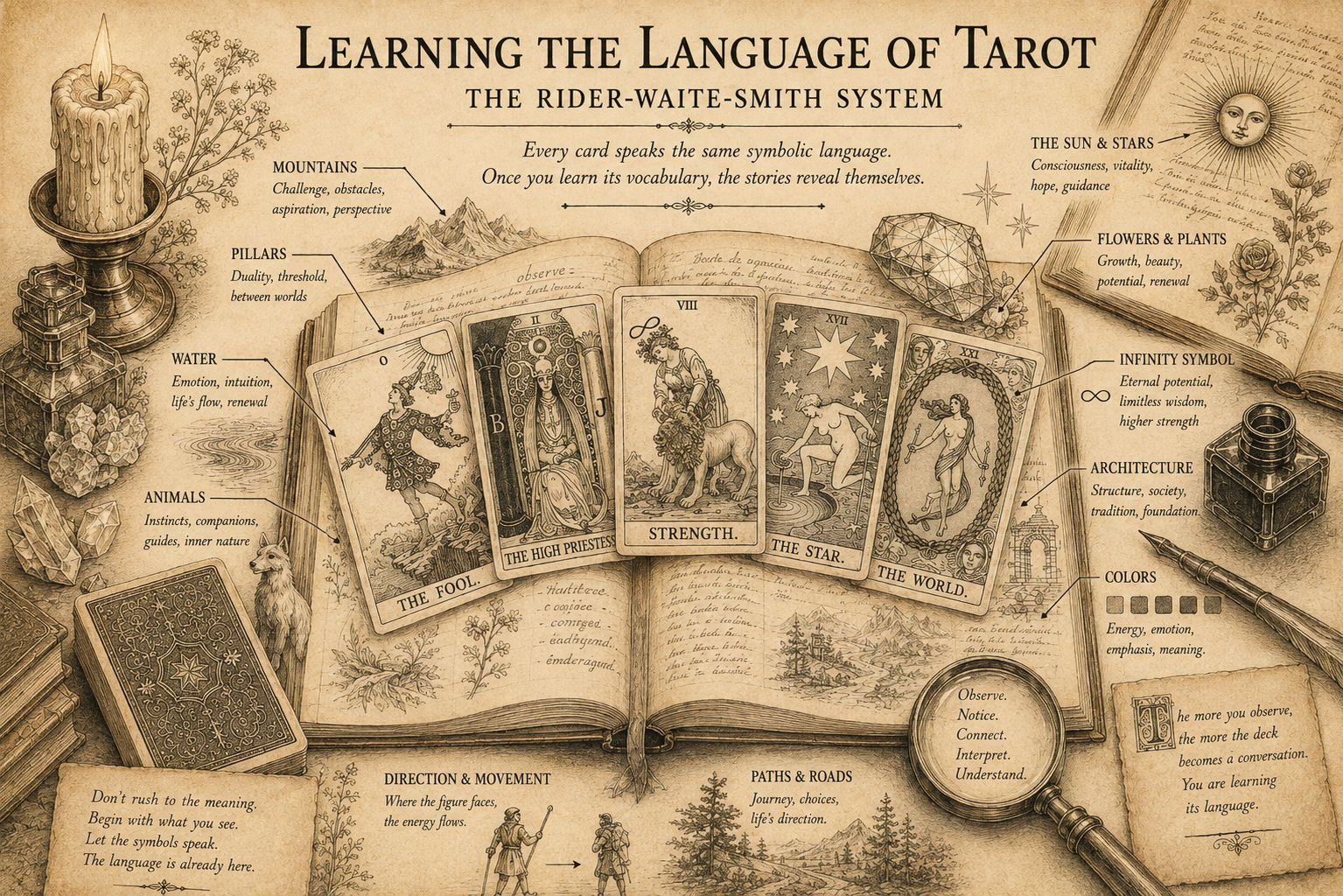
Look at The Magician and Strength. Both figures have the infinity symbol above their heads, but they express power very differently. The Magician stands before his tools with one hand raised and the other pointing toward the earth. Strength shows a woman calmly interacting with a lion. One image can lead us toward will, direction, and conscious action, while the other asks us to think about a quieter kind of power.
Same symbol, but a very different conversation.
Then there are the pillars. The High Priestess sits between two of them. Justice sits between pillars as well, but Waite specifically tells us that those pillars do not open into the same symbolic world. Even when an image repeats, it doesn’t necessarily mean exactly the same thing.
And that is where studying the Rider-Waite-Smith Major Arcana gets fun.
You begin spotting repeated mountains, water, gardens, stars, moons, suns, pathways, crowns, gestures, colors, and poses. A symbol you noticed on one card suddenly appears somewhere else, but the context has changed.
Now you start asking questions. Why does that symbol appear here, too? What changed between the two cards? Are these ideas connected? Is one card developing something introduced earlier?
The cards start talking to one another.
And that may be one of the most important things the Rider-Waite-Smith system gave modern Tarot readers. The symbolism isn’t there only to make an individual card meaningful. Symbols can repeat, change, develop, and create relationships across the Major Arcana.
That also helps explain why so many different ways of studying these cards developed later.
Carl Jung gives us an interesting example.
If you’ve spent much time reading about Tarot archetypes, you might get the impression that Jung developed an entire psychological theory around the Major Arcana. He didn’t. His direct comments about Tarot were brief. In one, he described the images as “sort of archetypal ideas,” and elsewhere he connected Tarot images with what he called the “archetypes of transformation.”
Other writers would take that connection much further.
But I find those brief comments fascinating because Jung looked at Tarot’s symbolic images and recognized something that went beyond the individual cards. The Hermit, Lovers, Death, Devil, Tower, Sun, and other figures could be understood as images connected to recognizable human experiences and patterns.
That doesn’t mean Waite was secretly developing Jungian psychology before Jung. He wasn’t.
Still, knowing Waite and his fondness for hidden meanings, I can’t help wondering what he would have thought about where people eventually took his symbolic Tarot.
Maybe he would have disagreed completely.
Or maybe he would have told us the real answer was an initiatory secret and left us wondering for another hundred years.
What matters here is what happened to the Major Arcana after Rider-Waite-Smith. Readers didn’t have to treat the twenty-two cards as isolated meanings. They could compare them, follow repeating symbols, notice visual relationships, study their esoteric correspondences, and eventually explore them through psychological and archetypal lenses that Waite and Smith themselves never could have anticipated.
The symbolism gave later readers something to keep exploring.
And more than a century later, we’re still doing exactly that.
The Major Arcana didn’t just give us twenty-two cards to learn. It gave us a symbolic language we could keep learning to read.

The Minor Arcana Finally Began Telling Stories
The Minor Arcana Finally Began Telling Stories
This is where the Rider-Waite-Smith system really changed Tarot for readers like me.
We’ve already talked about my relationship with memorizing keywords. Give me five keywords for one card and I’m fine. Give me five keywords for seventy-eight cards, upright and reversed, and suddenly we’re discussing 780 things I’m apparently supposed to remember before I’ve even shuffled the deck.
It makes my brain hurt.
That wasn’t going to work for me. But give me a picture and ask me what I see?
Now we have something to work with.
That is what the illustrated Minor Arcana changed. Instead of beginning with a definition and trying to remember which meaning belonged to which card, a reader could begin with observation.
Take the Eight of Cups. Even if you have never studied the card before, you can see someone walking away. Eight cups have been carefully arranged in the foreground, so this isn’t necessarily a scene where nothing was there to begin with. Something has been built or collected, yet the figure is still leaving it behind.
Immediately, I have questions. Why are they leaving? Where are they going? Why leave those cups behind? Is this a sad departure, a necessary one, or something they’ve simply outgrown?
I can explore the card before I ever reach for the guidebook. Then I can add the traditional meanings. I can study the symbolism, number, suit, elemental associations, colors, landscape, astrology, its position in the spread, and, of course, the question I actually asked.
The picture didn’t replace Tarot study, and I am not sure that it made reading Tarot any easier.
It gave me a way into it.
That difference is important because the illustrated Minor Arcana also gave readers room to develop their own relationship with a card.
Maybe I notice the missing space in the arrangement of the Eight of Cups. Someone else notices the mountains ahead. Another reader is drawn immediately to the moon. We are looking at the same card and working within the same traditional framework, but the image gives each of us somewhere different to begin exploring.
That doesn’t mean anything we imagine automatically becomes the meaning of the card. The traditional structure still matters. The suit matters. The number matters. Symbolism matters. Context within a reading matters.
But now interpretation can become a conversation between what we’ve learned, what we’ve experienced, and what we’re actually seeing in the card. Somewhere in that conversation, we begin making our own connections to the meaning.
And that was huge.
The illustrated scenes also made it possible to look at how cards interact with one another instead of reading each card as an individual definition.
Put the Eight of Cups next to The Hermit and suddenly I might notice that both figures are moving through difficult landscapes. Put it beside the Six of Swords and now I have two very different images of leaving something behind. Place it next to the Four of Pentacles and I have one figure walking away while another seems determined to hold on.
Those relationships aren’t printed in a list of keywords. We discover them by looking at the cards, comparing the images, and asking what changes when one card is placed beside another.
This is one of the reasons I think the Rider-Waite-Smith system became such a powerful foundation for learning Tarot. It didn’t eliminate memorization, tradition, or deeper study. Trust me, there is still plenty to learn. It simply gave us another way to learn it.
We could observe first. Ask questions. Notice patterns. Compare cards. Follow symbols. Build connections. Then bring our growing Tarot knowledge into what we were already seeing.
For someone like me, that changed everything. I didn’t have to memorize Tarot before I could begin reading Tarot.
I could learn Tarot by reading the cards.
Reading Stories Instead of Memorizing Keywords
Reading Stories Instead of Memorizing Keywords
Learning to read one card through its imagery was one thing. Learning to read several cards together changed things again.
How in the world am I supposed to connect abandonment, introspection, and security? Or maybe I should connect disappointment, wisdom, and control.
What!?
This was another place where memorizing keywords failed me.
If I pulled three cards and treated each one like a flashcard, I might end up with three perfectly acceptable definitions that didn’t seem to have anything to do with one another.
Eight of Cups: walking away.
The Hermit: isolation.
Four of Pentacles: frugality.
Okay. Ugh.
Now what am I supposed to do with that?
This is where the illustrated scenes of the Rider-Waite-Smith system gave me something that a list of keywords couldn’t. I could put the cards beside one another and look at what was actually happening.
Maybe the Eight of Cups figure is walking toward The Hermit. Now leaving something behind may be connected to a need for solitude, reflection, or searching for an answer.
Put the Four of Pentacles on the other side and things get even more interesting. One figure is walking away. Another is deliberately withdrawing. Another is holding on for dear life.
Now I don’t just have three meanings. I have a story developing.
Of course, the question and spread positions still matter. So do the traditional meanings of the cards. I’m not throwing all of that out because two characters happen to be looking in interesting directions. The imagery simply gives me another layer to work with.
I can notice whether figures face one another or turn away. I can compare landscapes, colors, repeated symbols, movement, expressions, and where my eye travels across the spread. Sometimes one card seems to continue an idea introduced by another. Sometimes two cards look almost like they’re arguing with each other.
And sometimes a card sits there looking completely uninterested in whatever drama is happening beside it.
That tells me something, too.
This was when Tarot began making more sense to me. I wasn’t trying to remember seventy-eight separate definitions and somehow glue them together into a reading. Before, every spread felt like I was building one of those crime-solving boards with cards pinned everywhere and strings connecting all the clues. Except my strings kept getting tangled, and I’m pretty sure the cat carried off half the evidence.
Now I was learning the structure and traditional meanings of the cards while also paying attention to what was happening between them. I didn’t need a complicated web of keywords to force the cards to connect. The images were already giving me clues about where those connections might be.
The question gives the reading direction. The spread position gives each card a job. Traditional knowledge gives me a foundation. The images give me something to observe. My own experience and intuition help me notice connections.
Somewhere in all of that, the reading begins to take shape.
And this is where I think Rider-Waite-Smith quietly changed the expectations of modern Tarot reading. Once the Minor Arcana became fully illustrated scenes, readers weren’t limited to asking, What does this card mean?
We could also ask:
What is happening between these cards?
That’s a very different question. It turns a spread from a collection of individual definitions into something we can explore as a whole. The cards stop behaving like flashcards and start behaving more like chapters of the same story.
And for me, that’s when Tarot really started becoming a language instead of a vocabulary list.

Every Card Became a Teacher
Every Card Became a Teacher
Once I stopped treating the Minor Arcana as fifty-six separate cards I had to memorize, something else started to click.
The suits had personalities. The numbers had a sequence. And who doesn’t love a little numerology when you’re trying to make sense of fifty-six cards?
Cups didn’t feel like Swords. Swords definitely didn’t feel like Pentacles. And Wands seemed determined to keep everybody moving whether they were ready or not.
But the suits were only part of it.
The Aces had something in common. So did the Twos, Threes, Fours, and all the way through the Tens. A Five of Cups and a Five of Pentacles weren’t telling me the same story, but there was something about that Five energy I could learn to recognize.
That gave me another way to understand what I was seeing.
In the Rider-Waite-Smith system, the four suits are traditionally connected with four elements: Wands with Fire, Cups with Water, Swords with Air, and Pentacles with Earth. Those associations weren’t invented for the RWS deck. Waite and Smith were working within an esoteric system that already connected the suits with elemental qualities.
But the illustrated Minor Arcana gave those qualities somewhere to play out.
Wands: Fire Has to Go Somewhere
Wands carry the energy of Fire: action, creativity, passion, ambition, inspiration, and drive. And the suit rarely sits still.
Someone is defending their position in the Seven of Wands. Someone is charging ahead in the Knight of Wands. Eight Wands are flying through the air. By the Ten, somebody has picked up all that Fire and apparently decided carrying every single Wand at once was a reasonable plan.
I can relate.
When I look across the suit instead of memorizing each card separately, I start seeing what happens when Fire develops. Inspiration can become action. Action can become momentum. Momentum can become competition, persistence, or eventually too much to carry.
The individual cards matter, but so does the energy connecting them.
Cups: Water Gets Complicated
Cups bring us into the world of Water: emotions, relationships, intuition, connection, and our inner responses.
Which sounds lovely until you actually look through the suit.
There is attraction and celebration, but there is also boredom, disappointment, illusion, and walking away. Cups can overflow, spill, be offered, ignored, exchanged, or left behind.
That helped me understand something important about elemental associations. Water doesn’t simply mean emotions, and Cups don’t automatically mean love. The suit explores what happens when we experience emotion in different ways.
The Three of Cups doesn’t feel like the Five. The Four doesn’t feel like the Eight. They belong to the same family, but they’re having very different days.
Swords: Air Can Cut
Swords are traditionally associated with Air: thought, communication, ideas, logic, decisions, and conflict.
This was one of the suits that made much more sense to me once I stopped trying to reduce Air to thinking, because apparently thinking can get us into quite a bit of trouble.
Look across the RWS Swords and you’ll find decisions, arguments, anxiety, heartbreak, strategy, restriction, and those lovely moments when your brain decides 3:00 a.m. is the perfect time to review every questionable decision you’ve made since 1997.
Hello, Nine of Swords.
The imagery shows us different expressions of the same elemental territory. A thought can become an idea, a decision, a fear, an argument, or something we use against ourselves.
Air moves. Swords cut. And sometimes our thoughts do both.
Pentacles: Earth Makes It Real
Pentacles are connected with Earth: resources, work, money, health, home, skills, security, and the physical world.
For a long time, it would have been easy for me to stop at Pentacles = money. But then what do I do with the Three of Pentacles? Or the Seven? Or the Eight?
The illustrated scenes make the suit much bigger than a financial forecast. People are working, learning, building, waiting for results, sharing resources, protecting what they have, and creating something that might last beyond them.
Earth asks what we actually do with what we have.
Ideas are wonderful. Feelings matter. Inspiration can get us started. But eventually somebody has to build the thing.
The Numbers Give Us Another Clue
Then there are the numbers.
Once I started studying numerology alongside the suits, another piece of the puzzle fell into place. Instead of memorizing four completely unrelated Fives, for example, I could start looking for what the number Five brought into each suit.
Five can bring disruption, challenge, instability, or change. But what does that look like when it meets Fire? Water? Air? Earth?
Now look at the cards.
The Five of Wands gives us conflict and competition. The Five of Cups brings emotional loss and disappointment. The Five of Swords takes us into conflict of a much sharper kind. The Five of Pentacles shows hardship and insecurity in the material world.
They’re four very different cards, but the number gives me something to compare.
The same thing happens with the Aces. An Ace brings us to a beginning or potential, but Fire doesn’t begin the same way Water does. The Ace of Wands offers a spark of inspiration or action. The Ace of Cups opens emotional and intuitive possibilities. The Ace of Swords brings the potential for clarity, thought, or a new idea. The Ace of Pentacles puts something tangible in our hands.
Now I wasn’t just memorizing cards.
I was learning patterns.
The Suits Became More Than Categories
Once I began looking at the Minor Arcana this way, I wasn’t learning fourteen random meanings under four different symbols anymore. I was watching elemental energy move through a numerical progression, with Pamela’s illustrations giving me scenes where I could actually see some of that movement play out.
Fire could inspire or overwhelm. Water could connect or drown us in emotion. Air could clarify or trap us inside our own thoughts. Earth could support us or become something we cling to too tightly.
I could still study each card individually, but now I could also ask where it belonged. What suit is this? What kind of energy am I dealing with? What does the number add? How does Pamela’s picture show me that combination? And how does all of that connect back to the question I’m asking?
Those questions gave me another route into a card when the meaning wasn’t immediately obvious.
And that may be one of the biggest lessons the Rider-Waite-Smith system taught me.
I didn’t have to learn seventy-eight cards one at a time. I could learn how Tarot was built.
A Shared Language for Modern Tarot
Perhaps the greatest legacy of the Rider-Waite-Smith system is not simply that it became popular. It became a shared visual language through which modern readers, teachers, writers, and artists could communicate.
Pick up a beginner’s Tarot book and there is a good chance its meanings are based primarily on Rider-Waite-Smith imagery. Watch a Tarot lesson online, browse a deck review, join a study group, or search for the meaning of a particular card, and the same visual references appear again and again. A teacher discussing the Four of Cups may point to the folded arms of the seated figure and the offered cup emerging from the cloud. An article about the Ten of Swords may mention the sunrise along the horizon. Even when the original deck is not shown, its scenes continue shaping the conversation.
Modern artists frequently use the Rider-Waite-Smith framework as the underlying structure for entirely new worlds. A science-fiction deck might replace castles with space stations and medieval travelers with explorers moving between planets. A woodland deck might reinterpret human figures as foxes, ravens, bears, or spirits. A contemporary deck may shift the clothing, relationships, cultures, bodies, and settings represented in the cards. These changes can add new perspectives and make the imagery more personally or culturally relevant, while the underlying narrative remains recognizable.
The Five of Pentacles may take place in an alley, a hospital corridor, or a frozen forest, but it still explores hardship, exclusion, vulnerability, and the possibility of support. The Six of Cups may feature childhood friends, ancestors, or animals sharing an offering, yet its conversation with memory and generosity remains intact. The Ten of Wands may replace wooden staffs with books, tools, packages, or glowing cords of energy, but the experience of carrying too much still comes through.
This familiarity allows readers to enter new decks without beginning completely from scratch. The setting and characters may change, but the reader can recognize the bones of the story beneath the new artwork. Understanding Rider-Waite-Smith does not prevent someone from appreciating creative reinterpretations. It often makes those choices more visible because the reader can see what the artist has preserved, expanded, questioned, or intentionally changed.

The Ripple Effect That Continues Today
The influence of the Rider-Waite-Smith deck reaches far beyond the cards themselves. Its illustrated scenes changed how Tarot could be taught, giving teachers a visual framework for discussing emotion, symbolism, character, and narrative. It changed how guidebooks were written because authors could point to details within the images rather than relying entirely on abstract definitions. It also expanded what artists could imagine when creating new decks, opening the Minor Arcana as a space for storytelling rather than decorative arrangement alone.
The system also helped make Tarot more approachable for independent learners. A beginning reader could sit with a card and find an entry point through the artwork, even before understanding every astrological, numerological, or esoteric correspondence. The image did not provide a single automatic answer, but it offered enough information to begin asking meaningful questions. That invitation helped Tarot move beyond small circles of specialized study and into a much broader community of readers.
Today, that community includes classrooms, blogs, podcasts, workshops, social media accounts, deck collectors, professional readers, artists, and people quietly drawing one card at their kitchen tables. Many may never consciously identify the Rider-Waite-Smith structure beneath what they are studying, yet they are still working within the visual tradition it helped establish.
Every time an artist reimagines the emotional landscape of the Five of Cups, the influence continues. Every time a teacher asks a student to notice where a figure is looking before opening the guidebook, the influence continues. Every time a reader recognizes the weight of the Ten of Wands before remembering its formal keywords, the influence continues.
More than a century after its publication, the Rider-Waite-Smith system remains part of modern Tarot not because every reader must use it, but because its visual storytelling gave generations of readers a way to enter the cards. Once you learn to recognize that language, its fingerprints begin appearing almost everywhere.
More Than a Deck: A Foundation for Modern Tarot
When Arthur Edward Waite and Pamela Colman Smith published their deck in 1909, they could not have known just how profoundly it would shape the future of Tarot. Their collaboration did not replace the decks and traditions that came before it, nor did it establish a single “correct” way to read the cards. Instead, they created a symbolic system that welcomed new readers while preserving layers of meaning that dedicated students could continue exploring for years.
That balance between accessibility and depth is one reason the Rider-Waite-Smith system remains so influential more than a century later. The artwork gives beginners a place to enter, while its symbolism offers experienced readers new paths to follow. A developing reader can begin with a figure’s posture, the emotional tone of a scene, or the first detail that catches the eye. As that reader’s knowledge grows, the same card can open into conversations about numerology, astrology, elemental relationships, mythology, spiritual philosophy, psychology, and esoteric tradition.
The cards meet us where we are, but they do not leave us there.
That may be why so many readers return to the Rider-Waite-Smith deck even after exploring dozens of others. Familiarity does not necessarily make the images feel finished. A card studied many times can suddenly reveal a small background detail, an unexpected relationship between symbols, or a shift in perspective that changes the entire reading. The framework remains recognizable, but the conversation continues to evolve.
Why I Continue Returning to the Rider-Waite-Smith System
Over the years, I have collected and worked with many Tarot decks. Some are richly detailed and filled with layers of symbolism. Some are whimsical, modern, or beautifully strange. Others reimagine the traditional cards through different cultures, landscapes, artistic styles, and personal experiences. Exploring these differences is one of the things I love about studying Tarot because every artist brings a distinct voice to the conversation.
Even with so many decks available, I continue returning to the Rider-Waite-Smith system. I do not return because I believe it is the only deck worth studying or because every reader must use it. I return because it provides a dependable framework for understanding how visual Tarot works.
When I open a new deck, I often notice how the artist has approached the Rider-Waite-Smith structure. Some decks stay close to Pamela Colman Smith’s original compositions, changing the characters, colors, setting, or artistic style while preserving the familiar narrative. Others retain only a few symbolic details. Some intentionally depart from the system altogether, creating a new relationship between the card’s image and its traditional meaning.
Understanding the Rider-Waite-Smith framework helps me recognize those choices. I can see what an artist has preserved, what has been expanded, and what has been deliberately left behind. Rather than limiting my experience of other decks, that knowledge deepens it. The original structure becomes a reference point, and each new deck becomes a conversation with that foundation rather than an isolated collection of images.
Understanding the Language Before Exploring Its Dialects
I often think of learning Tarot as learning a language. A language has vocabulary, structure, rhythm, context, and nuance. Knowing the definition of a word is helpful, but fluency develops when we understand how words change through relationships, tone, and placement.
The Rider-Waite-Smith system works in a similar way. The suits provide a broad vocabulary for different areas of life. Numbers create patterns and progression. Recurring colors, plants, animals, landscapes, and objects add emphasis. Characters respond to one another through posture, movement, expression, and direction. No single element carries the entire meaning, but together they create a visual sentence.
Learning this system does not mean you will only ever read Rider-Waite-Smith decks. Instead, it gives you a language you can carry into other systems. When you begin exploring the Tarot de Marseille, the Thoth Tarot, modern independent decks, or even Oracle cards, you have already practiced noticing patterns, relationships, and visual choices.
The comparison to dialects is not perfect because Marseille and Thoth are distinct Tarot traditions with their own histories, structures, and philosophies. Still, the language metaphor helps explain why a strong foundation can make future study easier. Once you understand how imagery, symbolism, number, and suit interact within one complete system, you become better prepared to recognize where another deck follows familiar patterns and where it asks you to learn something entirely new.
The Legacy Continues
Today, more than a century after its publication, the Rider-Waite-Smith system continues to influence artists, teachers, publishers, and readers around the world. Thousands of Tarot decks now offer their own artistic voices, cultural perspectives, spiritual frameworks, and interpretations of the cards. Some remain remarkably close to Pamela Colman Smith’s scenes, while others travel far beyond them.
Even when a deck looks entirely different, the influence of Rider-Waite-Smith storytelling can often be found beneath the surface. A modern Five of Pentacles may no longer show two figures passing a church window, yet it may still explore what it means to feel excluded from warmth, support, or belonging. A contemporary Four of Cups may replace the seated figure and offered cup with an entirely new scene, while preserving the tension between emotional withdrawal and an opportunity that has gone unnoticed.
The legacy also continues through the way Tarot is taught. When a teacher asks students to observe a card before consulting the guidebook, they are working with the visual accessibility that helped make this system revolutionary. When a reader studies a figure’s posture, follows the direction of movement across a spread, or compares a recurring symbol between cards, they are using the deck as a connected visual language rather than a stack of isolated definitions.
This system has not endured simply because it is old. It has endured because it continues to offer readers a practical way to learn, question, interpret, and grow.
What the Rider-Waite-Smith System Changed
The Rider-Waite-Smith deck did not invent Tarot, but it fundamentally changed how many people encountered and learned it. By illustrating the Minor Arcana as complete scenes, Pamela Colman Smith created a visual entrance into cards that had often required substantial symbolic knowledge before they became accessible. Readers could begin with what they saw, then deepen their interpretations through traditional meanings, correspondences, and study.
That change helped establish the Rider-Waite-Smith system as a shared foundation for much of modern Tarot. Its influence can be seen in beginner books, courses, deck guides, online interpretations, and the countless modern decks that preserve or reinterpret its scenes. It also strengthened the role of observation in Tarot practice, reminding readers that the image itself is not merely decoration. It is part of the meaning.
Perhaps most importantly, the system created room for study and intuition to work together. Traditional knowledge gives the reader structure, while the artwork invites curiosity and personal connection. One does not need to cancel out the other. The most meaningful readings often emerge when both are allowed to participate.
Where to Go Next
Understanding why the Rider-Waite-Smith system changed Tarot gives us important historical context, but it is only the beginning. The next step is to look more closely at how the system itself is organized and how its different parts work together.
In the next article, Introduction to the Rider-Waite-Smith Tarot System, we will explore the deck’s basic structure, including the Major Arcana, Minor Arcana, four suits, court cards, and the framework that holds the system together.
From there, the Rider-Waite-Smith Foundations Series moves from History & Foundation into System Introduction, then Anatomy & Visual Language, and finally Interpretation. Each article adds another layer, allowing readers to build understanding gradually rather than trying to memorize all seventy-eight cards at once.
Learning Tarot is Also the Story
The Rider-Waite-Smith system changed Tarot because it changed the reader’s relationship with the cards. It made the Minor Arcana visible as human experience, filling it with recognizable moments of worry, celebration, conflict, generosity, exhaustion, hope, and change. The cards still asked for study, but they also invited readers to begin by looking.
That invitation remains one of the system’s greatest strengths. You do not need to understand every symbol before you can ask what is happening in a scene. You do not need to memorize every correspondence before you can notice how a card makes you feel. The deeper knowledge develops over time, but the artwork gives you somewhere honest and useful to begin.
Learning the Rider-Waite-Smith system is not about confining yourself to a single deck or declaring one tradition superior to another. It is about studying a visual foundation that continues to shape modern Tarot. Once you understand that foundation, you begin recognizing its influence across decks, books, lessons, and readings. You also become better equipped to notice when another system speaks differently and deserves to be understood on its own terms.
Every card contains a story, but learning Tarot is also the story of becoming a reader. We begin by noticing one image, asking one question, and following one symbol a little deeper than we did before. Over time, those individual discoveries begin connecting into a language.
That is where fluency begins.