
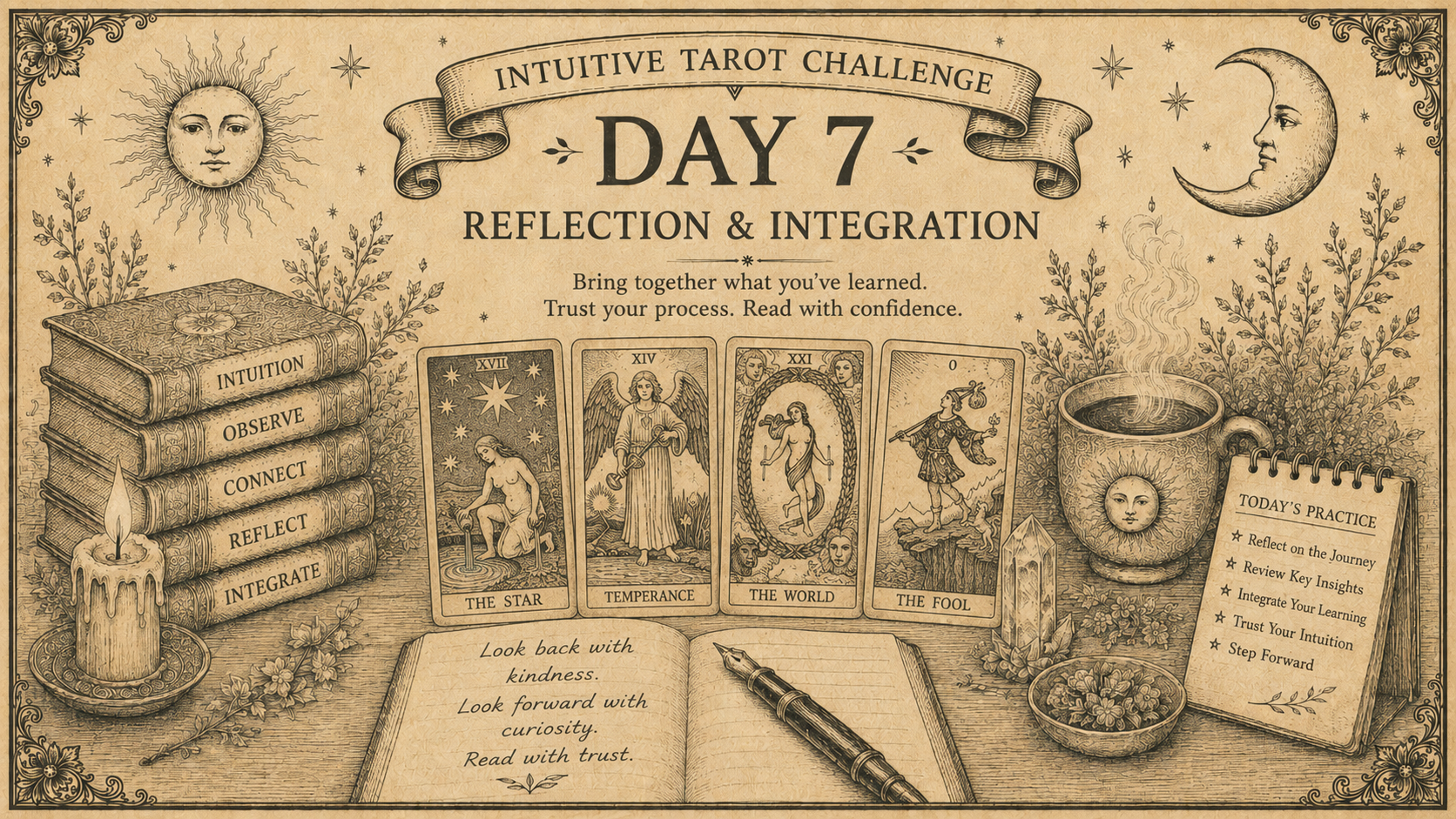
Day 7 · The Practice Continues
Reflections and Integration
Day 7 intention: Integrate the practices you have learned into a flexible reading process.

Honoring Your Intuitive Journey Through Tarot
Over the past six days, you have been practicing different ways of listening to a Tarot card.
You began by noticing your first response before reaching for a guidebook. From there, you explored the card through your senses, paid attention to the emotional language of color, met the figures as characters rather than immediately assigning them meanings, learned to sit with the quiet spaces in a card, and finally used the Mirror Method to explore how a card might reflect different parts of your own experience.
Each day asked you to focus on something slightly different, but those practices were never meant to remain separate. Today, we begin bringing them together.
This is where intuition starts to feel less like a technique you are trying to perform and more like a reading process you can actually trust. You are no longer asking yourself to remember six different exercises while staring anxiously at a card and wondering which one you are supposed to use first. Instead, you are beginning to notice which practices naturally step forward when you need them.
One card may catch your attention through color. Another may introduce itself through the expression on a figure’s face. You might look at a quiet landscape and suddenly become aware of what seems to be missing, or recognize something in the scene that feels uncomfortably familiar. Sometimes your first response will arrive immediately. Other times, you may need to stay with the card for a while before anything begins to surface. That difference matters because intuitive reading is not about getting the same kind of response from every card. It is about learning how you respond to the cards and becoming curious enough to follow what catches your attention.
Today is less about learning another method and more about noticing what has already begun to change. You have spent six days building a conversation with the cards. Now we are going to see what happens when you let the whole conversation unfold.
Looking Back Before Moving Forward
Before we bring everything together, take a moment to think about how you approached a Tarot card at the beginning of this challenge.
You may have been accustomed to looking at the card, recognizing its name, and immediately reaching for the meaning you already knew. Maybe you mentally ran through a list of keywords. Maybe you reached for a guidebook. Or perhaps you had already developed a fairly intuitive reading style but wanted to understand why certain details caught your attention and how to work with them more intentionally.
None of those approaches were wrong. The purpose of this challenge was never to convince you to abandon traditional meanings or everything you already know about Tarot. It was to create a little more room between seeing the card and deciding what it means.
Over the past six days, we have been filling that space with curiosity.
You began with the response that arrives before explanation and gradually learned to stay with the image longer. You explored the atmosphere of the card, paid closer attention to its visual language and characters, slowed down enough to notice what was quiet or easily overlooked, and finally considered how the scene might reflect something within your own experience.
Each practice asked you to look again, but from a slightly different direction. Taken separately, those practices give you different ways into a card. Taken together, they begin to create something much more useful: a flexible reading process.
That word flexible is important. You do not need to march through every practice every time you draw a card. Tarot does not require a six-point inspection before you are allowed to have an interpretation. Some cards will practically grab you by the sleeve. Others will sit across the table with their arms folded and make you work for it. The goal is not to use every tool. The goal is to recognize that you now have more than one.
As you move into today’s practice, pay attention to which of these approaches have begun to feel natural. Notice which ones you reach for easily, which ones surprise you, and which still feel a little awkward. That information is part of the challenge too, because developing an intuitive Tarot practice is not only about learning to read the cards. It is also about learning how you read them.
Seven Practices, One Reading Process
Over the past six days, we have separated intuitive reading into individual practices so you could slow each one down and explore what it contributes. Today, we stop separating them quite so carefully.
Think about what happens when you first turn over a card. You probably do not experience the image in neat little categories. You see the figure, notice the colors, feel something about the atmosphere, recognize a familiar symbol, and perhaps have a thought or memory surface almost at the same time. The card arrives as a whole scene, even though we have spent the week learning how to examine its different layers.
That is where integration begins.

Start where we began on Day 1.
Before you explain the card, notice what happens when you first see it. A word may appear. Your attention may immediately land on one detail. You might feel comfortable, uneasy, curious, hopeful, irritated, or completely puzzled.
Do not worry about whether that response is “correct.” Just notice it. Your first response gives you a starting point; it does not have to give you the entire reading.
Next, allow yourself to step a little farther into the scene.
What would you hear if you were standing there? What might the air feel like? Is the environment warm, cold, crowded, exposed, peaceful, noisy, damp, dry, or still? What movement can you imagine happening just beyond the frozen moment shown on the card?
You do not need to deliberately work through every sense. Follow the one that makes the scene feel more alive.
Now notice how color contributes to the atmosphere.
Which colors dominate? Which ones seem unusually important? Does the palette make the scene feel warm, distant, energetic, heavy, peaceful, uncertain, or something else entirely?
Color does not have to carry a fixed meaning. What matters is how it changes your experience of this card in this reading.
If people or creatures appear in the card, spend a moment with them.
Notice posture, expression, gaze, distance, movement, and relationships. Who seems engaged? Who appears withdrawn? Who holds power? Who is watching whom? What might have happened just before this moment, and what might happen next?
Instead of beginning with an archetype or court-card title, allow the figure to become a person within the story first.
Then look beyond whatever initially demanded your attention.
What is still? What is empty? What seems absent? Is there a background detail you almost overlooked? Is someone turning away from something important? Does the scene contain a pause, distance, boundary, or silence that changes how you understand it?
Sometimes the quietest part of the card carries the detail that makes the rest of the reading click into place.
When the card begins to feel more familiar, turn the question inward.
Where might you recognize yourself in the scene? What could represent the Self you already know, a Shadow you would rather avoid, or Support that is available but easy to overlook?
You are not forcing yourself into every character or symbol. You are simply asking whether the card reflects something worth noticing.
This is where Day 7 adds something new.
You have spent six days practicing different ways of paying attention to a Tarot card. Now you can begin bringing those observations together with what you already know about Tarot.
Consider the card’s traditional meanings, symbols, suit, element, number, archetype, or other correspondences that are useful to you. Then compare that knowledge with what you discovered by actually spending time with the image.
Sometimes tradition will confirm your intuitive response. Sometimes it will deepen it. Occasionally, the two may seem to disagree, and that can be useful too. Instead of deciding that one must be wrong, ask what the tension between them adds to the reading.
Integration is the seventh practice. It is the point where first responses, senses, color, characters, quiet, personal reflection, and traditional Tarot knowledge stop behaving like separate exercises and begin contributing to the same interpretation. You are not choosing between intuition and Tarot knowledge; you are allowing them to work together.
A reading may begin with a color, wander into a character’s expression, pause over something missing from the scene, connect with a traditional symbol, and suddenly bring you back to the first feeling you had when you turned over the card. Another reading may take an entirely different route.
That is the point.
Seven practices do not give you seven separate ways to read Tarot. They give you more ways to enter the same conversation.
Seven Practices, One Skill
How the Practices Begin to Work Together
Once you stop treating these practices as separate exercises, something interesting begins to happen. One observation starts leading naturally into another.
You might turn over a card and immediately notice the gray sky. That color creates a feeling of uncertainty, which makes you look more closely at the figure standing beneath it. Their posture seems hesitant. Once you notice that hesitation, the empty road behind them suddenly feels important. Then you realize that what first looked like a card about moving forward may also contain a story about deciding whether to leave something behind.
You did not deliberately move from color, to character, to quiet, to story. One observation simply opened the door to the next. That is what we are practicing today.
Follow the Thread
When something catches your attention, stay with it for a moment instead of immediately moving on.
Ask yourself:
- Why did I notice this?
- What does it make me notice next?
- Does another part of the card support that impression?
- Does anything in the image challenge it?
- How does this connect with the question I am asking?
Think of it as following a thread through the card. You do not know exactly where it will lead when you begin, and you do not need to.
Suppose your first response to a card is lonely. Instead of stopping there and deciding that loneliness must be the meaning, look for evidence. Perhaps the figure is physically separated from everyone else. Maybe the colors feel muted. Perhaps there is a road disappearing into the distance, an empty chair, or someone looking away. Now your original response has something underneath it.
But you may also discover evidence that complicates the story. Maybe another figure is nearby offering help. Perhaps there is light in the distance. Maybe the person you first interpreted as isolated is actually choosing solitude. That does not mean your intuition failed. It means the card asked you to keep reading.
Let the Card Correct You
This may be one of the most useful habits you can develop as an intuitive reader: allow the image to change your mind.
Your first response matters, but it is not a verdict. Sometimes the detail that initially catches your attention gives you the beginning of the reading. Sometimes it sends you in a direction that needs adjusting once you notice more of the scene. The purpose of looking for visual evidence is not to prove that your first impression was right. It is to stay in conversation with the card long enough to discover what else is there.
This is also where traditional Tarot knowledge becomes especially useful. Once you have explored what you see and feel, traditional meanings can offer another perspective. They may reinforce what you noticed, introduce something you missed, or create a little productive friction.
That friction is not a problem to solve as quickly as possible. It is often where the interesting part of the reading begins.
You Are Building a Reading, Not Collecting Clues
There is one more distinction worth making before we move into the full practice: the goal is not to collect as many observations as possible.
A reading can contain ten accurate observations and still feel disconnected if none of them speak to one another. The yellow sky, crossed legs, distant mountain, flowing river, number four, and tiny bird in the corner may all be worth noticing, but listing them does not automatically create meaning.
Instead, look for relationships. Which details seem to belong to the same story? Which observation changes another? What repeats? Where is there tension? What seems to support the central idea that is beginning to form?
Gradually, the pieces start organizing themselves. That is the shift we have been working toward throughout this challenge: moving from seeing details to recognizing relationships, and from recognizing relationships to forming an interpretation.
You are no longer asking, What does every part of this card mean?
You are beginning to ask a much more useful question:
What is this card showing me right now?
Integration Practice
One Card, the Whole Conversation
For today’s practice, choose one card.
You can draw randomly, choose a card you have not worked with during the challenge, or return to a card that has been difficult for you to understand. If possible, use a Rider-Waite-Smith card or a deck closely based on the RWS system so you have plenty of visual material to explore.
Place the card in front of you and give yourself a few minutes with it before reaching for a guidebook or reference. This time, there is no required order. You are not going to march through the practices one by one. Instead, your job is to notice where the card invites you to begin and then follow the thread.
Begin With What Arrives First
Look at the card and notice your immediate response.
What catches your attention before you have time to organize it? It might be a color, figure, expression, object, movement, empty space, memory, emotion, word, or question.
Write it down without trying to make it sound profound. If your first thought is That person looks exhausted, write that. If you notice the enormous yellow sky before anything else, start there. If your response is I have absolutely no idea what this card is trying to tell me, that counts too. Intuition does not always arrive wearing a velvet cape and carrying a perfectly formed interpretation.
Now look again.
Follow What the Card Shows You Next

Now use the thread you practiced following earlier.
Ask what your first observation leads you toward. Perhaps an exhausted figure makes you notice what they are carrying. That draws your attention to their posture, which makes the road ahead suddenly feel important.
Follow the connection rather than trying to decide which practice you are supposed to use. The skills from the previous days may begin appearing on their own. You might imagine the sound or temperature of the environment, notice a color that changes the atmosphere, become curious about one of the figures, recognize something important in a quiet part of the image, or see part of your own experience reflected in the scene.
You do not need to use all of them. Use what helps you understand the card, and allow one useful observation to lead naturally into the next.
Look for the Story Forming Between the Details
After a few minutes, stop collecting new observations and look at what you have.
Which details seem connected?
Maybe several observations point toward movement, hesitation, protection, conflict, isolation, possibility, or support. Perhaps two parts of the image seem to contradict each other. One figure appears ready to move forward while another detail suggests resistance. The card may contain both at once.
Try completing this sentence:
This card seems to be showing me…
Do not worry about producing the perfect interpretation. Write the clearest version of the story you can see right now. Then ask:
What in the card makes me say that?
This second question is important. It brings you back to the image and helps distinguish an interpretation that grew from the card from one that was simply placed on top of it.
Bring In What You Know
Only after you have formed your own initial interpretation, bring traditional Tarot knowledge into the conversation.
Consider the card’s established meaning, imagery, suit, number, element, archetype, or correspondences that are relevant to your practice. If you use a guidebook, this is the time to open it.
Notice where tradition and your interpretation meet. Did the traditional meaning reinforce something you had already noticed? Did it introduce another layer? Did you interpret one part of the scene differently? Is there a traditional meaning that suddenly makes more sense because you discovered it through the artwork first?
If something does not match, resist the urge to erase your original response. Explore the difference. Sometimes you will decide that your first interpretation needs adjusting. Sometimes the traditional meaning will broaden what you saw. And sometimes the specific question, imagery, and context of the reading will make one aspect of the card more relevant than its familiar keywords.
Let the Reading Settle
Finally, look at the card one more time.
You have now seen it through several different lenses, but you do not need to carry every observation into the final interpretation. Ask yourself what remains after everything else settles. What feels most important now?
Write your reading in a few sentences or a short paragraph. Then finish with one final question:
What did I notice today that I might have missed seven days ago?
That answer may tell you more about your progress than whether you arrived at the “right” meaning. The real practice today is not proving that you can interpret one card. It is recognizing that you now know how to stay with a card long enough to let a reading develop.
Reflection on Your Seven Days
Before you begin thinking about what comes next, take a little time to look back at what actually happened during these seven days.
Not what you think should have happened or whether every exercise produced a brilliant insight. Look instead at the smaller changes in the way you approached the cards.
Maybe you became more comfortable sitting with an image before reaching for a meaning. Perhaps you started noticing background details that you would normally overlook. You may have discovered that color speaks loudly to you, while another reader might be drawn immediately to posture or movement. Maybe the quiet spaces turned out to be surprisingly useful, or the Mirror Method helped you recognize when your own experiences were entering the reading.
You may also have discovered practices that did not come easily. That is useful information too.
Notice What Changed
Return to some of your notes from earlier in the challenge if you have them. You do not need to reread every word. Just look for differences between how you responded to the cards then and how you approached today’s integration practice.
Consider:
- What do I notice now that I might have overlooked before?
- Which practice feels most natural to me?
- Which practice makes me slow down and look more carefully?
- Which practice surprised me?
- Where do I still tend to second-guess myself?
- When did traditional Tarot knowledge strengthen what I noticed intuitively?
- When did the card itself cause me to reconsider my first impression?
There are no ideal answers hiding somewhere in this list. You are looking for patterns in your own reading process.
Notice Your Strengths
One of the easiest things to do when learning Tarot is focus on everything you still do not know.
There will always be another symbol to study, another correspondence to learn, another deck to explore, another book quietly suggesting that its 400 pages contain the one missing piece standing between you and Tarot enlightenment.
Learning matters. I certainly would not be building Tarot Studies if I thought otherwise. But knowledge is only one part of reading.
During this challenge, you have also been practicing observation, curiosity, imagination, reflection, and the ability to stay with uncertainty for a little longer. Those skills are harder to fit onto a keyword chart, but they are enormously important.
Notice which of them are already becoming strengths. Maybe you tell stories easily. Perhaps you are especially sensitive to emotional atmosphere. You might notice relationships between figures almost immediately, or have a knack for spotting the one tiny background detail that changes the entire scene.
Those tendencies are not distractions from learning Tarot. They are part of how you read it.
Notice Where You Want More Practice
Now consider the places where you still hesitate.
Perhaps you notice plenty of details but struggle to connect them into an interpretation. Maybe your first response comes quickly, but you immediately distrust it. You might find it difficult to separate what you actually see in the card from what you already know the card is “supposed” to mean.
Choose one area that you would like to continue developing. Not six. One. Your Tarot practice does not need an emergency renovation because one exercise felt awkward. Give yourself somewhere specific to continue experimenting.
If reading through the senses felt strange, spend another week occasionally stepping into the scenes. If characters fascinated you, explore more cards through their relationships. If you discovered that you rush past quiet details, deliberately give the backgrounds a little more attention.
The goal is not to become equally skilled at every practice. It is to understand which tools help you see more clearly and which ones deserve a little more time.
Look Back at the Beginning
Finally, think about the version of you who began Day 1.
You were asked to look at a card and notice what arrived before the guidebook, keywords, or familiar meanings stepped in.
Seven days later, that same simple moment contains a lot more possibility. You can notice the first response and then investigate it. You can enter the scene through your senses, pay attention to color, meet its characters, listen to its quiet spaces, recognize yourself in its mirrors, and bring traditional Tarot knowledge into the conversation without asking any one of those approaches to do all the work.
That does not mean you have finished learning intuitive Tarot. It means you have something much more useful than a finish line.
You have begun to recognize how you read.
ReFine your Reading Process
Building Your Own Reading Process
Now that you have experimented with each of these practices, you can begin shaping them into a reading process that feels natural to you.
That process does not need to look exactly like mine, and it certainly does not need to look the same every time you sit down with your cards. One of the things you have been discovering throughout this challenge is that different cards ask for different kinds of attention.
Some practically begin the conversation for you. A figure’s expression catches your eye, a color changes the entire atmosphere, or your first response arrives before you have even finished placing the card on the table. Other cards are quieter. They may require you to linger, explore the scene, or ask a few questions before anything begins to take shape.
A flexible reading process gives you room for both.
Start With Observation, Not a Formula
You do not need to replace your old list of Tarot keywords with a new checklist of intuitive techniques.
Instead, keep the beginning simple: Look at the card. Notice what catches your attention. Stay curious about it.
From there, allow yourself to use whichever practices help you explore what you noticed. If a figure draws your attention, meet the character. If the atmosphere feels unusually strong, explore the senses or color. If something about the scene feels strangely familiar, the Mirror Method may be useful. If nothing seems to be happening at all, spend some time in the quiet.
Then bring in your traditional Tarot knowledge and see how it contributes to the story that is forming.
That alone can become a dependable reading rhythm:
Notice → Explore → Connect → Check → Interpret
Notice what catches your attention. Explore it through the image. Connect the details that seem to belong together. Check your observations against the card, the question, and your Tarot knowledge. Then interpret what the pieces are showing you together.
The rhythm gives you structure without telling you exactly what you must notice.
Let Context Shape the Reading
The same card will not always tell the same story because readings happen within a context.
Imagine drawing the Eight of Pentacles while asking about developing a new skill. Its repetition, concentration, and steady workmanship may immediately become important. Draw that same card while asking why you feel exhausted, and you may notice the repetitive labor differently. The artwork has not changed, but your relationship to the scene has.
This is one reason intuitive reading and traditional Tarot knowledge work so well together. Traditional meanings give the card boundaries and history. Observation helps you discover which part of that larger meaning is active in the reading in front of you.
You are not inventing a completely new meaning every time you turn over a card. You are learning to recognize which part of the card is speaking most clearly to this question, in this moment.
Keep Asking for Evidence
One question from today’s practice is worth carrying with you:
What in the card makes me say that?
It is a wonderfully useful little question, and it can become part of your regular reading process long after this challenge is finished.
If you think a figure seems defensive, what makes them appear defensive? If the scene feels hopeful, where do you see that hope? If you believe the card is suggesting hesitation rather than refusal, what details support that distinction?
You will not always be able to point to one perfect symbol. Sometimes an interpretation comes from the relationship among several details or from the overall atmosphere of the card. That is fine. The purpose is not to put intuition on trial. It is to keep intuition connected to observation.
Make Room for “I Don’t Know Yet”
There is another phrase worth keeping in your Tarot vocabulary:
I don’t know yet.
Some cards will not make immediate sense. Some readings will contain contradictions. Occasionally, you will turn over a card and your intuitive response will apparently decide to take the afternoon off.
You do not have to force an answer simply because a card is sitting in front of you. Stay with it. Describe what you see. Ask another question. Look at the surrounding cards if you are using a spread. Return to the traditional foundation. Write down what you notice and come back later.
Uncertainty is not evidence that you cannot read Tarot. Sometimes it is simply the space before the pieces connect.
Let Your Process Keep Changing
The reading process you are beginning to recognize today will not be exactly the same process you use six months or five years from now.
That is a good thing.
As you study more cards, symbols, systems, and correspondences, you will have more knowledge available to bring into a reading. As you gain experience, you will also become more familiar with your own habits. You will learn when your first response tends to be useful, when you are making assumptions, which visual details speak most strongly to you, and when you need to slow yourself down.
Your process will become more refined because you will become more experienced. So keep studying, keep looking, and keep asking what you see before deciding what you think you are supposed to see.
The goal was never to give you a perfect method for intuitive Tarot reading. It was to help you begin building one that belongs to you.
And that brings us to one last question. Not what you should learn next, or which technique you should add to your readings. Something much simpler:
What happens tomorrow, when there is no Day 8?
NOW WHAT?
When There Is No Day 8
Tomorrow, there will not be another challenge lesson waiting for you. No new technique to practice, no next step telling you where to look, and no Day 8 asking you to pay attention to one more part of the card.
There will just be you and your deck. And, really, that was the point.
These seven days were never meant to give you a script for reading Tarot. They were meant to slow the process down long enough for you to notice what is already happening when you look at a card.
Now you get to take the structure away.
Draw a card tomorrow if you want to. Look at it before reaching for the meaning. Notice what catches your attention. Follow it if it seems interesting. Bring in what you know. Question what you assume. Let the image change your mind.
And if absolutely nothing interesting happens? Have your coffee and come back later. Not every card needs to produce a revelation, and not every reading needs to become a profound conversation with the universe. Sometimes practice is simply spending enough time with the cards that their visual language becomes familiar.
That familiarity accumulates. A symbol you barely noticed today may jump out at you three months from now. A character you once understood through a keyword may suddenly feel like someone whose story you recognize. A traditional meaning you memorized years ago may finally make sense because one day you actually see it happening in the card.
That is how a Tarot practice grows.

Keep Studying. Keep Noticing.
Intuition and knowledge do not need to compete for space at your Tarot table.
Study the traditional foundations. Learn the symbols. Explore the history. Pay attention to structure, number, element, suit, archetype, and correspondence. Those things give you a richer language for understanding what the cards can communicate.
But keep looking at the cards themselves.
Let yourself notice something before you name it. Ask what in the image supports the interpretation you are forming. Stay curious when the card does not behave exactly the way you expected. Allow your understanding to change as your knowledge and experience deepen.
There will always be more to learn. That is one of the reasons Tarot can remain interesting after years of study. You do not need to know all of it before you begin trusting yourself to participate in the conversation.
Day 7· Closing Reflection
Closing Thoughts for Day 7
The Challenge Ends Here. The Practice Doesn’t.
Seven days ago, I asked you to begin with something remarkably simple:
Look at the card.
Notice what happens.
We added a lot to that simple act over the course of this challenge, but we never really left it behind.
That is where I hope you return whenever Tarot begins to feel complicated. When there are too many meanings, too many correspondences, too many opinions about the “right” way to read, or too much pressure to produce an answer immediately, come back to the card in front of you.
Look.
Notice.
Stay curious.
Then use what you know to help you understand what you found.
You do not need to choose between being an intuitive reader and a knowledgeable one. The strongest practice has room for both.
So tomorrow, when there is no Day 8:
Shuffle your cards.
Draw one.
And see what you notice.
Previous
Day 4: Meeting the Characters
Challenge Overview
7-Day Intuitive Tarot Challenge