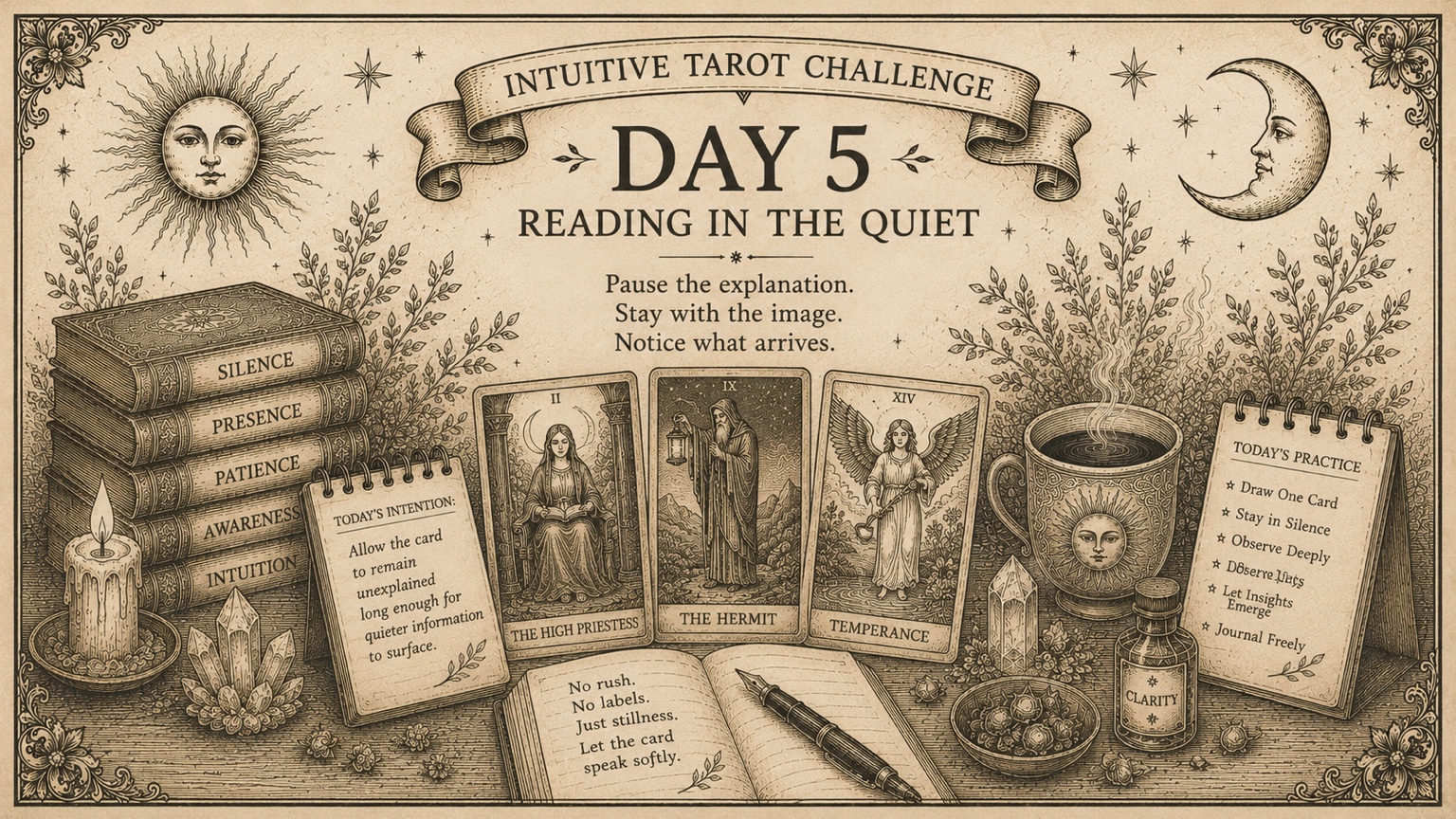
Day 5 · Quiet Reading
Reading in the Quiet
Day 5 intention: Give the card enough quiet for something unexpected to surface.

There is a point in almost every Tarot reading when we become busy.
We look at the card. We remember a keyword. Then another one. We think about something we read in a book, something another reader once said, the question we are trying to answer, whether we are interpreting the card correctly, and whether we should have chosen a different spread in the first place.
Before long, there can be quite a crowd gathered around one small piece of cardstock.
Today, we are going to try something different.
Instead of asking the card for more information, we are going to give it a little more room.
Reading in the quiet is not about emptying your mind or waiting for a mysterious voice to deliver the perfect interpretation. It is much simpler than that. It means allowing yourself to stay with the card for a few moments without immediately reaching for a meaning.
You have already practiced noticing your first response. You have explored the card through your senses, paid attention to the emotional language of color, and met the people inside the cards before assigning them an archetype. Today, we are going to bring those skills together and then become a little quieter.
Sometimes what matters most is not the first thing we can say about a card. Sometimes it is what surfaces after we stop trying to say anything at all.
Building the Practice
Why Quiet Comes Fifth
The sequence matters.
Day 1 asked you to notice your first response before the guidebook arrived. Day 2 expanded your attention through the senses. Day 3 explored the emotional language of color. Day 4 slowed things down again by asking you to meet the figures in the cards as people before assigning them an archetype.
Each day has given you another way to pay attention. Today, we are going to do something that may feel almost opposite: we are going to stop adding information for a moment.
That pause is not a retreat from the skills you have been building. It gives those skills somewhere to settle.
There is an important difference between what you practiced on Day 1 and what we are doing today. On Day 1, you were learning to catch that first response before interpretation rushed in. Today, you are staying with the card after that first response has already appeared.
Instead of immediately deciding what the card means, you are giving your attention a little more time. That extra space can allow a detail, feeling, question, memory, or connection to become noticeable before you explain it away.
Today, the goal is not to find more information. It is to discover what happens when you stop reaching for it quite so quickly.
DAY 5 CONCEPT
What Surfaces in the Quiet
Intuition becomes easier to hear when we stop rushing to explain what we see.
Once you give yourself a little space with a card, all kinds of things can begin to surface. Some responses are closely connected to the image and easy to trace. Others may seem to arrive from somewhere completely different, especially at first.
You might notice an emotion before you understand why it is there. A particular detail may suddenly remind you of a person or situation. A phrase might form in your mind that sounds nothing like a traditional Tarot keyword. You may find yourself imagining what happened just before the scene on the card or wondering what is about to happen next. Sometimes the response is physical. A card may make you feel restless, heavy, comfortable, guarded, or strangely energized. Other times it is subtler, perhaps only a sense that something in the scene does not quite add up, even though you cannot immediately explain what is bothering you.
This is one of the reasons quiet matters when we are developing intuition. Our first response to a card is often the easiest one to hear because it arrives quickly. But it is not necessarily the only response available to us. When we stop filling every moment with interpretation, our attention has a chance to move beyond what we already recognize. Something quieter can finally get a word in.
That quieter response is not automatically wiser, more intuitive, or more important simply because it arrived later. But it is worth noticing because it tells you something about the interaction taking place between you and the image. Intuition often begins there, not as a fully formed answer, but as a small shift in attention that makes you curious enough to look again.
Not Every Thought Is a Message
Of course, giving your mind room to wander creates another problem: your mind will, in fact, wander.
If you sit quietly with a card and suddenly remember that you need milk, the universe probably has not transformed the Two of Cups into a grocery reminder. Your brain is still your brain. It remembers, plans, worries, makes associations, and occasionally chooses terrible timing to remind you about laundry.
That does not make the quiet useless. It makes discernment part of intuitive reading. You do not need to assign significance to everything that appears, but you also do not need to dismiss an unexpected response simply because it does not resemble something you would find in a Tarot guidebook.
Instead, notice what seems to remain connected to the card or the question you are exploring. Perhaps a thought lingers after the ordinary mental chatter has moved on. Maybe your attention keeps returning to the same small detail. A feeling may become stronger when you look at a figure’s posture, or an unexpected phrase may suddenly make more sense when you notice the direction someone is moving. Those connections give you a reason to become curious.
Then return to the card and look for the visual evidence. Maybe the feeling came from the figure’s posture. Perhaps the phrase that appeared connects with the direction someone is moving. Maybe the memory surfaced because the scene resembles an experience you have had before. You are not trying to prove that your first impression was correct. You are investigating where it came from and whether the image gives you a reason to continue following it.
This is an important distinction. Intuitive reading is not the practice of believing every thought that enters your head. It is learning which thoughts deserve another look.
Let Curiosity Do the Sorting
One of the quickest ways to interrupt this process is to immediately ask, Is this right? That question demands a verdict before you have had time to investigate what you noticed.
A more useful question is:
Why might I be noticing this?
That small change leaves the door open. Instead of forcing an impression to become an interpretation, you can explore it. You can return to the image, notice what supports the connection, see what challenges it, and allow the idea either to deepen or fall away. Some impressions will become surprisingly useful. Others will disappear almost as soon as you look more closely. Both outcomes teach you something.
This is where listening to the quiet becomes an important part of developing intuition. You are learning how your attention behaves when you are not constantly directing it. You begin to recognize the difference between an idea you went searching for and a detail that repeatedly asks for your attention. You become more familiar with the way emotions, memories, physical responses, visual details, and associations enter your readings, and with which of those responses tend to lead somewhere meaningful.
Over time, that familiarity builds discernment. Intuition becomes less about waiting for a mysterious answer to appear and more about recognizing the quieter movements of your own attention, then having the curiosity to investigate them.
The quiet gives intuition room to speak. Discernment teaches you how to listen.
Quiet + Intuition
How Quiet and Intuition Work Together

Quiet does not create intuition. It gives us a better chance of noticing it.
That distinction matters because intuition has probably been part of the reading from the beginning. It may have appeared in the detail that caught your attention before you understood why, the slight change in feeling when you looked at a figure, or the unexpected question that formed while you were studying the scene. The response may have been there for only a moment before everything you already know about the card came rushing in behind it.
And there is quite a lot waiting to rush in.
When we read Tarot, we know the name of the card. We remember keywords and traditional meanings. We think about the question, the position in the spread, the cards nearby, and what we believe the reading is supposed to be telling us. None of that is a problem. We need those things. But sometimes the familiar information arrives so quickly that we follow it down the usual path before anything less obvious has a chance to get our attention.
Quiet changes the pace just enough.
When you stay with the card instead of immediately moving toward an interpretation, your attention has a chance to wander somewhere you did not deliberately send it. Your eyes may return to a small object in the background. A figure’s expression may begin to feel different. You might suddenly notice the distance between two things or realize that something about the scene feels tense, guarded, lonely, or unexpectedly peaceful.
You may not know why yet.
And that yet is important.
Intuition Often Arrives Before the Explanation
One interesting thing about intuition is that recognition does not always arrive with an explanation attached. You may look at a figure and think, Something about this person feels guarded, even though you cannot immediately point to the part of the card that gave you that impression.
It can be tempting to dismiss a response like that, especially if guarded is not one of the meanings you normally associate with the card. But quiet gives you another option. You can stay curious long enough to find out where the response came from.
When you look again, you may notice crossed arms, a turned body, a particular expression, or an object creating distance between the figure and the rest of the scene. Perhaps none of those details seemed especially important on their own, but your attention had already begun putting them together before you consciously recognized the pattern.
That is one of the ways intuition can work in a Tarot reading. Sometimes we notice the whole feeling of something before we understand all the pieces that created it.
This is also why intuition does not have to arrive as a perfectly formed answer to be useful. Sometimes it simply points. It gives you a small nudge toward a detail, feeling, question, or connection and asks you to look again.
Sometimes intuition does not tell you what the card means. It tells you where to look next.
Giving the First Answer a Little More Room
There is another reason quiet helps. Our first interpretation can become surprisingly convincing simply because it arrived first.
Once we decide that a card is about conflict, change, rest, celebration, loss, or any other familiar meaning, our attention naturally begins organizing the image around that idea. We notice the things that support it, often without realizing that we are doing so. Meanwhile, details that might complicate the interpretation can slip quietly into the background.
The pause does not ask you to distrust your first answer. It simply keeps you from closing the reading too quickly.
Perhaps your first interpretation is exactly where the card needs to go. If so, looking again may strengthen it. But sometimes another detail changes the emotional tone, makes the meaning more specific, or raises a question you would not have asked if you had already decided that the reading was finished.
That is where quiet and intuition work especially well together. Traditional meaning gives you a foundation. Observation keeps you connected to the actual image. Intuition notices relationships and possibilities that may not have reached a complete explanation yet. Quiet gives all three enough time to have a conversation.
Over time, this becomes less about waiting for intuition to deliver an answer and more about recognizing how your own intuition gets your attention. You begin to learn what it feels like when something in a card deserves another look, and you become more comfortable staying with that uncertainty long enough to investigate it.
The goal is not to make every reading slower. It is to become a little less eager to finish the card before you have finished seeing it.
Practice Builds Recognition
The first few times you notice this happening, you may not recognize it as anything important. That is where practice begins to matter.
At first, those signals may not seem particularly distinctive. You might notice that your eyes keep returning to the same detail, or that a word appears in your mind that does not quite match the meaning you expected. You may feel a small shift in the emotional atmosphere of the card without being able to explain what changed. Because these responses are usually much quieter than a memorized keyword, they can be easy to overlook.
Practice helps you become familiar with them.
This is not about developing a special set of intuitive signals that always mean the same thing. A tight feeling in your stomach does not automatically become your personal Tarot code for danger, and noticing the color red does not mean the universe has assigned you a permanent message about passion. Context still matters. The card matters. The question matters. What you are learning to recognize is the way your attention behaves when something catches it.
With repeated practice, you may begin to notice patterns in that process. Perhaps your intuition often begins visually, with one small detail becoming unusually difficult to ignore. Maybe yours tends to arrive through language, with an unexpected phrase or question appearing before you understand its connection to the card. You may notice emotional shifts first, or find that you begin imagining what happened just before the scene or what the figures might do next.
None of these ways of responding is more intuitive than another. The important part is becoming familiar with your own way of noticing.
That familiarity also makes discernment easier. When you have spent time observing how impressions arise, investigating them, and returning to the card for evidence, you begin to develop a sense of which responses tend to open the reading and which ones usually disappear when you look again. You are not creating a perfect intuition detector. You are building experience.
And experience matters because intuition becomes easier to work with when it is no longer a stranger.
Think about how differently you read Tarot now compared with the first time you picked up a deck. At one point, even locating the important details in a card may have required deliberate effort. With practice, some of those observations happen almost automatically. You recognize the landscape, notice posture and direction, understand familiar symbols, and see relationships between cards more quickly because you have encountered them again and again.
Intuitive recognition can develop in much the same way. The more often you give yourself time to notice what happens before you explain it, the more familiar that process becomes. You begin recognizing the moment when your attention shifts, when a familiar card suddenly feels slightly different, or when an unexpected connection deserves another look.
That is why today’s Quiet Pause is a practice, not a test. You are not trying to prove that you are intuitive or produce an impressive insight on command. You are giving yourself repeated opportunities to notice how intuition actually behaves when you read.
Over time, you may need less of a deliberate pause because the habit of noticing begins to travel with you. What once required you to consciously stop and wait can gradually become part of the way you naturally approach a card.
Practice does not teach intuition what to say. It teaches you to recognize when it is speaking.
Hands-On Practice
Today’s Practice: Reading in the Quiet
Now it’s your turn.
For today’s practice, choose a single Tarot card and place it in front of you. You can draw one at random or deliberately choose a card that interests you. A card you know well can actually be useful here because familiarity gives your mind plenty of opportunities to rush ahead and tell you what it already knows.
For this exercise, try not to begin with the card title or traditional meaning. You are not pretending you have forgotten what you know. You are simply asking that knowledge to wait for a few minutes while you stay with the image in front of you.
There is no timer to set and no special breathing technique to master. You do not need a perfectly quiet room. The practice is simply to create a little space between looking at the card and deciding what it means.
Choose one Tarot card and place it in front of you. Then move through the six steps below, allowing the practice to unfold without trying to make anything impressive happen.
Step 1: Look Before You Explain
Take in the whole scene. Notice what catches your attention first, but do not stop there. Let your eyes move around the card. Look at the foreground and background, figures, objects, colors, landscape, posture, movement, and small details you might normally pass over.
Step 2: Allow the Quiet Pause
For a few moments, stop trying to interpret the card. You do not need a timer, a special breathing technique, or a perfectly peaceful room. You are simply creating a small pause between looking at the card and deciding what it means.
Step 3: Notice Where Attention Goes
Keep your attention loosely on the image. You might continue looking at the whole card, or you may find yourself focusing on one particular detail. Try not to direct the experience too much. Notice where your attention goes on its own.
Step 4: Notice What Surfaces
What keeps pulling your eye back? What suddenly feels more important than it did a moment ago? Does a word, memory, feeling, question, image, or association appear?
Step 5: Return to the Card
Once something catches your attention, become curious about it before deciding what it means. Look back at the image. What in the actual scene supports, challenges, or complicates the impression?
Step 6: Write Down What Changed
Record what you thought the card was saying when you first looked at it, what surfaced during the quiet pause, and what you noticed when you returned to the image. Then ask: What do I understand about this card now that I did not notice at the beginning?
SEE IT APPLIED
Worked Example: Four of Swords
The Four of Swords is especially useful for this exercise because quiet is already built into the scene. In the Rider-Waite-Smith card, a figure lies horizontally on a stone tomb or resting place. Three swords hang on the wall above the resting figure, while a fourth lies horizontally beneath. The hands are held together in a prayer-like position, and a stained-glass window provides one of the few areas of visual activity in an otherwise remarkably still scene.

If I already know the Four of Swords, several familiar meanings arrive almost immediately: rest, retreat, recovery, contemplation, and the need for a pause. Those meanings give me a useful traditional foundation. And, depending on how literally I am looking at the scene, there may also be that brief Wait, is he dead? moment.
But for this exercise, I won’t stop there. I begin by looking at the card without trying to explain it.
The stillness is hard to miss. Nothing appears to be moving. There is no conversation, no visible task to complete, and no destination appearing in the background. Compared with many Tarot cards, there is remarkably little happening. My familiar interpretation of rest fits the scene beautifully, which also means I could stop looking almost immediately. Instead, I stay with it a little longer.
After a while, I notice that my attention keeps returning to the swords above the figure. They are not being held or used, and they do not appear to be actively threatening anyone. But they have not disappeared either. They are still there, hanging directly above someone who is supposedly resting. Once I notice that, the rest begins to feel a little different to me.
Now I am wondering whether I am looking at someone who has finished dealing with a problem or someone who has simply stepped away from it for a while. That is a small difference, but it changes the conversation I am having with the card. Rest is still there. I am simply becoming curious about what kind of rest this might be.
As I keep looking, a thought begins to form: Rest does not require everything to be resolved first. That is not a phrase I went searching for, and it is not something I need to immediately declare as the meaning of the card. It is simply what surfaced while I was looking. So rather than deciding whether it is right, I use the question we have been practicing throughout this lesson: Why might I be noticing those swords today?
When I return to the image, I can see why the thought may have appeared. The figure is resting, but three swords remain directly above. The fourth is still nearby. Nothing in the scene suggests that the swords have been defeated, discarded, or removed from the story. For the moment, they are simply no longer being carried.
That gives my initial thought somewhere to stand. Maybe the Four of Swords is not only about resting after everything is finished. Perhaps it can also describe the decision to put something down before it is finished because continuing to carry it without interruption is no longer useful.
I have not invented a completely different meaning for the card. I have taken something already present in the traditional meaning and allowed the image to make it more specific.
Once that happens, I find myself looking at the figure differently too. The folded hands begin to stand out. They make me wonder whether this rest is entirely passive. The body is still, certainly, but the scene does not necessarily feel empty. Those hands suggest prayer, contemplation, reflection, or at least some kind of inward attention.
That makes me reconsider what I mean when I call this a card of rest. Maybe the pause represented by the Four of Swords is not simply about doing nothing. Perhaps it is a different kind of work, the kind that becomes possible when outward activity grows quiet enough for reflection to take over.
Again, I can return to the card and see where that idea came from. The still body, folded hands, suspended swords, and stained-glass window give me visual reasons to keep exploring it. The traditional meaning has not disappeared anywhere along the way. If anything, I understand it a little better now. I have not moved away from the Four of Swords. I have moved further inside it.
If I had stopped with my first response, I could have looked at this card and said Four of Swords = rest, and I would not have been wrong. That is important because intuitive reading is not about finding a clever alternative to the traditional meaning every time we pick up a card. What changed was not the basic meaning. What changed was my understanding of it.
After spending more time with the image, rest has become more specific. Now I am thinking about the kind of rest we take while something remains unresolved. I am wondering whether we can temporarily put down what we cannot permanently solve, and whether reflection itself can be part of moving forward rather than simply a break from it.
That is the relationship between quiet and intuition we have been exploring. The traditional meaning gave me a foundation. The quiet kept me with the card long enough for my attention to settle somewhere unexpected. Intuition nudged me toward the swords and the folded hands, and returning to the image helped me understand why those details had caught my attention in the first place.
Nothing particularly mysterious happened. The Four of Swords did not suddenly reveal a secret meaning that had been hiding for more than a century, waiting for me to show up. I just stayed long enough to hear more of what I was already noticing. And sometimes, that is exactly what intuition needs.

Still Waiting…Nothing
When Nothing Seems to Happen
You sit. You get quiet. You give the card your full attention and wait for something profound to happen.
Nothing.
So you wait a little longer.
Still nothing.
This is usually the point where the brain starts filing complaints. Maybe you are doing it wrong. Maybe you picked the wrong card. Maybe intuition is supposed to feel more dramatic than this. Maybe everyone else gets shimmering insights and mysterious inner knowing while you are apparently staring at a piece of cardstock and thinking about whether you remembered to switch the laundry.
That experience is much more useful than it looks. Quiet does not guarantee revelation. Sometimes the card does not suddenly open up. No new phrase arrives. No emotional shift appears. No tiny background symbol steps forward waving both arms. You may simply sit with the image and notice that it still seems to mean exactly what you thought it meant five minutes ago. That is not failure.
Part of developing intuition is learning that nothing happening is also something you can notice. You are learning what it feels like when there is no strong pull, no repeated detail, no meaningful association asking for another look. That matters because intuition becomes easier to recognize when you are not expecting every quiet moment to produce a message.
When nothing seems to happen, stay with the card for another moment and return to what is actually there. Look at the figure. Notice the landscape. Follow the direction of movement. See whether your attention settles anywhere naturally. If it does, explore it. If it does not, that is fine too.

This is where the difference between waiting for intuition and forcing intuition becomes important. Waiting leaves room for something to develop. Forcing starts inventing significance because silence has become uncomfortable. You do not need to turn every feeling into a message or every wandering thought into symbolism. Sometimes the most intuitive response you can have is simply, Nothing else is asking for my attention right now. That is a perfectly good place to stop.
The point of the Quiet Pause is not to prove that you can produce insight on command. It is to become familiar with the space between looking at a card and deciding what it means. Sometimes that space becomes surprisingly interesting. Sometimes it stays quiet. Both experiences teach you how your intuition works.
Pause + Reflect
What Did the Quiet Change?
Before you move on, take a moment to compare where you started with where you ended. Think back to those first few seconds with your card. What caught your attention? What seemed important? What did you immediately assume the card was saying? Now compare that first response with what you noticed after you stayed with the image a little longer.
Maybe a detail that barely registered at first became more important. Perhaps the emotional tone shifted, or something you initially overlooked slowly moved toward the center of the reading. You may even have found that a card you thought you knew very well became a little less familiar once you stopped relying on what you already knew about it.
That change matters, even when it is small. It does not mean your first impression was wrong or that the later response is somehow more intuitive. In fact, your first response may still be the strongest part of the reading. What the quiet gives you is an opportunity to see how that first response develops when you do not immediately close the door behind it.
Sometimes the most interesting discovery is not a new interpretation at all. It is noticing how you interpret. You may realize that you tend to settle on a meaning quickly, that certain details consistently capture your attention, or that you become uncomfortable when a card does not immediately give you somewhere to go. Those observations tell you as much about your developing reading process as any new insight about the card itself.
Think about what you did when the answer was not immediate. Did you want to reach for the guidebook, write something down simply so the page would not be blank, draw another card, or move on? Did you keep looking because something genuinely held your attention, or because you felt that the exercise was supposed to produce more? Those reactions are useful because they begin to show you where you hurry, where you look for certainty, and where you are comfortable allowing a question to remain open.
The more familiar you become with those habits, the easier it becomes to recognize the difference between following something that is actually developing in the card and trying to get yourself to an answer. That awareness is part of the practice too. You are not only learning what you notice in Tarot. You are learning what you tend to do with what you notice.
So the useful question at the end of today’s practice is not whether the quiet produced a better or more impressive interpretation. Ask instead whether slowing down helped you become more aware of how your interpretation was forming in the first place. Maybe the meaning changed. Maybe it became more specific. Maybe your first response held exactly as it was. What matters here is that you had enough room to notice the process rather than only the answer.
The quiet does not give you better answers simply because it is quiet. It gives you more room to notice how your answers are forming.
That is the part worth carrying forward, because the more clearly you recognize your own reading process, the easier it becomes to know when to trust the first answer, when to stay curious a little longer, and when there is simply nothing more the card needs to say right now.
Bringing the Quiet Into a Full Reading
So far, we have been practicing quiet with a single card because it makes the process easier to see. There is less information competing for your attention, and you can spend a little time noticing what happens between your first response and the interpretation that eventually develops. But the goal is not to turn every Tarot reading into a long silent exercise.
The Quiet Pause is something you can carry into a full reading whenever you need it.
Imagine that you are reading a three-card spread. Two of the cards make sense almost immediately, but the third one feels awkward. It does not seem to fit the question, or perhaps you know its traditional meaning but cannot understand what it is doing beside the other cards. The temptation is usually to work harder. You search through meanings, reconsider the spread position, mentally rearrange the story, or keep explaining the card until something finally sounds reasonable.
This is exactly where a little quiet can help.
Instead of asking the difficult card to give you more information, stop asking for a moment. Look at it again. Notice where your attention goes now that the other cards are part of the conversation. Perhaps a figure is looking toward another card. Maybe a repeated color, object, posture, or direction suddenly connects two scenes. You may notice that the card you thought was interrupting the reading is actually changing the way you understand the cards around it.
Quiet can also help when a reading feels almost too easy. Sometimes the cards line up so neatly with the interpretation we expected that we move through them without really looking. A short pause gives you an opportunity to ask whether you are seeing the whole reading or simply recognizing the story you were already prepared to tell.
You do not need to pause after every card or wait for intuition to produce an additional layer simply because you have learned how to listen for one. Use the quiet when you feel yourself rushing, when a card does not seem to fit, when an interpretation feels too automatic, or when something in the spread keeps asking for your attention even though you cannot yet explain why.
Over time, this pause can become much smaller. You may not need to deliberately sit in silence at all. It can become the extra moment you spend looking before speaking, the second glance at a card you thought you understood, or the willingness to say, I want to stay with this one for a minute.
That is how the practices we have been building begin to move from exercises into an actual reading process. You notice your first response. You pay attention to the sensory and emotional language of the card. You meet the figures in the scene. And now, before deciding that you have heard everything the card has to say, you leave a little room for something quieter to join the conversation.
The pause does not interrupt the reading.
It becomes part of the way you read.
Bringing the Practices Together
By Day 5, you have already built several different ways of paying attention to a Tarot card. On Day 1, you began with the first thing you noticed before interpretation had time to take over. Day 2 asked you to experience the card through the senses. Day 3 explored the emotional language of color, and Day 4 brought the figures forward as characters with posture, expression, direction, and their own presence within the scene.
Today adds something different. Instead of giving you another thing to look for, Day 5 asks you to leave a little room around everything you are already noticing.
That may sound like a small addition, but it changes how the earlier practices work together. You can notice a figure’s posture and then wait before deciding what it means. You can recognize the emotional effect of a color without immediately turning it into a keyword. You can have a strong first response to a card and remain curious enough to see whether something else follows it. The quiet gives all of those observations a little time to interact before you decide what the reading is saying.
This is also where the challenge begins to look less like a collection of individual exercises and more like a reading process. You are not meant to sit down with a checklist and think, First impressions, done. Senses, done. Color, done. Character, done. Now I need to be quiet. That would make a Tarot reading feel suspiciously like assembling flat-pack furniture.
Instead, the practices begin to overlap. Your first impression may come from a color. A character’s posture may create a physical response. A detail you noticed through the senses may become more important after you sit with the card for another moment. Quiet gives you enough space to notice those connections without forcing them into a particular order.
The goal of this challenge has never been to give you seven separate tricks to perform when you read Tarot. You are building a way of paying attention. Each day gives you another way to slow down the automatic response of I know what this card means and become curious about what is actually happening in front of you.
For today’s reading, pay particular attention to the pause. Notice what happens when you resist finishing the card too quickly. You may discover something new, or you may simply confirm what you noticed at the beginning. Either way, you have allowed observation, knowledge, and intuition to work together rather than asking one of them to do the entire job.
Tomorrow, we will take that developing reading process somewhere more personal. Day 6 turns the card toward the reader with The Mirror Method, exploring what happens when we begin to recognize ourselves, our reactions, and our own perspectives in the images we are reading.
Day 5 · Closing Reflection
Closing Thoughts for Day 5
There is a natural temptation in Tarot reading to keep moving.
Reading in the quiet is not about making Tarot slower, more serious, or more mysterious. It is about recognizing that we do not always have to hurry toward an interpretation simply because we know how to make one.
As your knowledge of Tarot grows, that temptation can actually become stronger. The more meanings, symbols, correspondences, and patterns you know, the easier it becomes to look at a familiar card and immediately decide what it is doing. Knowledge gives us an important foundation, but sometimes we need to leave a little room around what we know so we can notice what is happening in this card, in this reading, right now.
That is what today’s quiet has been practicing. You have not been trying to empty your mind or wait for a mysterious message to arrive. You have been learning to notice what happens when you stay with an image after the first answer appears. Sometimes another detail comes forward. Sometimes the emotional tone changes. Sometimes an unexpected connection begins to make sense. And sometimes nothing particularly remarkable happens at all.
All of those experiences belong.
Intuition does not require every card to produce a revelation. What it needs is enough room for you to recognize when something deserves your attention and enough curiosity for you to investigate it when it does. The more often you practice that rhythm of noticing, waiting, returning, and looking again, the more familiar your own intuitive process becomes.
There is something valuable in becoming comfortable with a card before you completely understand it. We can notice something without rushing to name it. We can sit with a question before demanding an answer. And we can allow a card to remain slightly uncertain long enough to see something we might otherwise have missed.
The quiet is not where you stop reading. It is part of how you learn to listen.
Looking Ahead to Day 6
Tomorrow, we will take what you have been learning about attention and turn it toward The Mirror Method. Instead of asking only what you notice in the card, we will begin exploring what your response to the card might reveal about the perspective you are bringing to the reading.
That makes today’s practice an important bridge. Before we can recognize ourselves in a card, it helps to become familiar with the difference between what the image gives us and what we bring to it. The quiet has given you a place to begin noticing that relationship.
For today, give yourself permission to leave a little space around the answer. You may be surprised by what follows you out of the quiet.
Previous
Day 4: Meeting the Characters
Challenge Overview
7-Day Intuitive Tarot Challenge