
Effective Date: January 15, 2025
Last updated: August 14, 2026
Why I Use AI
I wish I had a creative writing coach, editor, researcher, marketing manager, SEO specialist, graphic designer, web consultant, and all the other people whose skills go into building something like Tarot Studies.
I don’t.
Tarot Studies is an independent project, and hiring a team of professionals to support every part of the creative process simply isn’t financially realistic for me. Like many independent creators, I have ideas that are much bigger than my budget. Or even my own experience and expertise.
AI has helped close some of that gap.
It gives me access to tools that can help me examine my writing, organize research, think through marketing, troubleshoot a website, develop an illustration concept, explore SEO, question an idea, plan a project, or figure out why a paragraph I have rewritten six times still isn’t working.
But I want to make an important distinction: AI is not the equivalent of having all of those professionals on my team.
A professional editor brings experience and judgment that AI cannot duplicate. A writing coach understands the person sitting across from them. An illustrator intentionally creates every mark. A researcher understands the nuances of evidence and sources. A marketing professional brings strategy, experience, and knowledge of an evolving industry.
If I had the resources and access, I would absolutely have those people on the Tarot Studies team.
I would love to work with a creative writing coach who could challenge me and help me continue developing my voice. I would love an editor who could catch what I miss, a researcher who could disappear down historical rabbit holes with me, a marketing professional who understands things I am still learning, and designers and illustrators who could bring their own experience and creativity to the work.
AI isn’t my replacement for those people.
What AI has given me is something different: access.
Right now, it gives me access to some of the support, feedback, knowledge, and opportunities to learn that might otherwise be financially or practically out of reach. It lets me ask questions, explore unfamiliar areas, experiment with new skills, and keep building, revising, and editing Tarot Studies as both the project and my own knowledge continue to grow.
It doesn’t mean the work is finished faster or that the work is done for me. It means I have a tool that helps me continue doing work I might not otherwise have the resources or access to do on my own.
And if Tarot Studies grows enough someday to support an actual creative team?
I would happily make room at the table.
AI Has Helped Me Become a Better Writer
I am terrible at spelling.
I’m a decent writer. I have ideas, stories, opinions, questions, and things I genuinely want to teach. But spelling, grammar, sentence structure, and getting those ideas onto the page as clearly as they exist in my head have not always come quite as easily.
AI has changed that relationship for me.
Instead of simply correcting a misspelled word or fixing a sentence, I can ask why something isn’t working. I can explore why one paragraph flows while another feels awkward. I can experiment with prose, structure, transitions, metaphors, organization, and tone.
Sometimes I write something rough and ask AI to help me work through it. Sometimes AI gives me something technically polished that doesn’t sound anything like me, and we start again.
Sometimes I have to explain exactly what doesn’t sound like me. Oddly enough, doing that makes me think more carefully about what does make my writing mine.
That process has taught me a great deal about writing.
AI has not removed my need to learn how to write. It has given me another way to learn how to write better.
That difference matters to me.
Tarot Studies Is a Learning Project
Tarot Studies has always been about learning.
I didn’t begin studying Tarot already knowing everything I would eventually want to teach. My own Tarot education has involved books, journaling, readings, symbolism, history, artwork, experimentation, reflection, mistakes, and returning to ideas I thought I understood only to discover another layer.
My approach to learning Tarot has gradually become experiential. I study something, try it, reflect on what happened, return to the research, question what I thought I understood, and try again.
AI has become another tool within that cycle.
It can help me ask better questions, organize research, compare ideas, find gaps in an explanation, explore different interpretations, structure a lesson, or turn a tangled collection of thoughts into something I can examine more closely.
Sometimes a conversation leads to an answer.
Sometimes it leads to three more questions.
And sometimes the most useful thing AI does is make a claim that causes me to stop and think, Wait. Is that actually true?
That sends me back to books, historical sources, research, and other references.
Asking AI a question is not the same thing as establishing that its answer is true.
Tarot Studies grows while I grow. I don’t want to pretend that learning process doesn’t exist. I want readers to be part of it.
What AI Helps Me Do
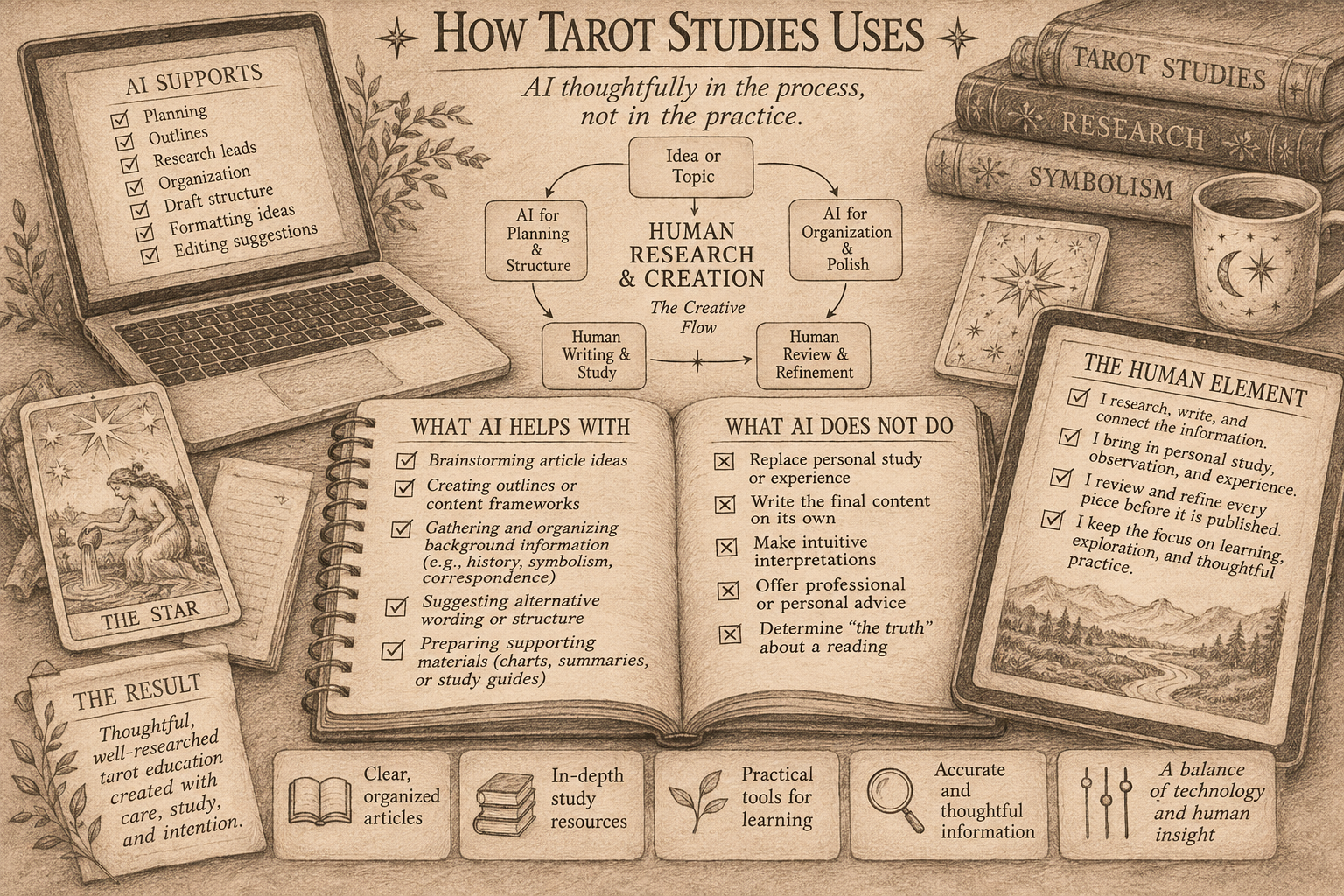
AI can appear at many different points in the Tarot Studies process. Depending on the project, I may use it to help with:
- brainstorming and developing ideas;
- organizing research and identifying areas that need further investigation;
- outlining articles, lessons, series, and educational resources;
- editing spelling, grammar, clarity, structure, and readability;
- examining my writing and learning how to improve it;
- revising and updating existing Tarot Studies content;
- comparing drafts and finding inconsistencies;
- exploring Tarot symbolism, history, correspondences, and interpretations that can then be investigated further;
- developing SEO information and organizing website content;
- thinking through marketing and content strategy;
- creating and refining worksheets, study resources, infographics, and other educational materials;
- developing concepts and detailed production briefs for illustrations;
- generating and revising AI-assisted artwork;
- troubleshooting aspects of website development and organization;
- organizing the growing collection of Tarot Studies content and maintaining production workflows.
The amount of assistance varies considerably.
Sometimes AI may help me clean up a paragraph I have already written. Sometimes we may spend an entire session discussing an idea before anything gets written. Sometimes it produces a useful first draft. Other times the first draft is completely wrong and becomes useful mainly because it helps me identify what I don’t want to say.
And sometimes I return to something I wrote months or years earlier because my understanding has changed. AI can help me compare the old work with what I know now, preserve the pieces that still sound like me, identify what needs more research, and work through a revision without automatically throwing everything away and starting over.
The first output is rarely the whole process.
AI Can Also Be Wrong
AI is useful.
It is not infallible.
It forgets instructions. It misunderstands requests. It loses context. It occasionally heads enthusiastically down a path I never asked it to take.
Sometimes it feels like I am working with AI for the very first time, even after we have spent months establishing a process.
And it hallucinates.
AI can produce inaccurate or unsupported information with enough confidence and polished language to make it sound completely reasonable.
That is particularly important for Tarot Studies.
Tarot draws from history, art, symbolism, astrology, numerology, psychology, esoteric traditions, personal practice, spiritual beliefs, and multiple Tarot systems. Those things are related, but they are not interchangeable.
A modern symbolic interpretation should not quietly become an ancient historical fact.
A spiritual correspondence should not be presented as though every Tarot tradition accepts it.
A personal interpretation should not suddenly become the only correct meaning of a card.
And an AI-generated explanation should not become a source simply because it sounds convincing.
Factual and historical claims may therefore require additional research and verification. I also try to distinguish among documented information, established Tarot tradition, interpretation, and my own experience.
AI output is something to evaluate, not an automatic authority.
About AI-Assisted Illustrations
Creating an image with AI can sound deceptively simple.
Type a prompt. Get a picture.
That has definitely not been my experience.
The visual identity of Tarot Studies has taken more than a year and a half of experimentation and refinement to develop. Establishing that style has involved decisions about composition, density, line work, sepia treatment, typography, symbolism, educational information, and how Rider-Waite-Smith imagery should be represented.
Even after all that work, established examples, detailed prompts, and repeated instructions, AI doesn’t always get it right.
I still find myself saying:
Sepia.
That is ridiculously too dense.
That isn’t the established illustration style.
Why are there nine Wands?
Sometimes it can take numerous attempts just to get the correct number of objects into a Tarot illustration.
That isn’t merely an annoying design problem.
In Tarot, those details mean something.
The number of Wands, Cups, Swords, or Pentacles matters. So do gestures, posture, direction, relationships between figures, landscape details, colors, symbols, and card orientation.
A beautiful Tarot illustration with incorrect symbolism can also become an incorrect educational illustration.
For that reason, AI-generated and AI-assisted artwork requires human review and often multiple rounds of revision.
Visual appeal never overrides symbolic accuracy.
An illustration isn’t finished simply because the AI successfully generated something attractive.
Memory Helps. Documentation Matters More.
One of the advantages of working with AI over time is its ability to retain or retrieve some information about established preferences, workflows, styles, and previous decisions.
That can be extremely useful.
It is not perfect memory.
Sometimes established instructions are overlooked. Sometimes the wrong reference is emphasized. Sometimes AI proposes creating something new when we already spent considerable time developing and approving a system for exactly that purpose.
There are still moments when I have to ask:
Are you using your memory feature?
That experience has taught me something important about using AI for a long-term creative project.
Memory helps the collaboration. Documentation governs it.
Tarot Studies therefore relies on approved examples, established templates, production records, research, documented decisions, and other project resources rather than assuming AI will always remember everything correctly.
What AI Does Not Get to Decide
AI does not have final editorial authority over Tarot Studies.
It does not decide what I believe about Tarot.
It does not determine which interpretation I must accept.
It does not get to invent personal experiences and present them as mine.
It does not decide that a historical claim is factual simply because it generated it.
It does not decide when an article, illustration, resource, or interpretation is finished.
And confidence is never evidence that something is true.
My experiences remain my own.
My Tarot interpretations develop through study, observation, reflection, and practice.
Historical and factual claims should be supported by research.
AI can participate in exploring, organizing, questioning, and communicating those things, but it does not replace the distinctions between them.
A Working Relationship
The best description I have found for my use of AI is simply this:
It is a working relationship.
Sometimes AI helps me articulate something I have been struggling to explain.
Sometimes it asks a question that sends me down an entirely new research path.
Sometimes it helps me see a weakness in my writing.
Sometimes I disagree with it.
Sometimes I rewrite what it wrote.
Sometimes it rewrites what I wrote, and I tell it to put half of it back.
Sometimes we revise something repeatedly until I finally recognize the thought I was trying to express in the first place.
And sometimes it gives a Tarot card an extra Wand.
Using AI has not eliminated the thinking, studying, writing, designing, researching, questioning, revising, editing, or creative process behind Tarot Studies.
In some ways, it has given me more opportunities to do all of those things.
It has allowed me to explore skills that were once outside my experience, get past some of the mechanical barriers that made writing difficult, ask questions without worrying whether they were “good enough,” experiment with ideas, revisit older work with new knowledge, and transform what I am learning into resources that might help someone else learn too.
That is ultimately why I use it.
AI participates in the creative and intellectual process at Tarot Studies. It does not replace it.
Tarot Studies remains a place for curiosity, study, reflection, experimentation, mistakes, questions, revision, and continuing education.
For the people who visit it.
And for me.
I am still learning, too.